

Benefits of Using an Expert Company for Urgent Care Website SEO Services
Why Professional Urgent Care SEO Services Are Important?
Modern Urgent Care SEO is highly complex. To do it right, you need someone (usually a company – not 1 person) who understands technical code, local map pack optimization, medical content writing, and link-building. Finding one person who is an expert in all of these is rare and very expensive. A company or agency that specifically focuses on Urgent care and Walk-in clinics will produce higher returns for your clinic, rather than in-house staff or a a general SEO agency.
What is the impact of using plagiarized content on SEO of an Urgent Care website?
Using plagiarized or heavily duplicated content on an urgent care website can significantly damage its SEO, leading to lower search rankings, reduced visibility, and decreased patient trust. While Google may not always issue a manual penalty for non-malicious duplicate content, its algorithms are designed to filter out unoriginal material, often resulting in the site being pushed down or entirely removed from search results.
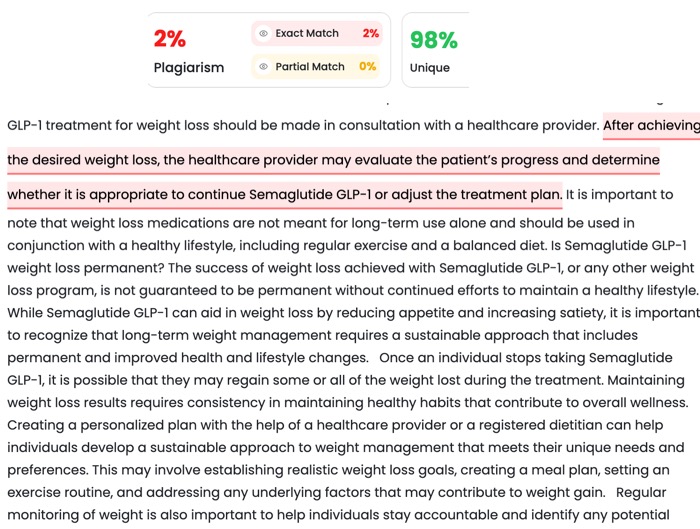
Example 1: In this example below, you will see that majority of the content is unique. 2% of the content is being reported as plagiarized. This is normal. The goal is to pass 90% unique test for every page.
How Much Does it Cost For Professional Urgent Care SEO Packages?
For most professional companies, this service will cost you $800/mon to $1500/mon – this is for a single location. If you have multiple locations, then it will cost more. See data from multiple companies here.
What is Urgent Care SEO?
SEO is short for Search Engine Optimization. Successful SEO for an urgent care website will refine it so that search engines better understand the services you are offering. A search engine like Google’s overriding goal is to provide its users with the most relevant choices as quickly as possible. By applying SEO strategies to your website, you’ll become more and more relevant to your top keywords, making it more likely you’ll be presented as a top result. SEO is not like putting a sign on the front of your facility. You will not see effects overnight in most cases, and it is a slow build towards your goals.
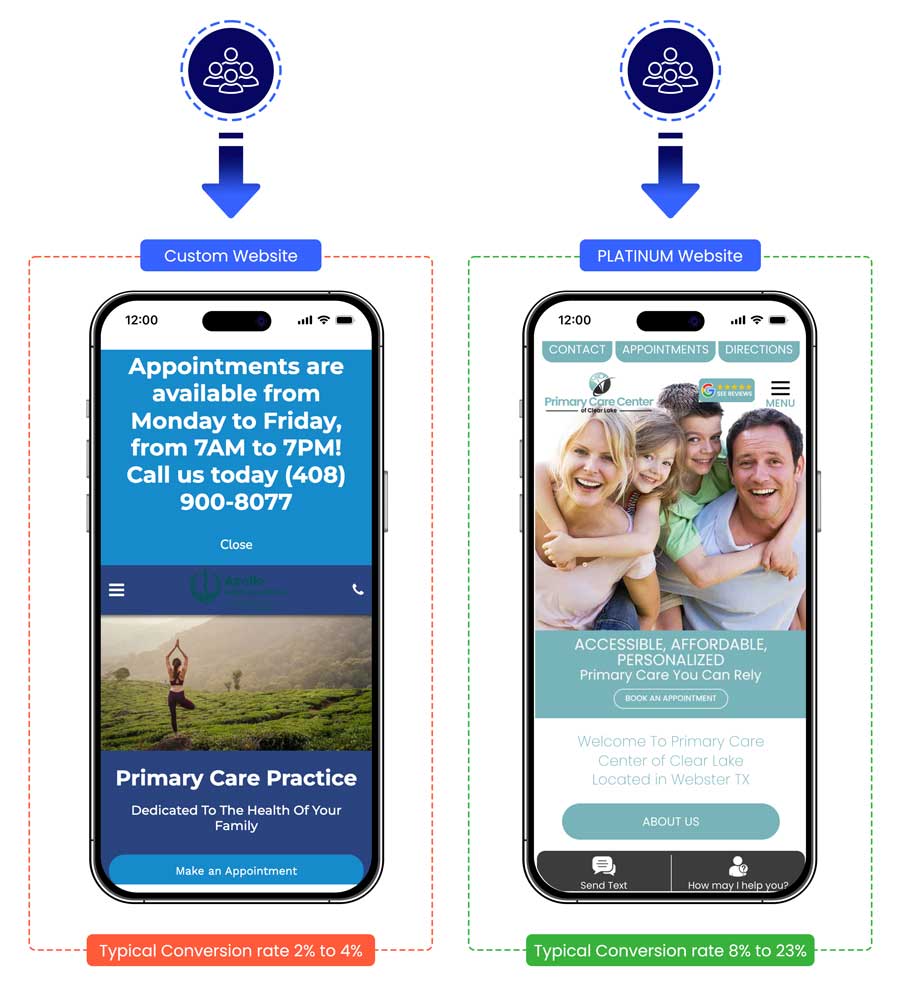
Example of a high conversion website, with very high SEO rankings.
What is a Urgent Care SEO Company?
An Urgent Care SEO Company is a specialized digital marketing agency that optimizes the online presence of walk-in clinics and immediate care facilities to attract more patients. These companies focus on “high-intent” searches—capturing potential patients exactly when they need medical help and are searching for terms like “urgent care near me” or “walk-in clinic open now.”
What is typical pricing of an experienced, HIPAA compliant Urgent Care SEO Company?
Typical pricing for an experienced, HIPAA-compliant Urgent Care SEO company in generally falls between $899 and $1,699+ per month, for a single location urgent care. If you include advertising on Google PPC ads, then typically, with an average of approximately $3,600 per location for ads is extra. However, some urgent care clinics are in very competitive areas, and they spend $5000 to $8000 per month on Google ads. Google Local SEO, SEO and Google PPC are the main drivers for new patients.
Monthly pricing for an experienced, HIPAA compliant Urgent Care SEO Company
- Low competition area ($899 /month): Single location – GOLD service from PatientGain is $799+ per month, no setup fees, with 1 year contract. Suitable for single-location clinics needing SEO, local SEO setup, and essential HIPAA-compliant patient lead tracking. You can add additional locations for an added fee.
- Mid-competition/Growth ($1699/month): Single location – PLATINUM service from PatientGain is $1399+ per month, no setup fees, with 1 year contract. Suitable for single-location urgent care clinics in moderate-high level of competition. This is a comprehensive service package SEO, local SEO setup, and essential HIPAA-compliant patient lead tracking. You can add additional locations for an added fee.
- High-competition/Growth ($1999/month): Single location – PLATINUM-PLUS service from PatientGain is $1999+ per month, no setup fees, with 1 year contract. Suitable for single-location urgent care clinics in moderate-high level of competition. This is a comprehensive service package SEO, local SEO setup, and HIPAA-compliant patient lead tracking, AI based apps, top customer service and 20+ additional apps. You can add additional locations for an added fee.
- Enterprise/Multi-Location ($500/ per location/ month): For large networks or high-competition markets, including in-depth SEO, AI search optimization, and comprehensive reporting.
Factors Influencing Costs
- HIPAA Compliance Requirements: Specialized agencies often charge more because they must provide a Business Associate Agreement (BAA) and implement secure patient data handling in analytics, form submissions, and texting tools.
- Location and Competition: Higher competition in major metropolitan areas requires a more aggressive, higher-cost strategy.
- Number of Locations: Multi-location groups (10-15 locations) can expect to pay between $5,500 and $7,000 monthly
What’s Included in an Experienced Package (PLATINUM and PLATINUM+)?
- E-E-A-T Content Strategy: Articles written by or reviewed by medical SEO experts to meet Google’s “Trust” standards.
- Local SEO/Google Business Profile Management: Crucial for appearing in “near me” searches. Posting on GBP 20 times per month.
- HIPAA-Compliant Analytics & CRM: Secure, PHI-safe tracking of patient leads and phone calls.
- Reputation Management: Actively managing and improving patient reviews.
- AI/Answer Engine Optimization (GEO): Optimizing for AI summaries in search results.
How to choose HIPAA compliant Urgent Care SEO Company?
Choosing a HIPAA-compliant SEO company for your urgent care center is critical because traditional SEO tools (like Google Analytics 4) and strategies (like unencrypted contact forms) can inadvertently leak Protected Health Information (PHI), leading to massive fines.
Follow these steps to select a partner that balances visibility with patient privacy:
1. Mandate a Business Associate Agreement (BAA)
The single most important step is ensuring the agency will sign a Business Associate Agreement (BAA).
- What it does: Legally binds the agency to protect any PHI they encounter (e.g., patient names in reviews, form submissions, or appointment data).
- Red Flag: If an agency refuses to sign a BAA or claims they “don’t need one” because they only do SEO, look elsewhere. Any access to your website’s backend or lead-tracking systems constitutes a potential HIPAA risk.
2. Verify Their Use of HIPAA-Compliant Tools
Standard marketing tools are often non-compliant. Your agency should use “privacy-first” alternatives:
- Analytics: Instead of standard GA4, they should have their own HIPAA compliant solution. Like PatientGain, uses obfuscation and other technical details for a customized version of GA4.
- Forms: They should implement encrypted form solutions such as PatientGain’s encrypted HIPAA compliant apps.
- Leads capture funnel: The leads capture app should be HIPAA compliant. Example is PatientGain’s SPOC app.
3. Evaluate Healthcare-Specific SEO Expertise
Healthcare is governed by Google’s strict YMYL (Your Money Your Life) and E-E-A-T (Experience, Expertise, Authoritativeness, Trustworthiness)standards.
- Medical Accuracy: Ask if their content is written or reviewed by qualified medical professionals. Google prioritizes content that cites reliable sources like the CDC or NIH.
- Local SEO Mastery: For urgent care, ranking in the “Local Pack” for “urgent care open now” is the highest-ROI activity. Verify they have a proven strategy for Google Business Profile management and posting on GBP at least 20 times per month.
4. Review Their Reputation Management App
Patient reviews are powerful SEO signals but are also HIPAA minefields.
- Compliant Responses: The agency must never confirm a patient was treated or disclose any health details in a review response—even if the patient did so first.
- Review Collection: They should use automated, HIPAA-compliant SMS or email tools to request reviews right after appointments.
5. Check Technical Infrastructure
Ensure their technical SEO recommendations include:
- Secure Hosting: Use of HIPAA-eligible services on AWS, Google Cloud, or Microsoft Azure.
- Data Protection: Implementation of SSL certificates, end-to-end encryption for data in transit and at rest, and multi-factor authentication (MFA) for website access
Most frequent types of Google searches related to urgent care practices:
The most frequent types of Google searches related to urgent care practices are driven by immediate need and fall into three main categories: localized, symptom-specific, and service-based.
1. Localized searches
These searches are focused on finding the nearest or most convenient clinic, often performed from a mobile device.
- “Urgent care near me”: The most common search query for individuals needing immediate medical attention. It is a high-intent keyword that often converts to an immediate patient visit.
- “Walk-in clinic near me”: Another common search for quick, no-appointment medical care.
- “Urgent care [City]”: Localized searches that include a specific city or neighborhood name.
- “24-hour urgent care”: Used by people seeking care outside of standard business hours.
- “Urgent care open now”: Similar to the above, this query has a high intent for an immediate visit.
2. Symptom and condition-specific searches
Many users begin with symptom-related queries to self-diagnose or understand their condition before deciding to visit a clinic.
- “Clinic for flu symptoms”: A common seasonal search during cold and flu season.
- “Urgent care for broken bones”: Used by people seeking care for minor injuries.
- “What is pink eye” or “how to treat pink eye”: People often search for information on common illnesses before seeking professional treatment.
- “Urgent care for sore throat”: An informational search that can lead to a clinic visit.
3. Service-based searches
These searches are more specific and focus on the types of services that urgent care clinics provide.
- “Urgent care for X-ray”: Used when a specific diagnostic service is needed.
- “Pediatric urgent care near me”: Used by parents seeking specialized care for their children.
- “Walk-in clinic for vaccinations”: Used by people looking for quick and convenient immunizations.
- “COVID-19 testing”: A trending search term for specific diagnostic needs.
Factors influencing these searches
The types of searches are heavily influenced by the patient’s immediate need for medical attention. People often grab their phones to find the closest open clinic when they have an urgent issue. The growth of mobile search has also caused a significant increase in “near me” queries over the last several years.
As a result of this growing industry, competition has become intense in some areas. As more urgent care centers open, it is becoming increasingly difficult for these businesses to find the right people who need their services. Making sure your urgent care center’s website has a robust search engine optimization, or SEO, the strategy is vital to maintain and grow your patient count. There are 4 important areas for SEO of your urgent care.
- Local SEO for Doctors
- Organic SEO for Doctors
- Speech Based SEO – New Emerging Area – As more patients are “speaking” to devices.
- Paid Advertising or PPC Advertising for Doctors
What Percentage of New Patients Come from Urgent Care SEO?
While no single percentage can apply to all urgent care clinics, PatientGain’s data reports that 63% to 77% of new urgent care patients come from organic search (SEO), this includes Local SEO and SEO. For those customers who are using the PLATINUM service for urgent care centers, they spend less on Google PPC ads. This finding reflects a broader industry trend where a high percentage of patients rely on search engines to find healthcare providers.
Why SEO is a primary driver for urgent care
- Urgent, high-intent searches: When people need urgent medical care, they typically use their phones to search for phrases like “urgent care near me”. The high-intent nature of these queries means that appearing at the top of search results is very effective for patient acquisition.
- Trust in organic results: Many online users, particularly in the healthcare sector, trust organic search results more than paid advertisements. Studies have shown higher click-through rates for the top organic results compared to paid ads.
- High conversion rate: For clinics with an established SEO presence, organic searches convert at exceptionally high rates, making it one of the most reliable and cost-effective marketing strategies.
The SEO channels that matter most
While comprehensive SEO involves many elements, urgent care clinics see the most patient-driving results from a few key areas:
- Google Business Profile: Local SEO is critical for urgent care, and your Google Business Profile is the most important component. An optimized profile ensures your clinic appears in the map results when patients search for “near me.”
- Mobile-optimized website: Since most urgent care searches happen on a mobile device, a user-friendly and responsive website is essential to converting visitors into patients.
- Quality content: Developing high-quality, relevant content that addresses patients’ urgent concerns can also boost your search rankings and attract new patients.
A comparison with paid advertising (PPC)
It is useful to compare SEO against paid ads (PPC), another powerful tool for patient acquisition:
- Cost and speed: PPC ads can provide immediate visibility for a specific budget, with PatientGain data reporting between $4 to $9 range for most keywords, an average “cost per click” of over $11 in some most competitive areas. However, SEO provides long-term, low-cost organic traffic once established.
- Channel effectiveness: While PPC can accelerate patient growth, PatientGain data suggests that for established clinics, the percentage of new patients from organic search far outweighs those from paid ads. For this reason, many clinics focus their marketing investments on building a strong SEO foundation. However, building SEO for an urgent care is not easy and it takes a lot of time.
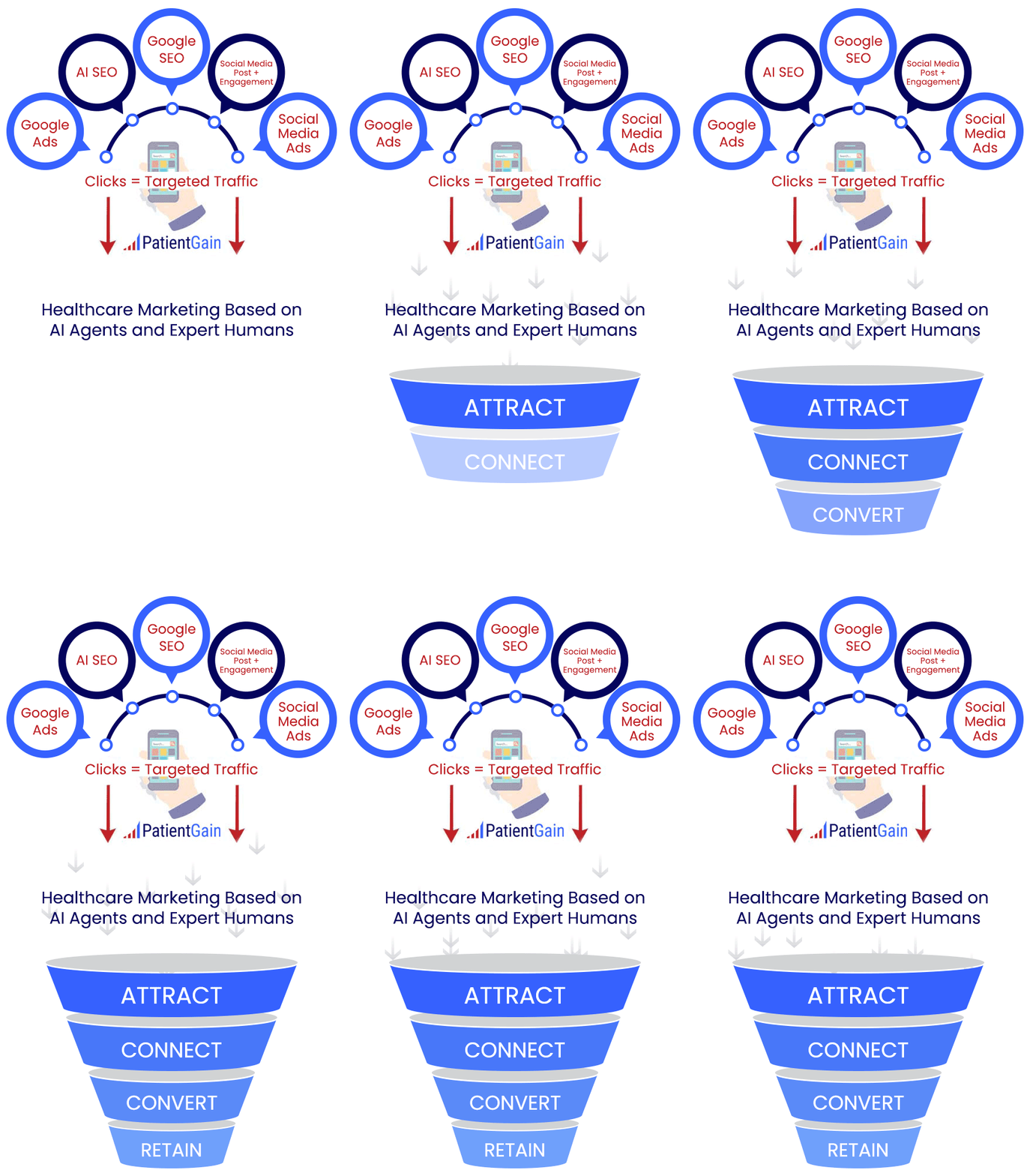
Examples of Urgent Care SEO
Several strategies can help you find high-volume, low-competition keywords that align with patient search behavior.
Some examples are:
- “Urgent care open now”
- “Urgent care without insurance”
- “Urgent care for ear infection”
Increase the rankings for your keywords
There are some natural keywords you will rank very well for unless you have launched your website recently, and it is brand new. “Urgent Care” and “Urgent Care Near Me” are keywords that facilities generally do very well with once their website has been given time to mature and be crawled by search engines. If you are sitting at a computer in your facility this very moment and are not ranking when you type in those keywords, this is your starting point. It would be best if you started with your most active keywords and then work your way down other top keywords.
Once these keywords are producing results, you are satisfied with, concentrate on other keywords. Start with your services and begin to monitor where you rank. Ideally, it would help if you were a top choice for each of your services. Some services are not generally associated with Urgent Care Centers, so those will be more challenging to tackle. However, if you apply SEO strategies to these keywords for these services, you should start to see some improvement.
Some other challenges that urgent care centers often face include:
- A competitor that specializes in a specific service you offer
- Distance between your facility and a potential patient if there are closer choices available
- The content on your service page is cut and pasted from somewhere else.
How can I increase the rankings of my keywords? Are there other benefits?
The best way to improve the rankings of your keywords is to post unique content that is of decent length. A few sentences, no matter how unique they might be, will not get the job done. Granted, you do not want to write a novella about the services you offer. Aim for at least 500 words when writing about your service, and mention the keywords associated with it frequently but do not pack them in there. Google will penalize you if you “stuff” content with keywords. If you can write a trustworthy, informative, and accurate 1,000 words about a service you offer, you are in good shape.
One of the most significant side benefits of applying SEO tactics to your urgent care website is that you will keep your content up to date. Some Urgent Care Centers will post a page and then never look at it again for several years. Reviewing content periodically to ensure everything is still accurate and adding additional content not only helps your rankings but keeps everything current.
SEO work now, will pay benefits down the line. SEO results are not immediate, but they take time.
Working on the SEO of your urgent care center’s website is like an investment. You will not see any difference in the following days, but over time you will build higher rankings with continued SEO work. Continually refining the content on your websites will give you a strong base to work from for future updates and also if you add any new services.
Patience are critical in the SEO process. Updating your content every week will not give it time to get traction in search engines, making updates rather useless. Once you’ve updated content, keep it for several months to see if any changes take place. If you are adding new content, do it incrementally. Adding 100 pages of new material in a single day, as strange as this may seem, is less effective than adding a couple every week. Granted, if these pages are vital for the function of your business, then add them. But, if you are adding more content, writing blog entries, or updating individual pages, try to spread those out over time. You will build more strength if there is constant, small updates to your website.
Higher Rankings Means More Traffic and Lower PPC Advertising Costs
The more relevant your website is to your target keywords, the more likely you will be presented as a top choice when people are looking for an urgent care center. Ideally, your website should be so relevant, it will appear on Google Maps in the search results. Appearing on Google Maps can be tricky and is determined by not only your website’s relevance, but also its reviews and distance from the person searching for your services. By making your website more relevant, you only increase your chances of making an appearance on Google Maps.
Another benefit of making your website more relevant to users is with your PPC marketing efforts. While not always the case, often, it is cheaper to bid on keywords if your website is more relevant to the targeted keyword. You’ll overall PPC Marketing budget will be more efficient, and you will get more bang for your buck with improved website SEO. In addition, if your SEO is pushing you higher up in organic rankings, some users may skip your ad all together and click directly on the search result.
Urgent Care SEO Examples
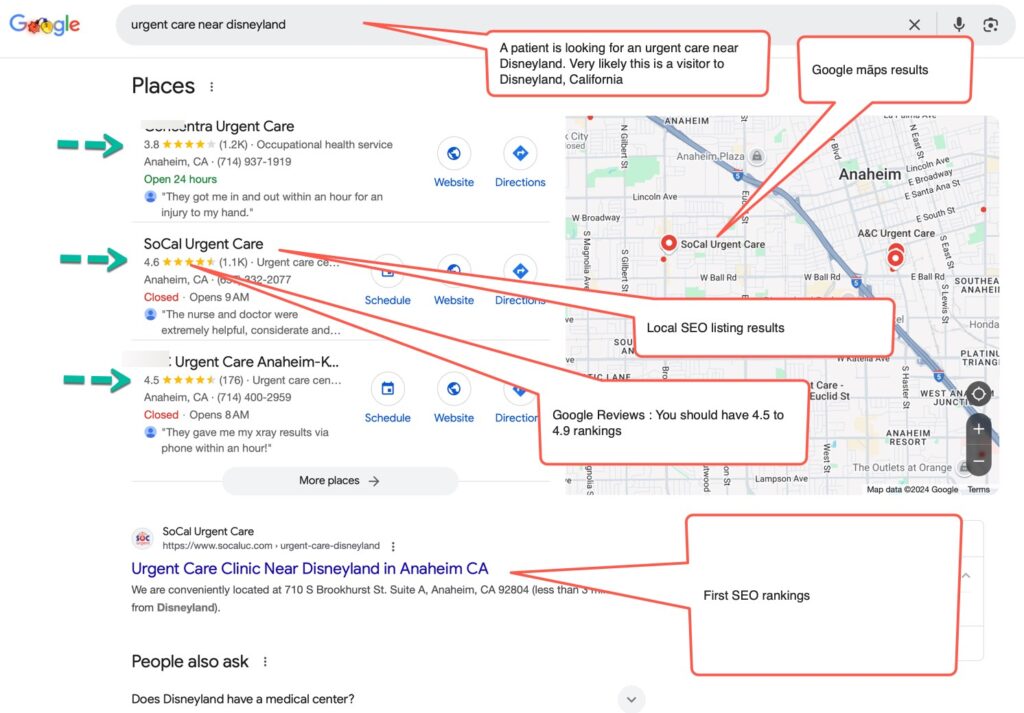
Example no 1 : Patient searching for an urgent care close to Disneyland in California. Very likely this patient is a visitor to Disneyland. PatientGain’s data intelligence can tell by keywords the intent of the patient.
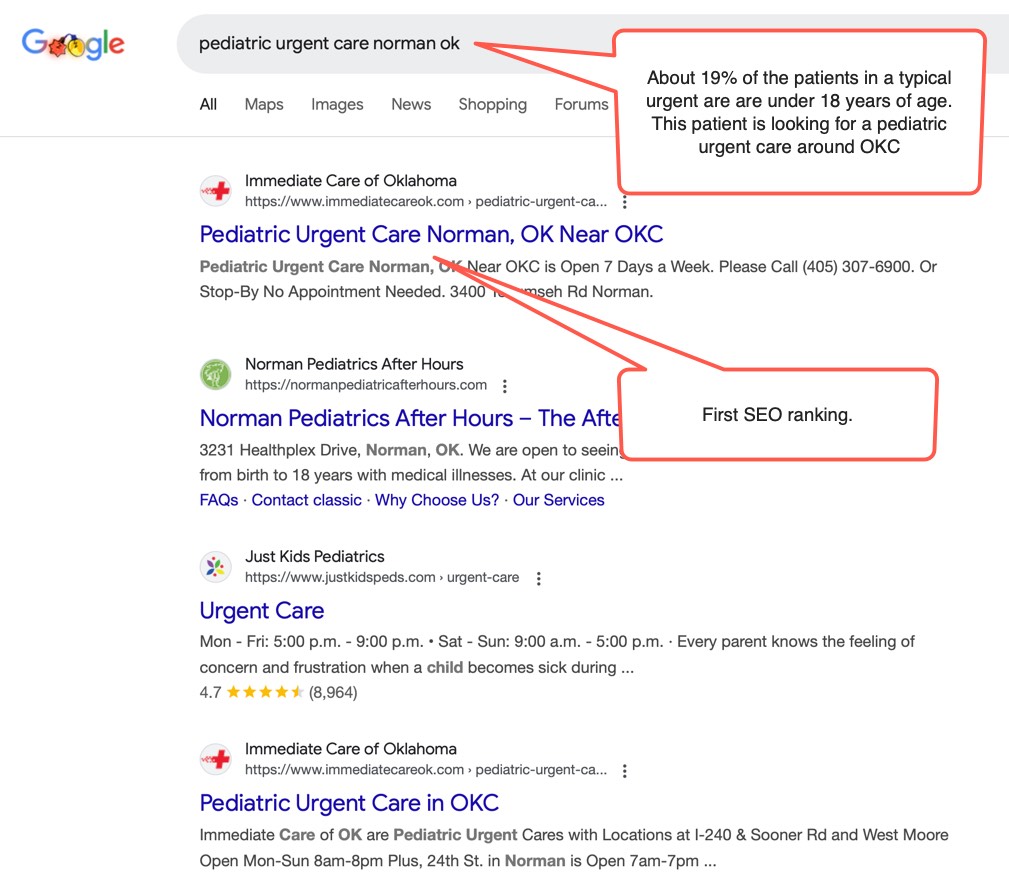
Example no 2 : Patient searching for a pediatric urgent care in Norman OK / OKC area. You will see that many patients, approximately 19%, look for urgent care for children, so pediatric urgent care is an extremely useful SEO keyword for any urgent care clinic that offers this service.
PatientGain’s Urgent Care SEO Services
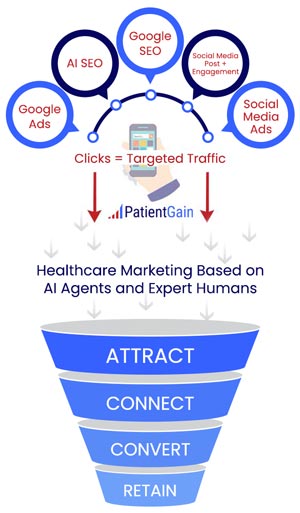
PatientGain’s urgent care SEO is based on AI and reverse search engine algorithms. It typically costs $899 to $1699 per month but, it is included in the comprehensive monthly service packages GOLD and PLATINUM. We constantly add fresh relevant content for your practice. We have database of thousands of conditions and we generate social media treatment based posts for your practice. Texting from and to patients is included. A simple dashboard is included so you can see all new leads from your desktop, iPhone or iPad. Monthly Email marketing is included and focuses on patient education and call to action for cash-pay patients.
These solutions are for those healthcare practices who are focused on medicine and want a running system, with high ROI and a professional customer service.
If you are in a low competition area, then check out GOLD solution.
If you are in a medium competition area, then check out PLATINUM solution.
If you are in a high competition area, then check out PLATINUM+ solution.
What is Urgent Care SEO Service From PatientGain?
SEO for urgent care clinics from PatientGain.com is a specialized, AI-driven service designed to help clinics dominate local search results—specifically capturing the high-intent “Urgent Care Near Me” and “Open Now” traffic that drives walk-ins. PatientGain treats SEO not just as technical optimization, but as a complete patient acquisition engine that combines high-speed technology with authoritative medical content.
Core Pillars of PatientGain Urgent Care SEO
- Local SEO & Map Pack Dominance: This is the most critical area for urgent care. The service focuses on getting your clinic into the Google Local 3-Pack. This involves optimizing your Google Business Profile (GBP) with accurate hours (including holiday/extended hours), services, and geotagged photos.
- AI-Powered “Reverse Search Engine” Algorithm: PatientGain uses a proprietary algorithm that analyzes how patients actually search for urgent care services. It then “reverses” that data to optimize your website content, meta tags, and page structures to match those specific search patterns.
- Fresh Monthly Content: Google rewards active websites. PatientGain adds new, unique, and medically relevant content to your site every month. For urgent care, this often focuses on seasonal trends (flu shots, sports physicals) and common conditions (X-rays, stitches, allergies).
- AEO (Answer Engine Optimization): As search evolves toward AI (Gemini, ChatGPT), PatientGain structures your content to be the “source” for AI-generated answers. This ensures you appear as the recommended provider when patients ask voice assistants or AI tools for local care.
A well-rounded urgent care SEO strategy not only boosts online visibility but also attracts local patients, reduces marketing costs, and helps the clinic stay competitive in its market.
Urgent Care SEO Guide & Steps
Medical SEO is not a simple task. It is complex and time consuming. Here is a short-cut summary.
Step 1 : Create a mobile friendly website. If you use newer versions of WordPress software, this is included in the template setup. Website should load fast, less than 3 seconds. Avoid using heavy images, it is the number 1 cause for slow loading websites. Your website’s top menu should have information for at least 6 key areas. About Us page, Services page, Resources page, Phone number & directions, Contact Us page, Call-To-Action (CTA Areas), and don’t forget Home button. Your urgent care website should also load very fast. In fact Google now ranks speed of the website as one of the major factors for SEO rankings.
Step 2 : Start adding content under each of the areas. For example, for services page list all your services. each service should have a separate landing page for each service. Use original non-plagiarized content.
Step 3 : Structure of each page should be optimized, this area is also known as technical SEO. Each page should have a heading 1, possibly heading 2, and then paragraph text. heading 1 should be used for keywords and main subject of the page. heading 2 should support heading 1, paragraph text should provide details of the service. At least one image or a video should be added to each page. Add tags and meta data for each image.
Step 4 : Add professional quality images. So your website looks unique. Generic images purchased from image banks, and added to your website will make your website look generic. Custom images should be used to “brand” your website.
Step 5 : Contact forms should be used, using HIPAA in mind. Avoid mail-to forms.
Step 6 : Display testimonials or reviews from customers on the home page.
Step 7 : Add social media or other widgets to build your social presence also.
Step 8 : Add google analytics code. If you use WordPress (which we recommend) this step is very easy.
Step 9 : Submit the pages to Google search engine. Yahoo and Bing are also helpful.
Step 10 : Start building the content of your website. This is the foundation of your SEO success. Adding your website domain to other websites is called link-building, this is also an important part of your strategy.
Step 11 : Be patient. Unfortunately it takes time and a lot of effort to start seeing results from SEO. But results and ROI from SEO efforts are worth it.
Conclusion
Overall, SEO for your urgent care center should be a top priority. It will not be a “one and done” proposition, and you should consciously be making an effort to update your website consistently. The long-term benefits will be worth the constant attention. SEO for Urgent Care Centers is vital in the highly competitive healthcare industry. Unless you are the only urgent care center for miles and miles around, this should be one of your top concerns. Lockdown a good search engine optimization strategy and follow through with it. If you continue to update your SEO plan, you will stay a step ahead of your competitors. PatientGain is proven medical and dental marketing automation platform, based on AI agents, apps, HIPAA compliance and professional services. PatientGain healthcare marketing services cost $799/mon to $1999/mon. GOLD Service from PatientGain.com includes SEO optimization for your Urgent Care Center.
 Send Text
 How may I help you?