

Is There Any Impact on the SEO of My Healthcare Practice Website If I Have Plagiarized Content?
The short and candid answer is: YES – Massive Negative Impact. Having plagiarized content is arguably the single fastest way to completely destroy your healthcare website’s search rankings.
While having duplicate content is bad for any business, it is uniquely catastrophic for medical and dental practices. Search engines like Google do not treat a local plumber and a local cardiologist the same way. Also remember that any large website will always have some content that appears on multiple pages. There is a big difference between your own content appearing on multiple pages VS copied content from another website.
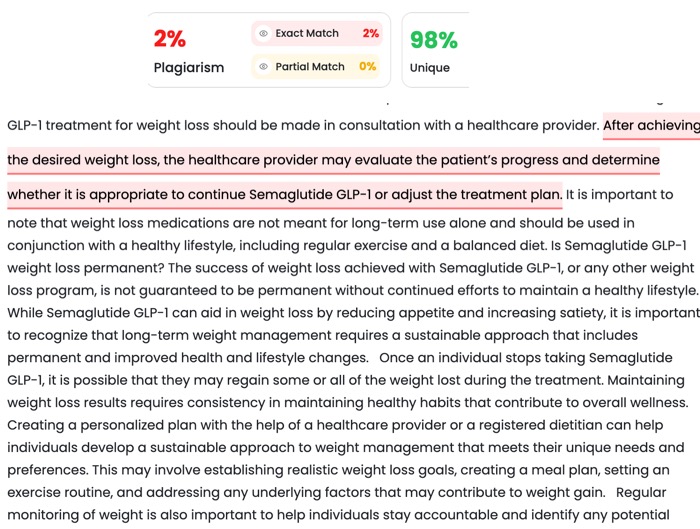
Example 1: In this example below, you will see that majority of the content is unique. 2% of the content is being reported as plagiarized. This is normal. The goal is to pass 90% unique test for every page.
What is the difference between plagiarized content VS duplicate content on a healthcare website?
While both “plagiarized content” and “duplicate content” involve the exact same words appearing in multiple places, Google’s algorithm treats them very differently. One is viewed as a technical error, while the other is viewed as malicious theft.
Understanding the distinction is crucial for healthcare marketing because getting penalized for either will destroy your visibility. Here is the candid difference between the two and how they manifest on a medical website.
1. Plagiarized Content (Theft & Malice)
Plagiarism is the intentional or negligent act of stealing another author’s original work and presenting it as your own.
- The Intent: It is deceptive. It happens when a lazy marketing agency or an in-house staffer goes to WebMD, Mayo Clinic, or a rival practice’s website, copies three paragraphs about “Sciatica Symptoms,” and pastes them directly onto your clinic’s website.
- How Google Sees It: Google views this as a massive violation of E-E-A-T (Experience, Expertise, Authoritativeness, and Trustworthiness). Google knows exactly who published the text first based on crawling timestamps. When it sees your site publishing stolen text, it flags your domain as untrustworthy, spammy, and devoid of medical expertise.
- The Penalty: Plagiarism leads to algorithmic penalties where your site is pushed down or entirely removed from search results. Furthermore, it opens your practice up to legal action and DMCA Takedown Notices from the original copyright holder.
2. Duplicate Content (Technical & Structural Issues)
Duplicate content simply means that identical (or nearly identical) blocks of text appear on more than one web page. It is usually unintentional and a result of poor website architecture. Google understands that a lot of duplicate content is innocent.
- The Intent: It is usually structural, not malicious. In healthcare marketing, this happens in three common ways:
- The “Multi-Location” Trap: A dental group has 5 locations. Instead of writing unique pages for each clinic, the web developer copies the exact same 1,000-word “Root Canal” page 5 times, only changing the name of the city at the top of each page (e.g., Root Canals Miami, Root Canals Orlando, etc.).
- Manufacturer Boilerplate: A medical spa copies the exact product description provided by the manufacturer of Botox or CoolSculpting onto their service page. (Hundreds of other spas are also using that exact same manufacturer text).
- Technical Glitches: Your website generates two different URLs for the exact same page (e.g.,
www.yourclinic.com/botoxandyourclinic.com/botoxwithout the ‘www’).
- How Google Sees It: Google does not usually view this as malicious theft, but rather as confusing. Search engines want to show a variety of results. If Google finds 5 identical pages on your site, it doesn’t know which one is the “master” copy, so it often chooses to rank none of them highly.
- The Penalty: Google rarely hits you with a severe, manual “spam penalty” for structural duplicate content. Instead, you suffer from SEO Cannibalization. Your pages compete against each other, diluting your ranking power and making it incredibly difficult to reach the top of the search results
Plagiarized content
Plagiarized content on your healthcare practice’s website can significantly damage your SEO by lowering search rankings, diluting your site’s authority, and creating a poor user experience. While Google does not have a “duplicate content penalty” in the traditional sense, its algorithms are designed to filter out unoriginal material, which effectively suppresses the visibility of sites that rely on it.
Core SEO Impacts of Plagiarism
- Lowered Search Rankings: Search engines prioritize unique, valuable information. When multiple pages across the web contain identical text, Google typically only displays the version it deems most authoritative (often the original source), pushing duplicates far down the search results or omitting them entirely.
- Devaluation of E-E-A-T: For healthcare sites, Google heavily weighs Experience, Expertise, Authoritativeness, and Trustworthiness (E-E-A-T). Plagiarism directly signals a lack of unique expertise and trust, which can cause search engines to flag your site as low-quality.
- Keyword Cannibalization and Internal Competition: If you use similar “canned” or templated content across different pages of your own site, you risk keyword cannibalization. This confuses search engines about which page is most relevant, preventing any of them from ranking effectively.
- Inefficient Crawl Budget: Search engine bots may waste their “crawl budget” on your duplicate pages instead of indexing your actual unique service or location pages.
- Reduced Backlink Potential: Credible websites are unlikely to link to unoriginal content, which is a major missed opportunity to build the domain authority necessary for high rankings.
Patient Trust and Legal Risks
Beyond SEO, plagiarized content has severe practical consequences for a medical practice:
- Loss of Patient Trust: Patients who find identical content on multiple sites may view your practice as untrustworthy or “cookie-cutter,” which increases bounce rates and reduces appointment bookings.
- Legal & Ethical Repercussions: Stealing copyrighted material can lead to legal challenges, financial penalties, or professional disciplinary action.
- Inaccuracies: Copied healthcare information may not be tailored to your specific protocols, leading to the spread of outdated or inaccurate medical data.
Recommended Action Plan
- Conduct a Content Audit: Use professional tools like Copyscape or Grammarly to identify existing duplicate text on your site.
- Rewrite Core Pages: Prioritize creating original content for “core” pages like services, procedures, and “About Us” sections.
- Include Credentials: Improve your E-E-A-T by adding unique author bios and highlighting your specific medical credentials.
- Use Strategic Internal Linking: Connect your original pages with internal links to help search engines understand your site’s unique structure
Conclusion: The Importance of Original Content for SEO
Plagiarized content can seriously damage your website’s SEO rankings and reputation. For a healthcare practice, producing high-quality, original content is key to building trust with both patients and search engines. By providing valuable, relevant, and unique information, your website will rank higher, attract more patients, and establish itself as a credible source of medical information. Always prioritize original content to protect both your SEO and your brand’s integrity.
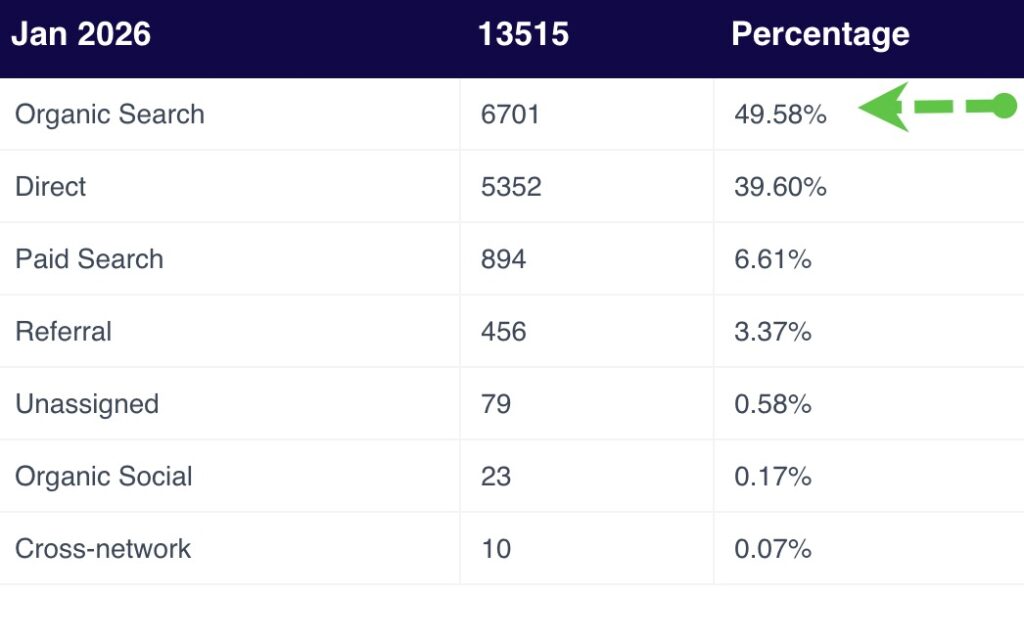
Example of a successful SEO. This healthcare practice has very good SEO – you can see that 49.58% of the traffic in from organic SEO.
 Send Text
 How may I help you?