

Pain Management & Pain Relief AI Marketing Expert Companies in USA and Canada. Cost of Complete Marketing Solution $1699/mon
A “Pain Management AI Marketing Expert” is a digital marketing professional specializing in creating and executing AI marketing strategies specifically tailored to pain management clinics, focusing on attracting new patients by highlighting the services and treatments offered to alleviate chronic or acute pain, while adhering to healthcare regulations and patient sensitivities. In pain management marketing, the focus is on understanding and addressing the pain points of your target audience, offering solutions to alleviate their suffering, and building trust through transparent communication and evidence-based approaches. For your pain management website, you also need Patient Privacy app for patient consent and keep these records for up to 6 years in a HIPAA Compliant database.

There are many different type of pain management and pain relief providers. For example a very specific provider may provide medical treatment based on precise endometriosis removal for females and fertility preservation procedures. On the other hand a chiropractor may offer simple pain management services for patients. Regardless of your target area of practice, PatientGain can add value to your practice.
Key Differences Between Pain Management Approaches
| Approach | Treatment Type | Common Techniques | Best For |
|---|---|---|---|
| Interventional Pain Management | Minimally invasive, procedural | Injections, nerve blocks, spinal stimulators | Chronic pain, sciatica, arthritis |
| Non-Interventional Pain Management | Non-invasive, conservative | Medications, physical therapy, behavioral therapy | Mild to moderate pain, first-line treatment |
| Integrative Pain Management | Holistic, multi-disciplinary | Acupuncture, herbal medicine, mindfulness, physical therapy | Fibromyalgia, migraines, neuropathy |
| Regenerative Pain Management | Biologic, tissue repair | PRP therapy, stem cell therapy, prolotherapy | Joint pain, osteoarthritis, sports injuries |
| Chiropractic Pain Management | Hands-on, manual therapy | Spinal adjustments, soft tissue therapy, posture correction | Back pain, sciatica, headaches |
How PatientGain’s Platinum Service Helps Pain Management and Pain Relief Practices
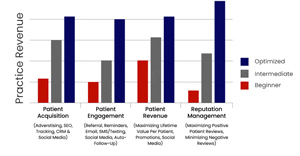
By integrating your practice website, Website SEO, artificial intelligence, advanced marketing tools, patient engagement systems, and reputation management, PatientGain’s Platinum Service helps pain management practices:
- Attract and retain patients through better marketing, reputation management, and streamlined scheduling.
- Increase online visibility with improved SEO, Google Ads, and GMB management.
- Enhance patient experience by providing easier access to booking, communications, and treatment information.
- Track and improve performance with detailed analytics and real-time reporting to optimize marketing efforts and practice operations.
Example of local SEO results and AI SEO for a pain practice location in Houston TX
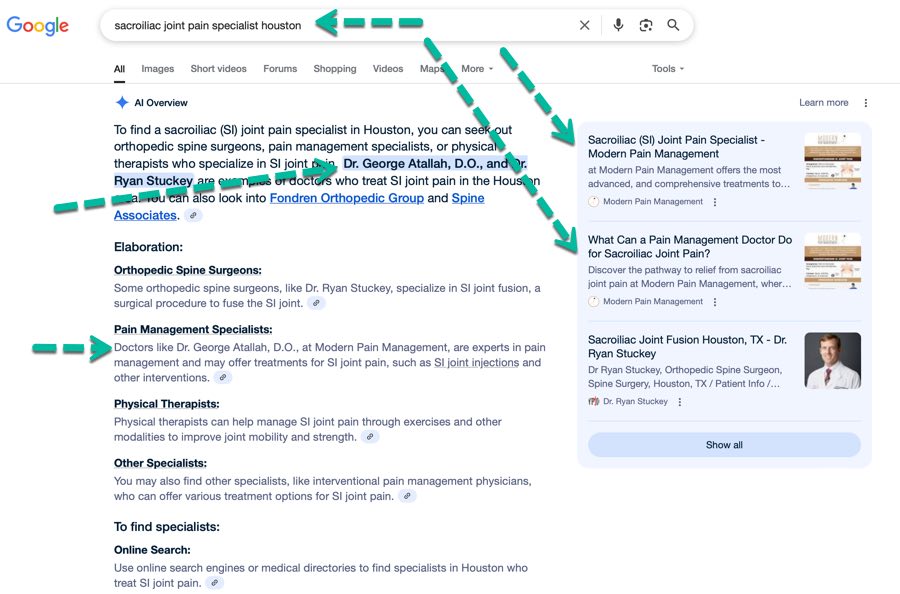
This service helps pain management practices expand their reach, provide better patient care, and achieve long-term growth in an increasingly competitive healthcare market.
1. Improved Online Presence & SEO
PatientGain helps pain management practices improve their visibility on search engines (Medical SEO) , making it easier for potential patients to find their services when searching for pain relief options in the local area.
- SEO Optimization: The Platinum Service includes search engine optimization (SEO) tools that help improve the clinic’s website ranking for highly relevant keywords like “pain management near me,” “chronic pain doctor,” or “back pain treatment.” This ensures the practice ranks higher in Google searches and is visible to patients actively searching for pain relief.
- Google My Business (GMB) Management: The platform ensures that Google My Business is optimized for local SEO, improving local search rankings and increasing visibility on Google Maps when patients search for nearby clinics.
Example of AI SEO of pain management practice
Let’s look at a real-world example using a clinic with locations in Houston and Sugar Land, Texas. Pain management is a highly competitive medical field in major Texas cities. If this clinic only had a generic “Our Services” page, they would struggle to capture patients. Instead, their website is built with a vast library of condition-specific pages.
Here is how the concepts of condition-specific SEO apply directly to their website architecture and patient acquisition strategy.
a. Matching High-Intent Patient Searches
When a patient is suffering from nerve pain down their leg, they do not open Google and search for “Interventional Pain Management Physician Houston TX.” They search for their symptoms or diagnosis.
Pain Management intercepts this by having highly specific condition pages such as:
- Sciatica Treatment
- Herniated Disc Treatment
- Neuropathy
- Complex Regional Pain Syndrome (CRPS)
The SEO Result: When a patient in Sugar Land searches “Why is my leg burning and numb?” or “Best sciatica treatment near me,” Google serves them Modern Pain Management’s dedicated Sciatica page. The clinic captures the patient exactly at the moment they are desperately seeking relief.
b. Capturing Long-Tail, High-Value Keywords
Generic keywords like “Pain Doctor Houston” are incredibly expensive to bid on and hard to rank for organically. Condition pages allow the clinic to capture “long-tail” traffic that competitors miss.
Looking at their menu, they have pages for:
- Arachnoiditis
- Sacroiliac (SI) Joint Pain
- Post-Laminectomy Syndrome (Failed Back Surgery Syndrome)
The SEO Result: Patients searching for “Arachnoiditis” or “Post-Laminectomy Syndrome” are usually chronic pain sufferers who have already seen other doctors and need highly specialized, high-ticket interventions (like a Spinal Cord Stimulator). Because Modern Pain Houston has a dedicated page for these obscure conditions, they easily rank #1 or #2 for these highly lucrative, low-competition searches.
c. Establishing “Topical Authority” (E-E-A-T)
Google looks at the overall depth of a website to determine if the doctors are true experts. Pain Management doesn’t just list “Back Pain.” They break the spine down into multiple distinct condition pages:
- Vertebral Compression Fractures
- Spinal Stenosis
- Lumbar Biacuplasty
- Kyphoplasty Therapy
The SEO Result: Google’s algorithm crawls this site and realizes, “Dr. Atallah and Dr. Harandi aren’t just general practitioners; they have a massive, encyclopedia-like depth of knowledge regarding spinal conditions.” Google rewards this “Topical Authority” by pushing their entire website higher in the map pack.
d. The “Hub and Spoke” Internal Linking Strategy
Condition-specific content works best when it acts as a funnel toward a treatment (the service you can actually bill for).
- The Funnel: A patient finds the “Arthritis Pain” (Condition) page via Google. They read about the symptoms of osteoarthritis in the knee. Inside that text, there is a hyperlinked bridge to the “Hyaluronic Injections” (Treatment) page. On the injection page, there is a prominent “Request an Appointment” button.
- The SEO Result: This internal linking structure keeps the patient clicking through multiple pages on the website. This increases “dwell time” (how long a user stays on the site), which signals to Google that the website is highly relevant and helpful, further boosting their SEO rankings.
The Bottom Line for Pain Clinics
By shifting their website architecture away from “Here are the doctors we have” and toward “Here are the exact painful conditions we solve,” Pain Management effectively turned their website into a 24/7 digital triage nurse. They capture organic Google traffic for almost every type of pain a Houston resident could possibly search for.
2. Patient Acquisition & Lead Generation
PatientGain provides HIPAA compliant leads funnel app to capture leads and convert website visitors into actual patients, enhancing patient acquisition for pain management practices.
- Automated Lead Generation: With PatientGain, pain management practices can capture leads via 6 intelligent apps, chatbots, or calls to action, making it easy for potential patients to inquire about services or schedule appointments directly.
- PPC Campaigns & Google Ads : The Platinum Service integrates with pay-per-click (PPC) advertising campaigns, allowing practices to run targeted Google Ads to capture high-intent leads actively searching for pain management solutions.
3. Online Appointments App + SPOC App
A seamless online appointment app allows pain management patients to easily schedule their consultations or treatments at their convenience, making the process simpler and faster. This app is part of larger SPOC (Single Point Of Conversion) platform. The vast majority of patients do not just “Book Appointments”. So the best strategy is to use an app that allows them to contact your practice, as they want it. How SPOC App functions:
- The PatientGain SPOC (Single Point of Conversion) App works for doctor websites by acting as a centralized, HIPAA-compliant “virtual front desk”. It consolidates patient inquiries—from web forms, 2-way texting, and phone calls—into a single inbox, using AI to manage 24/7 engagement and reduce lead leakage.
- Centralized Inbox: Funnels communications from various channels (Website, Facebook, SMS, Appointments, Email) into a single Gmail-like dashboard, making it easy for staff to manage inquiries without switching apps.
- AI-Powered Automation: The Intelli*Connect™ AI Agent provides instant, 24/7 responses to common patient questions regarding hours, services, and insurance.
- Lead Conversion & Tracking: The app tags incoming inquiries (e.g., “new patient,” “billing,” “referral”) to ensure follow-up, significantly decreasing lead leakage and increasing conversion rates.
- HIPAA Compliance: The system is built for healthcare, ensuring all communication and data handling is secure and compliant with regulations.
- Operational Efficiency: It includes features like automated appointment scheduling, 2-way texting, and patient retention tools to streamline front desk operations.
- The SPOC app serves as a centralized dashboard allowing staff to efficiently manage communication, reducing the need for multiple apps and increasing patient engagement. While the QuickSend app works as an instant responder. The QuickSend app by PatientGain is a HIPAA-compliant, secure messaging tool for doctors’ websites that allows front-desk staff to instantly send secure texts or emails for appointments, forms, and insurance information. It integrates with the SPOC (Single Point of Contact) AI-driven dashboard to centralize patient inquiries.
- 24/7 Appointment Booking: Patients can book appointments anytime, even outside of business hours, improving the patient experience and increasing appointment conversion rates. The ability to request appointments online directly from the practice’s website or Google My Business profile is a huge convenience.
4. Patient Communication & Engagement – AI & Human Responses
How does PatientGain.com’s QuickSend app responds to messages?
- PatientGain.com’s QuickSend app responds to messages by enabling secure, HIPAA-compliant, two-way text and email communication via a centralized Unified Inbox. It acts as an “Intake and Response” system, allowing staff to instantly send pre-canned, AI-driven, or custom responses, including patient forms and appointment links.
- Key ways the QuickSend app responds to messages:
- Instant Staff Replies: Within the SPOC AI-driven unified inbox, staff can select a patient inquiry and use QuickSend to reply instantly via text or email.
- Template & Automated Responses: The app features ready-to-use templates for common patient requests, such as sending intake forms, directions, or insurance information with a single click.
- AI-Powered Automation: The PatientGain AI Agent (Intelli*Connect™) can provide 24/7 automated answers to routine questions regarding hours or services before staff intervention.
- AI Driven answers: It facilitates AI to create messages and reply to patients. It can be setup where a human has to approve or it can reply on it’s own.
- Audit Trails: Every message sent via QuickSend is automatically logged in a HIPAA compliant database, ensuring HIPAA compliance for all communications.
- The app serves as a fast, secure messaging application designed to reduce staff workload while maintaining patient engagement.
5. Reputation Management & Online Reviews
Having a strong online reputation is crucial for pain management practices as it influences patients’ decision-making.
- Automated Review Requests: The Platinum Service includes tools that automate the requesting of patient reviews on platforms like Google, Yelp, and Healthgrades. Positive reviews help build credibility and attract new patients, while also boosting local SEO.
- Review Monitoring & Response Tools: The platform also enables practices to monitor and respond to reviews, addressing any patient concerns and maintaining a professional online presence.
6. Monthly Newsletters
Email marketing is crucial for pain clinics because it provides a cost-effective, HIPAA-compliant way to build trust, retain patients, and improve treatment adherence by delivering targeted, educational content directly to patients. For specialized care, it keeps the clinic “top of mind” while reducing administrative burdens through automated scheduling reminders. To be successful, email marketing must be:
Mobile-Friendly: Ensuring emails are easily readable on smartphones, as a significant portion of users check emails on mobile devices
HIPAA Compliant: Using secure email service providers to protect patient privacy is non-negotiable.
Personalized: Using the recipient’s name and offering relevant information based on their condition makes the communication effective.
- Automated Patient Retention Campaigns: The service allows practices to set up automated patient retention campaigns that keep patients engaged with regular check-ins, reminders, and newsletters.
- Mobile-Friendly: Ensuring emails are easily readable on smartphones, as a significant portion of users check emails on mobile devices.
- HIPAA Compliant: Using secure email service providers to protect patient privacy is non-negotiable.
- Personalized: Using the recipient’s name and offering relevant information based on their condition makes the communication effective.
7. Google Business Profile Posting
For pain clinics, using a Google Business Profile (GBP) posting app is critical for maintaining high local search visibility and building patient trust in a highly competitive medical market. Why GBP Posting is Vital for Pain Clinics?
Local SEO Boost: Active posting signals to Google that your clinic is operational and relevant, which is a major ranking factor (accounting for roughly 32–36% of local ranking weight)
Dominating “Near Me” Searches: Optimized profiles with regular posts are more likely to appear in the Local Pack (the top 3 local results on Google Search and Maps) when potential patients search for terms like “pain clinic near me” or “chronic pain specialist”.
Building Instant Credibility: Regular updates serve as “mini-billboards,” allowing clinics to share success stories, health tips, or news about new pain management treatments.
Encouraging Direct Engagement: Apps often facilitate features like online contact, booking, Texting, which 75% of patients prefer, directly from the search results page.
7. Live, Real-Time Dashboards
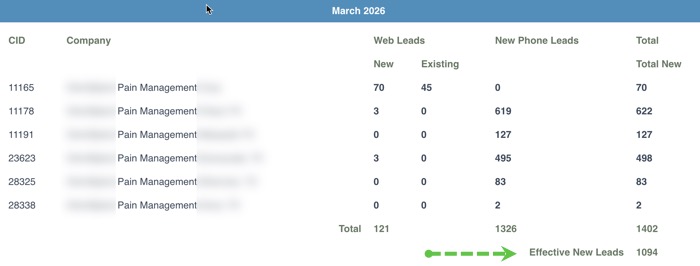
Example of a live marketing dashboard for a pain management and pain relief practice with 5 locations, 16 providers in a very competitive area of eastern USA. For example in the month of March, there are total of 1402 new patients leads recorded. After subtracting duplicates and sales people contacting, and existing patients there were 1094 new leads recorded.
What type of pain practices use PateintGain’s PLATINUM Service
Pain management encompasses multiple treatment approaches, each focusing on different methodologies to address acute and chronic pain. Below is a breakdown of the key differences between five major types of pain management:
1. Interventional Pain Management
Definition: A specialized approach that uses minimally invasive procedures and targeted treatments to block pain signals or correct underlying pain conditions.
Key Features:
- Uses injections, nerve blocks, and implantable devices to treat pain.
- Often performed by pain management specialists, anesthesiologists, or interventional radiologists.
- Targets chronic pain conditions that don’t respond to medications or therapy.
Common Treatments:
- Epidural steroid injections
- Facet joint injections
- Radiofrequency ablation
- Spinal cord stimulators
- Nerve blocks
Best For:
- Sciatica, herniated discs, spinal stenosis
- Chronic back and neck pain
- Joint pain (arthritis, knee pain)
- Neuropathic pain (nerve-related pain)
2. Non-Interventional Pain Management
Definition: A conservative, non-invasive approach that focuses on medications, physical therapy, and lifestyle modifications to manage pain.
Key Features:
- Does not involve injections, surgeries, or invasive procedures.
- Focuses on pain relief through medication, rehabilitation, and behavioral therapy.
- Often used as first-line treatment before interventional procedures.
Common Treatments:
- Pain medications (NSAIDs, muscle relaxants, opioids)
- Physical therapy and exercise programs
- Cognitive behavioral therapy (CBT) for chronic pain
- Acupuncture and massage therapy
Best For:
- Mild to moderate pain conditions
- Chronic conditions like fibromyalgia, tension headaches, and arthritis
- Patients looking for non-invasive pain relief options
3. Integrative Pain Management
Definition: A holistic approach that combines traditional medicine with complementary and alternative therapies to address the physical, emotional, and psychological aspects of pain.
Key Features:
- Merges Western medicine (pain meds, injections) with Eastern or holistic therapies (acupuncture, herbal medicine, meditation).
- Focuses on treating the whole person, not just the symptoms.
- Often involves multiple specialists including pain doctors, physical therapists, and holistic practitioners.
Common Treatments:
- Acupuncture and dry needling
- Mindfulness meditation and relaxation techniques
- Herbal medicine and nutrition therapy
- Chiropractic care and osteopathic manipulation
Best For:
- Chronic pain conditions like migraines, fibromyalgia, and neuropathy
- Patients who want a mix of traditional and holistic treatments
- Those seeking long-term pain relief and overall well-being
4. Regenerative Pain Management
Definition: A cutting-edge medical field that uses cell-based therapies to repair damaged tissues and regenerate healing in the body.
Key Features:
- Uses biologic substances (stem cells, platelet-rich plasma, growth factors) to promote natural healing.
- Focuses on restoring function rather than just pain relief.
- Minimally invasive, with little to no downtime.
Common Treatments:
- Platelet-Rich Plasma (PRP) Therapy – Uses the patient’s own platelets to stimulate healing.
- Stem Cell Therapy – Injects stem cells to regenerate damaged tissue.
- Prolotherapy – Injects irritants to trigger the body’s natural healing response.
- Exosome Therapy – Uses cell-derived exosomes to repair inflammation and injury.
Best For:
- Joint pain, osteoarthritis, sports injuries, and tendon damage
- Patients seeking alternatives to surgery
- Athletes and active individuals needing faster recovery
5. Chiropractic Pain Management
Definition: A manual therapy approach that focuses on the alignment of the spine and musculoskeletal system to relieve pain and restore function.
Key Features:
- Uses spinal adjustments and manipulations to restore movement and reduce pain.
- Focuses on neuromuscular conditions, joint dysfunction, and nerve-related pain.
- Often combined with exercise therapy, massage, and lifestyle counseling.
Common Treatments:
- Spinal Adjustments & Manipulations – Aligns the spine to reduce nerve irritation.
- Soft Tissue Therapy & Massage – Relaxes muscles and relieves tension.
- Corrective Exercises & Stretching – Improves mobility and prevents injuries.
- Postural Training & Ergonomic Advice – Helps correct daily habits that contribute to pain.
Best For:
- Back pain, neck pain, headaches, and sciatica
- Muscle strain and joint misalignment
- Patients who prefer hands-on, drug-free treatments
Marketing Companies For Pain Management Clinics: Pricing and Packages
Marketing packages for pain management clinics are typically structured into monthly tiers based on the number of locations and the intensity of the competition. Most specialized medical agencies charge a monthly management fee ranging from $500 to $2,500+ per location, while others offer “all-in-one” platform-based packages starting at roughly $1699 to $2499 per month –Like PatientGain.com’s PLATINUM Service.
Typical Monthly Marketing Packages
| Package Tier | Typical Price | Best For | Typical Inclusions |
|---|---|---|---|
| Starter / Foundation | $500 – $1,200/mo | Single-location clinics in low-competition areas. Check GOLD service. | Local SEO, Google Business Profile management, and basic reputation management. |
| Growth / Pro | $1699 – $2499/mo | Clinics looking for steady new patient growth. | Foundational features + Focused SEO content creation every month, HIPAA compliance, monthly Email marketing, Leads Funnel app, 2-way patient texting, Auto-Responders AI & Human, High Conversion websites, Websites that load in less than 4 seconds on mobile devices, Full BAA for service and applications, Support and HIPAA Leakage protection. |
| Enterprise / Multi-Location | $4,000 – $8,000+ /mo | Practices with 3+ locations or highly competitive urban markets. | Advanced multi-location SEO, full-funnel brand management marketing, physician referral programs, and CRM Incldued. |
What is Included in These Packages?
Comprehensive packages generally bundle the following four key pillars of medical marketing:
- Search Engine Optimization (SEO)
- Local SEO: Optimizing Google Business Profile – Posting on Google Business Profile 20 times per month, and citations for each location.
- Healthcare-Specific Content: Creating HIPAA-compliant, medically reviewed blogs about specific treatments like epidural injections, PRP, or spinal cord stimulation.
- Paid Advertising (PPC) Management
- Google & Meta Ads: Running targeted campaigns for high-intent keywords (e.g., “back pain doctor near me”).
- Landing Pages: Designing conversion-focused pages to capture patient leads from ads.
- Reputation & Patient Engagement
- Review Generation: Tools to request and monitor 5-star reviews on Google, Healthgrades, and Yelp.
- Patient Messaging: Secure 2-way texting or HIPAA-compliant chatbots to help staff respond to inquiries instantly.
- Reporting & Technology
- HIPAA-Compliant CRM: A system to track leads from first click to their first appointment.
- Conversion Tracking: Detailed reports on Patient Acquisition Cost (CAC), which can range from $27 to $400 per new patient for Pain Management practices.
Common Additional Costs
- One-Time Setup Fee: Agencies often charge $5,000 to $9,000 for a HIPAA-compliant, custom-designed single location website. However you can also check PatientGain’s PLATINUM-PLUS service, which does not have any setup costs with 12 month contract.
- Ad Spend: Is always extra – And it the money that is paid to Google or Facebook is a separate budget, which for busy clinics can range from $3,000 to $20,000+ per month
- Cost of Apps:
Example 1: If you want to send monthly Email marketing campaigns, you will need an app service like MailChimp(But it is not BAA compliant). PatientGain offers this service and it is included in the PLATINUM service.
Example 2: HIPAA Compliant Lead Management – These apps allow your practice to improve conversions. For example, before a patient becomes a patient, they are a prospect patient – Your practice will need to store their information an separate Leads Funnel app – not in your EMR. The cost of these apps typically ranges from $300 to $500 per month, however it is included in the PLATINUM service.
Example of a 2 location Pain Management clinic. Using PatientGain’s PLATINUM service.
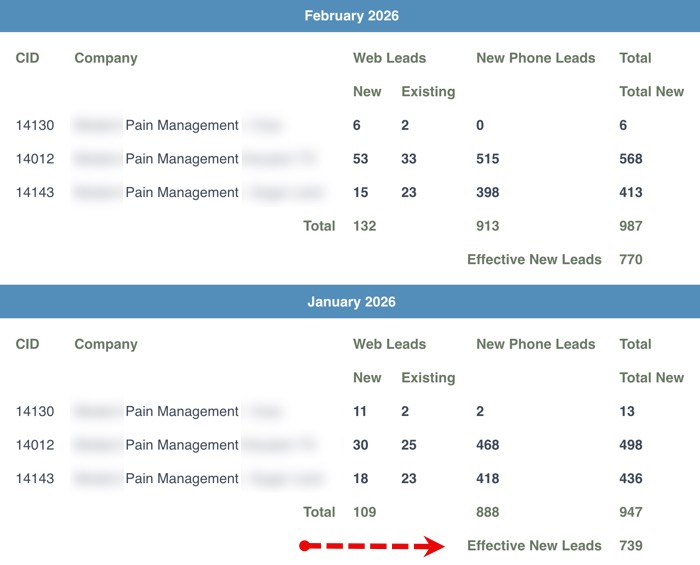
Location is a extremely competitive urban area in Texas. In the month of January there are 947 new patient recorded leads. Out of which 739 are effective leads. This customer has been using PLATINUM service for the last 5+ years. In the first 2 years there Google ads – however in the last 3 years, there are ZERO ads. All of these new patient leads are coming from organic SEO. So the patient acquisition cost is $27/per new patient.

 Send Text
 How may I help you?