

Marketing experts for multi-location healthcare practices pricing starting at $500/mon to $800/mon per location. Involves a centralized strategy with localized execution.
Replace 5 to 8 service providers and technology apps with a single coherent HIPAA compliant solution with top human customer service, better ROI, at half the cost.
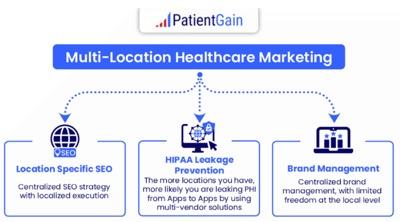
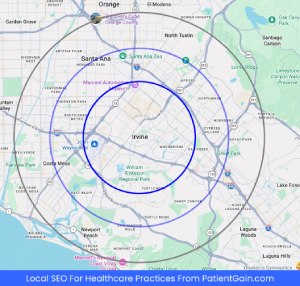
Marketing multi-location healthcare practices involves a centralized strategy with localized execution, focusing on consistent branding while creating location-specific digital presence for each location, specifically focusing on proximity marketing and advertising. Very simple example is posting on Google Business Profile (GBP) at least 20 times per month, for each location, with treatment and services based content. Another simple change to make is to make sure that the mobile version of the website for your each location loads within 4 seconds. This should be based on Google’s mobile website speedtest measurement, not based on anyone’s opinion.
Multi Location Healthcare Marketing: Table Of Contents
What are the key tactics used for muti-location healthcare marketing strategy?
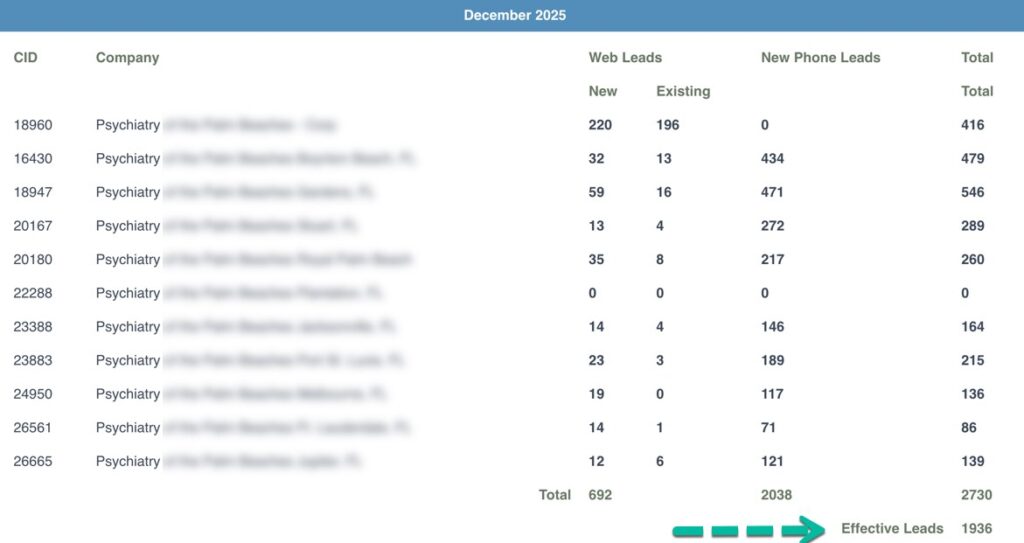
Example 1: Mental Health practice Multi-Location Healthcare Marketing Dashboard
How can PatientGain’s Multi-Location service replace 5 to 8 different fragmented AI apps and service providers?
What is a Digital Marketing PR service, and do I need it for my multi-location practice?
How PatientGain Cuts Costs and Scales Efficiency
What are the key tactics used for muti-location healthcare marketing strategy?
Key tactics include a unified website (one single main website, not multiple domains) with dedicated pages for each location, optimizing for local SEO and online reviews at each site, and managing location-specific advertising and social media. A central function should manage brand consistency, but local teams or coordinators should be empowered to create locally relevant content and campaigns. The most common question asked by multi location practices, is should there be one main website or each location should have its own website, its own domain. Answer: One main unified website: Create a single website as the main hub. With location based multiple pages specific to each location. These serve as micro-sites for each location.
Example 1: Mental Health practice Multi-Location Healthcare Marketing Dashboard
Data: In the month of December there are 2730 new patient recorded leads. Out of these 1936 are effective leads.
How can PatientGain’s Multi-Location service replace 5 to 8 different fragmented AI apps and service providers?
PatientGain.com platform’s primary value proposition is increasing ROI for healthcare practices by vendor consolidation + AI Agents + human oversight with HIPAA compliance. Historically, to run an aggressive online footprint, a medical or dental practice had to stitch together 5 to 8 different fragmented AI apps and over-priced service providers. PatientGain replaces this entire fragmented stack with a unified ecosystem, with a single BAA for HIPAA compliance. Standardized, A/B-Tested Software: Instead of custom-coding a site from scratch, they build on semi-custom blueprints refined over 10+ years across thousands of doctors.
Examples of types of multi-location healthcare practices
Acquired Practices: A common example is when a larger network acquires smaller groups, leading to a collection of subsidiaries that need to be integrated under one brand.
Investor Led Practice Groups: Example could be a provider who has partnered with investors to create a brand. Then using the financial resources of the investment entity, duplicating the success of two locations to 12+ locations in 6 years.
MSOs : Management Services Organization. It is a company that provides non-clinical administrative and business services to healthcare providers, such as physician groups, clinics, and hospitals.
Hospital Networks: Large health systems, such as Kaiser or Providence Health, operate multiple hospitals and clinics under a single brand.
Specialty Groups: Practices that focus on a specific area of medicine, such as Schweiger Dermatology Group, which quickly expanded to numerous locations.
Integrated Health Systems: Government-run or large private networks like the Veterans Administration (VA) that provide a wide range of services across a broad geographic area.
Urgent Care Centers: A single company can operate multiple urgent care clinics, sometimes with different service specializations like pediatrics or occupational health at different locations.
Dermatology Clinics: Multi-location dermatology marketing balances centralized brand authority with hyper-local optimization. The strategy relies on maintaining a single website with distinct, geo-targeted location pages, unified HIPAA-compliant tracking, and localized reputation management to dominate “near me” dermatology and aesthetic searches.
Primary and Family Care Centers: Multi-location marketing for primary care clinics requires balancing a strong centralized brand with hyper-local patient acquisition. Success hinges on robust local SEO, accurate directory listings, and unique, location-specific landing pages that make it effortless for nearby patients to find and book appointments.
Gastroenterology & Hepatologists Centers: Multi-location gastroenterology marketing requires balancing enterprise-level brand authority with hyper-local patient acquisition. Strategies must seamlessly manage high-intent service lines (e.g., colonoscopies, IBD, reflux) across all regions, maintain strict HIPAA-compliant CRM tracking, and generate location-specific reviews to build trust for sensitive digestive procedures for each location.
Regional Practices: A practice, like a urologist with 10 locations in the Atlanta area, can have a mix of facilities such as hospitals, treatment centers, and imaging centers in different counties.
What is HIPAA leakage and what are the best practices of controlling HIPAA Leakage?
HIPAA leakage refers to the unauthorized acquisition, access, use, or disclosure of Protected Health Information (PHI) in violation of the HIPAA Privacy or Security Rules. It involves losing control over patient data, which can occur via lost devices, unauthorized snooping, hacking, or improper disposal. Controlling leakage requires encryption, strict access controls, regular audits, and employee training. PatientGain’s PLATINUM solution addresses this potential issue for your healthcare practice. For Example: A pain practice located in Texas contacted PatientGain – The owner had acquired a running successful practice, and the practice was using the following setup:
1. Website hosted by GoDaddy – No BAA with GoDaddy
2. Website agency hired for SEO and Google ads –No BAA with the service provider
3. Website contact forms added for lead capture – BAA with the service provider – But the forms are on a seperate server and there is different dashboard.
4. CRM (GoHiLevel)- used for work-flow to follow up – No BAA with the service provider – It is an extra cost item
5. Social media company hired to post and run ads on Meta No BAA with the service provider – They do not even know what BAA is
6. Reputation management apps setup through another company – No BAA offered by the reputation management company.
7. Email marketing company (Constant Contact – but never signed BAA)
8. Call Tracking app and missed call app from another company – No BAA with the service provider – It is an extra cost item
9. Texting app added to send text messages to patients – No BAA with the service provider – It is an extra cost item
10. Patient Consent Management app (Missing altogether)
What is different about marketing a practice with multiple locations VS a single location?
Marketing a practice with multiple locations is significantly more complex than marketing a single location, primarily due to the need to balance a consistent brand identity with localized marketing efforts for each unique market.
Key Differences
| Feature | Single-Location Practice | Multi-Location Practice |
|---|---|---|
| Website Strategy | Single standalone – one domain website | Highly recommended to have one domain (One website) and have multiple pages for each location, with localized content, and local focus on the sub pages. |
| Strategy & Coordination | A single, centralized strategy focusing on one local audience. | Requires a balance of centralized brand strategy from the main office/Corporate office and localized execution by each locations. High coordination is essential to avoid conflicting or duplicated campaigns. |
| Audience | A single, specific geographic target audience with relatively uniform needs and preferences. | Diverse local audiences across different regions, each with unique demographics, preferences, and cultural nuances. |
| Brand Management | Easier to maintain consistent messaging, visuals, and tone across all channels. | A major challenge is ensuring brand consistency (logos, voice, quality of service) across all locations while allowing for local flexibility. Clear brand guidelines are critical. |
| Local SEO & Web Presence | Focuses on optimizing one Google Business Profile (GBP) and one website’s content for a single area. | Requires optimizing a unique GBP for each location and creating dedicated, location-specific landing pages on the website. This avoids duplicate content issues and helps each location rank in local search results. |
| Data & Analytics | Manages a single set of performance data and KPIs. | Involves collecting and analyzing multiple data sets from various locations and platforms, which adds complexity to reporting. Data needs to be viewed at local, regional, and corporate levels. |
| Technology | Can rely on simpler, general marketing tools. | Often requires more sophisticated, integrated marketing technology platforms (e.g., CRM, review management software) designed to manage and track efforts across multiple locations efficiently. |
| Community Engagement | Easier to build personal, local connections through direct involvement. | Needs specific strategies for each location to build community trust and loyalty, such as sponsoring local events or charities, as what works in one city may not in another. |
In essence, a single-location practice focuses its energy on dominating a single market with a focused strategy, while a multi-location practice must scale these efforts, managing increased complexity, coordination, and localization to connect with multiple diverse audiences effectively.
Example of a multi-location practice using Multi-Location service from PatientGain
Case Study Arthritis and Rheumatic Diseases.
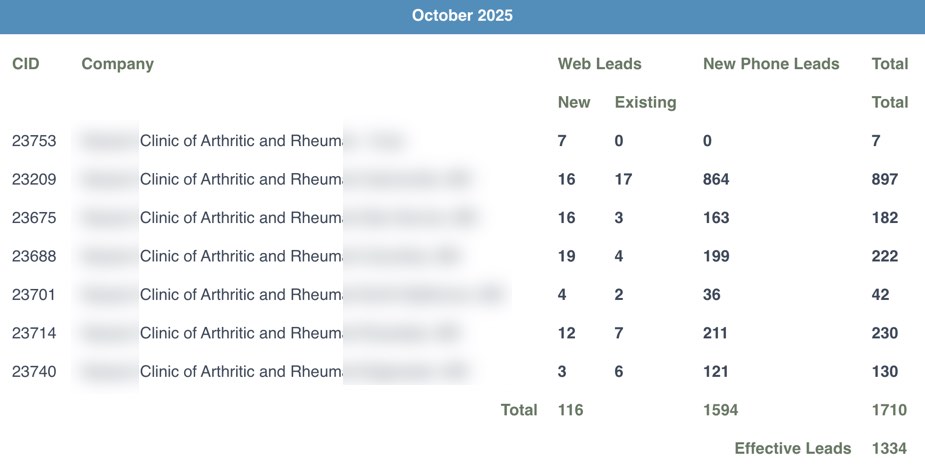
Example 1: Marketing dashboard of 6 locations practice. In the month of Oct you can see there are 1334 effective leads, majority of these leads are from SEO and Local SEO and using the Multi-Location service from PatientGain.
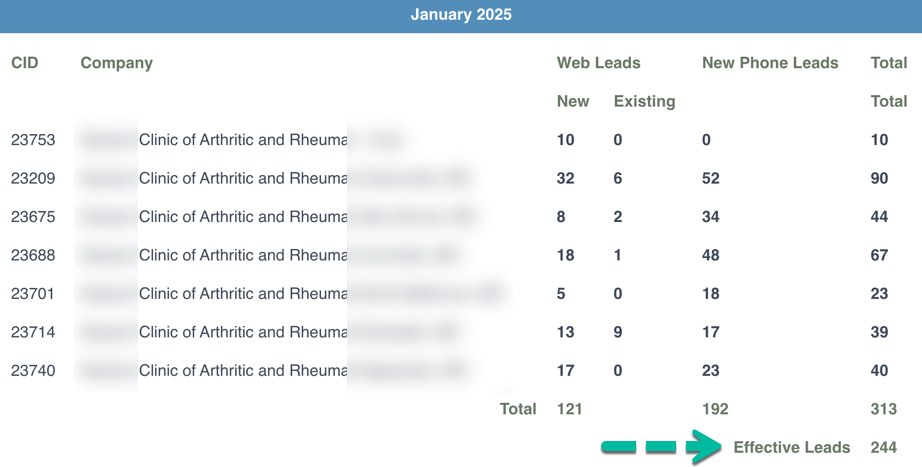
Example 2: Marketing dashboard of 6 locations practice. In the month of Jan you can see there are 244 effective leads, majority of these leads are from SEO and Local SEO and using the Multi-Location service from PatientGain.
Case study results, 6 locations example of Arthritis and Rheumatic medical practice.
This practice located in an extremely competitive area on the east coast focuses on Arthritis and Rheumatic Diseases. In 2024, before using Multi-Location service from PatientGain, the customer was using 8 different vendors, apps, and service providers.
- Website was developed by website company that provides services to many healthcare providers in US.
- Hosting of the website was on GoDaddy platform.
- There is one in-house marketing manager who also handles off-line traditional marketing and local relationships with primary care providers in the area.
- Google and Facebook ads were being handled by a local advertising agency
- SEO services were being offered by another national “medical SEO company”
- Email marketing was being done using MailChimp (but was done inconsistently)
- Social Media posts were posted by the in-house marketing manager (but was done inconsistently)
- Reputation management app was another company.
- 2-Way Texting with patients was handled by another app / company
- Another 3rd party app was used for ADA compliance on the website.
After using the Multi-Location service from PatientGain, the customer replaced 8 different vendors, apps, and service providers with one solution, this solution is Done-For-You, rather than D.IY. The cost savings were more than 50% reduction in monthly fees. There is also considerable increase in business, as evidenced by the the live marketing dashboards above. For example there are 244 recorded new leads ( beginning of the year – January data). In the month of October the leads have increased to 1334 recorded new leads.
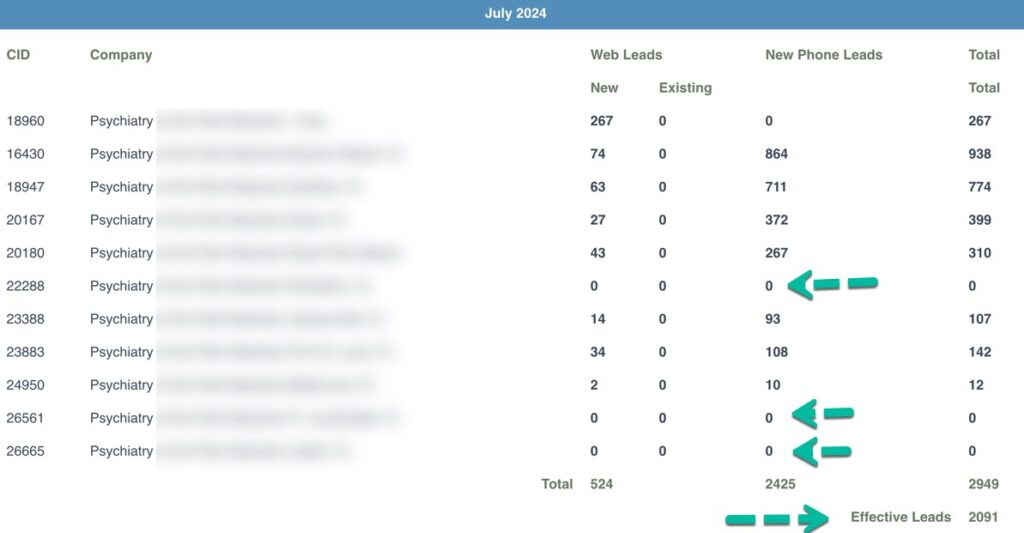
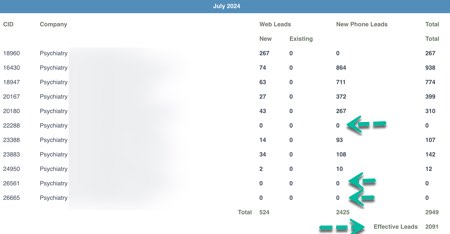
Case study results, 10 locations example of mental health medical practice.
5 years ago, during Covid, a lot of healthcare providers were trying to salvage their practices. This provide had a small practice, with 2 providers and 1 location, in the eastern US. They started using PLATINUM+ service for one location, and with the help of PatientGain, we launched telemedicine offering also. From the data below in the month of of July there are 2091 new leads, after subtracting sales calls and repeat callers. There are 7 active locations, and 3 new locations. Each of 7 location has $1000 / month advertising budget ( on Google ads ) and according to leads funnel data, 52% of new leads from organic SEO, 35% from Google ads.
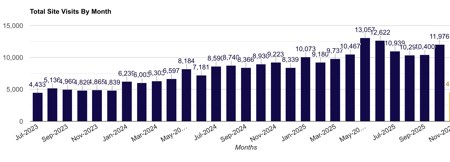
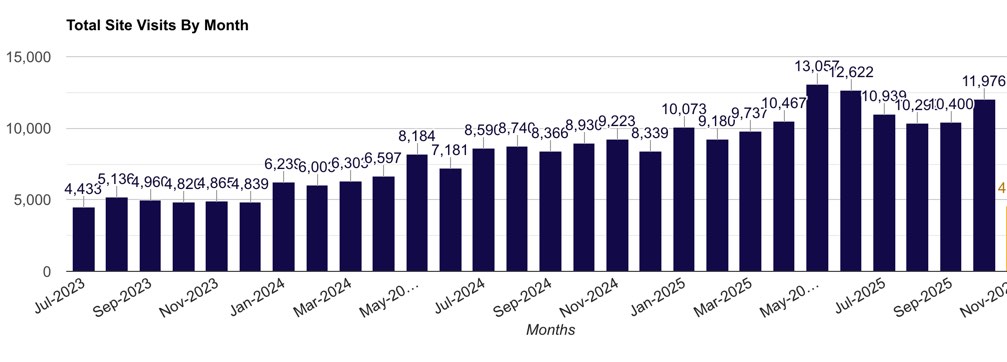
Case study results & example of a dermatology medical practice with multiple locations in the in the east coast. The results are based on following good SEO practices.
In Jun there are 4433 website visits – In Nov- 27 months later, it is 11976 website visits. All of locations for this customer have zero ads budget. All of the increase in the last 36 months, is due to the high conversion website, provided by the PatientGain PLATINUM service and the SEO of the website. This practice has increased new patients without spending any $$$ on advertising in the last last 36 months.
How does PatientGain.com’s multi-location healthcare marketing service works compared to traditional agency model?
The primary difference between PatientGain.com and a traditional agency is the core business model. Traditional agencies rely on labor-intensive, bespoke consulting hours, while PatientGain runs as an infrastructure-first, Software-as-a-Service (SaaS) platform. PatientGain acts as a semi-custom “all-in-one platform plus support” model rather than a completely customized, high-hourly-rate consulting firm.
Key Operational Differences
| Feature | Traditional Agency Model | PatientGain Multi-Location Platform |
|---|---|---|
| Tech Stack | Fragmented. Requires paying for 5–8 separate software subscriptions (CRM, Texting, Chatbot, Call Tracking, Reviews). | Unified. Replaces multiple vendors by housing all communication and marketing apps inside one secure software platform. |
| HIPAA Compliance | Highly risky. Often builds tools on hosts or third-party apps that lack proper Business Associate Agreements (BAAs), risking data leakage. | Native compliance. Every integrated application, database, and CRM tool includes signed BAAs to strictly protect patient data. |
| Multi-Location Setup | Labor-intensive. Manually builds and duplicates unique campaigns, which drives up costs as you expand locations. | Automated scaling. Uses a “clone effect” strategy to roll out centralized branding across new locations while automating localized execution. |
| Ad Spend Markup | Hidden fees. Traditional agencies often mark up the cost of ad keywords or charge high variable management fees. | Transparent billing. No markup on ad costs; client ad budgets go directly to ad platforms with a flat management fee percentage. |
| Data Visibility | Fragmented reporting. Manual monthly data assembly across separate location metrics creates reporting delays. | Live dashboards. Real-time access to centralized conversion dashboards separated by location and filtered to identify effective leads. |
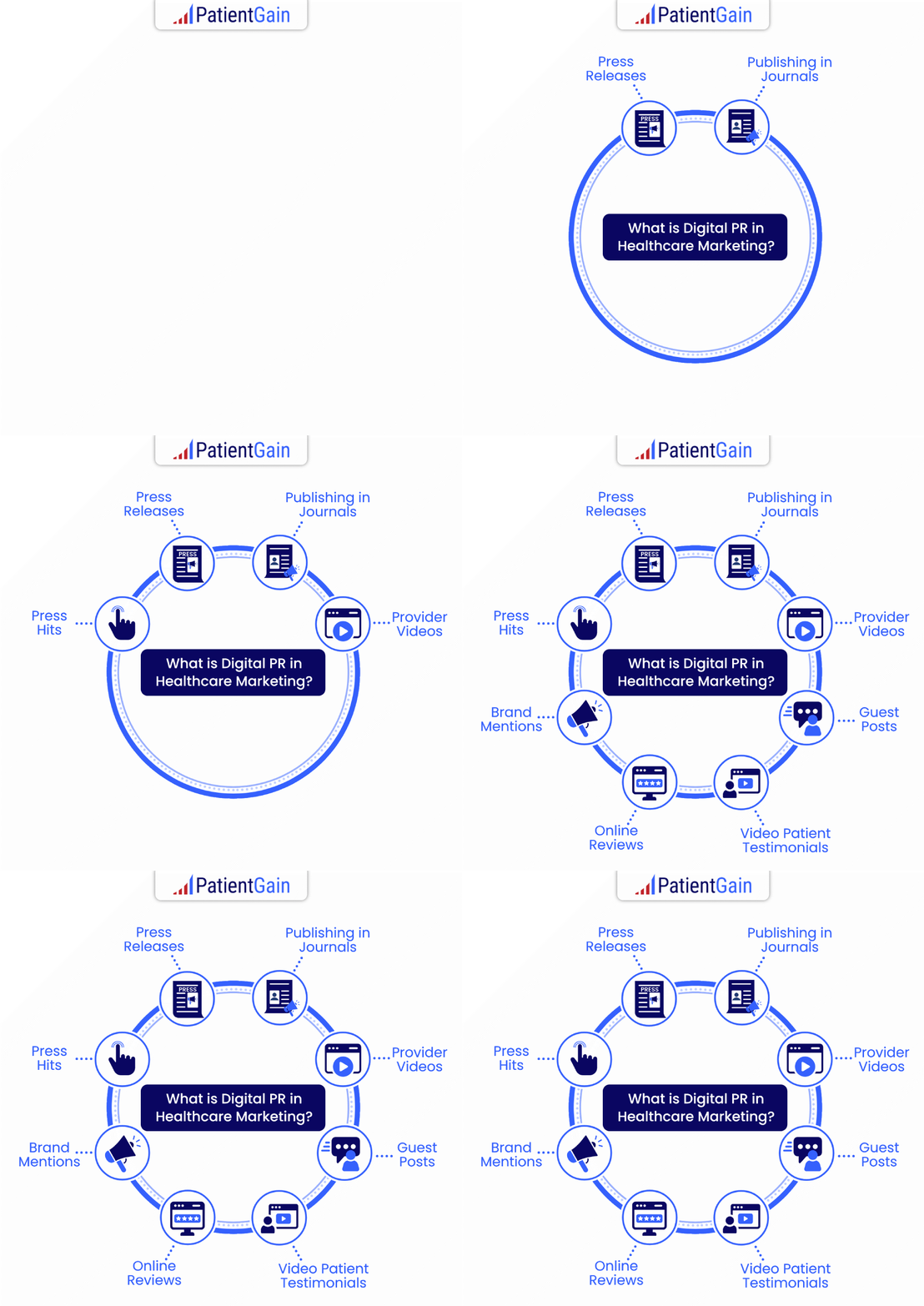
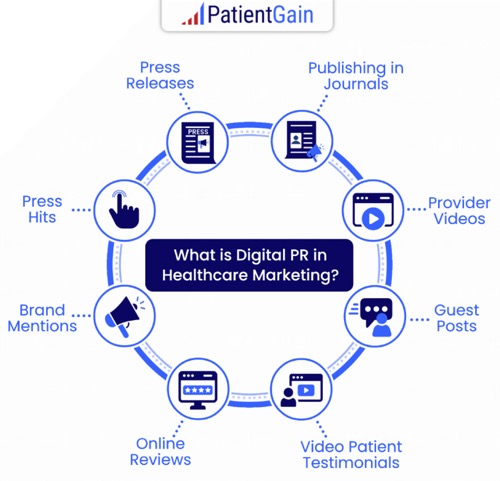
What is a Digital Marketing PR service, and do I need it for my multi-location healthcare practice?
A digital marketing Public Relations (PR) service combines digital marketing like SEO, PPC ads, Email marketing with modern online strategies to build brand authority, secure press coverage on high-traffic websites, and manage public reputation. Yes, if your strategy is to dominate, your multi-location healthcare practice absolutely needs it to maintain brand consistency, manage online patient reviews across different clinics, and outrank regional competitors in local search results. However it is expensive, takes long time, and ROI is very difficult to measure.
How PatientGain Cuts Costs and Scales Efficiency
1. Software AI Automation vs. Manual Labor
Traditional boutique agencies charge for the manual, hourly labor required to manage separate tasks. PatientGain automates repetitive processes—such as local SEO updates, review requests via SMS/Email, and social media scheduling—significantly dropping multi-location costs down to $500 to $800/month per location.
2. Single Hub Domain Strategy
While some traditional agencies mistakenly recommend buying individual domains for each location, PatientGain builds one main unified website hub. They scale the presence of each branch using geo-targeted location pages that act as specialized local micro-sites. This strategy consolidates your overall domain authority to outrank competitors locally without duplicating web properties.
3. Lead Conversion Unification
Instead of losing inquiries between the front desk and third-party apps, PatientGain pipes phone calls, texts, chats, and form leads into a Single Point of Conversion (SPOC) dashboard. This structure eliminates the lead leakage common to multi-vendor systems managed by traditional agency teams.

Use this data as an example, as every customer will see different results. However feel free to book a Zoom meeting with PatientGain.

 Send Text
 How may I help you?