

How to Optimize Google Business Profile (GBP) for Medical & Dental Practices
Optimizing your Google Business Profile (GBP) (Also known as GMB – Google My Business) listing is essential for medical and dental practices to improve local SEO, attract more patients, and enhance online visibility. Standing out in the crowded healthcare landscape requires a strong online presence. Google Business Profile (GBP) optimization is a crucial step for medical practices to attract new patients and establish themselves as trusted providers. Many patients actually look for your Google Business Profile (GBP) before contacting your practice. There are 3 basic things you must do for your healthcare practice’s GMB optimization:
1. Must have complete and accurate information on the Google Business Profile. See example below. Fill out all sections, including “products” and “services”. Also you need to keep it updated.
2. Do not ignore the GBP page. It requires constant attention. For majority of healthcare practices, it si even more important than your social media page.
3. Post about 20 times per month on the Google Business Profile posting page. This is called “high frequency posting” . See example below. Basically in this section, you want to post 20 times per month. It should be about your services. Educational posts are the best.
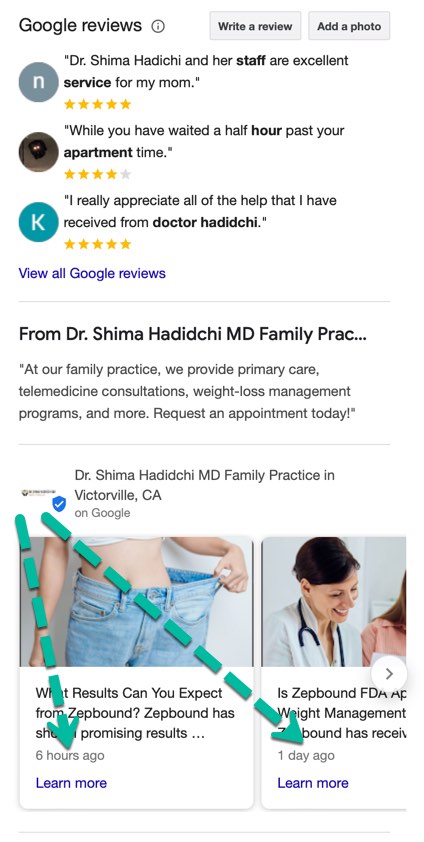
For a doctor or medical practice, Google Business Profile optimization should be treated as a core part of local SEO—not just a directory listing. Google says local visibility is driven primarily by relevance, distance, and prominence, so the goal is to make the practice highly relevant for the services patients search for and highly credible in the local market. Google Help
Roadmap to optimize your GMB profile and climb the ranks in local search results: Start by searching for your practice name on Google Maps or by visiting https://support.google.com/business/answer/7039811?hl=en.
Here are key steps to effectively optimize your GMB listing:
- Claim and Verify Your Listing:
- Start by claiming your GMB listing. If one doesn’t exist, create it through the Google My Business website.
- Complete the verification process as directed by Google, which might involve receiving a verification code via mail, phone, or email.
- Complete All Information:
- Fill out every section of your GMB profile. This includes your practice’s name, address, phone number, and hours of operation. Specifically, your business hours, your open and close days, and special holidays are very important. Millions of patients look at GMB first and then go to your website. So both of them need to be accurate.
- Make sure your information is consistent with what is listed on your website and other online pages to avoid confusion.
- Other online pages include many steps. Most useful are tier 1, 2 and 3.
- Add a Detailed Business Description:
- Write a clear and concise description of your medical practice, including the types of services offered, specialties, and any unique attributes or qualifications.
- Include relevant keywords that potential patients might use to find services like yours, but avoid keyword stuffing.
- Select the Right Categories:
- Choose appropriate categories that accurately describe your practice to help Google show your business for the right searches. For instance, if you’re a dermatologist, ensure “Dermatologist” is a selected category.
- Upload High-Quality Photos:
- Regularly update your listing with high-quality images of your clinic, staff, and any special equipment. Images make your listing more appealing and can affect a potential patient’s decision to choose your practice.
- Manage and Respond to Reviews:
- Encourage patients to leave reviews by sending follow-up emails or reminders after appointments.
- Respond professionally to both positive and negative reviews to show that you value patient feedback and are actively managing your online reputation.
- Use Posts to Engage with Patients:
- Utilize the Posts feature on GMB to share updates, promotions, health tips, or upcoming events. This keeps your profile active and engaging for users.
- Add Products and Services:
- Clearly list your services along with brief descriptions and pricing if applicable. This helps patients understand what you offer and can aid in their decision-making process.
- Set Up Messaging:
- Enable the messaging feature to allow potential patients to text you directly from the GMB listing, however this can have HIPAA issues, so use a HIPAA compliant messaging app on the website, for added security. This can increase engagement and speed up the communication process.
- Monitor Your Insights:
- Regularly check GMB Insights to understand how patients are finding your listing (whether through direct searches, discovery searches, etc.), and what actions they are taking (e.g., clicking on phone numbers, requesting directions). Use this data to further refine your SEO and listing management strategies.
By following these steps, your medical practice can maximize the effectiveness of your Google My Business listing, enhancing visibility in local search results and attracting more patients.
Detailed Step By Step Plan For the Front Desk Staff
Standard Operating Procedure (SOP): Front Desk GBP Management & HIPAA Compliance
Daily & Weekly Front Desk Task Checklist
| Frequency | Task | Responsible Party | Standard / Goal |
| Daily (Morning) | Check Special Hours & Profile Status | Reception Lead | Ensure hours accurately reflect practice availability, holiday closures, or weather delays. |
| Daily (Continuous) | Patient Review Requests | Front Desk Staff | Invite satisfied patients at check-out via printed QR cards or automated intake follow-up. |
| Daily (Afternoon) | Public Q&A & Message Triage | Receptionist | Check Google Q&A for general administrative questions and route clinical queries offline. |
| Weekly (Friday) | Review Response Queue | Practice Manager / Lead | Process and reply to all new online reviews using pre-approved, HIPAA-compliant templates. |
| Monthly | Visual Privacy Audit & Photo Update | Medical Assistant / Lead | Upload 1–2 refreshed facility/staff photos after verifying zero patient PHI is visible. |
SOP A: In-Person Review Request Protocol (Check-Out Desk)
Objective
Encourage satisfied patients to leave Google reviews without offering incentives or violating HIPAA/Google policies.
Steps
- Identify the Moment: During check-out, after verifying next steps (follow-up appointment scheduled, co-pay collected, paperwork completed).
- Use the Verbal Script:
- “Thank you for coming in today, [Patient First Name]! If you had a great experience with Dr. [LastName] and our team, we would really appreciate it if you shared a review on Google. It helps other patients find our practice.”
- Provide the Physical Asset: Hand the patient a physical review card containing a QR code linked directly to the GBP review page.
- Follow HIPAA Limits:
- DO NOT write patient names or appointment details on the review card.
- DO NOT record in the EHR or appointment calendar whether a patient agreed or declined to write a review.
- DO NOT offer gifts, discounts, gift cards, or entry into raffles for leaving a review.
SOP B: Responding to Google Reviews
Objective
Maintain a 100% response rate on all GBP reviews within 48 business hours while eliminating HIPAA disclosure risk.
Step 1: Categorize the Review
Determine if the review is Positive, Negative, or a Clinical/Administrative inquiry.
Step 2: Apply the Pre-Approved Response Template
Never acknowledge that the reviewer is a patient or confirm any visit details, even if the patient names themselves or their specific condition in the review.
- Template 1: Positive Review (Generic)“Thank you for sharing your feedback with us. Our practice is dedicated to delivering high-quality care to our community. We appreciate your support!”
- Template 2: Critical or Negative Review (Service / Wait Time / Billing)“Thank you for your feedback. Due to privacy laws, we cannot discuss individual patient care or office visits on a public platform. We take all patient experiences seriously. Please contact our Office Manager directly at [Office Phone Number] so we can discuss your experience in detail.”
- Template 3: Clinical Disagreements or Complex Complaints“We appreciate you bringing this to our attention. Patient satisfaction and privacy are top priorities for our practice. Because we cannot address personal health or visit details online, please call our Patient Relations line at [Office Phone Number] to speak with us directly.”
Step 3: Mandatory Escalation Protocol
If a review contains any of the following, DO NOT post a reply immediately. Flag the review and notify the Office Manager/Compliance Officer within 2 hours:
- Allegations of medical malpractice or legal threats.
- Direct identification of clinical staff alongside specific diagnostic outcomes.
- Obscene language, harassment, or suspected competitor spam (submit a removal request to Google directly).
SOP C: Google Q&A and Native Messaging Triage
Objective
Address administrative questions publicly while redirecting all medical questions to secure channels.
Protocol for Responding to Public Questions
- Administrative Questions (Hours, Parking, Insurance, Walk-ins):
- Answer directly, concisely, and factually.
- Example Q: “Do you take Blue Cross Blue Shield?”
- Example Response: “We participate with many insurance plans, including several Blue Cross Blue Shield products. Please call our billing department at [Phone Number] with your specific plan details to confirm coverage prior to your visit.”
- Medical or Triage Questions (Symptoms, Treatment Options, Prescription Refills):
- NEVER provide diagnoses, treatment recommendations, or confirmation of appointment status in public Q&A.
- Example Q: “I have a severe rash on my arm, can the doctor see me today for eczema?”
- Example Response: “Our practice provides treatment for a wide range of dermatological conditions. For safety and privacy, we cannot offer clinical advice online. If you are experiencing medical symptoms, please call our triage line at [Phone Number] or request an appointment through our secure patient portal at [Portal URL].”
SOP D: Visual Privacy Audit for GBP Photo Updates
Objective
Regularly upload high-quality practice photos without exposing Protected Health Information (PHI).
Pre-Photo Checklist (Perform before taking any photos)
- [ ] Computer monitors in the background are turned off or set to blank lock screens.
- [ ] Paper charts, patient intake forms, daily schedules, and lab slips are cleared from desks and counters.
- [ ] Whiteboards containing patient names, room numbers, or initials are completely erased.
- [ ] No patients or non-permissioned staff are present in the frame.
Approved GBP Photo Types
- Exterior building signage, main entrance, and patient parking areas.
- Empty, clean waiting rooms and sanitized exam rooms.
- Staff headshots (ensure staff members have signed an internal media consent form).
What parts of the GBP optimizations can cause potential HIPAA violations?
Several key areas of Google Business Profile (GBP) optimization carry significant HIPAA compliance risks because Google is an unauthenticated, public platform that does not execute Business Associate Agreements (BAAs) for GBP core features.
Key risk areas are:
- Responding to patient reviews. This is probably the most obvious GBP risk. If a patient writes, “Dr. Smith treated my depression,” the practice should not reply, “We’re glad your TMS treatment worked.” That confirms the reviewer is a patient and confirms treatment information. A safer response is generic: “Thank you for your feedback. We appreciate you taking the time to share your experience.” HIPAA generally restricts disclosures of PHI unless permitted or authorized. HHS.gov
- Google Business Profile messaging/chat. If patients use GBP messaging to say things like “I need help with my ketamine treatment,” “Can I refill my medication?” or “My appointment is Tuesday,” health information can enter a consumer communication platform that may not be appropriate for PHI. Staff should move clinical or patient-specific discussions to an approved secure channel.
- Appointment links from GBP. The GBP itself may simply link to a scheduling page, but the real HIPAA issue starts on the destination page. HHS specifically notes that appointment pages can involve PHI when identifying information such as email addresses is combined with the reason for seeking healthcare. If tracking technologies receive that information, HIPAA obligations can apply and a BAA may be required with vendors handling the PHI. HHS.gov
- Google Analytics, Google Ads tags, Meta Pixel, call-tracking scripts, or other trackers on GBP landing pages. This is one of the most important hidden risks. A patient may click from GBP → “Ketamine Therapy” → appointment form. The website could transmit identifiers, URLs, form fields, device IDs, IP information, appointment activity, or other information to third parties. HHS and FTC have specifically warned healthcare organizations about tracking technologies, including Google Analytics and Meta/Facebook Pixel, where sensitive health information may be disclosed. HHS.gov
- Call tracking numbers. Using a tracking number on GBP is not inherently a HIPAA violation. The risk depends on what happens to the call. If a vendor records calls, transcribes them, analyzes conversations, stores caller information, or captures appointment details, it could receive PHI. At that point you need to determine whether the vendor is acting as a business associate and whether the appropriate safeguards and BAA are in place.
- Contact forms on the website linked from GBP. Forms such as “Request an Appointment,” “Do I qualify for semaglutide?”, “Schedule TMS Consultation,” or “Tell us your symptoms” may collect identifiable health information. HHS specifically identifies appointment scheduling and symptom-related tools as circumstances where PHI can be involved. HHS.gov
- Posting patient photos or before-and-after images. A patient photo associated with treatment may reveal that the individual received healthcare. Don’t assume that because the patient agreed verbally or posted their own photo that the practice can use it for advertising. Healthcare marketing uses of patient information may require an appropriate HIPAA authorization. HHS emphasizes that authorizations must clearly describe what information is being disclosed and how it will be used. HHS.gov
- Patient testimonials. The same issue applies to testimonials such as: “Jane lost 42 pounds with our semaglutide program.” Name + treatment + outcome can clearly constitute identifiable health information. Obtaining a proper authorization before the practice publishes such material is very different from a patient independently leaving a public review.
- Uploading photos containing patient information. Staff may unintentionally upload an office picture that contains a patient on a screen, a whiteboard, intake form, appointment calendar, prescription information, or identifiable person in a treatment area. Reasonable safeguards remain important even for incidental disclosures. HHS.gov
- Connecting GBP activity to advertising audiences or remarketing. This is one of the highest-risk areas. Imagine someone searches:
“Ketamine treatment near me” → GBP → website → Ketamine page → appointment request
And that behavior is then passed into an advertising or remarketing platform. The practice should carefully evaluate what identifiable health-related information is being transmitted. HHS says regulated entities cannot use tracking technologies in ways that cause impermissible PHI disclosures, and marketing disclosures can require HIPAA-compliant authorization.
These potential violations can be minimized by implementing best practices and also using technologies like AI agents called HITL healthcare marketing agents.
 Send Text
 How may I help you?