

Local SEO for Dermatologists Services
Dermatology Practices need 3 type of SEO services A) Local SEO for Dermatologists and B) SEO for Dermatology office and now you also need 3) Medical AI SEO for your dermatology practice– All are equally important for your derma practice.
Dermatology search engine optimization expert for a dermatologist’s practice specializes in optimizing the practice’s website and online presence to improve its visibility in search engine results, attracting more patients and increasing business. PatientGain uses various techniques, adding fresh content every month (related to your medical service) including reverse medical search engine based on AI, content marketing, local SEO, speech based SEO, AI based SEO and technical SEO, to ensure the practice’s website ranks highly for relevant search terms.
Local SEO for Dermatologists: Table Of Contents
Local SEO for Dermatologists
SEO for Dermatology Practices
How is SEO for dermatology practices different from Local SEO?
What is the cost of Local SEO & SEO for Dermatologists?
Why is PatientGain’s pricing so low?
Example 1: How Dermatology practice SEO can improve the ROI
Example 2: ROI of Dermatology practice + Medical spa cash pay services
Key aspects of PatientGain’s Medical SEO for Dermatologists
How can PatientGain’s PLATINUM service increase your dermatology practice’s SEO and local SEO?
SEO Steps for Dermatology Practices
Local SEO for Dermatologists (Also called Proximity based marketing)
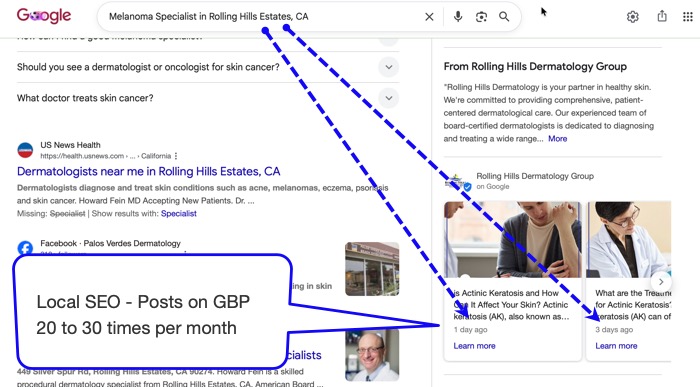
Local SEO for dermatologists is the process of optimizing a practice’s online presence to attract patients in their immediate geographic area. It focuses on making the clinic highly visible in Google’s local map pack and “near me” searches for specific skin, aesthetic and medical services. Local SEO for dermatologists optimizes a practice’s online presence to attract nearby patients. By focusing on “near me” queries, Google Map Pack visibility, and targeted location keywords, clinics can capture 65% to 80% of practice revenue from patients who live or work within a 30-45 minute drive. Hence, optimization of Google My Business (GBP) and posting on GBP 20 to 30 times per month are the most important steps.
Example: A patient is looking for Melanoma doctor in certain city. In this case Google Business Profile (GBP) posts are increasinging becoming important for the Local SEO results.
SEO for Dermatology Practices
SEO for dermatology practices is a digital marketing strategy that optimizes a clinic’s website and online presence to rank higher in search engines like Google. It targets patients actively looking for medical or cosmetic skin services, ensuring your practice shows up when they need care. Generally, SEO for dermatology practices is a bigger picture strategy on how to have more comprehensive online presence without paying for advertising, so patients find your practice and service your offer, without having to pay for Google or Meta ads.
How is SEO for dermatology practices different from Local SEO?
While Local SEO focuses on geo-targeted map packs and location keywords (e.g., “dermatologist near me”), Dermatology SEO (often called Medical SEO) is highly specialized. It requires meeting Google’s strict E-E-A-T (Experience, Expertise, Authoritativeness, Trustworthiness) guidelines for health, navigating healthcare regulations, and balancing clinical needs with lucrative cosmetic procedures.
Strategy & Content Focus
- Local SEO: Centers on your Google Business Profile, proximity, and localized keywords. It aims to get your clinic listed at the top of map results for basic, transaction-ready phrases.
- Dermatology SEO: Focuses on comprehensive, medical-grade content. It requires detailed service pages that educate patients on specific skin conditions (e.g., eczema, melanoma) as well as cosmetic treatments (e.g., Botox, laser resurfacing).
Trust & Credibility (E-E-A-T)
- Local SEO: Emphasizes reviews on platforms like Google and Yelp to build local trust and drive immediate foot traffic.
- Dermatology SEO: Requires adherence to Google’s YMYL (Your Money or Your Life) standards, meaning content must be authored or reviewed by board-certified dermatologists, citing medical journals or authoritative organizations (like the American Academy of Dermatology).
Search Intent
- Local SEO: Targets patients with high intent to book immediately (e.g., “best dermatologist in Palo Alto”).
- Dermatology SEO: Targets both immediate local needs and long-tail informational searches (e.g., “how to treat an itchy mole,” “acne scar treatments for dark skin”). This requires a dedicated blog or patient education center.
Conversion Metrics
- Local SEO: Success is typically measured by phone calls, click-to-calls, and map directions requests.
- Dermatology SEO: Success is measured by tracking which service pages (e.g., clinical vs. cosmetic) drive the most patient appointments, consults, and high-value bookings
- PatientGain SPOC App tracks all conversions from one single app.
What is the cost of Local SEO & SEO for Dermatologists?
Local SEO and SEO services for dermatologists typically cost between $1,000 and $5,000 per month for monthly retainers. Some specialized agencies offer basic starter packages starting around $500 to $1,000 per month, while competitive multi-location enterprise strategies can exceed $6,000 per month. PatientGain’s pricing is more attractive and much more comprehensive: PatientGain utilizes a SaaS subscription model for dermatologists, bundling HIPAA-compliant websites, SEO, and various software apps with monthly fees ranging from $899 to $2,499 based on market competition, which differs from traditional labor-intensive SEO agency pricing. Key tiers include GOLD for low competition, PLATINUM for medium, and PLATINUM Plus for high competition, often requiring a 12-month commitment to waive setup fees. For a detailed breakdown of services and pricing.
| Pricing Tier / Model | Estimated Cost | Best For / Key Features | Contract & Setup |
|---|---|---|---|
| Traditional SEO Agency (Basic) | $800 – $1,500 / month | Solo practitioners, basic local keywords, and Google Business Profile management. | Varies; often month-to-month or 6-month terms. Often requires setup fees. |
| Traditional SEO Agency (Mid level) | $2,000 – $5,000 / month | Mid-sized clinics, custom content creation, technical audits, and link building. | Varies; typically requires 6 to 12-month retainers. Often requires setup fees. |
| PatientGain Gold(Low Competition) | Starting around $899 / month | Practices in rural or low-competition areas needing standard SEO and software tools. | 12-month commitment usually required to waive setup fees. |
| PatientGain Platinum (Medium Competition) | Around $1,200 – $1,600 / month | Suburban practices facing moderate competition; includes expanded software apps. | 12-month commitment usually required to waive setup fees. |
| PatientGain Platinum Plus (High Competition) | Up to $2,499 / month | Urban practices or cosmetic clinics fighting in highly competitive markets. | 12-month commitment usually required to waive setup fees. |
Why is PatientGain’s pricing so low, compared to traditional healthcare SEO companies, and they offer over 20 apps with HIPAA compliance?
The main reason PatientGain’s pricing is significantly lower than traditional healthcare SEO companies comes down to its business model: it is an infrastructure-first, Software-as-a-Service (SaaS) platform, whereas traditional agencies run on a labor-intensive, bespoke consulting model. PatientGain lowers costs by replacing hours of manual agency work with automated software, offering standardized packages instead of unique, custom-built solutions. However, if a dermatology practice requires full CUSTOM implementation, then PatientGain offers CUSTOM Service – Which is more expensive and is on-par with traditional healthcare marketing agencies.
1. Standardization vs. Custom Labor
- Bespoke vs. Semi-Custom Websites: A traditional agency typically charges $10,000 to $20,000+ upfront because a web designer and developer must build a site completely from scratch. PatientGain uses pre-built, A/B-tested, semi-custom templates optimized specifically for healthcare conversion. This significantly lowers development costs and setup time.
- AI and Automation: Traditional SEO companies rely on heavily paid content writers, account managers, and SEO specialists to manually execute audits and write monthly blogs. PatientGain heavily integrates proprietary AI agents and automation for local SEO optimizations, review requests, and monthly content updates, greatly reducing human labor costs.
- Defined Scope of Work: Traditional agencies create variable, custom proposals based on individual client requests. PatientGain offers fixed, standardized service tiers (like their Gold or Platinum plans), allowing them to manage thousands of clinics with identical delivery structures.
2. Massive Vendor Consolidation
A typical medical clinic usually strings together 5 to 8 separate, third-party software tools to run its practice:
- Website Hosting (WP Engine, Google Cloud)
- SEO Experts
- PPC Ads experts
- Email marketing platform
- Promotions apps
- HIPAA-Compliant CRM/Forms (Jotform, Formstack)
- Chatbots and 2-way Patient Texting (Podium, Birdeye)
- Reputation / Review Software (Weave)
- Comprehensive marketing dashaboards
Buying these individually can cost a practice well over $1,500/month just in software licenses, before factoring in an agency’s SEO management fee. Because PatientGain owns and natively built all 20+ apps within its ecosystem, it faces zero third-party licensing fees. They bundle these apps with their SEO hosting for a single monthly subscription, passing those massive software savings directly to the clinic.
3. How PatientGain Can Offer 20+ Apps with HIPAA Compliance
Maintaining strict healthcare compliance across multiple different systems is incredibly difficult and expensive. PatientGain accomplishes this seamlessly through architecture:
- Single Unified Ecosystem: Instead of trying to securely link 5 different software brands together (which creates data-leak vulnerabilities), PatientGain routes all patient data through one central, closed-loop dashboard called the Single Point of Conversion (SPOC) app.
- HIPAA-Ready Hosting Infrastructure: The entire software platform is built directly on top of secure, HIPAA-eligible cloud environments like Amazon Web Services (AWS) and the Google Cloud Platform. They use role-based access, end-to-end data encryption, and regular staff security training to safeguard Protected Health Information (PHI).
- Signing a Business Associate Agreement (BAA): Because they control the software stack and database directly, PatientGain formally signs a Business Associate Agreement (BAA) with the medical practice. This legally binds them to handle medical records under federal HIPAA guidelines—something generic marketing agencies cannot or will not do.
PatientGain offers “Medical SEO for Dermatologists,” a specialized dermatology search engine optimization service tailored to the unique needs and regulations of dermatology practices. PatientGain approach aims to increase online visibility, attract more relevant patients, and improve search engine rankings, all while adhering to healthcare-specific guidelines.
Example 1: How Dermatology practice SEO can improve the ROI (Return on Investment)
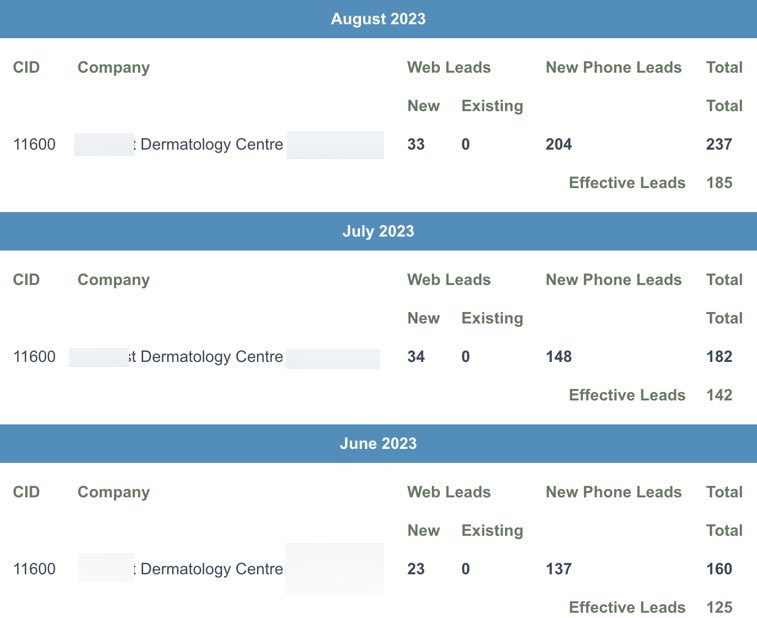
Example 1: How Dermatology practice SEO can improve the ROI (Return on Investment) : For this practice, they focus on medical dermatology and also started to offer med spa, aesthetics services like Botox. But main focus is dermatology related, insurance based services. There are no Google or social media ads, most of the leads are originating from SEO and majority of the patients search for dermatology services on Google. In the month of August there are total of 237 new patient leads/referrals received. After subtracting duplicates calls and sales calls, 185 are effective leads/referrals received.
Example 2: ROI of Dermatology practice + Medical spa cash pay services
Example 2: ROI of Dermatology practice + Medical spa cash pay services : Focus is on medical dermatology and also on med spa, aesthetics service. 60% of services are cash pay. : For this practice, they started as a pure dermatology practice using PatientGain in 2020. However in 2023, they decided to start offering cash pay medical spa services at the same location. They are using PLATINUM+ Service from PatientGain. In the month of April there are total of 1349 new patient leads/referrals received. After subtracting duplicates calls and sales calls, 1052 are effective leads/referrals received.

Key aspects of PatientGain’s Medical SEO for Dermatologists include:
- Healthcare-Specific and HIPAA-Compliant SEO: Unlike generic SEO, PatientGain’s strategies are designed with healthcare regulations like HIPAA in mind. PatientGain also focus on Google’s E-A-T (Expertise, Authoritativeness, Trustworthiness) principles, which are crucial for medical websites.
- AI-Powered Optimization: PatientGain leverages Artificial Intelligence in its SEO efforts. This includes AI-driven website design for high conversion, AI strategies for updating meta descriptions, keywords, and page structures, and AI-assisted content creation. PatientGain has created its own reverse search engine algorithm and an AI based agent. This means PatientGain uses algorithms to analyze how patients are searching for medical services and then optimize their clients’ online presence to match those search patterns, effectively “reversing” the typical search engine optimization process.
- Local SEO and Voice Search SEO: A primary goal is to help dermatologists rank high in local search results. This involves optimizing for “near me” searches (e.g., “best dermatologist near me,” “skin cancer screening in [city]”) and voice search queries. Optimizing the Google Business Profile is a key part of this.
- Targeted Content Marketing: They create SEO-optimized content relevant to dermatology patients. This often includes blog posts, articles, and FAQs addressing common skin conditions (like acne, eczema, psoriasis, signs of aging), specific treatments (e.g., Botox, fillers, microneedling, laser treatments), and general skincare advice. This content aims to educate potential patients and improve search engine rankings for relevant terms.
- Keyword Strategy for Dermatology: PatientGain conducts keyword research to identify and target terms that potential dermatology patients are searching for. This includes a mix of broad terms and more specific, long-tail keywords related to particular conditions, treatments, and services offered by the dermatologist.
- High-Conversion Website Design: PLATINUM service includes creating modern, mobile-friendly websites that are optimized for speed, user experience, and converting visitors into patients. ADA (Americans with Disabilities Act) compliance is also a consideration.
- Reputation Management App: Online reviews are critical in healthcare. PatientGain’s reputation management app is included with the PLATINUM service. This app works by encouraging satisfied patients to leave positive reviews, which can positively impact local SEO and patient trust.
- Technical SEO: This involves optimizing the technical aspects of the dermatologist’s website, such as site structure, page load speed, and mobile-friendliness, to ensure search engines can easily crawl and index the site.
- Comprehensive Digital Marketing Approach: Medical SEO is typically part of a broader digital marketing strategy that PatientGain offers, which can include paid advertising (PPC), social media marketing, and email marketing, all tailored to the dermatology field.
- Performance Tracking and ROI Dashboards: PatientGain service provides analytics and reporting to track the performance of SEO campaigns, website traffic, keyword rankings, and patient inquiries, allowing for strategy optimization.
PatientGain’s Medical SEO for Dermatologists is a robust, specialized service that allows dermatology practices to effectively improve their online visibility, attract more patients, and grow their business through tailored search engine optimization (SEO) strategies. By focusing on SEO strategies designed specifically for dermatologists, PatientGain ensures that these practices rank high on search engines like Google, making it easier for potential patients to find them.
Key Features of PatientGain’s Medical SEO for Dermatologists
1. Local SEO Optimization
Local SEO is a key part of the PatientGain strategy, as dermatology practices rely on local patients for the majority of their business. PatientGain optimizes dermatology practices’ online presence to appear prominently in local search results, ensuring they reach patients in their geographic area.
- Geo-targeted Search: PatientGain uses geo-targeted keywords to ensure that dermatologists show up in searches like “dermatologist near me” or “acne treatment in [city].” Example: A Miami-based dermatology clinic may target keywords like “pediatric dermatologist in Miami” or “Botox treatment Miami.” By optimizing for these location-specific keywords, the practice can appear in search results when potential patients in Miami search for dermatology services. This geo-targeted SEO approach brings in patients who are more likely to convert into clients.
- Google My Business (GMB) Optimization: PatientGain ensures the dermatology practice is visible in local search results by fully optimizing their GMB listing. This includes ensuring that the practice appears in the “Local Pack” and Google Maps results, which is crucial for local visibility. Example: A Los Angeles dermatology practice can optimize their GMB listing to rank for searches like “dermatologist near me” or “acne treatment Los Angeles.” A properly optimized GMB listing can lead to increased clicks, calls, and bookings, making it easier for local patients to find and contact the practice.
2. Website Optimization for SEO
A strong, user-friendly website is crucial for effective SEO. PatientGain helps dermatology practices build or optimize their websites to ensure they meet SEO standards and provide a seamless experience for users.
- Responsive and Mobile-Friendly Design: Given the increasing use of mobile devices to search for services, PatientGain ensures that dermatology practice websites are fully responsive and mobile-optimized. This not only improves user experience but also enhances SEO rankings, as Google prioritizes mobile-friendly sites. Example: A New York City dermatology clinic could see an increase in patient inquiries after optimizing their website to be mobile-friendly. Patients using smartphones can easily navigate the site, schedule appointments, or contact the clinic, improving conversion rates.
- Speed and Performance Optimization: Fast-loading websites are critical for both user satisfaction and SEO rankings. PatientGain works to optimize the website’s speed, ensuring fast load times that enhance both user experience and search engine rankings. Example: A Chicago dermatology practice may notice a drop in bounce rates and an increase in website engagement after PatientGain optimizes the site’s loading speed. A fast website ensures patients don’t leave due to slow performance, improving SEO rankings and conversion rates.
3. On-Page SEO
On-page SEO refers to the strategies used on the website itself to improve its ranking. PatientGain helps dermatology practices optimize their websites for specific, relevant keywords and ensure content is structured for both SEO and user engagement.
- Keyword Optimization: PatientGain conducts thorough keyword research to identify high-value, relevant keywords and phrases that potential patients are searching for. These keywords are then strategically placed in the practice’s website content, meta tags, headings, and URLs. Example: A San Francisco-based dermatology practice might target keywords like “dermatologist for acne treatment in San Francisco” or “anti-aging treatments SF.” PatientGain ensures that these keywords are used effectively across the practice’s web pages, improving their chances of ranking for those terms.
- Content Strategy: Regular content updates, such as blog posts and service pages, are essential for maintaining high SEO rankings. PatientGain helps create engaging and informative content that addresses common patient questions, like “What is the best treatment for acne?” or “How can Botox help with wrinkles?” Example: A Miami dermatology clinic might create a blog post titled “How to Prevent Wrinkles After 40,” which is SEO-optimized for keywords like “anti-aging skin care in Miami.” This blog post not only educates potential patients but also helps drive traffic to the website, increasing the likelihood of converting visitors into booked appointments.
4. Off-Page SEO
Off-page SEO helps improve the practice’s domain authority and search engine rankings. PatientGain assists dermatology practices with acquiring high-quality backlinks and local citations, boosting their online reputation and SEO performance.
- Backlink Strategy: By acquiring backlinks from authoritative websites, PatientGain helps dermatology practices increase their credibility and search engine ranking. Example: A Houston dermatology clinic might partner with a local health blogger who writes about skin care tips and links back to the practice’s website. These backlinks help improve the site’s domain authority, boosting rankings in search results.
- Local Citations: PatientGain ensures that dermatology practices are listed in relevant online directories and local websites. Consistent citations across the web help improve local search rankings. Example: A Dallas dermatology practice is listed in local directories like Yelp, Healthgrades, and BBB pages. These citations, combined with consistent NAP (Name, Address, Phone) details, help the practice rank higher for local search queries.
5. Patient Reviews and Reputation Management
Positive reviews are essential for both SEO and patient trust. PatientGain helps dermatology practices actively manage their online reputation by encouraging satisfied patients to leave positive reviews and responding to all feedback.
- Encouraging Positive Reviews: PatientGain sets up systems to encourage happy patients to leave reviews on platforms like Google Reviews, Yelp, and Healthgrades. Positive reviews enhance SEO rankings and help attract new patients. Example: A Phoenix dermatology practice may receive a steady stream of positive reviews, highlighting their excellent Botox treatments. These reviews not only boost local SEO but also influence new patients’ decisions to choose the practice.
- Review Response Strategy: Responding to reviews—both positive and negative—is crucial for reputation management. PatientGain helps dermatology practices respond professionally to reviews, building trust and demonstrating excellent patient care. Example: A Chicago dermatology clinic might respond to a review where a patient mentions a great experience with acne treatment, thanking them for the feedback and encouraging others to schedule their consultation. This shows prospective patients that the practice values patient feedback.
6. Tracking and Analytics
PatientGain provides real-time analytics and reporting, allowing dermatology practices to track the success of their SEO efforts.
- SEO Performance Tracking: Practices can monitor key metrics such as organic traffic, keyword rankings, and conversions to assess the effectiveness of their SEO strategy. PatientGain provides detailed reports and analytics to help practices make data-driven decisions. Example: A Los Angeles dermatology clinic can track which keywords are driving the most traffic and adjust their content strategy accordingly. If “Botox in Los Angeles” is performing well, they might create additional content or landing pages around that keyword to capture more leads.
- Continuous SEO Adjustments: SEO is an ongoing process, and PatientGain ensures continuous monitoring and adjustment of strategies to maintain high rankings. Regular audits, keyword updates, and content refreshes help ensure long-term SEO success. Example: A Miami-based dermatology practice might see their ranking for “acne treatment Miami” drop after a Google algorithm update. PatientGain immediately performs an audit, updates the content, and adds new backlinks, restoring the practice’s rankings.
How can PatientGain’s PLATINUM service increase your dermatology practice’s SEO and local SEO?
PatientGain’s PLATINUM service is designed to significantly enhance a dermatology practice’s SEO and local SEO, helping you attract more patients, improve search engine rankings, and increase visibility in your geographic area. PLATINUM service is a complete solution approach, with aggressive SEO offering, designed to compete. It goes beyond basic SEO by creating an integrated ecosystem where every component works together to maximize visibility, build authority, and, most importantly, targeting to generate a steady stream of high-value patients.
Detailed examples:
1. Optimized Website Structure and Content focusing on your SEO and conversion
- SEO-Friendly Website Design: PLATINUM service provides a mobile-responsive, fast-loading website that is optimized for search engines. The structure includes proper headings, meta tags, alt text for images, and schema markup for medical practices, which helps Google understand your site and rank it higher.
- Service-Specific Pages: Each dermatology service (e.g., acne treatment, Botox, skin cancer screening) gets a dedicated page optimized with targeted keywords.
- Example: A dermatology practice in Dallas can have a page for “laser hair removal Dallas” that is structured to rank for patients searching locally for this service.
- Reference: PatientGain.com
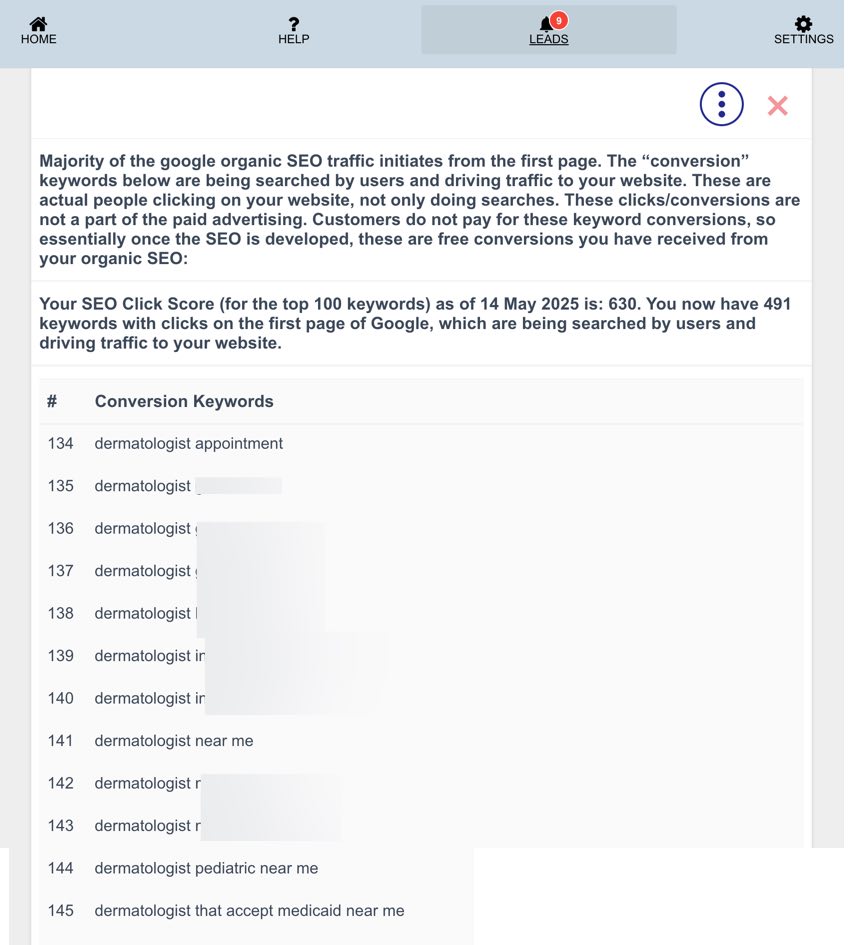
Example of a SEO marketing dashboard of a dermatology practice using PLATINUM service. This customer has been using the PLATINUM service for 3+ years. There are no Google PPC ads or social media ads. The dermatology website’s SEO is extremely good, and has 491 keywords on the first page og Google search, with actual clicks.
2. Local SEO Optimization
- Google Business Profile (GBP/GMB) Management: PLATINUM service manages and optimizes your Google Business Profile, ensuring accurate business information, hours, services, and photos.
- Local Keyword Targeting: Keywords such as “dermatologist near me” or “pediatric dermatologist in [city]” are integrated into content, metadata, and service pages.
- Citation Building: The service ensures your practice is listed consistently across local directories and healthcare platforms, which improves local search rankings.
- Example: A dermatology clinic in Miami might rank in the top 3 local results for “Miami cosmetic dermatologist” after optimizing their GBP and building citations through PatientGain’s PLATINUM service. (PatientGain.com)
3. Content Marketing for SEO
- Constant Content Creation: PLATINUM includes SEO-optimized pages and articles that answer common patient questions, such as “How to prevent acne scars” or “What to expect from Botox treatments.” New page(s) are constantly created, every month, based on the reverse search engine algorithm.
- Linking Strategy: These blog posts are internally linked to service pages, improving site authority and helping Google crawl your website effectively.
- Example: Publishing an informational page on “Skin Cancer Warning Signs” linked to your skin cancer screening page increases organic traffic and leads from patients searching for related terms.
4. Conversion-Optimized Landing Pages
- SEO + Conversion Focus: Landing pages are designed not just to rank, but to convert visitors into patients with clear calls-to-action (e.g., “Book a Consultation” or “Request a Skin Evaluation”).
- PatientGain uses SPOC app (Single Point Of Contact) to increase conversions from any healthcare website, while minimizing any leads leakage.
- Example: A Botox landing page in Los Angeles optimized with local keywords and structured for conversion can increase booked appointments while improving organic rankings.
SEO Steps for Dermatology Practices
Expert Medical SEO Strategy for Dermatology Practices
Implementing an effective medical SEO keyword strategy for dermatology practices involves several key steps tailored to the unique services and local competition of the dermatology field.
PatientGain’s medical SEO strategy for dermatologists works effectively because it is specifically built around the behavioral patterns, search intent, and compliance requirements of healthcare consumers. Here’s why it stands out and delivers real results for practices like dermatology clinics: PatientGain doesn’t rely on generic SEO tactics. Instead, they target high-converting, service-specific, and symptom-driven keywords that real patients are typing into search engines or into ChatBots like ChatGpt, Gemini, Grok etc.
Example 1: Instead of using broad terms like “dermatologist,” PatientGain focuses on phrases like: “acne scar removal near me”, “rash that won’t go away dermatologist”. This high-intent focus drives traffic from people who are more likely to book appointments.
Example 2: PatientGain strategy builds dedicated pages for each condition or treatment, making it easier for Google to understand and rank each offering separately. Each page is optimized with Medical FAQs using schema Local keywords Structured headings (H1, H2) Conversion-focused design
Example 3: PatientGain strategy uses artificial intelligence and and AI agents for their medical SEO.
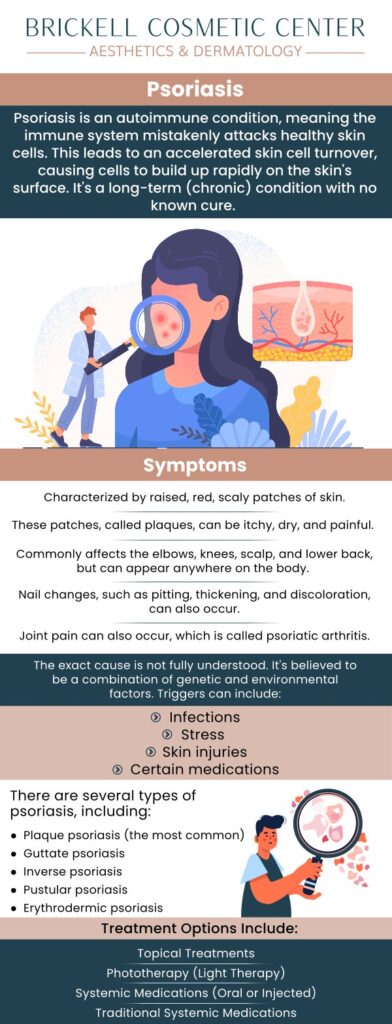
Example 4: PatientGain strategy uses specific custom infographics for their medical SEO.
1. Understand Your Audience and Their Intent (Aligns with PatientGain’s focus on attracting ideal patients):
- Patient Personas & Intent: PatientGain stresses understanding the “type of patients you want to attract.”
- Example (Dermatology – from PatientGain context): Instead of just targeting “dermatologist,” a practice aiming for more cosmetic procedures might focus on personas interested in “anti-aging treatments” or “body contouring.” If the focus is medical, personas might be those suffering from “chronic eczema” or needing “skin cancer screenings.” The keyword strategy must align with these desired patient types.
- User Intent: PatientGain mentions “targeted results.”
- Example (Dermatology): For “informational intent,” keywords like “what are the first signs of rosacea” would lead to a blog post. For “transactional intent,” “book Mohs surgery consultation [City]” would lead to a service/booking page. PatientGain’s approach implies optimizing for these different stages of the patient journey.
2. Comprehensive Keyword Research (Reflecting PatientGain’s “Keyword Research & Selection” component):
- Service-Specific Keywords: PatientGain emphasizes that “Medical SEO is not just about ranking for general terms.”
- Example (Dermatology – aligning with PatientGain’s specificity):
- Medical: “pediatric eczema specialist [City],” “treatment for severe psoriasis [State],” “actinic keratosis removal options.”
- Cosmetic: “non-invasive fat reduction [City],” “microneedling with PRP benefits,” “Juvederm Voluma for cheeks [Neighborhood].”
- Example (Dermatology – aligning with PatientGain’s specificity):
- Location-Based Keywords (PatientGain highlights “Local SEO”):
- Example (Dermatology): “top-rated dermatologist [Your City],” “skin clinic [Your Zip Code],” “best Botox injector near [Local Landmark].” This is crucial as most patients search locally.
- Long-Tail Keywords: PatientGain’s approach of “high-quality content” naturally supports long-tail keywords.
- Example (Dermatology): “how to manage oily skin and acne in adults,” “what to expect after a chemical peel for hyperpigmentation,” “is laser hair removal permanent for PCOS patients?”
- Symptom-Based Keywords:
- Example (Dermatology): “persistent red rash on face,” “itchy blisters on hands and feet,” “scaling patches on scalp.” These often represent an early stage of the patient’s search.
3. Utilize Keyword Research Tools (Implied by PatientGain’s data-driven approach):
- While PatientGain doesn’t list specific third-party tools on that page, their emphasis on “analyzing your competition” and “tracking rankings” implies the use of sophisticated SEO tools common in the industry (like Semrush, Ahrefs, Google Keyword Planner, Google Search Console) to identify high-value keywords, assess difficulty, and monitor performance – all essential for a dermatology practice.
4. Keyword Mapping and Content Strategy (PatientGain emphasizes “Website Content Optimization” and “High-Quality Content Creation”):
- Service Pages: PatientGain notes that “Each page of your website should be optimized for specific keywords.”
- Example (Dermatology – Mohs Surgery page): The page should target “Mohs surgery [City],” “skin cancer treatment Mohs,” “highest cure rate skin cancer surgery.” The content should detail the procedure, benefits, and doctor’s expertise, reflecting PatientGain’s focus on “high-quality content.”
- Example (Dermatology – Laser Resurfacing page): Keywords like “CO2 laser resurfacing [City],” “ablative laser for wrinkles,” “improve acne scars with laser.” The content would explain the technology, expected results, and downtime.
- Useful service pages: PatientGain adds, “Regularly adding fresh, relevant content to your website is crucial for SEO.”
- Example (Dermatology Blog Titles inspired by PatientGain’s approach):
- “A Dermatologist’s Guide to Choosing the Right Anti-Aging Serum in [City]” (Long-tail, local, informational)
- “Understanding Psoriasis: Causes, Symptoms, and Advanced Treatments Offered at [Your Practice Name]” (Condition-specific, branded)
- “Before & After: Real Patient Results with [Specific Cosmetic Procedure] at Our [City] Clinic” (Visual, trust-building, service-specific – assuming ethical presentation and consent).
- Example (Dermatology Blog Titles inspired by PatientGain’s approach):
- FAQ Pages:
- Example (Dermatology): An FAQ page might target question keywords like “How often should I get a skin cancer screening?” or “Is cryotherapy for warts painful?”
5. On-Page SEO Implementation (Core to PatientGain’s “On-Page SEO” services):
- Title Tags & Meta Descriptions: PatientGain would optimize these for click-through rates and keyword relevance.
- Example (Dermatology – Eczema Service Page Title): “Eczema Treatment & Relief in [City] | [Your Practice Name]”
- Example (Dermatology – Meta Description): “Struggling with eczema in [City]? Our expert dermatologists offer personalized treatments for lasting relief. Book your consultation today!”
- Header Tags (H1-H6):
- Example (Dermatology – H1 for Acne Page): “Advanced Acne Treatments in [City]”
- Example (Dermatology – H2s): “Types of Acne We Treat,” “Our Approach to Acne Management,” “Meet Our Acne Specialists.”
- Body Content: PatientGain emphasizes “well-written, informative content that is valuable to your target audience.” This means naturally incorporating keywords within comprehensive explanations of conditions, treatments, and patient care philosophies.
- Image Alt Text:
- Example (Dermatology): An image of a microneedling procedure might have alt text like “Microneedling treatment for acne scars at [Your Practice Name] in [City].”
6. Local SEO Optimization (A strong focus of PatientGain: “Local SEO for Doctors”):
- Google Business Profile (GBP): PatientGain assists with GBP optimization.
- Example (Dermatology): Ensuring the GBP listing includes all services offered (e.g., “Botox,” “Fillers,” “Skin Cancer Checks,” “Eczema Management”), patient reviews are actively managed, and Google Posts highlight new treatments or seasonal skin care tips (e.g., “Summer Sun Protection Tips from Your [City] Dermatologist”).
- NAP Consistency & Local Citations: PatientGain mentions building “citations on relevant local directories.” For a dermatologist, this includes Healthgrades, Vitals, Zocdoc, and local business listings.
7. Technical SEO Considerations (PatientGain mentions “Technical SEO Audits” and “Website Speed Optimization”):
- Website Speed: PatientGain highlights this for better user experience and rankings. A slow-loading dermatology site with many images of before/afters (if not optimized) could suffer.
- Mobile-Friendliness: Essential, as many patients will research dermatologists on their phones.
- Secure Website (HTTPS): PatientGain lists “SSL certificate implementation” as a standard practice.
8. Monitoring, Analyzing, and Refining (PatientGain emphasizes “SEO Performance Tracking & Reporting”):
- Track Keyword Rankings: Understanding which dermatology-specific keywords are improving in rank, and which are not.
- Example (Dermatology): Monitoring rankings for “best psoriasis doctor in [City]” or “affordable mole removal [State].”
- Analyze Website Traffic & Conversions: PatientGain would provide reports on “website traffic, keyword rankings, conversion rates, and other key metrics.”
- Example (Dermatology): Tracking how many users who landed on the “laser hair removal” page subsequently filled out the appointment request form.
- Competitive Analysis: PatientGain notes they “analyze your competition to identify opportunities.”
- Example (Dermatology): If a competing dermatology practice ranks highly for “chemical peels [City],” analyze their content and backlink profile to develop a strategy to compete for that term.
By applying these strategies with the kind of detailed, tailored approach PatientGain Platinum service, dermatology practices can significantly enhance their visibility for relevant keywords, connect with more qualified local patients, and achieve their patient acquisition goals. The key is a consistent, expert-led effort focused on both technical excellence and high-value, patient-centric content.
Conclusion
PatientGain’s Medical SEO for Dermatologists offers a comprehensive, data-driven approach to improving the online presence of dermatology practices. By focusing on local SEO, website optimization, content strategy, reputation management, and continuous tracking, PatientGain helps dermatologists improve their rankings, attract new patients, and grow their practices. Whether through targeted local SEO, optimized content, or a reputation-building strategy, these tailored SEO efforts ensure that dermatologists can stand out in a competitive online healthcare marketplace.
 Send Text
 How may I help you?