

What is ReputeMD Service from PatientGain?
Online Reputation Management Service for Doctors & Dentists
Automated and Done-For-You Service. Simple app and work-flow process with HIPAA compliance: Get constant reviews from your patients. Starting at $100/mon/provider, minimum $200/mon. If you are using PLATINUM service, it is already included in your package, there is no extra cost.
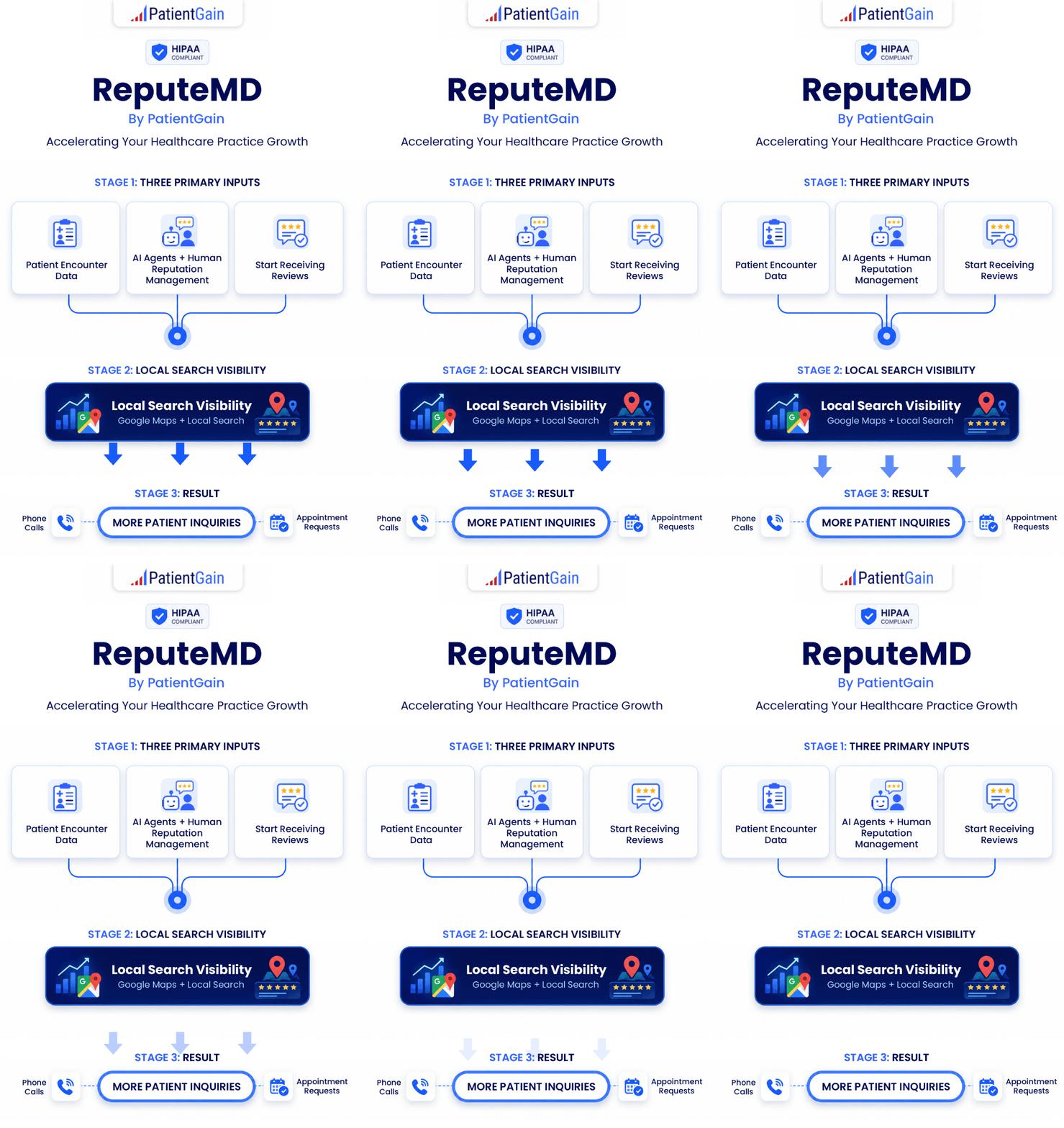
The ReputeMD app is a core component of PatientGain’s Online Reputation Management software suite. It is a HIPAA-compliant digital application designed specifically for doctors, dentists, and healthcare clinics that is designed to ask your patients to provide a review on websites like Google Business Profile, Healthgrades and others. It also offers options so patients can create a video testimonial without using any hand-held cameras, or iPhones etc (due to potential HIPAA issues). See pricing here.
Key Features & How It Works
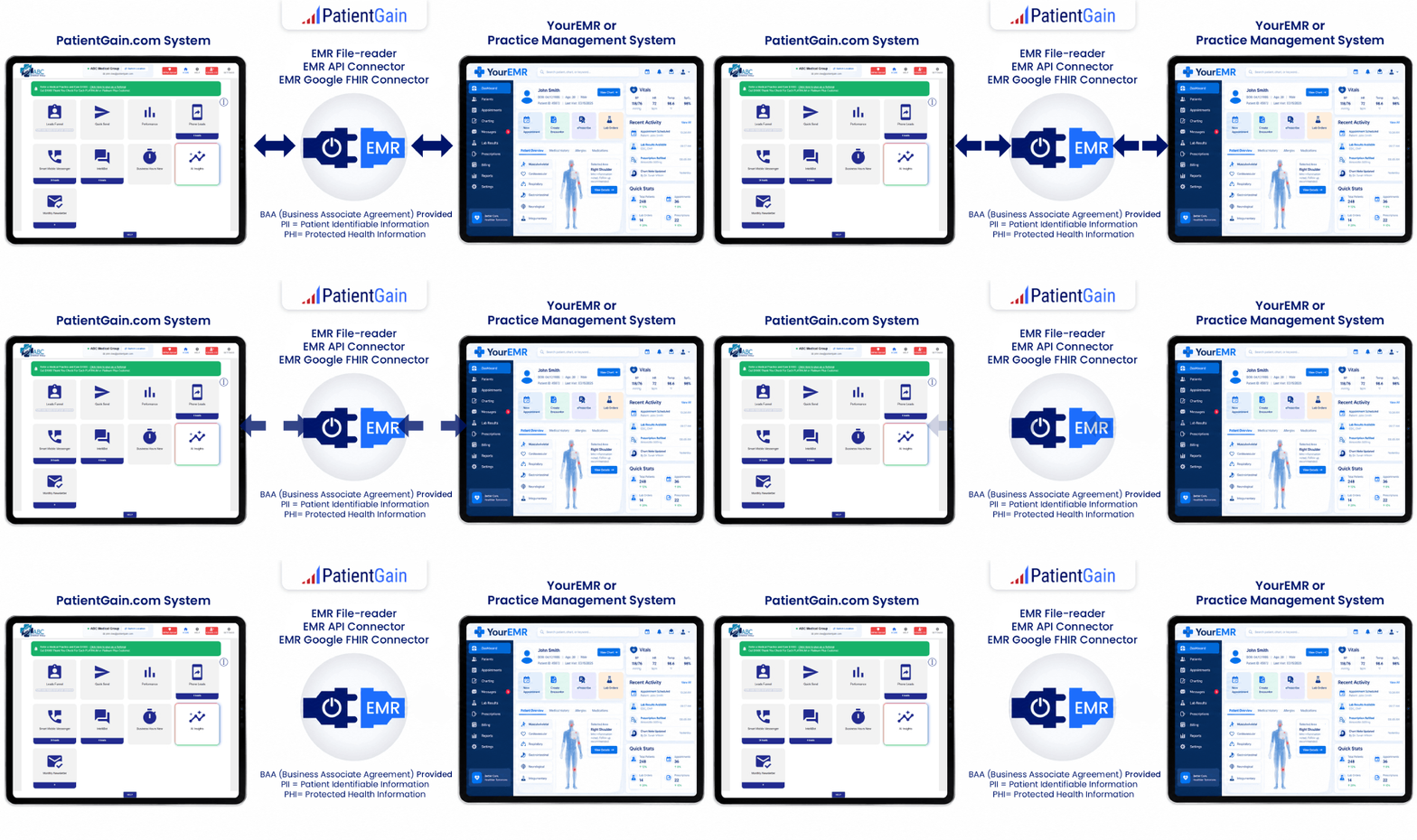
- Multi-Channel Review Requests: The app allows medical staff or EMR connected app to send review requests to patients via SMS text messages or email. Using EMR-Xtract connector solution.
- Multi-Media Reviews: Reviews can be text based, like on Google Business Profile (GBP), Healthgrades or any other healthcare related websites, or short video testimonials.
- In-Lobby Kiosk Mode: The app can be set up on an iPad or tablet at the front desk. As happy patients are checking out of the clinic, staff can invite them to leave feedback right away, turning the lobby into a prime source for gathering reviews.
- Review Generation: It streamlines the process for patients to post reviews directly onto major healthcare and public review platforms, including Google Reviews, Healthgrades, Yelp, and Facebook.
- One happy patient is worth a lot!!!! Once they post a good review, the app allows you to get a testimonial video with HIPAA compliance – Using PatientReel app. The same video is worth a lot more!!! The happy patient’s video is now used for your monthly Email Marketing campaign using the PatientGain’s CareConnect Email Marketing work flow.
- HIPAA Compliance: Unlike generic business review tools, the app includes end-to-end data encryption and proper digital authorization tracking to safely handle patient communication without violating medical privacy laws.
- Done-For-You service. We use human experts and AI agents to get you constant reviews. You can sit back and relax.
- Top Human Customer Service. No need to call call-centers. You are assigned a Project Manager and a Techy to assist you.
What is so unique about ReputeMD app?
Use ReputeMD app from PatientGain to get honest feedback from your patients. This app allows your patients to post a review in their own words on GBP (and other sites) and then it allows you to ask the same happy patients to record a testimonial review video using PatientGain’s PatientReel app. This app is HIPAA compliant and a BAA is issued.
How much does ReputeMD app cost?
Why your reviews on GBP (Google Business Profile) are the most important part of your Reputation Management strategy?
AI recommendation engines and search algorithms (such as Google’s Local Search, AI Overviews, Apple Maps, and LLM-driven discovery tools) process patient review data as structured and unstructured signals to evaluate, rank, and recommend healthcare practices.
1. Average Rating (The Trust Baseline & Qualification Filter)
- Algorithmic Role: Serves as a primary quantitative filter and core component of an algorithm’s “Prominence” score.
- How AI Processes It: AI engines use star averages as an initial inclusion/exclusion threshold. When users search for recommendations using terms like “best doctor” or “top-rated cardiologist,” search algorithms apply strict filtering criteria that eliminate practices falling below a baseline average score (typically 4.0 to 4.5 stars).
- Impact on Recommendation: A high overall star rating increases the AI’s confidence score that recommending the practice will yield a positive user outcome, making it a prerequisite for inclusion in top local recommendation maps (“Local Pack”) and conversational AI answers.
2. Recency of Reviews (The Operational Freshness Signal)
- Algorithmic Role: Verifies that a practice is actively operating and currently delivering high-quality care.
- How AI Processes It: Local search algorithms apply time-decay formulas to review data. Reviews posted within the last 30 to 90 days carry the strongest weight, whereas feedback older than 180 days loses a significant portion of its algorithmic influence.
- Impact on Recommendation: Healthcare operations fluctuate over time due to physician turnover, front-desk staff changes, or management updates. AI engines treat recent feedback as proof of current reliability, ensuring they do not recommend a practice whose strong rating relies entirely on outdated performance.
3. Number of Reviews (Statistical Significance & Authority)
- Algorithmic Role: Measures sample size, statistical confidence, and regional popularity.
- How AI Processes It: Algorithms evaluate total review count to calculate the statistical validity of the average rating. A practice with a 4.9-star rating across 500 reviews is algorithmically prioritized over a practice with a 5.0-star rating based on only 30 reviews, as the larger sample size minimizes the risk of outlier skewing.
- Impact on Recommendation: Higher review volume signals higher patient throughput, market presence, and established authority in a geographic area. In competitive markets where multiple practices have similar star ratings, review count acts as a tiebreaker.
4. Sentiment Analysis (Contextual & Semantic Intent Matching)
- Algorithmic Role: Translates unstructured text into qualitative, categorical data using Natural Language Processing (NLP).
- How AI Processes It: Large Language Models and NLP tools scan the text within patient reviews to extract entities, emotional tone, and specific operational or clinical themes. They tag feedback into distinct sentiment categories such as bedside manner, wait times, billing transparency, compassion, or facility cleanliness.
- Impact on Recommendation: Enables AI engines to match hyper-specific, conversational search prompts. For example, if a patient asks an AI, “Find a pediatric dentist near me who is patient with anxious children,” the algorithm identifies practices whose review text exhibits strong positive sentiment around terms like “patient,” “gentle,” and “calmed my child.”
5. Volume and Quality of Feedback (Review Velocity & Entity Richness)
- Algorithmic Role: Evaluates the continuous rate of review accumulation (velocity) alongside the descriptive depth of patient experiences.
- How AI Processes It:
- Review Velocity: Algorithms monitor incoming review flow over time. A steady, predictable cadence (e.g., 8–15 new reviews per month) indicates organic patient engagement, whereas sudden unnatural spikes can trigger spam filters or suppress rankings.
- Feedback Quality: AI checks for length, detailed descriptions, and contextual keywords (such as specific procedures, condition names, or treating physicians).
- Impact on Recommendation: Long-form, descriptive reviews provide the algorithm with rich “entity connections” (e.g., mentioning “knee replacement,” “physical therapy recovery,” or “Dr. Adams”). This detailed feedback allows the AI to recommend the practice for specialized procedure queries rather than just general medical category searches.
How to optimize GBP (Google Business Profile) for healthcare practice?
Optimizing your Google Business Profile (GBP) (Also known as GMB – Google My Business) listing is essential for medical and dental practices to improve local SEO, attract more patients, and enhance online visibility. Standing out in the crowded healthcare landscape requires a strong online presence. Google Business Profile (GBP) optimization is a crucial step for medical practices to attract new patients and establish themselves as trusted providers. Many patients actually look for your Google Business Profile (GBP) before contacting your practice. There are 3 basic things you must do for your healthcare practice’s GMB optimization:
1. Must have complete and accurate information on the Google Business Profile. See example below. Fill out all sections, including “products” and “services”. Also you need to keep it updated.
2. Do not ignore the GBP page. It requires constant attention. For majority of healthcare practices, it is even more important than your social media page. Google Business Profile (GBP) rankings for healthcare websites are heavily driven by a combination of proximity, profile optimization, and website authority.
3. Regular GBP posting (About 20 times per month) can support patient engagement, profile freshness and conversion, but should be used as part of a broader local SEO strategy that includes reviews, authoritative service content, citations and website SEO.
What is Review Gating?
Review gating—the practice of filtering out unhappy customers to prevent them from leaving public reviews—is strictly prohibited by Google’s Deceptive Content Guidelines and FTC rules. Violating these can result in Google deleting a practice’s entire review history. PatientGain’s ReputeMD app does not use Review Gating.
To remain completely compliant, ReputeMD app prompts every single patient to leave a public review, regardless of whether their feedback is positive or negative.
The system avoids “gating” penalties through a legally and policy-compliant structure:
| Feature | How ReputeMD Handles It Compliantly |
|---|---|
| Equal Opportunity | All patients receive the exact same initial text or email invitation to review the provider on public platforms like Google, Healthgrades, or WebMD. |
| Parallel Internal Feedback | Patients can optionally answer a brief internal survey. If a patient leaves a low score here, it does not block them from posting on Google. |
| Real-Time Alerts | When a negative internal score is submitted, ReputeMD sends an immediate notification to the practice managers. This allows staff to contact the patient to resolve the issue directly, often prompting the patient to naturally skip or change their public review. |
| Natural High Ratings | Because ReputeMD automates outreach to every patient, the sheer volume of happy patients dwarfs the negative ones. Statistically, ReputeMD data shows that more than 95% of all patients leave 4- or 5-star reviews when asked. |
Does online reputation management for doctors impacts local SEO?
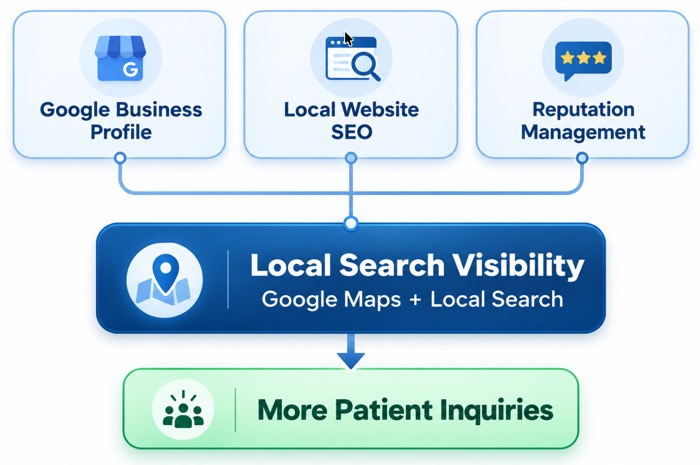
Yes, online reputation management (ORM) heavily impacts local SEO for doctors. Patient reviews are considered one of the top three ranking factors for Google’s local search results and Map Pack. When a medical practice actively manages its digital reputation, it directly feeds Google the data, trust signals, and fresh content required to rank higher for hyper-local queries like “primary care doctor near me”.
How Reputation Management Directly Drives Local SEO
Online reputation management is not just about public relations; it functions as a core technical driver for local search engine optimization.
| Reputation Signal | Impact on Local SEO | Why It Matters to Search Engines |
|---|---|---|
| Review Volume & Velocity | High | A steady stream of new reviews signals to Google that your clinic is active, open, and consistently seeing patients. |
| Sentiment & Star Ratings | High | Higher overall star ratings improve your chances of appearing in filtered local searches (e.g., users filtering for “4 stars and up”). |
| Review Keyword Diversity | Medium to High | When patients organically mention specific symptoms, procedures, or treatment names in reviews, Google parses that user-generated content to match your profile with relevant, long-tail local searches. |
| Review Responsiveness | Medium | Consistently replying to reviews—both positive and negative—demonstrates active listing engagement, which search algorithms favor. |
| Directory Consistency (NAP) | High | Matching your Name, Address, and Phone number across healthcare directories ensures search bots can verify your physical location authority. |
The Local Search Ecosystem for Healthcare
When an ORM strategy is properly executed, it optimizes a doctor’s presence across the critical nodes of the local search ecosystem:
- Google Business Profile (GBP) Optimization: Your GBP is the central hub of local SEO. Gathering reviews directly here dictates whether your clinic lands in the coveted “Local 3-Pack” (the top three map results displayed at the top of Google).
- Medical Directory Synergy: ORM ensures accurate data syndication across high-authority medical directories like Healthgrades, WebMD, and Vitals. Google scrapes these prominent third-party platforms to build its knowledge graph of your medical practice.
- Click-Through Rate (CTR) Boost: Higher rankings grant visibility, but excellent ratings entice users to actually click your website or hit “call”. A higher CTR flags your listing as highly relevant, creating a positive feedback loop that further cements your high local ranking.
Crucial Guardrail: HIPAA Compliance
While engaging with reviews is essential for local SEO rankings, doctors must manage their reputations with strict medical compliance. When responding to patient reviews to signal activity to Google, never acknowledge or disclose protected health information (PHI). Even if a patient voluntarily shares their clinical details in a public review, a doctor’s response must remain generic, calm, and aimed at taking the conversation offline to protect patient privacy.
You can only use a reputation management app if they are HIPAA compliant, and issue a BAA with your practice.
 Send Text
 How may I help you?