

What is The Most Important Part of GBP (Google Business Profile) Rankings For Healthcare Websites?
Your GBP does not rank in a vacuum; it is tied directly to your website. Google scans your website’s local landing page to validate your GBP data. If your website has strong local optimization (like structured data/schema markup and location-specific headings), your map profile gets a massive algorithmic boost. Hence you must have a very good practice website, first. The website itself should be designed to provide useful information to new and existing patients.
The absolute most important part of Google Business Profile (GBP) map-pack rankings is Proximity, followed closely by Relevance and Prominence.
While Google officially lists these three factors together, multiple industry local SEO studies confirm that where the user is standing when they search is the single heaviest ranking weight. However, because you cannot move your physical clinic closer to every patient, the most important element you can actively control to win the map pack is Primary Category Selection combined with Review Velocity & Sentiment.
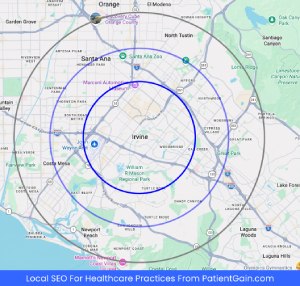
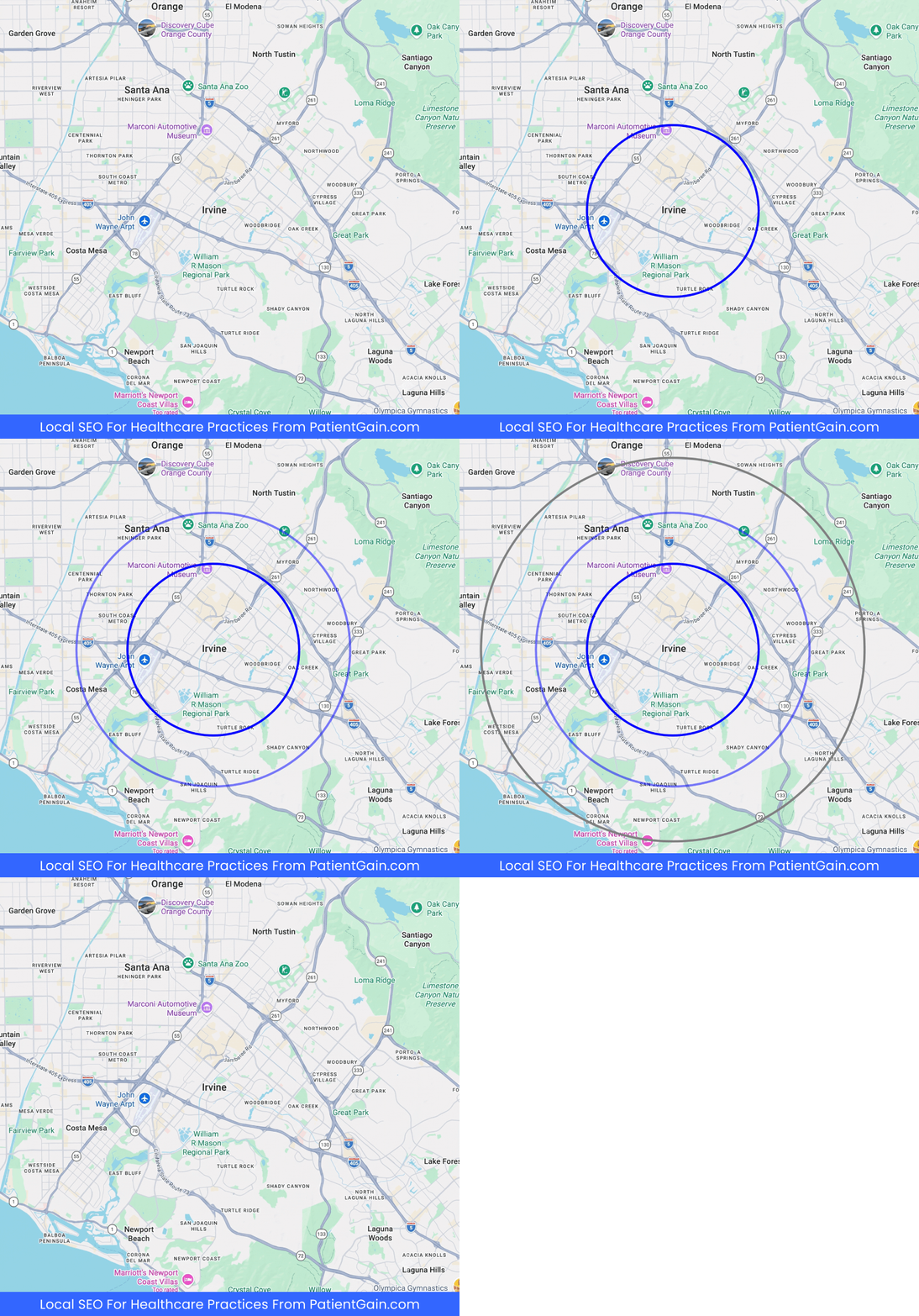
Example of an Urgent Care GBP ranking
Here is how the core ranking factors break down in order of importance for an urgent care clinic:
1. Proximity (The Uncontrollable Champion)
Google’s main goal is to show the closest possible solution to a user in need. If a patient searches “urgent care near me,” Google draws a tight geofence around their smartphone’s GPS coordinates.
- The impact: A clinic 0.5 miles away from the patient will almost always outrank a clinic 5 miles away, even if the further clinic has a better website and more reviews.
2. Primary Category (The Most Important Control Element)
If your primary category is wrong, you will not rank, regardless of your proximity. For your business, your primary category must be “Urgent Care Center.”
- Why it matters: Google uses this single field to establish core Relevance. If you mistakenly set your primary category to “Medical Clinic” or “Doctor,” you will lose map-pack positioning to competitors who correctly claimed “Urgent Care Center” when patients look for immediate walk-in care.
3. Review Volume, Velocity, and Keywords (The Prominence Driver)
Once Google establishes who is nearby (Proximity) and what kind of business they are (Relevance), it uses reviews to determine who deserves the top 3 spots (Prominence). For urgent care, Google looks heavily at:
- Review Velocity: How frequently are you getting new reviews? A steady stream of 5 reviews a week is vastly superior to getting 50 reviews in one day and then going silent for a month.
- Review Keywords: When patients organically write words like “fast walk-in,” “stitches,” “X-ray,” or “urgent care” in their reviews, it drastically boosts your ranking for those specific search terms.
4. Link & On-Page Authority of Your Website
Your GBP does not rank in a vacuum; it is tied directly to your website. Google scans your website’s local landing page to validate your GBP data. If your website has strong local optimization (like structured data/schema markup and location-specific headings), your map profile gets a massive algorithmic boost.
Since you cannot control Proximity, your entire local SEO strategy must focus on dominating Relevance and Prominence. You do this by perfecting your categories, keeping your business data 100% accurate, and aggressively generating a steady stream of fresh, keyword-rich patient reviews.
Steps you can take for your urgent care website and GBP rankings
While Google’s core algorithm evaluates Relevance, Distance, and Prominence, optimizing GBP specifically for healthcare requires focusing on four critical pillars:
1. Primary Category Selection (The Relevance Foundation)
- Select the Most Specific Primary Category: Google relies heavily on your primary category to determine which searches your practice is eligible for. Selecting “Orthopedic Surgeon” yields higher local visibility for targeted searches than a broad category like “Medical Center” or “Doctor”.
- Utilize Secondary Categories: Add all applicable secondary categories (e.g., “Sports Medicine Clinic” or “Pain Management Physician”) to capture broader local intent without diluting your main specialty.
2. Review Quantity, Recency, and Rating (Prominence)
- Steady Review Velocity: Over 75% of patients check Google reviews before booking. Google’s local algorithm heavily favors profiles with a consistent trickle of recent reviews over older, static reviews.
- HIPAA-Compliant Responses: Replying to all positive and negative reviews signals profile activity and trust. Crucial rule for healthcare: Never acknowledge patient identity, diagnosis, or clinical details in public replies, even if the patient explicitly mentions them in their review.
3. On-Site Landing Page Optimization (Website Alignment)
- Targeted Web Linkage: The specific landing page linked to your GBP profile significantly impacts rank. If your GBP represents a single clinic location, link directly to that specific location page (not a generic homepage).
- On-Page Local Signals: Ensure the landing page contains matching Name, Address, and Phone number (NAP) data, localized heading tags (H1/H2), relevant local medical Schema markup, and clear service summaries.
4. Completeness & Healthcare Attributes
- Services & Conditions Treated: Populate the custom service list within GBP with specific procedures, treatments, and conditions (e.g., “Tonsillectomy”, “Pediatric Asthma Management”) to boost relevance for long-tail patient queries.
- Healthcare Attributes & Booking: Enable attributes such as “Accepting new patients,” “Telehealth available,” and direct online booking integrations to maximize click-through conversions.
- Operating Hours Accuracy: Google algorithmically downgrades local ranking visibility during the final hour a facility is marked open or when marked closed. Keep regular, holiday, and urgent care hours 100% accurate.
5. Regular GBP Posting Supports Patient Engagement and GBP Profile Freshness
Regular GBP posting can support patient engagement, profile freshness and conversion, but should be used as part of a broader local SEO strategy that includes reviews, authoritative service content, citations and website SEO. Posting 20 times per month is roughly: 5 posts per week.
That allows a practice to rotate:
- educational posts
- service explanations
- physician expertise
- FAQs
- clinic updates
- offers where permitted
- treatment education
- seasonal information
- patient education
This high-frequency GBP posting is for engagement and conversion optimization from the GBP.
Practitioner vs. Facility Profiles
For medical groups with multiple doctors, avoid creating separate individual GBP listings for every provider unless they maintain distinct, dedicated practices. Managing duplicate profiles splits review volume and dilutes local ranking authority, whereas focusing resources on primary location profiles builds stronger overall prominence.
 Send Text
 How may I help you?