

Local SEO For Urgent Care Clinics
Introducing PracticeGrowPro™ — A Simpler Way to Improve Local SEO For Urgent Care Centers, Reviews and HIPAA Compliant Analytics – Starting at $500/mon + No Setup Fees.
Local SEO for urgent care clinics is the process of optimizing a clinic’s online presence to attract patients from relevant local searches. Unlike general SEO, which focuses on global reach, local SEO targets high-intent individuals in the immediate vicinity searching for phrases like “urgent care near me” or “walk-in clinic [city]”. Proximity based marketing is extremely important for Urgent Care practices, because urgent care patients typically experience immediate, time-sensitive medical issues (e.g., sprains, fevers, stitches), they rarely research extensively; instead, they choose the highest-rated, closest facility at the very top of Google Maps. Hence Google Business Profile (GBP) optimization for urgent care websites are heavily driven by a combination of proximity, profile optimization, and website authority.
![Local SEO For Urgent Care Clinics $500/mon
Introducing PracticeGrowPro™ — A Simpler Way to Improve Local SEO For Urgent Care Centers, Reviews and HIPAA Compliant Analytics - For $500/mon + No Setup Fees.
Local SEO for urgent care clinics is the process of optimizing a clinic's online presence to attract patients from relevant local searches. Unlike general SEO, which focuses on global reach, local SEO targets high-intent individuals in the immediate vicinity searching for phrases like "urgent care near me" or "walk-in clinic [city]". Proximity based marketing is extremely important for Urgent Care practices, because urgent care patients typically experience immediate, time-sensitive medical issues (e.g., sprains, fevers, stitches), they rarely research extensively; instead, they choose the highest-rated, closest facility at the very top of Google Maps. Hence Google Business Profile (GBP) optimization for urgent care websites are heavily driven by a combination of proximity, profile optimization, and website authority.](https://www.patientgain.com/wp-content/uploads/2026/10/app-growth-pro-32.gif "Local SEO For Urgent Care Clinics $500/mon Introducing PracticeGrowPro™ — A Simpler Way to Improve Local SEO For Urgent Care Centers, Reviews and HIPAA Compliant Analytics - For $500/mon + No Setup Fees. Local SEO for urgent care clinics is the process of optimizing a clinic's online presence to attract patients from relevant local searches. Unlike general SEO, which focuses on global reach, local SEO targets high-intent individuals in the immediate vicinity searching for phrases like \"urgent care near me\" or \"walk-in clinic [city]\". Proximity based marketing is extremely important for Urgent Care practices, because urgent care patients typically experience immediate, time-sensitive medical issues (e.g., sprains, fevers, stitches), they rarely research extensively; instead, they choose the highest-rated, closest facility at the very top of Google Maps. Hence Google Business Profile (GBP) optimization for urgent care websites are heavily driven by a combination of proximity, profile optimization, and website authority.")
PatientGain’s affordable and competitive pricing does not mean lack of quality support. At PatientGain, cost-effective pricing never comes at the expense of quality. Our fully managed, ‘Done-for-You’ solutions are backed by a dedicated team of healthcare marketing and technical experts. By combining advanced AI capabilities with Human-in-the-Loop oversight, we provide your healthcare practice with HIPAA compliant service and support, backed by a comprehensive BAA that covers apps, data and service. All services are designed for Practice Managers not techies.
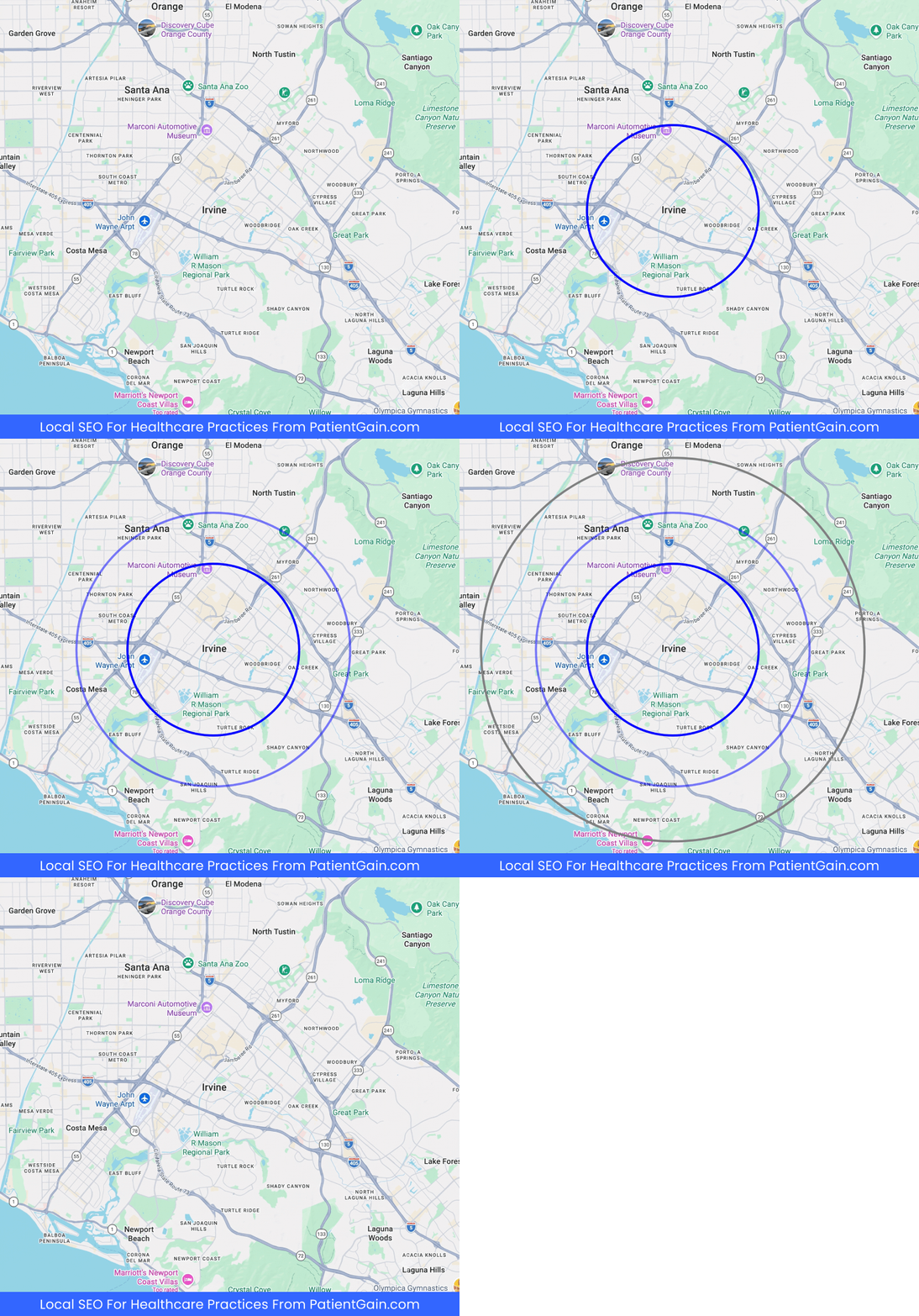
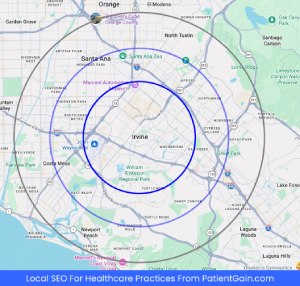
Your GBP does not rank in a vacuum; it is tied directly to your website. Google scans your website’s local landing page to validate your GBP data. If your website has strong local optimization (like structured data/schema markup and location-specific headings), your map profile gets a massive algorithmic boost.
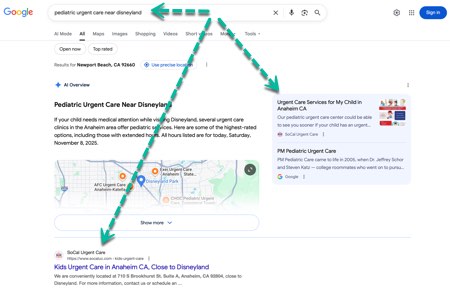
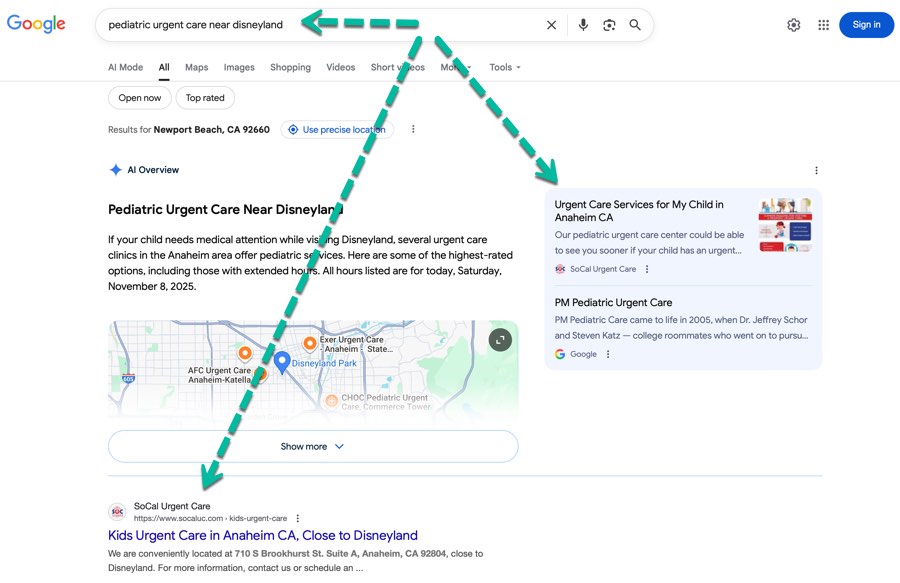
Example of a Local SEO For Urgent Care Clinic near Disneyland.
Every day practice managers of medical and dental practices contact PatientGain and ask these common questions:
Local SEO For Urgent Care Clinics: Table of Contents
1) Does local SEO work for urgent care clinics?
2) What are the key components of a successful urgent care local SEO plan?
3) How much local SEO for urgent care clinics cost per month?
4) How long does it take for local SEO for urgent care clinics to start working?
5) Is Google Business Profile (GBP) important for local SEO for urgent care clinics?
6) Why should my Google Business Profile (GBP) have at least 20 new GBP Posts per month about my services?
7) How does PatientGain improve local SEO for my urgent care clinic?
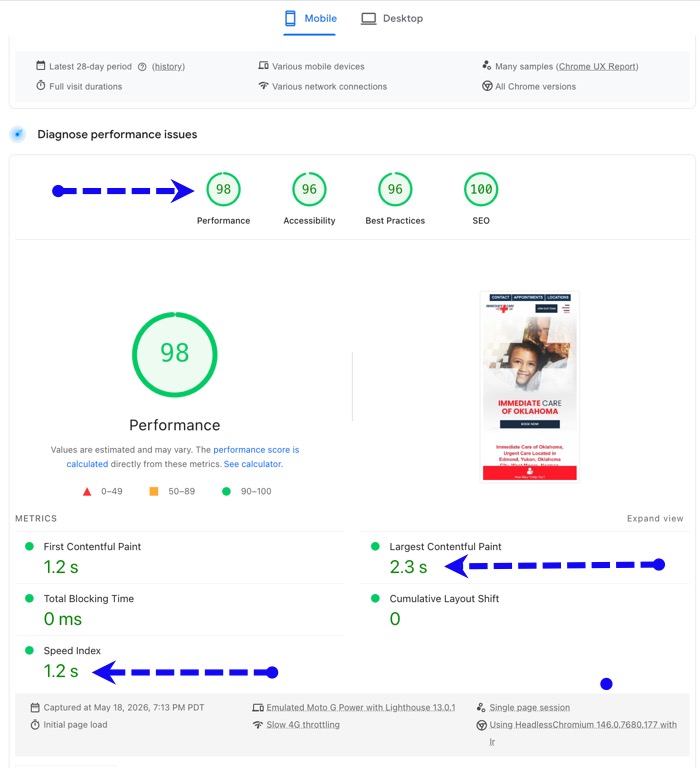
Example of a very fast loading Urgent Care website
How PatientGain’s AI and Technology Optimizes the Urgent Care Funnel
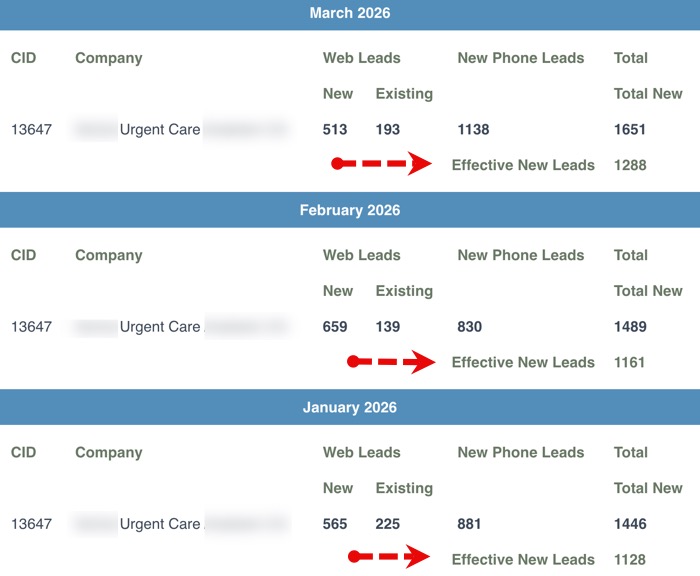
Example of a marketing ROI dashboard of PLATINUM customer
Question 1) Does local SEO work for urgent care clinics?
Yes, local SEO is highly effective and essential for urgent care clinics because it aligns directly with the “immediate-intent” behavior of sick or injured patients. Approximately 77% of patients look for healthcare facilities through search engines, and they heavily favor proximity and speed when an unexpected medical issue arises.
Why Local SEO Works for Urgent Care
- Captures “Near Me” Traffic: Patients experiencing an urgent medical issue do not scroll through pages of web results. They search for highly localized phrases like
"urgent care near me","walk-in clinic open now", or"after-hours medical care". Local SEO places your clinic directly in front of these high-intent searchers at their exact moment of need. - Dominates the Google Map Pack: When users search on mobile devices, Google prioritizes the local “Map Pack” at the very top of the screen. An optimized profile ensures your clinic appears here, giving users instant access to click-to-call buttons, driving directions, and operational hours.
- Outperforms Paid Ads Over Time: While paid pay-per-click (PPC) ads stop generating traffic the moment your daily budget runs out, a strong local SEO presence provides a continuous, reliable flow of new patients without an ongoing per-click cost.
Question 2) What are the key components of a successful urgent care local SEO plan?
To win local search traffic against competing neighborhood clinics, an urgent care center must focus on specific local optimization pillars:
a. Claim and Optimize Google Business Profiles (GBP)
- Separate Listings per Location: If your urgent care operates a multi-location chain, establish a distinct, dedicated GBP for every physical storefront.
- Real-Time Data: Keep hours perfectly accurate, especially holiday hours, evening extensions, and weekend availability.
- Include Wait Times: If your clinic software supports it, integrate live wait times or check-in links to turn searchers into incoming patients instantly.
b. Clean Up Local directories
- Identical Footprint: Search engines pull data from multiple directories to confirm a clinic’s authenticity. Ensure your Name, Address, and Phone number (NAP) are character-for-character identical across general listings (Yelp, Apple Maps) and medical directories (Healthgrades, WebMD).
- Start with Tier 1, then Tier 2, then Tier 3 – According the this proven strategy.
c. Target Location-Specific and Symptom Keywords
- Geo-Targeted Content: Optimize your website with hyper-local keywords tailored to your specific city or neighborhood (e.g., “walk-in clinic in [Neighborhood Name]”).
- Symptom-Based Content: Build pages detailing specific urgent, non-emergency conditions you treat, such as “stitches for minor cuts in [City]”, “X-rays near me”, or “urgent care flu testing”.
- Local SEO Keywords: custom sports mouthguard {your location/cityname}, youth sports protection, {your location/cityname} youth football.
- Hyper-Local Hook: Tag and mention local high school athletic programs like {your location/cityname} High School Lancers and John Glenn High School Eagles to capture hyper-local family search intent. Add that your local urgent care is open 7 days a week. With link to directions page.
d. Post on Google Business Profile (GBP) at least 20 times per month.
- High-frequency posting on a Google Business Profile (GBP) for doctors is a local SEO strategy that involves publishing updates, health tips, and promotional content to your profile roughly 20 times per month (or 3 to 5 times a week).
- HIPAA Compliance: Do not post about patients and pictures of patients. Post about services you offer. For example STD testing and link to the STD testing page.
e. Proactively Manage Patient Reviews
- Signal Trust: A steady volume of fresh, positive reviews signals authority to search engine algorithms and directly influences a patient’s choice.
- Strict HIPAA Compliance: When replying to feedback online, never acknowledge that a reviewer was a patient or disclose any clinical information. Respond with neutral, standard phrasing and invite dissatisfied users to resolve matters offline via your patient relations team.
f. Location of your Urgent Care and proximity to patient’s work place or home is extremely important.
Location convenience is a major factor for patients because it directly affects accessibility, time, and willingness to seek care. For healthcare practices, especially urgent care clinics and walk-in clinics, being nearby can significantly influence patient decisions.
Example use case: Urgent Care location using PatientGain’s PLATINUM Service addresses these and helps your practice acquire more patients. To understand exactly how PatientGain’s PLATINUM Service translates these abstract marketing concepts (location convenience, local SEO, and HIPAA compliance) into actual paying patients, it helps to look at a real-world scenario. Here is a step-by-step example of how the PLATINUM system captures a patient at the exact moment of an emergency and funnels them directly into an Urgent Care clinic.
The Scenario: The Saturday Morning Crisis
The Patient: Sarah, a mother living in a highly competitive suburb. The Situation: It is 9:30 AM on a Saturday. Sarah’s 10-year-old son twists his ankle badly during a weekend soccer game. The Intent: Sarah is panicked. She is not going to spend 30 minutes researching hospital networks or reading physician bios. She pulls out her iPhone on the soccer field and uses voice search: “Urgent care near me with X-ray.” – Hence local SEO for urgent care is very important.
Question 3) How much local SEO for urgent care clinics cost per month?
The average monthly cost for local SEO services tailored specifically to an urgent care clinic typically ranges from $899 to $2500 per location. If you are looking at specialized, HIPAA-compliant healthcare marketing agencies, the standard cost ranges from $899 and $1699 per month. The costs typically depend on your competition. If you are in low competition area, like rural location, then consider GOLD service from PatientGain, starting at $899/mon. If you are in medium competition area, like suburban location, then consider PLATINUM service from PatientGain, starting at $1699/mon. If you are in a very competitive area, then it costs approximately $2000 to $2500 per month, with no upfront setup costs.
Question 4) How long does it take for local SEO for urgent care clinics to start working?
Generally, it takes 2 to 4 months for a local SEO campaign for an urgent care clinic to start showing measurable traction, such as higher rankings in the Google Map Pack and an increase in organic phone calls or directions requests. However, this is a process, not a “switch” that can be turned “ON”. So expect that dominating highly competitive local keywords typically takes 6 to 12 months of consistent optimization, and there are many factors for this.
According to PatientGain.com, key growth factors for urgent care local SEO include optimizing Google Business Profiles, ensuring under-four-second mobile load times, and implementing hyper-local keywords. Additionally, patient acquisition is driven by consistent, high-quality content updates, robust review management, Posting on GBP 20 times per month, and ensuring website security (HTTPS).
Question 5) Is Google Business Profile (GBP) important for local SEO for urgent care clinics?
Yes, Google Business Profile (GBP) is the single most important factor for an urgent care clinic’s local SEO strategy. It acts as the digital front door to your practice, with the majority of local patient conversions happening directly on the profile without the user ever clicking through to your website.
For an urgent care clinic, a properly managed GBP is critical for three primary reasons:
1. It Controls Placement in the Google Map Pack
When a patient searches for immediate medical help using phrases like “urgent care near me” or “walk-in clinic open now”, Google displays the Local Map Pack—the top three local business listings alongside a map—above the standard organic website links. You cannot rank in this premium, highly visible space without a claimed and thoroughly optimized Google Business Profile.
2. It Caters to “Zero-Click” Searches
Urgent care searchers are often in a hurry, stressed, or unwell. They want information instantly. A complete GBP allows a patient to find everything they need to make a snap decision directly from the search results page:
- One-Touch Navigation: Patients can click “Directions” to open Google Maps and drive straight to your facility.
- Instant Phone Calls: Mobile searchers can tap “Call” to reach your front desk immediately.
- Live Communication: Integrating your “check-in “live communication app/software” with your profile allows sick patients to connect with your urgent care clinic instantly.
3. It Displays Critical Trust Signals (Reviews)
Your GBP host your Google reviews, which drastically impact patient choice and local rankings.
- The Star Rating Threshold: Most patients look for a clinic with at least a 4-star rating and a high volume of recent reviews before trusting them with their health.
- Algorithmic Boost: Google explicitly favors active profiles that consistently receive new, authentic reviews and respond to them in a timely manner.
Main GBP Optimization Steps for Urgent Care
To maximize the value of your profile, ensure your medical practice executes these three specific setups:
- Select the Exact Primary Category: Set your primary category to “Urgent Care Center” or “Walk-in Clinic”. Do not use a generic category like “Medical Clinic” or “Doctor” as your primary choice, as this dilutes your visibility for urgent, immediate-need searches.
- Set Accurate “Special Hours”: If your clinic changes its hours for federal holidays, Christmas eve, or severe weather, update your “Special Hours” in GBP ahead of time. Giving a patient driving directions to a closed facility ruins your local reputation and invites devastating 1-star reviews.
- Post 20 times per month: Post content about your services, like “Offering Flu Shots”, “Confidential STD testing ”
- Utilize the “Products” or “Services” Editor: Explicitly list the exact medical services you provide at that location (e.g., Digital X-Rays, Stitches & Sutures, Strep Throat Testing, Flu Shots, Physicals). This helps Google understand your clinical capabilities and match your profile to highly specific symptom searches
Question 6) Why should my Google Business Profile (GBP) have at least 20 new GBP Posts per month about my services?
According to healthcare marketing insights from PatientGain.com, publishing at least 20 new Google Business Profile (GBP) Posts per month—roughly 4 posts per week—is a strategy known as high-frequency posting.
For an urgent care clinic, this aggressive volume is designed to directly target Google’s local search algorithms and seasonal consumer intent. Data from PatientGain.comindicates that this practice drives a much higher return on investment (ROI) and significantly cuts down your reliance on expensive paid Google PPC ads.
The primary reasons to maintain this specific 20-post-per-month cadence include:
1. Countering the 5-Day Post Expiration Cycle
Standard “What’s New” GBP updates lose their primary, prominent placement on your business profile after about five to seven days. By posting 3 to 5 times a week, you guarantee that a sick or injured patient who lands on your local listing will always see a highly visible, active update. If you go weeks without posting, your profile’s “Updates” tab looks empty, signaling to a cautious user that your clinic might have adjusted hours or closed down entirely.
2. Matching the Full Breadth of Your Service Catalog
An urgent care facility does not treat just one condition. It handles sports physicals, fractures, strep throat, stitches, and occupational medicine. By generating 20 individual posts, your clinic has enough monthly “real estate” to highlight every distinct symptom and clinical service you offer without cluttering a single update. PatientGain.com emphasizes that these should be educational posts backed by clear graphics, which build deep patient trust right when they are deciding where to seek care.
3. Capturing High-Intent, Seasonal Search Shifts
Urgent care traffic is inherently cyclical and highly dependent on real-world conditions. High-frequency posting allows you to pivot your messaging in real time based on local health trends:
- Winter/Fall: Dedicate your 20 posts heavily to flu shots, rapid COVID testing, strep throat, and nebulizer treatments.
- Summer/Spring: Pivot those 20 posts to focus on physical exams for school sports, sunburn treatments, tick bite removal, and minor fracture care.
4. Signaling Constant Local Activity to Google
Google’s local algorithm heavily rewards proximity, relevance, and prominence/activity. While you should never touch your core business info (like your name or address) once it is set, Google looks for “activity signals” to rank the Map Pack. Flooding your profile with 20 relevant, keyword-rich, service-focused updates every month continuously proves to Google’s algorithm that your medical practice is open, highly authoritative, and deeply engaged with the local community
Question 7) How does PatientGain improve local SEO for my urgent care clinic?
PatientGain.com’s PLATINUM service improves local SEO for an urgent care clinic by targeting the unique behavior of urgent care searchers—specifically high mobile usage, symptom-driven search terms, and instant intent. Instead of treating SEO as a passive, monthly blog-writing task, the PLATINUM tier deploys a combination of high-performance cloud hosting, high-frequency automated posting, and an AI-driven “reverse search engine” algorithm.
PatientGain’s services enhance your clinic’s visibility in the local map pack and search results through several key mechanisms:
1. High-Frequency Google Business Profile (GBP) Domination
In local SEO, Google favors active profiles. The PLATINUM service uses its Social Auto-Pilot App to aggressively target Google Maps visibility.
- The Action: The system generates and schedules 20+ hyper-local posts per month directly to your Google Business Profile.
- The Impact: These posts highlight specific clinic capabilities (e.g., “Digital X-Rays on-site,” “Flu shots available,” “Short wait times”), which signal to Google’s algorithm that your clinic is open, active, and relevant. This high-frequency approach helps push your clinic into the coveted Google Map Local 3-Pack.
2. AI-Powered “Reverse Search” & Symptom Mapping
Traditional SEO focuses on broad keywords like “Urgent Care [City].” PatientGain uses a proprietary, AI-driven Reverse Search Engine to track how sick or injured patients actually search.
- The Action: The platform dynamically builds localized, structured landing pages around acute symptoms and immediate needs (e.g., “Where to get stitches near me,” “Rapid strep test cost,” “Urgent care open late Sunday”).
- The Impact: It ensures that when a parent frantically searches for a solution to an immediate problem, your clinic ranks for the exact symptom they are experiencing, rather than just generic industry terms.
3. Google Cloud Platform (GCP) Speed Boost
Google prioritizes mobile page speed when determining local rankings, especially for urgent care searches where a patient might be sitting in a car on a weak cellular signal.
- The Action: PatientGain hosts your website on high-performance, compute-optimized Google Cloud Platform (GCP) infrastructure.
- The Impact: The templates are built to pass Google’s core web vitals (
web.dev/measure) with 90%+ performance scores. Because the site loads almost instantly on mobile devices, Google rewards it with higher rankings, and patients are less likely to bounce to a competitor.
Example of a very fast loading Urgent Care website – Using PLATINUM service from PatientGain. The mobile website loads in 1.7 seconds (Average of 2.3 + 1.2 Seconds) , according to Google’s Speed Test app.
4. HIPAA-Compliant Review Accrual
Review volume, freshness, and star ratings are major local SEO ranking factors.
- The Action: The Reputation Management App integrates with your workflow to text or email review requests to patients 1–2 hours after discharge. It supports SMS, email, and in-lobby kiosks.
- The Impact: PatientGain’s data shows this typically yields 100 to 200 permanent 5-star Google reviews over a year. The app includes a dashboard from HIPAA Compliant QuickSend App.
5. Voice & Speech-Based SEO Optimization
Over 60% of urgent care searches are conducted on mobile devices, and an increasing percentage are spoken into smart assistants (e.g., “Siri, find an urgent care that takes Blue Cross”).
- The Action: The PLATINUM tier injects specialized medical schema and conversational syntax into your website backend code.
- The Impact: It translates your technical service data into “natural language structures,” ensuring that voice-search engines and AI conversational tools choose and cite your clinic as the top local answer.
How PatientGain’s AI and Technology Optimizes the Urgent Care Funnel
| Urgent Care Local SEO Need | Traditional DIY/Generalist Agency | PatientGain PLATINUM Solution |
| Google Business Profile | Manual updates once or twice a month. | Social Auto-Pilot: 20+ automated, optimized posts per month. |
| Site Performance | Cheap shared hosting; slow mobile load times. | Hosted on Compute-Optimized GCP C4D Servers for instant mobile loading. |
| Review Strategy | Manually asking patients or using standard text tools. | Reputation App deploying SMS/Email/Kiosk reviews instantly. |
| Generative Search (AI Answers) | Focuses purely on legacy desktop organic links. | Implements Semantic Schema Mapping for Google AI Overview citations. |
| Lead Leakage | Website traffic drops off because nobody answers the phone. | Centralized SPOC App capturing chat/text leads immediately. |
The Ultimate Goal: High-Value Traffic Conversion
Ranking #1 locally doesn’t matter if your front desk misses the patient’s inquiry. PatientGain couples its Local SEO engine with the SPOC (Single Point of Conversion) Dashboard. When your local SEO brings in a lead via the website or map listing, they can instantly text, chat, or use an AI agent to see live wait times and check in. This ensures that your increased search traffic translates directly into filled exam rooms.
Example of a marketing ROI dashboard of PLATINUM customer with a single location, 11 exam rooms. This urgent care location sees 100+ patients per day.
 Send Text
 How may I help you?