

What is Proximity Based Marketing for Healthcare Practices?
Proximity-based marketing for healthcare practices is a strategy that targets potential patients based on their physical location or proximity to your clinic. Some companies use the term Geofencing and proximity marketing interchangeably. The goal is to reach people who are nearby and more likely to schedule appointments, visit your office, or engage with your services. This approach is especially effective for urgent care centers, dental offices, MedSpas, and specialty clinics, where location convenience is a major factor for patients. There are 2 proven approaches that work very effectively A) Traditional Proximity Based Marketing B) Digital Proximity Based Marketing
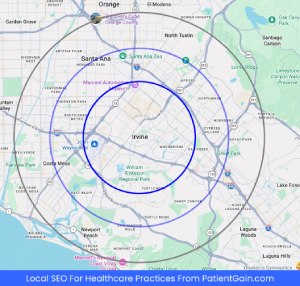
Example: Consider a healthcare practice located in the middle of the small circle (circle1) – for exampe it is the city or Irvine (California’s safest city) . Also check circle 2 (lighter blue) and then circle 3 (pale blue). Patient’s propensity to visit a healthcare practice is highest if they are located in circle 1.
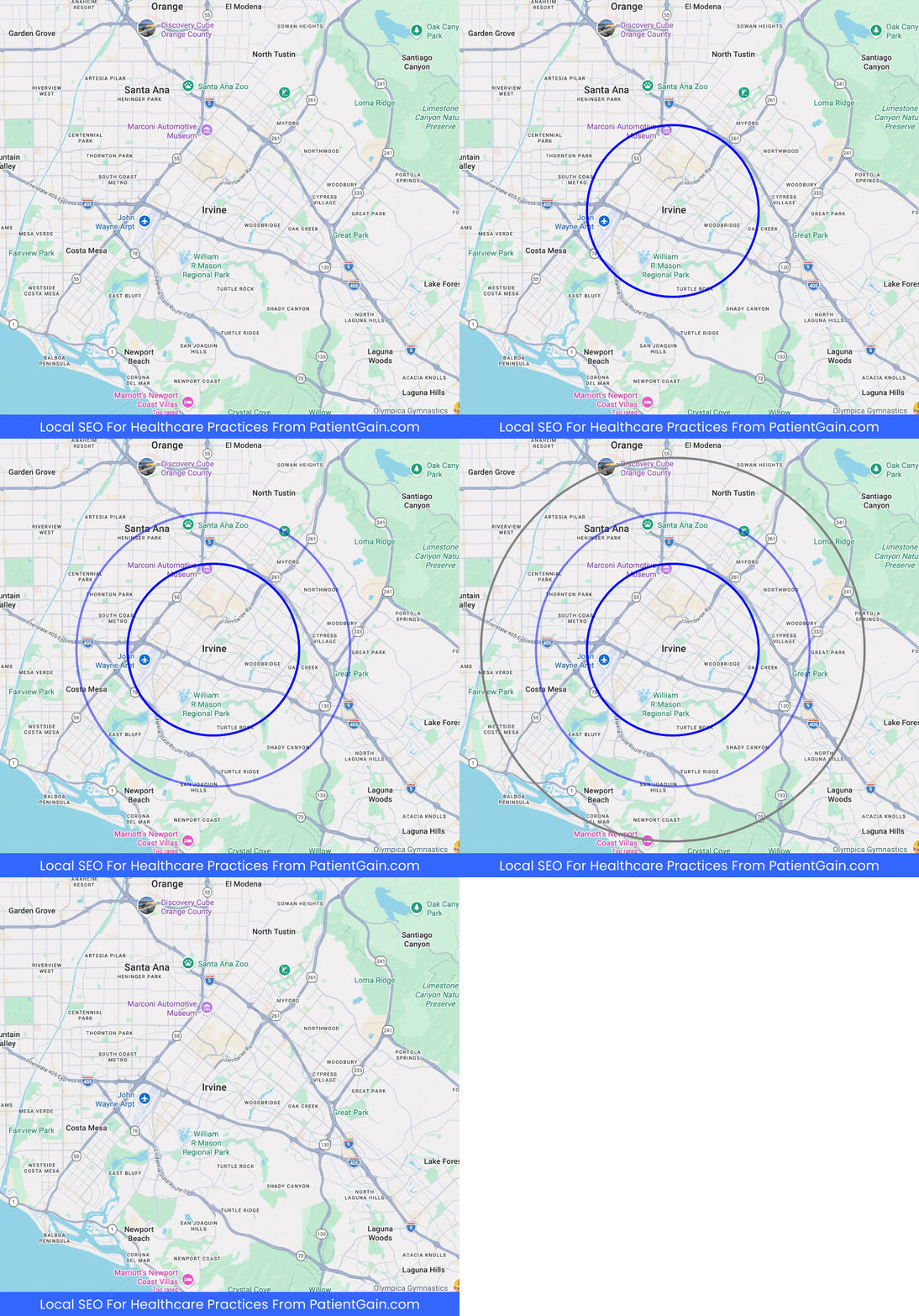
Question: Is this correct the patients who are nearby and more likely to visit a healthcare practice?
Yes, this is generally correct. Patients who live or work near a healthcare practice are much more likely to choose and visit that practice due to convenience, reduced travel time, and easier access. This applies to 90% of the healthcare practices. Exceptions are like a specialist cardiologist, specialist surgeon who can perform a very complicated surgery. In healthcare marketing and operations, this group of people is commonly referred to as your local target audience or primary service area.
Question: Why Proximity Matters to Patients?
- Convenience: Patients prefer shorter commute times, especially when they are feeling unwell or scheduling routine appointments around work and school.
- Accessibility: Proximity reduces transportation barriers, making it easier for elderly patients, families with young children, or individuals without reliable transit to attend appointments.
- Community Trust: People often trust local businesses and providers that are visible in their daily lives or recommended by nearby neighbors.
Question: What are Key Factors Beyond Location?
While being nearby is a major advantage, patients also weigh proximity against other critical factors:
- Insurance Acceptance: Patients will often travel further if a closer clinic does not accept their health insurance plan.
- Specialized Care: For rare conditions or complex surgeries, patients routinely travel long distances to see specific experts.
- Online Reputation: High ratings and positive patient reviews can convince someone to drive past a closer clinic to go to a better-rated one.
- Availability: A practice that offers next-day appointments or evening hours will often win over a closer practice with a month-long waiting list.
- Brand: If you have a known brand in the local community, and you advertise your brand for awareness on digital mediums and traditional mediums.
Question: What is Proximity-Based Healthcare Marketing Strategy?
1. How Proximity-Based Marketing Works
- Geo-Targeted Digital Ads: Ads on Google, Facebook, Instagram, and other platforms are displayed only to users within a specific radius of your clinic. There are HIPAA and PHI limitations when geo-targeting patients.
- Example: A dental clinic shows ads to people within 5 miles searching for “teeth whitening near me.”
- Location-Aware Content: Your website and landing pages can dynamically show location-specific services, addresses, and contact info.
- Mobile Notifications & SMS: Patients who have opted in can receive reminders or promotions when they are physically near your clinic.
- Google Business Profile Optimization: Ensures your practice appears in “near me” searches and local map packs.
2. Key Tools & Techniques
- Google Ads Geo-Targeting: Limits ads to a specific city, zip code, or radius. There are HIPAA and PHI limitations when geo-targeting patients.
- Facebook & Instagram Location Targeting: Ads are shown to users living, working, or recently visiting your area. There are HIPAA and PHI limitations when geo-targeting patients.
- Beacons & Mobile Location Services: Trigger messages when potential patients are near your location. However these can have HIPAA implications – See below.
- Local SEO: Optimizing your website, citations, and GBP ensures visibility for nearby searchers.
3. Benefits for Healthcare Practices
- Higher Conversion Rates: Targets patients actively searching nearby, increasing the likelihood of appointment bookings.
- Cost Efficiency: Ads reach a precisely defined audience, reducing wasted spend on users outside your service area.
- Improved Local Visibility: Appears in local search results and Google Maps for patients searching for your services.
- Timely Patient Engagement: Reaches patients when they are nearby, encouraging immediate action, such as walk-ins or same-day appointments.
4. Examples for Healthcare Practices
- Urgent Care Clinic: Ads for “urgent care near me” for users currently in the city or zip code.
- Dental Office: Promote “emergency dental services” within a 3–5 mile radius.
- MedSpa: Send Email marketing promotions for Botox or facials to local patients during a special event week.
- Wellness Clinic: Target nearby neighborhoods for seasonal services like flu shots or health screenings.
5. Best Practices
- Define Your Target Radius: Focus ads where patients are most likely to visit.
- Mobile Optimization: Ensure websites and landing pages are mobile-friendly.
- Combine with Local SEO: Boosts visibility in “near me” searches organically.
- Track Conversions: Use call tracking, online booking forms, or promo codes to measure ROI.
6. The Danger: HIPAA and Geofencing
While geofencing is a brilliant marketing tool, it is also a massive legal minefield in healthcare. The Department of Health and Human Services (HHS) Office for Civil Rights (OCR) is increasingly scrutinizing online tracking technologies. If you misuse proximity marketing, you risk severe HIPAA violations.
| Rule | Explanation |
| Never Geofence “Sensitive” Locations | It is strictly illegal to geofence places that imply a specific, sensitive medical diagnosis (e.g., oncology centers, addiction rehabs, std testing, or mental health clinics). |
| Keep Ad Copy General | Your ads cannot imply that you know the patient’s medical condition. You must use general, brand-focused language like, “Comprehensive Primary Care in Your Neighborhood.” |
| Use Compliant Vendors | Standard geofencing platforms collect granular location data. You must use a healthcare-specific, HIPAA-compliant vendor that securely hashes and anonymizes all device IDs so no Protected Health Information (PHI) is exposed. |
Question: What is the difference between traditional proximity based marketing VS digital proximity based marketing for healthcare clinics?
The difference between Traditional Proximity-Based Marketing and Digital Proximity-Based Marketing lies in how physical location data is captured and utilized to attract nearby patients. Traditional methods rely on static physical presence to capture foot traffic. Digital methods leverage live location-tracking technology to deliver precise, automated messages directly to a smartphone. HIPAA compliance and tracking of patient’s location must be done carefully, and in many cases it is a violation of HIPAA and PHI.
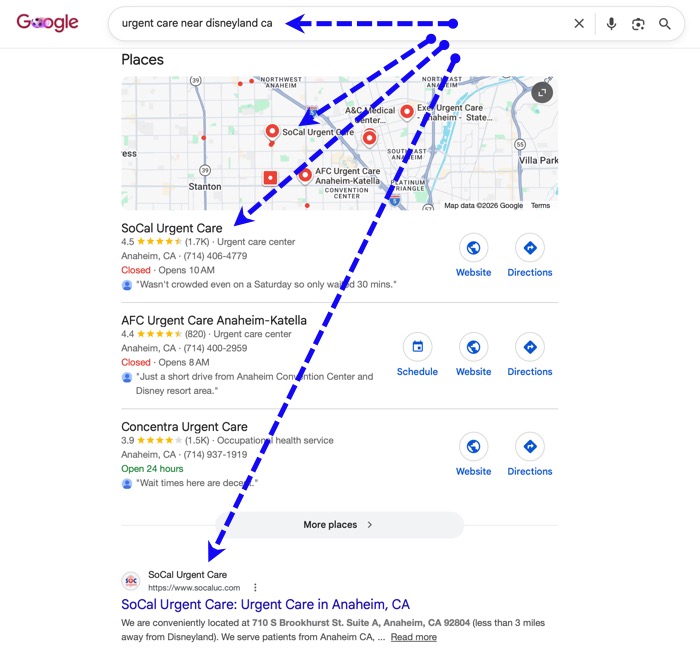
Example of a patient looking for an urgent care close to the proximity of Disneyland.
1. Delivery Methods & Technology
- Traditional: Relies on permanent or physically placed items. Examples include billboards visible from local highways, local newspaper inserts, direct mail sent to specific ZIP codes, or sidewalk sandwich boards outside an urgent care center.
- Digital: Relies on real-time hardware and tracking software. Examples include Geofencing (drawing a digital radius around a competitor’s clinic to trigger smartphone display ads) or Bluetooth Beacons(sending an automatic check-in notification to a patient’s app the moment they step into the clinic lobby).
2. Targeting Capabilities
- Traditional: Targets broad geographic areas. A mailbox campaign or billboard reaches everyone passing by, regardless of whether they need medical care.
- Digital: Offers micro-proximity targeting based on real-time behavior. A clinic can target users who are currently sitting inside a local pharmacy, or push physical therapy ads to people inside local fitness centers.
3. Patient Experience & Personalization
- Traditional: One-way, static communication. The messaging cannot change based on who is reading it.
- Digital: Interactive and dynamic. It allows a clinic to deliver customized, hyper-relevant notifications—such as displaying current wait times or sending appointment reminders when a patient arrives in the parking lot.
4. Cost and Measurability
- Traditional: Requires high upfront costs for printing or physical ad space. Tracking ROI is highly difficult, as clinics must rely on patients manually mentioning how they heard about the practice.
- Digital: Operates on highly customizable, scalable budgets. Results are highly measurable, tracking exact data points like impressions, link clicks, and the number of mobile users who physically walked into the clinic after seeing an ad.
Summary Comparison Table
| Feature | Traditional Proximity Marketing | Digital Proximity Marketing |
|---|---|---|
| Primary Tools | Billboards, Direct Mail, Flyers | Geofencing, Beacons, WiFi Networks |
| Accuracy | Broad ZIP code/neighborhood level | Exact real-time device coordinate level |
| Message Timing | Static; visible 24/7 in a set location | Instant; triggered by live entry into a zone |
| Patient Data | Minimal tracking capabilities | Tracks footfall attribution and app data |
| Privacy Hurdle | High public acceptance; low intrusion | Requires user opt-in (Bluetooth/Location) |
Question: Is there an example and use case for healthcare proximity marketing?
Example: Urgent Care Proximity Marketing
Use Case: Proximity-Based Marketing for an Irvine Urgent Care Clinic
Clinic Scenario:
- Urgent care clinic located in Irvine, CA, serving a busy area with multiple competitors.
- Goal: Increase walk-ins and same-day appointments for urgent care services like minor injuries, flu shots, and allergy treatments.
- Challenge: Patients in Irvine often search for the nearest clinic, especially during emergencies or seasonal illness spikes.
Patient Scenario
- Maria, a 28-year-old resident, is experiencing allergy symptoms and wants care quickly.
- She searches on her smartphone for:
- “urgent care near me Irvine CA”
- “walk-in clinic for flu shots Irvine”
- Maria is looking for a clinic that is conveniently close, has positive reviews, and allows easy online booking.
How Proximity Marketing Works
- Geo-Targeted Digital Ads
- Google Ads and Meta Ads are configured to display to users within 3–5 miles of the Irvine clinic.
- Example ad copy:
- “Irvine Urgent Care – Walk-in for Allergies & Minor Injuries Today”
- “Flu Shots Available – Same Day Appointments in Irvine”
- This ensures that only nearby residents see the ads, increasing efficiency.
- Local SEO and Optimized Google Business Profile (GBP)
- The clinic’s GBP includes:
- Accurate address, phone number, hours, and service list
- Photos, patient testimonials, and posts on services or seasonal offers
- Real-time updates on wait times and availability
- Maria sees the clinic at the top of local search results with maps and directions.
- The clinic’s GBP includes:
- Mobile-Friendly Landing Pages
- Clicking the ad directs Maria to a mobile-optimized page showing:
- Clinic location and directions on Google Maps
- Online booking or click-to-call buttons
- Services like flu shots, allergy testing, or minor injury care
- Simplifies immediate texting and communicating for patients on-the-go.
- Clicking the ad directs Maria to a mobile-optimized page showing:
- Automated Patient Engagement
- Once Maria visits the clinic’s mobile website, books online, the clinic sends:
- SMS/email with directions
- Appointment reminders an hour or day before the visit
- Reduces no-shows and improves patient satisfaction.
- Once Maria visits the clinic’s mobile website, books online, the clinic sends:
- Reputation & Review Management
- Positive patient reviews are highlighted in GBP and search results.
- Maria sees high ratings and testimonials, increasing trust and her likelihood to choose this clinic.
Outcome for the Clinic
- Increased Patient Acquisition: Maria books a visit immediately because the clinic is nearby and visible in search.
- Optimized Marketing Spend: Ads target only the Irvine area, reducing wasted spend.
- Improved Local Visibility: Local SEO ensures the clinic consistently appears in “urgent care near me” searches.
- Enhanced Patient Experience: Automated reminders and easy booking streamline visits, increasing loyalty and retention.
Question: Is there an example using PatientGain PLATINUM service?
Urgent Care Clinic Profile:
- Location: Irvine, CA ( Hypothetical )
- Services: Urgent care, minor injuries, allergy treatment, flu shots, pediatric care
- Goal: Attract new local patients, increase appointment bookings, and maintain HIPAA compliance
1. Proximity-Based Marketing Technology
- Local SEO Optimization:
- PatientGain handles local SEO for doctors by combining HIPAA-compliant marketing software, AI-driven content generation, and a centralized conversion dashboard. Their subscription-based platform builds geo-targeted service pages, automates Google Business Profile (GBP) posts, and streamlines patient review generation.
- Geo-Targeted Service Pages: Instead of generic blog posts, they create highly specific, transactional service pages (e.g., “Urgent Care in [City]”) to capture high-intent local patients.
- AI-Powered “Reverse Search Engine”: Their proprietary AI algorithm analyzes actual patient search patterns and conditions to optimize website content around how local patients search, rather than just basic keyword stuffing.
- Google Business Profile (GBP) Management: They automate the optimization of GBP profiles, encouraging high-frequency posting (often up to 20 times per month) to boost visibility in the local “map pack”.
- Reputation & Review Management: Their platform automates compliant SMS and email follow-ups to request and manage reviews on platforms like Google, Yelp, and Healthgrades.
- Centralized Lead Conversion (SPOC App): To prevent local SEO traffic from being lost at the front desk, they use a Single Point of Conversion (SPOC) dashboard to unify all phone calls, texts, chats, and form leads into one interface.
- Technical & E-A-T Optimization: Websites are optimized for mobile speed and structured data schema, while highlighting provider credentials to build Google’s E-A-T (Expertise, Authoritativeness, Trustworthiness) scores.
- Geo-Targeted Ads:
- Google Ads and Meta Ads targeted to patients within a 3–5 mile radius of Irvine – with full caution.
- Example: Ads for “walk-in urgent care” or “flu shots near Irvine” appear only to nearby patients.
- Real-Time Marketing Dashboards: Measure conversions, and tracks calls, text messages, AI Chatbot Questions, FAQs Clicks (and measures human behaviour on a mobile device) and appointments.
- Mobile-Friendly Fast Loading Pages: Patients can view services, provider bios, any offers, and simply click on “Contact” app – This app lives on the top of every page. Hence creating high conversion mobile experiences.
Benefit: Captures high-intent local patients, ensuring efficient ad spend.
2. Local SEO & Google Business Profile (GBP) Optimization
- Automated Posts: Frequent posts about seasonal services, hours, and special promotions.
- Review Management: Automatically requests and monitors patient reviews.
- Location-Specific Optimization: Ensures the clinic ranks in “urgent care near me” searches for Irvine.
Benefit: Boosts online visibility and improves local search rankings.
3. HIPAA-Compliant Patient Engagement
- QuickSend Messaging App: Handles inbound patient inquiries from the website securely.
- Automated Appointment Reminders: SMS and email reminders reduce no-shows.
- Follow-Up Messaging: Sends post-visit communications and satisfaction surveys.
Benefit: Engages patients efficiently while protecting PHI.
4. Reputation & Review Management
- HIPAA Compliant Review Requests: Patients receive messages prompting reviews after visits.
- Integration with Local Search: Reviews improve Google Maps and search rankings.
Benefit: Enhances trust and credibility, influencing patient choice.
5. Email Marketing
- HIPAA-Compliant Campaigns: Newsletters, promotions, and health tips sent securely.
- Segmentation: Emails sent based on patient history, visit type, or demographics ( With HIPAA Compliance)
- Event & Seasonal Promotions: Example: Flu shot reminders before flu season.
Benefit: Keeps patients informed and encourages repeat visits.
6. Analytics & Reporting
- Real-Time Dashboard: PatientGain’s Real-Time Dashboard is a HIPAA-compliant medical marketing command center that centralizes patient communications and tracks marketing performance across a clinic’s locations. It eliminates “lead leakage” by funneling all inbound inquiries into a single, Outlook-like inbox
- Conversion Tracking: Measures which campaigns are generating new patients.
- Actionable Insights: Guides marketing decisions for Irvine-specific campaigns.
Benefit: Provides data-driven marketing to maximize ROI.
7. Integrated Technology Stack
| Technology / Tool | Function |
|---|---|
| Google Ads / Meta Ads | Proximity-targeted advertising for high-intent patients |
| Reverse Search Engine | Proximity based content for local SEO rankings |
| QuickSend App | HIPAA-compliant patient messaging and lead capture |
| Google Business Profile Automation | Local SEO, posts, reviews, maps visibility |
| Email Marketing System | HIPAA-compliant newsletters, reminders, promotions |
| Analytics Dashboard | Tracks performance across SEO, PPC, email, and reviews |
| Reputation Management Tool | Review requests and monitoring |
| Mobile-Friendly Website / Landing Pages | Optimized for search, booking, and conversions |
Outcome for the Irvine Urgent Care Clinic
- Increased Patient Acquisition: New patients discover the clinic via proximity-targeted ads and local search.
- Higher Conversion Rates: Quick booking, automated follow-ups, and reminders lead to more confirmed appointments.
- Enhanced Online Reputation: Automated review management improves trust and search rankings.
- Time and Cost Efficiency: All marketing channels are managed from a single platform, reducing staff workload and eliminating the need for multiple vendors.
- HIPAA Compliance: All patient communications, reviews, and email campaigns are secure and compliant.
 Send Text
 How may I help you?