

What is Local SEO For Med Spas?
Most practice managers from MedSpas, Wellness and Aesthetics Practices contact us and ask us 1) What is local seo for med spas 2) How can I improve the local seo for my medical spa? 3) How Much Does it Cost? 4) Is Proximity Marketing and Local SEO For Med Spas the Same? 5) What are some examples of Local SEO For Med Spas? 6) How much does it cost? Approx $1500/mon to $2500/mon.
Local SEO For Med Spas: Table of Contents
- What is Local SEO for Medical Spas
- Is it important to have a physical location for my med spas for Local SEO?
- How much does it cost for local SEO for medical spas and aesthetics practices?
- How can I improve the local seo for my medical spa?
- What is 3 Tier Local SEO Strategy?
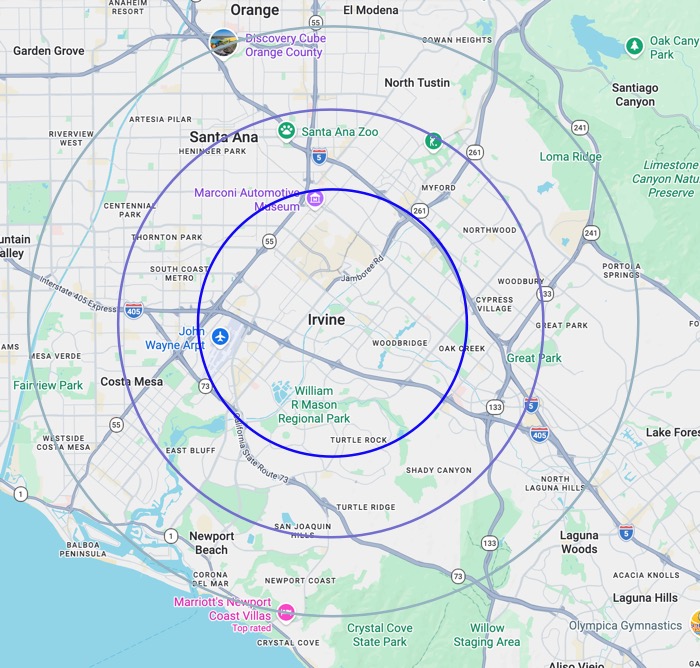
- Is Proximity marketing and local SEO for Med Spa’s the same?
- Example 1 Use Case of Local SEO: Using PatientGain’s PLATINUM service
- Example 2 Use Case of Local SEO: Using PatientGain’s PLATINUM service
Question 1. What is Local SEO for med spas?
Local SEO for MedSpas and Aesthetics Practices is the process of optimizing your online presence so that people in your local area can easily find your clinic when searching for cosmetic and med spa treatments. Unlike general SEO, which targets broad searches nationwide or statewide, local SEO focuses on location-based searches, making it essential for MedSpas and aesthetic practices that rely on nearby patients. This approach is also sometimes interchangeably called “proximity healthcare marketing“. However they are different, but related strategies.
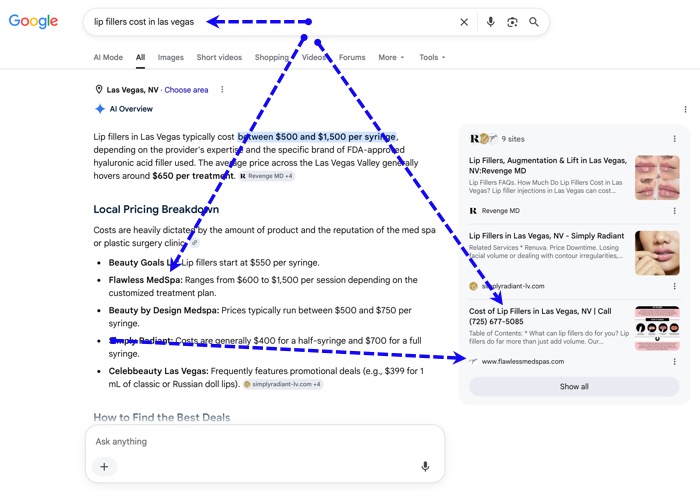
Example of Local SEO for “lip fillers cost in las vegas”. You will see that AI based information provided by Google is now even higher than Google PPC ads, in many cases.
Question 2. Is it important to have a physical location for my med spas for Local SEO?
Because a medspa or an aesthetic medicine practice requires physical, in-person visits, are the no 1 way for revenue generation. Google’s algorithms know the details of proximity and patient/client behaviour and Google’s algorithms and AI agent Gemini heavily give preference to local medspa or an aesthetic medicine practices rather than a practice that could be located 500 miles away from a patient. Unless a patient explicitly searches for a specific city or area.
Question 3. How much does it cost for local SEO for medical spas and aesthetics practices?
Local SEO for medical spas and aesthetics practices generally costs between $800 and $3,000+ per month, with most mid-sized clinics investing around $1,500 to $2,500 monthly. Unlike standard local businesses, medical aesthetics practices face high local competition and strict medical content standards, which drives up baseline strategy costs.
What are PatientGain prices for local SEO services medical spas?
PatientGain offers dedicated medical spa and aesthetics local SEO through bundled, HIPAA-compliant monthly subscription tiers that range from $899 to $2,499+ per month. Pricing is strictly determined by your geographic location and local market competition level. Most common pricing is $1699/mon for complete PLATINUM service.
Standard All-In-One SEO & Marketing Bundles
Most medical spas use PatientGain’s integrated packages, which include a conversion-focused, local-SEO-optimized medical website, a unified lead dashboard, and recurring medical content writing:
- GOLD Service: Built for medical spas located in low-competition markets. This package includes a foundational SEO-optimized website, Google Business Profile (GBP) alignment, and basic keyword tracking.
- PLATINUM Service: PatientGain’s most popular option, designed for medium-competition suburban and urban areas. It adds ongoing local SEO content creation tailored to aesthetic treatments (e.g., Botox, lip fillers) and active online reputation/review management to boost Google Maps rankings.
- PLATINUM PLUS Service ($2,499/month): Engineered specifically for medical spas in highly saturated, competitive metropolitan hubs. It includes advanced local search strategies, heavy SEO content architecture overrides, and multi-channel drip software to help a practice break into top-tier city map results.
Standalone Local SEO Services
If you already possess a functional medical spa website and do not want a complete marketing re-platform, PatientGain offers direct standalone SEO options:
- A la Carte Local SEO Services (Starting at $999/month): This plan focuses strictly on enhancing search engine visibility, managing directory citations, fixing local metadata, and driving organic ranking improvements without changing your site design.
- Existing Website Add-Ons (SILVER/SILVER PLUS at $1,699 – $2,499+/month): For med spas keeping their current site but needing PatientGain’s underlying SEO content creation pipelines, local review tools, and HIPAA-compliant tracking apps.
- Multi-Location Add-On ($500 to $800/month per site): If your aesthetics brand expands to multiple physical storefronts, scaling separate Google Map pins and localized area landing pages costs an additional flat fee per storefront.
Contract Terms & Additional Costs
- Setup Fees: There are generally $0 upfront setup fees if you sign a standard 12-month agreement for their subscription tiers.
- Custom Site Alternative: If you want a 100% custom-built medical spa website from them rather than their subscription template models, they charge a one-time project fee approximately $10000 one time fee.
Question 4. How can I improve the local seo for my medical spa?
First, the most important part of local SEO for MedSpas and Aesthetics Practices is to have a complete and accurate data on on Google Business Profile (GBP). Consider this a requirement, second, post on your Google Business Profile 20 times per month. This is called high-frequency posting.
To improve your MedSpas and Aesthetics Practices local SEO, you must focus heavily on optimizing your Google Business Profile (GBP) to get into the coveted Google Map 3-Pack, which captures the vast majority of local search clicks. Because aesthetic treatments are highly location-dependent, a focused local SEO strategy will directly translate into high conversion leads.
Optimize Your Google Business Profile (GBP)
Your GBP is your digital storefront; an incomplete profile will bury you beneath competitors.
- Maintain NAP Consistency: Ensure your exact business Name, Address, and Phone number (NAP) match perfectly across your website and all local directories. Consistent information boosts search relevance by up to 30%.
- Select Specific Categories: Choose “Medical Spa” as your primary category. Add highly relevant secondary categories like “Skin Care Clinic,” “Laser Hair Removal Service,” or “Facial Spa” to capture niche searches.
- Upload High-Quality Visuals: Regularly upload photos of your sterile treatment rooms, your licensed staff, and clear before-and-after results. Profiles featuring high-quality media receive significantly more requests for driving directions.
- Publish Weekly Google Updates: Post weekly offers, treatment spotlights, or flash promotions directly to your profile to signal active management to Google’s algorithm.
Question 5. What is 3 Tier Local SEO Strategy?
3 step plan for local med spas and aesthetics practices. Divide your strategy into 3 tiers. All of these directories in Tier 1, Tier 2 and Tier 3 are also extremely important for creating “back-links” to your website.
Tier 1 websites for local medical & dental SEO
These are most important websites for your med spas and aesthetics practice. They must have accurate and correct information about you and your practice. This means that your practice local SEO starts with the most import step: You must have robust and accurate setup on Google Business Profile -GBP – this used to be called Google My Business, and post on Google Business Profile atleast 20 times per month with useful information about your services. First, the most important part of local SEO for doctors is to have a complete and accurate data on on Google Business Profile (GBP). Consider this a requirement.
1) Google my business & Google maps . Read more about specific steps here.
2) Facebook
3) Instagram
4) Apple maps
5) Bing
Tier 2 websites for local med spas and aesthetics practices SEO – Some of these platforms require that the practice manager/owner create the listings
These are so important that as a practice owner, or the digital marketing company of a practice, you should create and manage them. No need to outsource to anyone else. Tier 2 websites should have accurate and correct information about you and your practice.
Local Link Building:
1) Participate in local events: Sponsoring or attending local events can generate backlinks and brand awareness.
2) Build relationships with other local businesses: Partner with complementary businesses to exchange links and referrals.
1) Local Chamber of Commerce. How to add your healthcare practice to US Chamber of Commerce ** This is very important **
2) Better Business Bureau . https://www.bbb.org/get-listed
3) Local City/Town Business Directory
4) Yelp. How to add your practice to Yelp
5) Nextdoor. How to add your practice to Nextdoor
6) Local Community Non-Profit Directory https://give.org
7) Mapquest Maps https://www.mapquest.com
8) Professional Association Website ( for example AMA )
9) Yahoo business directory https://local.yahoo.com/claim-your-business/
Tier 3 websites for local med spas and aesthetics practices SEO
These websites require the practice owner, practice manager to create their own listings.
1) Healthgrades https://update.healthgrades.com/landing/claim
2) WebMD https://member.webmd.com/signin
3) Psychology Today (for mental health providers). https://join.psychologytoday.com/us/signup
4) Vitals https://www.vitals.com/
5) RateMD https://www.ratemds.com/accounts/login/
and few more. These are less important, but they are still important, as they provide good back-link SEO benefits.
Question 6: Is Proximity marketing and local SEO for Med Spa’s the same?
No, proximity marketing and local SEO are not the same thing, although they both target nearby clients for your medical spa. The core difference is that local SEO is search-pull marketing (helping clients find you when they look for a service), while proximity marketing is location-push marketing (reaching out to clients automatically because of where they are standing).
Direct Comparison
| Feature | Local SEO (Search-Pull) | Proximity Marketing (Location-Push) |
|---|---|---|
| User Intent | High. They are actively searching for a solution. | Low to Medium. They are nearby but might not be thinking of you. |
| Primary Goal | Ranking in Google Maps and local search results, and most importantly – Gemini AI Results. | Sending instant alerts, ads, or texts to nearby phones. |
| Core Technology | Google Business Profile (GBP) Optimization, website keywords, citations, and posting on GBP 20 times per month. | Bluetooth beacons, Geofencing, Wi-Fi networks, GPS. |
| Timeline | Long-term. Takes months to build organic authority. Very competitive area. | Instant. Triggers the moment a user enters a boundary. |
What Local SEO Means for a Med Spa
Local SEO ensures that when a consumer types a high-intent phrase into a search engine, your medical spa shows up at the top of the organic results.
- How it works: You optimize your Google Business Profile, collect patient reviews, and build location-specific web pages for high-ticket treatments (e.g., “Laser hair removal in [City Name]”).
- The Med Spa Benefit: It captures patients at the exact moment they want a treatment. If someone searches “Botox near me,” they have high intent to book an appointment.
What Proximity Marketing Means for a Med Spa
Proximity marketing uses location-based technology to target consumers’ smartphones within a specific, real-world geographic boundary.
- How it works: You set up a digital “geofence” around a high-end shopping center, a luxury gym, or a competitor’s clinic. When a target consumer walks into that zone, your system triggers a mobile ad, a push notification, or an SMS offer.
- The Med Spa Benefit: It drives impulse visits or local awareness. For example, you can target people at a nearby luxury bridal boutique with a mobile ad that reads: “Getting ready for your big day? Get 10% off a HydraFacial just 2 blocks away.”
How They Work Together
The most successful medical spas do not choose between them; they use them to complement each other. Local SEO builds your clinic’s long-term digital footprint so you permanently dominate your city. Proximity marketing provides short-term, hyper-targeted ad boosts during slow weeks or special events to pull foot traffic directly from your immediate neighborhood.
Example 1 Use Case of Local SEO: Using PatientGain’s PLATINUM service
A patient is looking for a medical spa for botox for a coming up 20 year family reunion in California with her extended family.
PatientGain’s PLATINUM Service works for a highly competitive, cash-pay MedSpa environment.
A med spas and aesthetics practices patient is driven by aesthetics, trust, and timing. Let’s walk through the exact digital journey of capturing this specific patient.
The Scenario: The 3-Week Deadline
The Patient: Maria, a 45-year-old mother.
The Situation: She has a 20-year extended family reunion in Newport Beach, California, in exactly three weeks. She wants Botox so she can look rested and refreshed in the hundreds of family photos that will be taken.
The Intent: Maria knows that Botox takes about 10 to 14 days to fully “settle,” which means she cannot wait; she needs an appointment this week. She pulls out her phone and searches: “Best natural Botox near me fast appointment.”
Here is how the PLATINUM service captures Maria’s attention and her appointment.
Step 1: Winning the High-Intent Search (Reverse SEO & Trust Signals)
Because Maria is in a highly saturated California market, she is bombarded with MedSpa options.
- The Competitor: Has a generic website that ranks on page two. Their SEO only targets the broad word “Botox,” which is too competitive to win against massive corporate chains.
- The PLATINUM MedSpa: Ranks #1 organically. Why? Because PatientGain’s medical writers use a “Reverse SEO” strategy. They previously published a highly specific, AEO-optimized article titled: “Botox Timeline: When to Get Injections Before a Big Event in Newport Beach.” * The Result: Maria clicks the link because it exactly matches her highly specific, time-sensitive intent.
Step 2: Frictionless Mobile UX & The “Visual Proof”
Maria clicks the link on her phone. In aesthetics, visual trust is everything.
- The Competitor: Has a beautifully designed site, but it is bogged down by massive, unoptimized background videos of models. It takes 8.5 seconds to load. Maria gets impatient and hits the “back” button.
- The PLATINUM MedSpa: Hosted on Google Cloud C4D servers, the site loads in under 2.1 seconds. Instead of stock photos, Maria is greeted by a short, 60-second welcome video from the Medical Director, instantly building clinical trust.
- The Interaction: Maria doesn’t want to call while she is at work. The AI Medical Chatbot (Intelli*Connect) pops up. Maria types, “Do you have any openings for Botox before Friday?” The bot instantly replies, “Yes! We have a few spots left this week for injectables. Would you like to secure a consultation?”
Step 3: The SPOC Dashboard (The “Speed-to-Lead” Win)
Maria fills out the chatbot’s secure lead form with her name, number, and goal.
- The Competitor: Standard MedSpa sites send this lead to a general info@medspa.com inbox. The front desk coordinator is busy checking patients out and doesn’t see the email for four hours. By then, Maria has already booked elsewhere.
- The PLATINUM MedSpa: The lead bypasses email entirely and hits the SPOC (Single Point of Conversion) dashboard.
- The Action: A bright notification alerts the MedSpa coordinator. Without picking up a phone, the coordinator uses the built-in QuickSend 2-Way Texting App and texts Maria: “Hi Maria! We can absolutely fit you in on Thursday at 4 PM so your Botox settles perfectly before your reunion. Here is a secure link to our authentic before-and-after gallery so you can see our natural results.”
Step 4: Legal Advertising (Data Obfuscation)
MedSpas rely heavily on paid Google and Meta (Facebook) ads.
- The Competitor: They use the standard Facebook Pixel to track their ads. When a patient clicks on an ad for “Wrinkle reduction,” Facebook logs that medical intent. The federal government considers this a HIPAA violation, putting the MedSpa at risk of massive fines.
- The PLATINUM MedSpa: PatientGain’s platform acts as a secure Customer Data Platform (CDP). It hashes Maria’s data, strips away her identifying information and her interest in “Botox,” and sends a compliant, anonymous “conversion ping” back to the ad network. The MedSpa owner knows exactly which marketing campaign is generating revenue without breaking federal privacy laws.
Step 5: The Automated Retention Loop (The Real ROI)
Maria comes in on Thursday, gets her Botox, and loves her natural results at the family reunion three weeks later.
- The Review: After she leaves the clinic, the PLATINUM CRM texts her a compliant link asking for a review. Maria leaves a glowing 5-star review, which pushes the clinic’s local SEO even higher.
- The Retention: This is where the MedSpa makes its real money. Botox wears off. Using the monthly Email marketing campaign, the PatientGain CRM campaign sends a Email promotional for “botox” tagged patients from the HIPAA compliant leads-funnel. The PLATINUM service doesn’t just act as a website; it acts as a high-speed digital sales coordinator. It uses targeted SEO to catch Maria’s specific timeline, high-speed UX to keep her on the page, the SPOC dashboard to beat competitors to the punch, and automated software to turn her into a recurring, lifelong patient.
Example 2 Use Case of Local SEO: Using PatientGain’s PLATINUM service
Local SEO for med spa located in Las vegas NV, patient is looking for “lip fillers with reasonable prices and experienced staff”.
Las Vegas is not just a city built on entertainment — it is increasingly a city built on appearance. With a metro population approaching 2.3 million and one of the highest concentrations of aesthetics-focused consumers in the United States, the Las Vegas valley hosts more than 200 active med spas competing for the same high-intent patients. The lip filler market alone reflects this intensity: a global market valued at $1.43 billion, with demand that has surged among women in their 30s and early 40s driven almost entirely by social media visibility. Las vegas is unique, reinforcing the active, image-conscious identity that defines the area. Yet proximity to affluent consumers is not enough. In a market where a patient searching “lip fillers Summerlin Las Vegas” on a Sunday evening has 15 competing Google Business Profiles visible before she scrolls, Local SEO is not a marketing luxury — it is the infrastructure on which new patient acquisition is built. Practices that invest in that infrastructure, and layer Proximity Marketing on top of it, do not just appear in searches. They earn the click, hold the attention, and convert the visit into a booking before a competitor even loads.
The Patient Persona: Sofia, 34, Summerlin, Las Vegas Suburbs (hypothetical use case – not a real person)
Sofia relocated from Phoenix to Summerlin three years ago when her wedding photography business expanded into the Las Vegas events market. She is methodical with money — her income of approximately $92,000 per year puts quality aesthetics within reach, but she is not a casual spender. She researches everything.
Sofia has been watching lip filler content on Instagram Reels and TikTok for two years. She knows what she wants: a subtle, natural augmentation that enhances without announcing itself. She has seen the “duck lip” results that circulate on social media as cautionary tales, and she has no interest in becoming one. Her core fears are three: an inexperienced injector who will not listen to her vision, a result that looks unnatural in photographs (a professional liability as much as a personal one), and overpaying for mediocre work.
The motivation for acting now is specific. Her best friend’s wedding is in 10 weeks. Sofia will be photographing it — and she will also be in it. She wants to look great in both roles. She pulls out her iPhone 17 on a Tuesday night, opens Safari, and types: “lip fillers near me Las Vegas experienced injector reasonable price.” Moments later, she runs a second search: “lip filler before and after natural look Las Vegas.” The research phase has begun.
Phase 1 — Awareness – using Youtube, Meta etc she is already aware of the service “Lip fillers” – She is ready to buy.
She begins with a Google search: “lip fillers Las Vegas experienced injector reasonable price.” This is not a casual query — it contains four pieces of intent: location, treatment, injector quality signal, and price sensitivity. She is ready to be converted by the right practice; she just needs to find it.
Within thirty seconds she migrates to Google Gemini AI , searching “lip filler Las Vegas”. She saves three posts featuring before-and-after comparisons she finds natural-looking. Two of the posts come from GBP which PatientGain’s Social Media App has been publishing geo-tagged content to 20 times per month.
PatientGain PLATINUM features activating in this phase:
- SEO App — geo-targeted keyword optimization for “lip fillers Las Vegas” and related long-tail queries
- Social Media App — consistent Instagram and TikTok content publishing with Summerlin/Las Vegas geo-tags – PatientGain app provides the content.
- Google Business Profile optimization — category, service, and attribute configuration that surfaces in location-aware mobile searches
Phase 2 — Google Discovery
When Sofia returns to Google the following morning, searches again and “lip fillers in ” appears in the Local Pack — the top three Google Business Profile. The listing shows 4.8 stars from 312 reviews, a “lip filler specialist” service attribute, photos of the clean, modern interior, and a direct texting, calling and booking link (SPOC app from PatientGain) . Sofia notices that the two competitors flanking have fewer reviews and lower star counts, one has 5.0 stars with 1020 reviews, she does not believe this, and also knows people are human, there is no way that a business can have hundreds of reviews and 5.0 stars. Practices with 4.5 stars or higher convert 35% more new patients from search, and Sofia is behaving exactly like that data predicts.
She taps through to Google Business Profile and reads the most recent five reviews. Three of them use the word “natural.” One reviewer specifically mentions Tanya by name, writing that she “took 20 minutes to understand exactly what I wanted before we started.” Sofia screenshots this review and texts it to her friend. PatientGain’s Review Management App is responsible for this review velocity.
PatientGain PLATINUM features activating in this phase:
- Review Management App — visit SMS review requests generating a consistent flow of authentic reviews
- Google Business Profile App — keeping service listings, photos, and hours current to maximize Local Pack eligibility
- SEO App — location-page content targeting Summerlin, Henderson, and Northwest Las Vegas neighborhood search terms
Phase 3 — Website Engagement
Sofia taps the website link from the Google Business Profile. PatientGain-built, high-performance website loads in under two seconds on her iPhone. The above-the-fold content is direct: “Natural Lip Fillers in Summerlin — See Tanya’s Work.” A before-and-after gallery is accessible within one tap from the homepage.
Sofia spends eleven minutes on the site. She reads the lip filler service page, filters the before-and-after gallery to view lip results only, and watches a short video introduction from Tanya — a 90-second clip where Tanya explains her “less is more on the first visit” philosophy.
SPOC (Single Point of Contact) app asks the message reads: “Hi, I’m here if you have questions.
PatientGain PLATINUM features activating in this phase:
- PatientGain Website (high-performance, mobile-first build) — sub-2-second load, conversion-optimized layout
- Before/After Gallery App — filterable visual proof calibrated to Sofia’s natural-result concern
- AI Chat App / SPOC — lead capture at the moment of peak engagement, with pricing transparency that builds trust rather than deflecting
Phase 4 — Trust Building
Sofia does not book that night. Over the next 48 hours she runs two additional searches: “Tanya Doe PA-C Las Vegas injector” and her first result for the injector search is a PatientGain-optimized bio page for Tanya ranking organically — complete with her credentials, nine years of experience, specialty in natural-result hyaluronic acid fillers, and a photo that conveys warmth without sacrificing professionalism.
Her second search surfaces a Google AI Overview snippet that pulls directly from website structured FAQ content. The question it answers: “Are lip fillers safe?” The answer attributes the content to Med Spa, reinforcing the practice’s clinical authority. PatientGain’s Schema Markup infrastructure is responsible for this placement.
She also finds a third-party profile where Tanya has answered 14 patient questions publicly. One question mirrors Sofia’s exact anxiety: “I’m afraid of the overdone look — will you give me more than I want?” Tanya’s answer: “I always start conservatively and show you a mirror throughout. Your comfort with the result matters more than any treatment plan.” Sofia screenshots this too.
PatientGain PLATINUM features activating in this phase:
- Injector Bio Pages (SEO-optimized provider profiles)
- FAQ & Schema Markup App — structured content feeding Google AI Overviews and featured snippets
- Reputation Management App — monitoring and amplifying third-party review platforms
- Content Marketing App — educational blog content on “natural lip filler results” and “how to choose a lip injector”
Phase 5 — Booking/Texting/Calling
On Thursday evening — two days after her initial search — Sofia is ready. She taps “Book Online” and PatientGain’s Online Scheduling App presents Tanya’s real-time calendar. She selects a Saturday morning 45-minute “Lip Filler Consultation + Treatment” at 10:00 AM. The booking confirmation arrives via both email and SMS within 90 seconds. Sofia replies via text with a quick question about avoiding blood thinners beforehand, and a staff member responds within three minutes. Practices responding within five minutes convert 21 times more leads than those taking 30 minutes or longer — that three-minute response happened because PatientGain’s alert system flagged the inbound text to the front desk immediately, using the SPOC app and QuickSend App (HIPAA Compliant)
PatientGain PLATINUM features activating in this phase:
- Online Scheduling App — real-time calendar with provider-level filtering
- 2-Way Texting App — sub-5-minute lead response converting the hesitant browser to a confirmed patient
- Automated Confirmation App — multi-channel (SMS + email) confirmation reducing no-show risk at the point of booking
Phase 6 — Pre-Arrival
Between booking and her Saturday appointment, Sofia receives a carefully sequenced pre-arrival communication series. On Thursday evening, a digital intake form arrives via text and Email — a mobile-optimized form she completes in four minutes. She enters her health history, reference photos, and notes about the aesthetic she is aiming for. On Friday afternoon, a pre-care instructions message arrives via text and email: avoid alcohol, fish oil, and NSAIDs for 24 hours before treatment. The message is warm but clinical, signed from Tanya personally even though it was triggered automatically. The pre-arrival sequence also includes a payment options summary with a CareCredit explainer — framing it as a convenience option, not a sales pitch. Automated reminders at 48 hours and 2 hours before the appointment keep the visit top of mind; this reminder sequence cuts no-shows by up to 30%.
PatientGain PLATINUM features activating in this phase:
- Digital Intake Forms App — mobile-optimized pre-visit data collection with goal/preference capture
- Patient Communication App — automated pre-care instruction sequences with personalized sender attribution
- Appointment Reminder App — multi-touch SMS and email reminders reducing no-show rates
Phase 7 — The Appointment
Sofia arrives at Luminos at 9:55 AM. The front desk has her intake form pre-loaded. Tanya greets her personally. The consultation runs 15 minutes before any product is drawn — Tanya reviews Sofia’s intake notes, pulls up a mirror, and discusses the goal together. She uses a lip-mapping technique she explains aloud as she works, showing Sofia where each injection point will fall and why. Sofia mentions she is a photographer with a wedding in 10 weeks. Tanya adjusts the plan: a single syringe of Juvederm Ultra XC, focused on vermillion border definition and a modest cupid’s bow lift — nothing that reads as “work done.”
The treatment takes 22 minutes. When Sofia sees the final mirror, she laughs: “That’s it. That’s what I wanted.” Before she leaves, a front desk team member offers a photo in the photo station. Sofia also takes her own selfie and — unprompted — posts to her Instagram Stories, tagging MedSpa: “10 weeks before my best friend’s wedding and I’m obsessed.”
PatientGain PLATINUM features activating in this phase:
- Appointment Management App — intake form pre-loaded at check-in, reducing front desk friction
- Before/After Photo Documentation — in-practice photo station workflow supporting organic social content
- Social Media App (listening alert) — Luminos team notified of the Instagram tag for timely response and reshare
Phase 8 — Retention and Referral
Few days after Sofia’s appointment, she gets asked by Email and text “Hi Sofia! We hope you’re loving your results. Would you mind sharing your experience on Google? It takes 30 seconds and means the world to our team.” Sofia leaves a five-star review that evening — review number 313 — writing that Tanya “gave me exactly the natural look I asked for.”
Three days later, an email from PatientGain’s Email Marketing App arrives: “How are your lips feeling, Sofia?” It includes post-care tips, a note that lip filler typically lasts 9–12 months, and a $50 welcome credit toward her first Botox treatment. Sofia forwards the email to Caitlin, the bride, who has been asking about lip fillers since wedding planning started. Caitlin books a consultation the following week, citing Sofia’s referral.
Sofia is added to a long-term email nurture sequence: quarterly aesthetic tip content, seasonal promotion previews, and a personalized filler anniversary reminder at the 9-month mark. She cost the practice zero in paid advertising to acquire.
PatientGain PLATINUM features activating in this phase:
- Review Management App — automated post-visit SMS review request with one-tap Google link
- Email Marketing App — post-visit follow-up sequence, loyalty offer, and long-term nurture drip
- Patient Retention App — filler anniversary reminders and seasonal re-engagement campaigns
- Referral Tracking App — attributing Caitlin’s booking to Sofia’s documented referral
Touchpoint Table: Local SEO vs. Proximity Marketing at Every Phase
| Journey Phase | Patient Action | Local SEO Touchpoint | Proximity Marketing Touchpoint | PatientGain App |
|---|---|---|---|---|
| Phase 1: Search | Sofia Googles “lip fillers Summerlin Las Vegas” | Geo-targeted keyword rankings for Summerlin + Las Vegas lip filler terms | None yet — Sofia not yet near clinic | SEO App |
| Phase 1: Search | Sofia searches Instagram for “lip filler Las Vegas” | Geo-tagged Instagram posts indexed by topic | Location-tagged social content surfaced to nearby users | Social Media App |
| Phase 1: Search | Sofia saves Luminos Reels on Instagram | Organic content reach builds brand recall before website visit | Instagram proximity targeting to Summerlin zip codes | Social Media App |
| Phase 2: Discovery | Sofia views Local Pack results | Google Business Profile optimized for Local Pack position (4.8 stars, 312 reviews) | GBP proximity signals serve Luminos when Sofia’s phone GPS resolves to Summerlin | Google Business Profile App |
| Phase 2: Discovery | Sofia reads Google reviews | High review volume and recency from automated post-visit SMS requests | N/A — review signals affect ranking proximity logic | Review Management App |
| Phase 2: Discovery | Sofia taps website link from GBP | Organic CTR from Local Pack placement | Mobile proximity intent (searches near Downtown Summerlin geography) | SEO App + GBP App |
| Phase 3: Engagement | Sofia browses before/after gallery | Gallery pages indexed with alt-text, schema, and service keywords | Retargeting pixel fires on Sofia’s iPhone — display remarketing eligible | Before/After Gallery App |
| Phase 3: Engagement | Sofia asks chatbot about pricing | SPOC chat widget on SEO-optimized service page drives on-page engagement | Real-time chat response regardless of Sofia’s physical location | AI Chat App (SPOC) |
| Phase 3: Engagement | Sofia submits phone number for pricing guide | Lead capture form converts search traffic to CRM contact | SMS follow-up triggered immediately upon form submission | Patient Communication App |
| Phase 4: Trust | Sofia Googles “Tanya Marsh PA-C Las Vegas” | Provider bio page ranks organically for injector name + city | N/A — research behavior, not proximity-triggered | SEO App + Bio Page |
| Phase 4: Trust | Sofia finds Google AI Overview on lip filler safety | FAQ schema markup feeds AI Overview placement for Luminos content | N/A — structured data benefit is search-engine-side | Schema Markup / FAQ App |
| Phase 5: Booking | Sofia books Saturday appointment online | Online booking button accessible from GBP and SEO landing page | 2-way SMS conversation; responded to within 3 minutes | Online Scheduling App + 2-Way Texting App |
| Phase 6: Pre-Arrival | Sofia completes digital intake form | N/A — operational touchpoint | Automated pre-care instructions delivered via SMS | Digital Intake App + Patient Communication App |
| Phase 6: Pre-Arrival | Sofia receives 48-hour and 2-hour reminders | N/A — retention/operational touchpoint | Location-aware reminder timing | Appointment Reminder App |
| Phase 7: Appointment | Sofia posts Instagram Story tagging @LuminosMedSpa | Tagged content creates organic SEO and social signal for Luminos | Post goes live within proximity of Downtown Summerlin — local audience organic reach | Social Media App (listening alert) |
| Phase 8: Retention | Sofia leaves Google review | New 5-star review improves Local Pack positioning for future searchers | Review request SMS delivered within 8 hours of appointment | Review Management App |
| Phase 8: Referral | Caitlin books after Sofia’s referral | Referral converts as organic, non-paid acquisition | Sofia’s referral delivered via personal SMS | Referral Tracking + Email Marketing App |
How PatientGain PLATINUM Won Sofia Without Increasing Ad Spend
This Med Spa & Aesthetics did not outbid its 200+ competitors in Google Ads. It did not run a Facebook campaign. It did not hire a social media manager. What it did was build — over 14 months of PatientGain PLATINUM deployment — a presence and so precisely tuned to the patient’s decision journey that when Sofia typed her search query on a Tuesday night, every subsequent touchpoint she encountered between that query and her booking was controlled or influenced by MedSpa’s infrastructure. The Local Pack position was earned by review volume and GBP optimization. The Instagram saves were earned by consistent geo-tagged content. The AI Overview placement was earned by structured FAQ schema. The five-minute text response was enabled by automated alerting. None of these outcomes were the result of a single campaign — they were the result of a system.
That system, PatientGain PLATINUM, treats the full 8-phase patient journey as a single conversion funnel rather than a collection of disconnected marketing tactics. Sofia never felt marketed to. She felt informed, respected, and heard — first by the content, then by the chatbot, then by the confirmation text, then by Tanya in the treatment room. The referral from Sofia to Caitlin was not incentivized by a discount or a referral bonus. It happened because a 34-year-old wedding photographer in got exactly the result she asked for, and the practice’s follow-up communication gave her the language and the opportunity to share it. In a hyper-competitive Las Vegas med spa market where most competitors are spending on paid ads they cannot sustain, medspas compounding organic equity — one review, one ranking, one retained patient at a time.
Use case prepared for med spa practice managers and marketing directors evaluating Local SEO and Proximity Marketing strategy. All patient and clinic details are fictional and constructed for illustrative purposes.
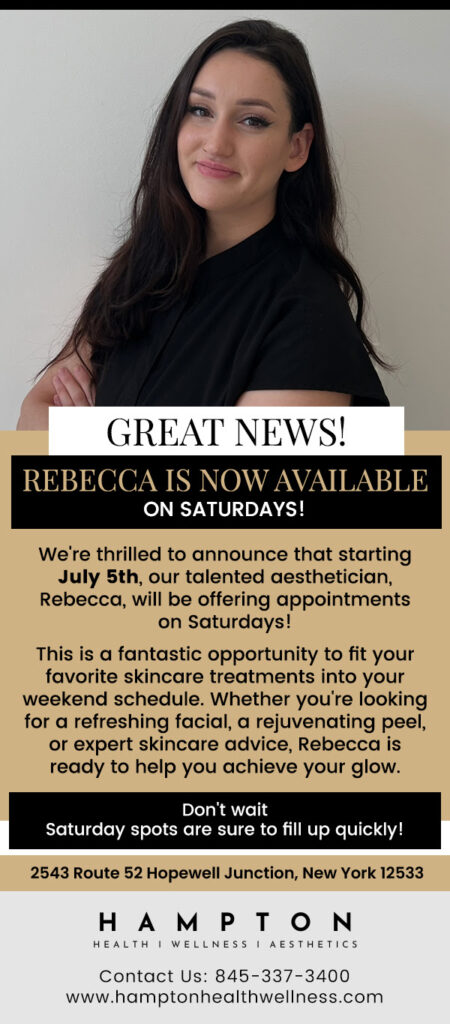
Example of PLATINUM Email marketing campaign to fill calendar of a new provider staff.
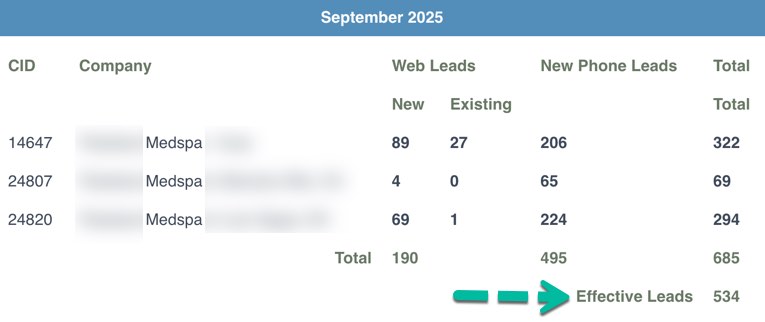
Example of PLATINUM marketing dashboard – 534 Effective leads in the month of September.
 Send Text
 How may I help you?