

Local SEO (Search Engine Optimization) For Healthcare Practices
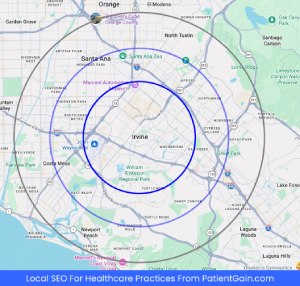
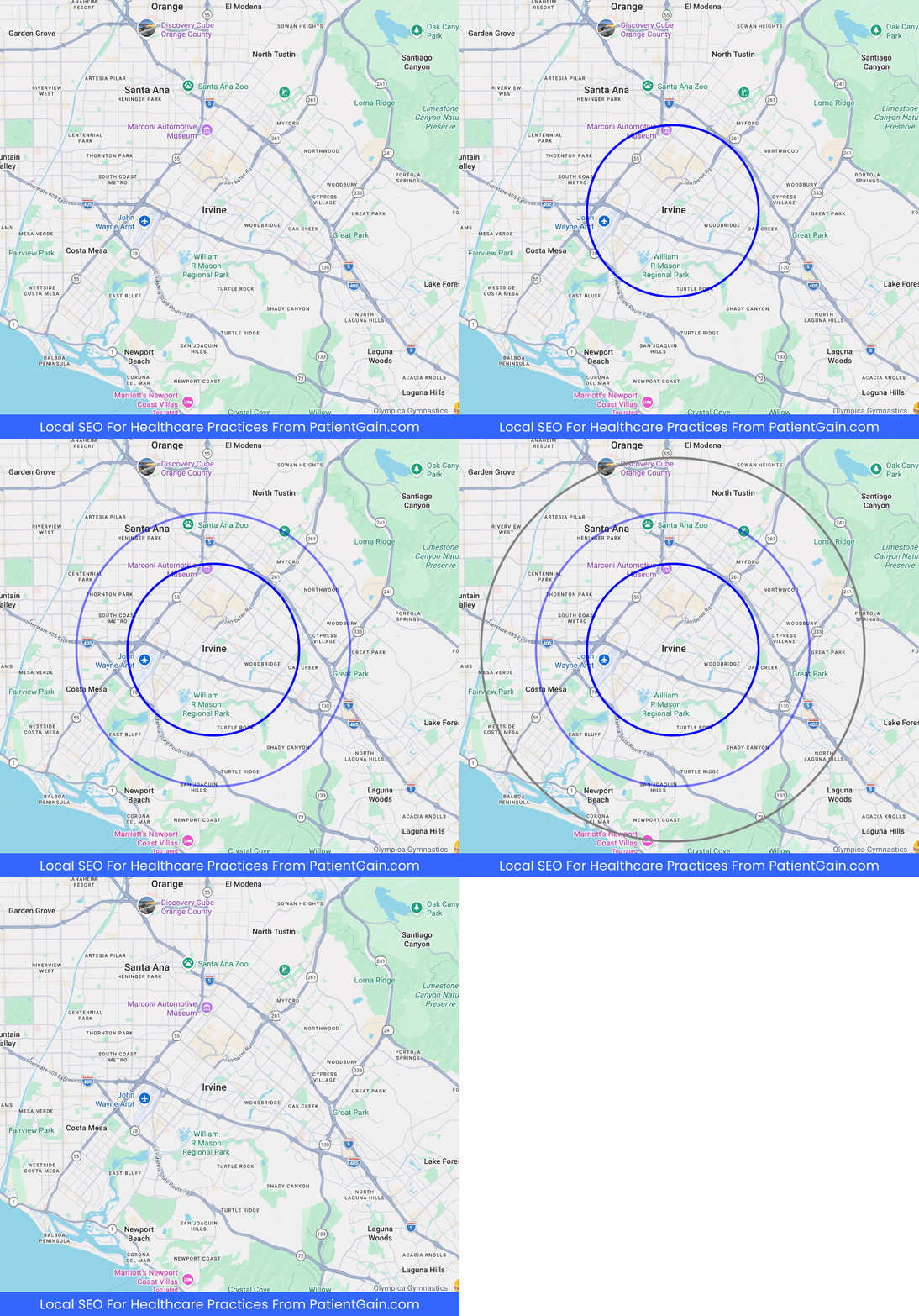
Local SEO for healthcare is the process of optimizing a healthcare practice’s digital presence so it appears prominently in proximity based relevant search results, like the Google Map Pack and “near me” queries. It helps nearby patients searching for care easily find, trust, and contact your healthcare practice. Data shows that location as a convenience factor for patients is an important strategy for your healthcare marketing, mastering local search and hyper-local SEO is critical for a steady stream of new patients.
Local SEO For Healthcare: Table Of Contents
Why is local SEO for healthcare so difficult?
What Is Included in Healthcare Local SEO?
Example 1: Local SEO For Healthcare / Pain clinic in Texas
Example 2: Local SEO For Healthcare / Med spa in Las Vegas
Packages for Local SEO (Search Engine Optimization) For Healthcare Practices
Are PatientGain services Done-For-You? Will I get timely support?
Why is local SEO for healthcare so difficult?
Local SEO for healthcare practices is highly specialized. It requires rigorous optimization of your Google Business Profile (GBP), dedicated local service pages, and robust review management. Because healthcare is local and intent-driven, proximity to the patient is the primary ranking factor. Local SEO for healthcare is exceptionally difficult because search engines hold medical websites to a higher standard of accuracy, strict regulatory compliance limits what you can publish, and intense regional competition creates thin margins for error.
Here is why optimizing local healthcare search is uniquely challenging:
1. High-Stakes Ranking Standards (YMYL)
Google classifies medical content as “Your Money or Your Life” (YMYL).
- Strict Evaluation: Search algorithms demand ultra-high levels of Experience, Expertise, Authoritativeness, and Trustworthiness (E-E-A-T).
- Algorithm Volatility: Healthcare sites are highly sensitive to core algorithm updates, meaning a drop in rankings can happen overnight if content lacks clear medical consensus.
2. Strict Legal & Privacy Restrictions
Healthcare marketers must navigate a legal minefield that other local businesses do not face.
- HIPAA Compliance: You cannot track users or display patient data freely. Tools like Meta Pixels or certain Google Analytics setups can trigger severe legal violations.
- Review Regulations: While local SEO thrives on reviews, providers cannot use patient reviews to disclose protected health information (PHI), and some medical boards restrict responding to reviews entirely.
3. Massively Fragmented Data (Providers vs. Clinics)
Managing local SEO for healthcare clinics has become incredibly complex due to overlapping data, changes in AI and search algorithms
- Competing Profiles: A single physical clinic needs a Google Business Profile, but each individual doctor working there may also have their own profile.
- Internal Competition: If not managed perfectly, individual doctor profiles will compete against the clinic profile for the same local keywords, cannibalizing search rankings.
- Information Decay: Doctors constantly change clinics, shift hours, or accept different insurance plans. Keeping this data synchronized across directories is a massive operational hurdle.
4. Fierce Local & Institutional Competition
The local search landscape is crowded and dominated by massive entities.
- Hospital Monopolies: Independent clinics must compete against hospital networks and massive hospital groups with million-dollar budgets and high domain authority.
- Aggregator Domination: Third-party directories like Zocdoc, WebMD, and Healthgrades often monopolize the top organic local spots, pushing actual clinic sites further down the page. Specifically ZocDoc also runs PPC ads in almost all areas of US. Hence they drive the top-intent traffic directly to their own website. The same patient that could have seen your website and converted as a new patient, is now on ZocDoc website, and can book an appointment with a competing provider, OR they can still book with you (If you are on ZocDoc) but now you pay ZocDoc a booking fee. For an OBGYN it could be $126 or for mental health provider it could be $171.
5. Intent and Keyword Complexity
Patients search using highly subjective, emotional, or symptom-based language rather than clinical terms.
Hyper-Local Intent: Search intent changes drastically by neighborhood. A clinic in an urban center faces completely different search behavior and keyword volume than a suburban clinic just ten miles away.
Language Mismatch: Doctors optimize for “otolaryngologist,” but patients search for “ear pain doctor near me.”
What Is Included in Healthcare Local SEO?
| Local SEO Area | Purpose |
|---|---|
| Google Business Profile optimization | Helps the clinic appear in Google Maps and local search. |
| Local keywords | Targets searches like “urgent care in Dallas” or “dentist near me.” |
| Location pages | Creates pages for each office location. |
| Service pages | Builds pages for treatments, conditions, and procedures. |
| Review management | Helps increase trust and improve local visibility. |
| HIPAA Compliance | Non-Negotiable HIPAA Compliance and BAA from all service providers. |
| NAP consistency | Ensures name, address, and phone number are correct on GBP, Healthgrades, Local Chamber of Commerce, and key listings. |
| Local citations | Adds the practice to directories like Yelp, Healthgrades, Vitals, and local listings. |
| Mobile optimization | Makes it easy for patients to call, book, or get directions. |
| Local content | Adds city, neighborhood, and service-area content to improve relevance. |
| Tracking and reporting | Measures calls, clicks, directions, forms, and appointments. |
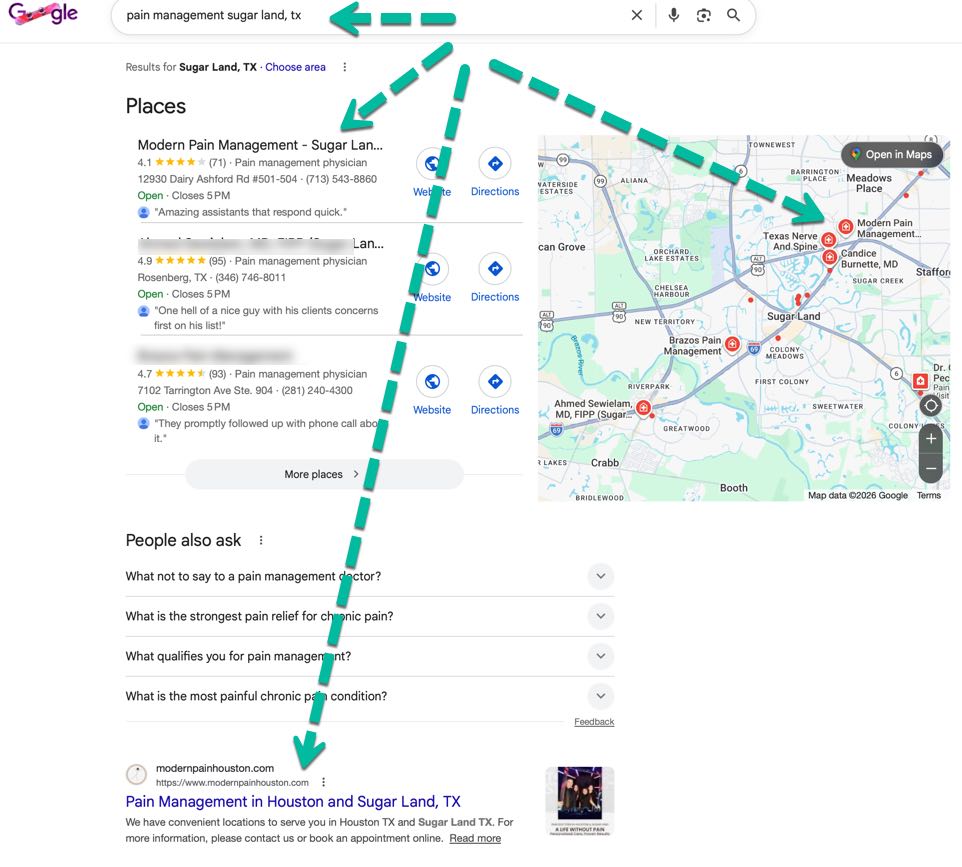
Example 1: Local SEO For Healthcare / Pain clinic in Texas
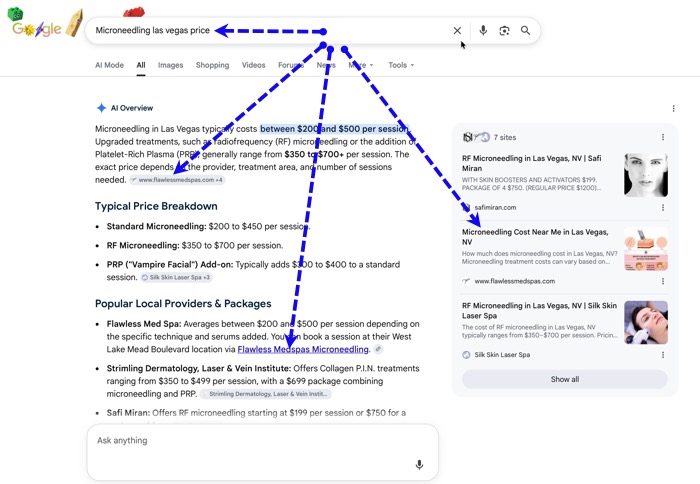
Example 2: Local SEO For Healthcare / Med spa in Las Vegas
Packages for Local SEO (Search Engine Optimization) For Healthcare Practices
PatientGain offers healthcare-specific local SEO and marketing packages priced from $899 to $2999+/month, depending on market competition. All tiers are HIPAA-compliant, generally require no upfront setup fees with a 12-month commitment, and include a managed mobile-optimized website alongside a comprehensive suite of digital apps.
PatientGain categorizes its primary monthly subscription packages into these main tiers:
- GOLD Service (~$899/month): Best suited for single locations in low-competition or rural areas. It includes a HIPAA-compliant medical website, secure patient lead storage, and around 10 essential apps covering CRM, lead tracking, and basic social posting.
- PLATINUM Service (~$1699/month): Their most popular tier, designed for medium-competition/suburban markets. It adds robust monthly SEO content, high-frequency Google Business Profile (GBP) posting (around 20 posts/month), AI/Answer Engine Optimization (AEO), and monthly targeted email marketing.
- PLATINUM PLUS Service (~$2999/month): Built for high-competition areas or multi-location practices. This tier features double the service-based content, infographics, advanced Voice AI and Missed Call apps, and optimization for YouTube channels. High-frequency Google Business Profile (GBP) posting (around 30 posts/month).
- CUSTOM Service – Requires upfront setup costs – This is very much like traditional healthcare marketing agency.
- Multi-Location Service – PatientGain’s multi-location service is a HIPAA-compliant, all-in-one digital marketing and patient acquisition platform tailored for healthcare organizations with multiple clinics. It provides centralized control, local SEO, and medical apps to support 4 or more locations, typically costing $500 to $800 per month per location.
These packages rely heavily on proximity-based SEO. Key technical local SEO features.
Are PatientGain services Done-For-You? Will I get timely support?
Yes, PatientGain services are explicitly structured as Done-For-You (DFY) marketing solutions, meaning their team handles the execution while providing direct, dedicated human support. You will not be left to manage a complex system by yourself.
The “Done-For-You” Execution
According to PatientGain’s Service Model, they do not expect medical practices to design websites, configure SEO frameworks, or write clinical marketing content. Their service includes:
- Fully Managed Setup: They design and optimize your HIPAA-compliant website and handle all the backend technical integrations.
- Content & Campaigns: Their staff creates the monthly SEO blog posts, builds infographics, and handles regular posting to your Google Business Profile (GBP) or social channels based on your package.
Customer Support Structure
PatientGain avoids generic ticketing queues and automated bots for customer service. Instead, they provide high-touch support through a dedicated structure:
- Assigned Account Team: Your practice is assigned a specific “team” consisting of human 1) project manager and 2) technical lead. You communicate with the same people regularly rather than explaining your practice to a new support agent every time.
- Direct Communication Channels: You can contact your dedicated manager directly via text messaging through your provider dashboard, email, or scheduled Zoom video consultations.
- Daily Training Availability: They offer live web-based training sessions every single business day to help your staff learn how to read patient dashboards, monitor incoming leads, and handle secure communications.
- No Extra Charges For Support: There in limit on how many times you meet your project manager and technical lead or how many questions you ask. There no extra charges for support tiers etc. All customers are important. You will be treated professionally. If the project manager and technical lead cannot answer your questions, they will get the right resource to assist you and setup a follow up Zoom meeting.
 Send Text
 How may I help you?