

How to Measure Healthcare SEO ROI
Measuring Healthcare SEO ROI (Return on Investment) involves comparing the revenue generated from new patients acquired through organic search against the total cost of your healthcare SEO efforts. The cost of these efforts can be simply amount you pay per month to an outside company, like a medical marketing company, or the cost of time spent by your internal staff members. Either way, the cost of healthcare SEO efforts is significant.
1. The Core Formula
The standard calculation for healthcare SEO ROI is:
[(Revenue from SEO Patients – SEO Investment) / SEO Investment] x 100.
- Example: If you spend $2,000/month on SEO and generate 5 new patients worth $1,000 each ($5,000 total revenue), your ROI is 150%.
2. Identify Your SEO Investment (Costs)
Calculate all monthly or annual expenses related to search optimization:
- Agency or Consultant Fees: Recurring monthly retainers.
- Content Production: Costs for medical writers, video editors, or blog posts.
- SEO Tools: Subscriptions like Semrush or Ahrefs.
- Technical & Development: Web developer time for site speed and mobile optimization.
3. Track Conversions and Attributed Revenue
Since healthcare is lead-based rather than direct e-commerce, you must bridge the gap between “clicks” and “office visits.”
- Patient Lifetime Value (LTV): This is the most accurate way to measure long-term ROI. Multiply the average treatment value by the number of visits per year and the expected years of retention.
- Conversion Tracking: Use Google Analytics 4 (GA4) to track “events” such as appointment requests, contact form submissions, and newsletter sign-ups.
- Call Tracking: Implement software like CallRail to track phone calls originating from organic search. Dynamic Number Insertion (DNI) can identify exactly which keyword led to a call.
- CRM Integration: Connect your website leads to your Electronic Health Record (EHR) or Customer Relationship Management (CRM) system to verify which leads actually became paying patients.
4. Alternative Measurement: Organic Traffic Value
If you cannot yet track direct revenue, calculate the “Cost Savings” of your SEO.
- Find the keywords your site ranks for in organic search.
- Determine the current Cost-per-Click (CPC) for those same keywords in Google Ads.
- Multiply your organic traffic volume by the CPC to see how much you would have spent to “buy” that traffic.
5. Essential Tracking Tools
- Google Analytics 4 (GA4): For monitoring organic traffic sources and conversion events.
- Google Search Console: To track keyword rankings and click-through rates.
- Google Business Profile: Crucial for local SEO ROI, tracking calls and direction requests directly from the “Map Pack”.
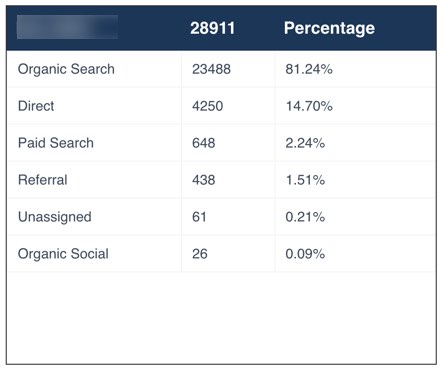
Example of a very successful healthcare practice. They are generating majority of the business from SEO. In the example below 81% of the traffic is being generated from SEO. There are 28,911 total website visitors in the month of September. 23,488 are from SEO. This customer is using PLATINUM+ service from PatientGain.
Why PatientGain’s Healthcare SEO ROI Is More Predictable
PatientGain’s healthcare SEO ROI is more predictable due to its integrated platform, specialized healthcare focus, conversion-optimized design, and robust tracking and analytics. These factors work together to generate a high volume of qualified leads, which are then effectively converted into paying patients. These patients can be insurance based or cash-pay patients, depending on your practice type.
There are 4 key areas, strategies, applications, and best practices developed by PatientGain over the last 10+ years.
1. Focus on Conversions and Patient Acquisition
Instead of focusing solely on search engine rankings, PatientGain’s platform is designed to convert website visitors into actual, booked patient appointments.
- Conversion-Optimized Design: Websites are built with proven, “semi-custom” designs specifically for medical and dental practices, which have been A/B tested for high conversion rates.
- High-Intent Visitor Targeting: The platform attracts users searching for specific services (e.g., “best acne treatment” or “pediatrician in [city]”) who have a high probability of booking an appointment, leading to more reliable lead generation.
- Measurable Leads: Success is measured by “effective leads” captured through appointments, new patient calls, direct-text-messages from the practice website, insurance checks, and chatbot questions, which provides clear metrics on patient acquisition costs (CAC) and lead conversion rates. All leads are documented in the leads funnel app.
2. All-in-One, Integrated Platform
By offering an all-in-one solution, PatientGain streamlines the entire patient journey and centralizes data collection.
- Replaces Multiple Vendors: The platform replaces various standalone services (website, SEO, apps, CRM, tracking) with one integrated system, reducing complexity and potential data leakages.
- Seamless Tracking: The system integrates data from all marketing channels (website, Google Ads, social media, call tracking) into a single HIPAA-compliant CRM, enabling accurate attribution and ROI calculation.
- Lead Leakage Minimization: Tools like the SPOC (Service Point of Contact) app ensure that inquiries via phone, chat, or forms are immediately captured and tracked, minimizing missed leads and maximizing the return on marketing spend.
3. Healthcare Specialization and AI
PatientGain’s strategies are specifically tailored to the nuances and regulations of the healthcare industry.
- HIPAA Compliance: All lead capture, communication tools (forms, chatbots, texting), and data management are HIPAA-compliant, which is crucial for building patient trust and avoiding legal issues.
- AI-Powered Optimization: The use of AI to analyze patient search behavior, optimize ad campaigns, and assist in content creation results in more effective and efficient marketing strategies compared to generic approaches.
- Industry Expertise: A team with specific expertise in medical and dental marketing understands how to navigate the unique challenges of the sector, from building authority with medical content to handling patient acquisition.
4. Data-Driven Framework and Analytics
PatientGain emphasizes robust analytics and data to drive continuous optimization and predictable outcomes.
- Robust Analytics: The platform provides clear metrics and KPIs (Key Performance Indicators) for tracking performance, which helps practices understand exactly where their investment is yielding results.
- Continuous Improvement: Data from A/B testing and analytics are used to continuously refine strategies, ensuring the best possible conversion rates and sustained growth.
- Long-Term Focus: While SEO requires an upfront investment, the compounding effect of organic growth over time, coupled with high patient lifetime value (LTV), makes the ROI highly predictable and sustainable.
What does PatientGain’s healthcare SEO strategy prioritize?
PatientGain’s healthcare SEO strategy prioritizes patient acquisition and conversion into actual paying patients, rather than just focusing on high search engine rankings alone. The core priorities include:
- Conversion-Focused Design and User Experience: The primary goal is to guide website visitors through a clear patient journey toward taking action (e.g., booking an appointment or calling the practice). Websites are optimized for speed, mobile use, and intuitive navigation to facilitate this process.
- Targeting High-Intent Patients: The strategy focuses on attracting users who are actively searching for specific medical services (e.g., “urgent care near me” or “best acne treatment”) and are more likely to convert into paying patients.
- Creation of High-Quality, Credible Content: The company emphasizes developing unique, medically accurate content that educates patients and builds trust (adhering to Google’s E-E-A-T guidelines). This content is designed to answer patient questions and establish the practice’s authority in its specialty.
- Local SEO Optimization: A major focus is on ensuring practices appear prominently in local search results and maps for “near me” searches, which is where a majority of patient searches occur.
- Measurable Results and ROI: Success is tracked using key metrics like conversion rates, cost per acquisition (CPA), and actual lead volume rather than vanity metrics like general website traffic. This data-driven approach allows for continuous optimization and a clear demonstration of ROI.
- Compliance and Trust: All strategies and tools are built to be HIPAA-compliant, and reputation management (acquiring positive patient reviews) is a crucial component to build online credibility and trust.

 Send Text
 How may I help you?