

Growth Focused Healthcare Marketing Companies
To successfully scale a medical or a dental practice from a single clinic to multi-locations, you need a marketing partner for growth and equipped with scalable AI technology, HIPAA compliance, healthcare SEO authority, paid advertising, and centralized ROI based marketing dashboards. Top-tier agencies in this space build success-based best practices yet locally-tuned acquisition playbooks to ensure rapid, profitable launches in every new territory.


Healthcare Marketing Companies For Growth: Table Of Contents
What is a Growth Focused Healthcare Marketing Company?
What is Multi Location Healthcare Marketing?
What are the main differences between a single location marketing vs multi-location marketing for healthcare practices?
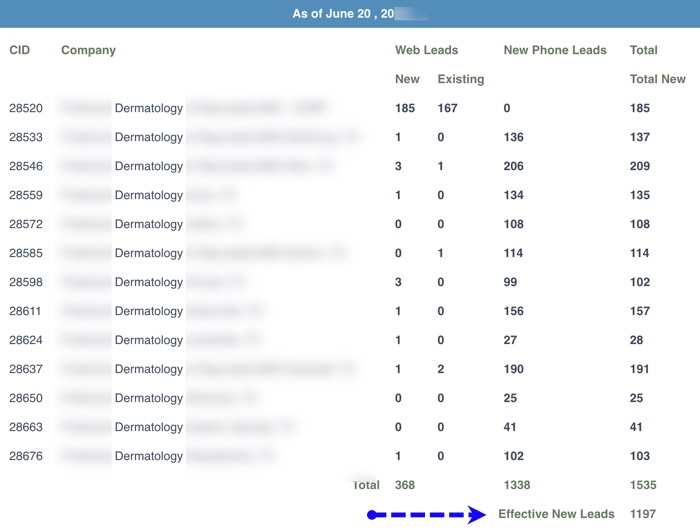
Example 1: Marketing dashboard of a dermatology practice MSO – Multi-location setup
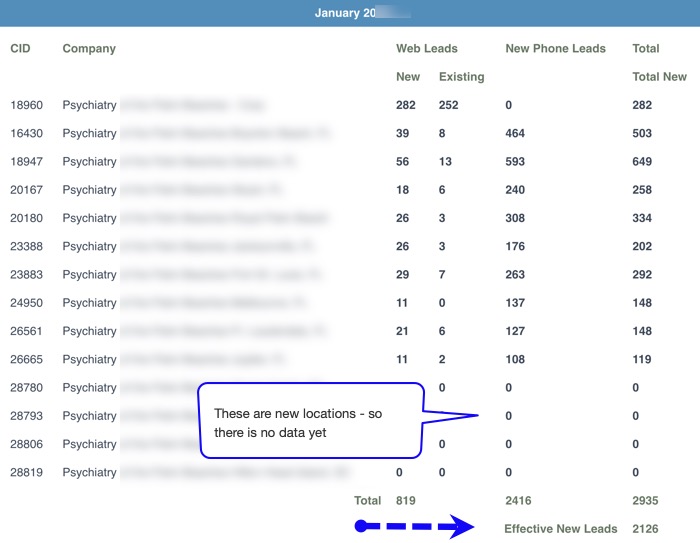
Example 2: Marketing dashboard of a psychiatry practice – Owner led (mental health provider), organic growth – Multi-location setup
The Core Challenge: Central vs. Local Tension
Who Needs Multi-Location Healthcare Marketing
What is PatientGain Pricing for Multi-Location Healthcare Marketing
The 7 Core Components of PatientGain’s Multi-Location Healthcare Marketing Solution
What is a Growth Focused Healthcare Marketing Company?
A growth-focused healthcare marketing company is a highly specialized digital agency that connects marketing spend directly to measurable revenue metrics like new patient acquisitions and practice profit. Unlike traditional branding agencies that focus on abstract metrics like “impressions,” “likes,” or website traffic, growth-focused companies focus strictly on patient acquisition, capacity optimization, and return on investment (ROI).
Traditional Branding vs. Growth-Focused Agencies
| Feature | Traditional Healthcare Branding Agency | Growth-Focused Healthcare Marketing Company |
|---|---|---|
| Primary Metric | Brand awareness, website traffic, logo design. | Patient volume, revenue growth, cost per acquisition. |
| Tracking Focus | Ad impressions, clicks, page views, video views. | New patient calls, appointments, SMS/Text Messages with “new patient” tracking, actual arrivals, patient retention (integrated Email Marketing) |
| Budget Approach | Fixed monthly retainers based on creative assets produced. | Performance-optimized budgets adjusted based on conversions and data analytics – Live new patient dahbaords |
| Tech Stack | Content management systems, social media schedulers. | Google Cloud Fast Website (Mobile Devices), server-side tracking, HIPAA-compliant CRM, Full BAA for apps and service, Single Point of Contact App (prevention of leads leakage) |
What is Multi Location Healthcare Marketing?
Multi-location healthcare marketing is a strategic branch of healthcare marketing designed to promote medical practices, franchise systems, clinics, dental practices, mental health providers, that operate across multiple physical locations, but they require proximity marketing for each location. Multi-location healthcare marketing is the strategy, technology, and operational framework used by healthcare organizations that operate two or more clinic locations — whether that’s a 3-location urgent care group, a 15-location dermatology MSO, a dental franchise, or a PE-backed specialty network — to attract new patients, manage their brand, follow HIPAA compliance, and track performance across all locations simultaneously from a single system.
What are the main differences between a single location marketing vs multi-location marketing for healthcare practices?
The main difference lies in scale, complexity, and structure. Single-location marketing focuses on winning a specific radius with a highly personalized touch. Multi-location marketing requires a dual-layer strategy that balances a unified corporate brand with automated, AI based, hyper-local execution for each clinic.
1. Website Structure and SEO Strategy
- Single Location: Operates on a simple website. The entire homepage is optimized for one city or neighborhood (e.g., “Wellness practice in Irvine”).
- Multi-Location: Requires a complex “parent-child” website architecture. The main domain holds corporate authority, while distinct, geo-targeted landing pages are built for each specific clinic (e.g.,
/locations/austin,/locations/dallas).
2. Google Business Profile Optimization and Posts for Each Location
- Single Location: Manages a single Google Business Profile listing. Reputation management, photo updates, and review replies are easily handled manually.
- Multi-Location: Manages tens, hundreds, or thousands of individual listings. This requires multi-location verification, specialized reviews management software, GBP posting 20 to 30 times per month, for each of the locations.
3. Advertising Budgeting and Ad Management
- Single Location: Features a single, straightforward ad budget. Google and Meta ads target a single geographic radius around the clinic.
- Multi-Location: Requires fractured, location-specific ad budgets. Capital must be dynamically shifted to support struggling locations, new openings, or specific providers, using hyper-targeted geo-fencing for each zip code.
4. Brand Control vs. Local Autonomy
- Single Location: Total creative freedom. The provider or office manager can request changes website copy, social media posts, or promotions instantly without approval layers.
- Multi-Location: Strict brand governance. Corporate marketing must enforce rigorous style guides to ensure visual consistency, while providing local clinic managers with approved templates for localized community outreach.
5. Compliance and Data Infrastructure
- Single Location: Relies on simpler, often disconnected software systems. Patient data handling is localized and easier to audit for HIPAA compliance.
- Multi-Location: Requires centralized, enterprise-grade software. All forms, call-tracking numbers, and scheduling tools must integrate into a single, highly secure, HIPAA-compliant CRM to track patient lifetime value across the entire network
Example 1: Marketing dashboard of a dermatology practice MSO – Multi-location setup
This single dashboard allows the owner/investor of the MSO to see maareking ROI from a single live dashboard of every location. And she has the ability to drill down to each location. Each practice manager for each location has complete marketing information about their own location (Meaning restricted access).
Example 2: Marketing dashboard of a psychiatry practice – Owner led (mental health provider), organic growth – Multi-location setup
This single dashboard allows the owner – who is a mental health provider, to see marking ROI from a single live dashboard of every location. And she has the ability to drill down to each location. Each practice manager for each location has complete marketing information about their own location (Meaning restricted access). This customer is using PatientGain’s multi-location service. They have grown from 2 locations to over a dozen locations.
The Core Challenge: Central vs. Local Tension
| Centralized Need | Local Need |
|---|---|
| Consistent brand voice and visual identity | Location-specific SEO for each city/neighborhood |
| One HIPAA compliance framework and BAA | Each location’s own Google Business Profile |
| Single reporting dashboard for the C-suite | Location-specific ad campaigns by market competition |
| Coordinated review response tone | Local patient reviews and community reputation |
| Shared ad audience data across locations | Local service mix may differ by location |
| One vendor contract, one invoice | Each location needs individual performance tracking |
A regional medical group with 10 locations that handles this poorly ends up with 4 to 6 separate agency relationships, 10 different website vendors, 10 separate texting tools, 10 separate ad accounts — and a CFO who cannot answer “what is our cost per acquired patient across the network?” This is a common scenario is you have grown your multi-location healthcare practice by acquisitions.
Who Needs Multi-Location Healthcare Marketing
- MSOs (Management Services Organizations) managing 2 to 200 clinic locations
- PE-backed specialty groups (dermatology, dental, orthopedics, ophthalmology, weight loss – see complete list from PatientGain’s specialties)
- Urgent care chains and franchise networks
- Hospital-affiliated outpatient clinic networks
- Multi-location med spas and aesthetic practices
- Multi-state specialty groups (pain management, behavioral health, fertility)
What is PatientGain Pricing for Multi-Location Healthcare Marketing?
For medical groups, MedSpas, or dental networks operating multiple physical clinics, PatientGain offers a specific volume-discounted pricing tier to centralize technology and reduce overhead. The Multi-Location Marketing Package is currently priced at $500 to $800 per month, per location. (Note: Just like PatientGain‘s single-location packages, the massive upfront custom setup fee is typically waived if the organization signs a standard 12-month contract).
Why the Per-Location Cost is Lower
If a practice only has one single clinic, they typically pay for the standard PLATINUM tier ($1,699/month). However, when you have 5, 10, or 50 locations, PatientGain drops the per-location cost to the $500–$800 because the heavy technical lifting (building the core corporate website, apps, AI agents, setting up the AI infrastructure, and securing the main HIPAA-compliant servers) is centralized. The per-location fee covers the localized execution.
What is Included in the Multi-Location Package
At this pricing tier, PatientGain provides the infrastructure for a “Hub and Spoke” marketing model:
- One Centralized Corporate Website: Instead of buying separate domains for every clinic, PatientGain builds one powerful main website hosted on Google Cloud. This website hosting is not like any other website hosting. This is the enterprise grade, top of the line servers on GCP.
- Localized Sites: PatientGain builds highly optimized, dedicated sub-pages for every physical clinic within the main site. This ensures the Dallas location ranks for Dallas searches, and the Austin location ranks for Austin searches.
- Granular Local SEO: Active management of the individual Google Business Profiles (GBP) and local directory listings for every single physical office. Posting to GBP posts 20 times per month, for each location.
- Multi-Tiered CRM Dashboards: * Corporate View: The executive team gets a global dashboard to monitor patient acquisition costs, total lead volume, and ROI across the entire organization.
- Local View: Individual clinic managers get a localized dashboard where they only see the patient data, AI chatbot transcripts, and secure texts for their specific building.
- Elimination of Third-Party Licensing Fees: Because PatientGain owns its 20+ healthcare apps natively, your network does not have to pay extra per-location software fees for AI chatbots, two-way texting, or automated review generators.
- Dedicated Account Management: A project manager coordinates the brand strategy across all locations to ensure localized ad campaigns do not compete against each other in Google search rankings. Each project manager is paired with a technical lead. Both project manager + technical leads are present on Zoom meetings with your team.
The 7 Core Components of PatientGain’s Multi-Location Healthcare Marketing Solution
1. Unified Hub Website with Location-Sites
Instead of building and maintaining a separate website for every clinic, a multi-location marketing platform creates one main hub website with individual, SEO-optimized sub-pages for each location. Each sub-page functions as a local location-site with:
- Location-specific address, phone, hours, and Google Maps embed
- Locally targeted keywords (“dermatologist in Henderson NV” vs. “dermatologist in Summerlin NV”)
- Location-specific provider bios and service listings
- Location specific promotions
- Location specific “predictive reverse search engine” is turned on.
- Individual conversion paths (call, chat, book online) routing to that clinic’s front desk
This approach avoids the SEO cannibalization problem where multiple locations compete against each other for the same search terms.
2. Local SEO at Scale
Each location needs its own local SEO footprint managed independently:
- Google Business Profile (GBP) — separate listing per location, optimized with correct categories, photos, hours, and posts
- Most overlooked: Posting on GBP every month 20 times — for every location
- Location-specific review velocity — each clinic needs its own steady flow of new Google reviews
- Local SEO content is added based on services provided by each location, and as suggested by the reverse search engine.
Manually posting on GBP for 10+ locations is operationally impossible without automation.
3. Corporate Roll-Up Dashboard
This is the most critical feature for owners, CMOs, and PE investors. A proper multi-location marketing system provides:
- Network-wide view: Total new patient leads across all locations in one screen
- Location-level drill-down: Which clinic is underperforming this month and why
- Channel attribution: Is Location 3’s lead volume coming from SEO, Google Ads, or social?
- Front desk accountability: Which location is leaving text messages unanswered for 4+ hours?
- Review leaderboard: Which location has the highest 5-star velocity; which has a reputation problem
- Cost per lead by location: Comparing ROI across markets with different ad spend levels
Without this, the owner of a 10-location group is receiving 10 separate monthly reports from 10 vendors — and still cannot answer basic performance questions.
4. Centralized HIPAA Compliance
Multi-location organizations face multiplied compliance risk. Every location generates its own patient data touchpoints — website forms, chat sessions, appointment requests, text messages. Without a centralized compliance architecture:
- Each location may be running non-compliant pixels, session replay tools, or contact forms
- Each vendor requires a separate BAA — a 10-location group using 8 vendors per location needs to track, renew, and audit 80 BAAs
- A breach at one location can expose the entire network if systems are interconnected without proper safeguards
A proper multi-location marketing platform issues one BAA that covers all locations and all tools — eliminating the fragmented compliance patchwork.
5. Coordinated But Localized Email Marketing
Automation & Content Creation: The service includes “done-for-you” content creation, saving staff time and ensuring 36+ campaigns per year (including seasonal and patient retention campaigns) – For Each location.
- The platform structures and executes email marketing for a large, multi-location practice using several key methods:
- Centralized Branding with Local Customization
- Unified Templates: PatientGain establishes master email layouts to keep brand colors, logos, and clinical voice consistent across all 30 locations (if you have a 30 location practice)
- Hyper-Local Updates: Even though the emails are built from a central source, they automatically dynamically swap out local phone numbers, clinic addresses, and specific regional calls-to-action (CTAs) depending on which location’s database is receiving the message.
- “Done-For-You” Content Generation & Setup – You simply need to “Approve” the final Email for each location.
- Automated Writing and Design: PatientGain’s platform uses AI models pre-trained on over 42 medical and dental specialties to automatically generate up to three high-quality, educational email newsletters per month (36 campaigns per year).
- Human Oversight (HITL): A dedicated PatientGain Project Manager and Technical Lead review every email blast .
- Simple Approvals: Your corporate or local practice managers do not have to write copy; they simply log into the platform, review the finished campaign, and click “APPROVE”.
6. Multi-Location PPC and Social Advertising
Running paid advertising for a multi-location group requires more than duplicating a single-location campaign:
- Geo-targeting must be set correctly so Location A’s ads don’t compete with Location B’s ads for overlapping zip codes
- Shared audience data — patient data from established locations can be used to build lookalike audiences that accelerate new or de novo location launches
- Budget allocation across locations based on capacity, competition level, and growth goals — not equal splits
- Conversion tracking that routes each ad click and phone call to the correct location, not a generic contact page
Ad management fee matters here: at $20,000/month in total network ad spend, the difference between 18% (PatientGain) and 35% (industry average) is $3,400/month in excess fees — $40,800/year.
7. Economies of Scale
This is where multi-location marketing fundamentally changes the financial equation:
Traditional agency model: Costs scale linearly. Adding Location 11 means adding another $3,000–$5,000/month in agency fees. 15 locations = 15× the cost.
SaaS platform model (PatientGain): Costs scale at a fraction. Each additional location adds $500–$800/month. 15 locations = roughly $7,500–$12,000/month total — for the same or greater output.
| 5 Locations | 10 Locations | 15 Locations | |
|---|---|---|---|
| Traditional Agency | $15,000–$50,000/mo | $30,000–$100,000/mo | $45,000–$150,000/mo |
| PatientGain Multi-Location | ~$3,400–$5,000/mo | ~$5,900–$8,000/mo | ~$8,400–$12,000/mo |
Common Failure Modes in Multi-Location Marketing
| Problem | What It Costs |
|---|---|
| Each acquired location keeps its own legacy vendor | Duplicated spend, fragmented data, no network-level reporting |
| No centralized GBP management | Individual locations drift out of sync — wrong hours, unanswered reviews |
| Separate BAAs per vendor per location | 50–120 BAAs to track and renew; one lapsed BAA = compliance gap across the network |
| SEO Canabilization | Lost rankings and hence new patients |
| Staff turnover at one location disrupts all vendor access | Marketing for that clinic stalls until access is recovered |
| No attribution across locations | Cannot identify which location has the best ROI on ad spend |
PatientGain’s Multi-Location Solution
PatientGain’s Multi-Location Service is built specifically for this problem:
| Feature | Details |
|---|---|
| Pricing | $500–$800/month per location |
| Setup cost | $0 upfront on 12-month contract |
| Website architecture | One unified hub + per-location-sites |
| BAA | Single BAA covers all locations and all 20 apps |
| Dashboard | Individual location view + corporate roll-up |
| Scalability | Designed for up to 200 locations |
| GBP management | All locations managed centrally; Social Auto-Pilot posts to all GBPs simultaneously – however local practice managers have access to local practice data |
| Reputation | Centralized review feed with HIPAA-compliant response templates |
| Ad management fee | 18% (vs. industry 25–40%) |
| Support | Dedicated project manager + technical resource for the network |
| EMR integration | OpenEMR included at no cost |
 Send Text
 How may I help you?