

HIPAA Compliant healthcare website development companies in USA serve hundreds of thousands medical providers and physicians.
United States had approximately 1.1 million licensed physicians and a workforce of over 818,000 physicians involved in direct patient care. Out of the total licensed physicians workforce, approximately 42.2% of physicians work in private practice. Most of them suffer with non-filled appointment calendars. There are approximately 2,876 healthcare website development companies. They can be divided in the following categories. However, all of healthcare website development agencies are not well versed in HIPAA compliance of Medical Website Development.
What are typical aspects of Medical Website Development?
Medical website development involves creating secure, patient-centric, and regulatory-compliant digital platforms that serve as the “digital front door” for healthcare providers. Key aspects focus on building trust, enabling easy access to services, and protecting sensitive patient data.
1. Regulatory Compliance and Security
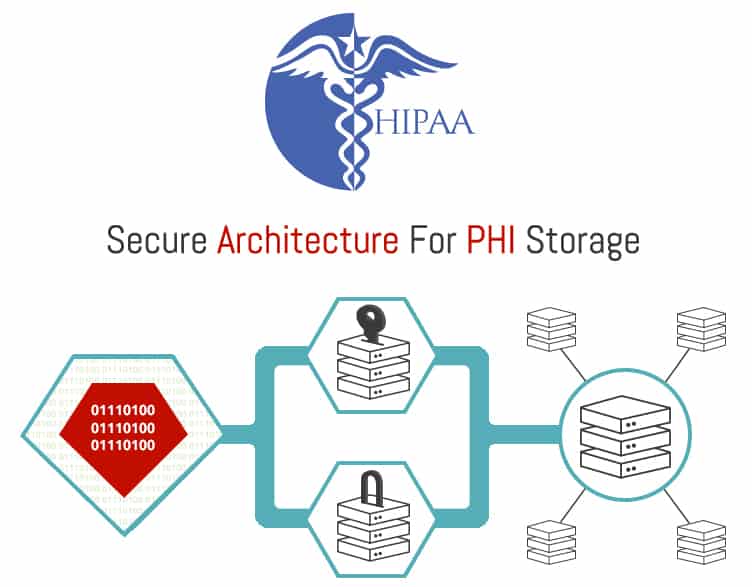
- HIPAA Compliance: In the U.S., websites must comply with the Health Insurance Portability and Accountability Act to protect Protected Health Information (PHI). This includes encrypted forms, secure hosting, and SSL certificates.
- Data Security: Implementing robust security measures like data encryption (at rest and in transit) and regular audits to prevent data breaches.
- Accessibility (ADA/WCAG): Designing for users with disabilities (e.g., visual or motor impairments) to comply with legal standards such as the Americans with Disabilities Act (ADA) and WCAG 2.1/2.2 guidelines.
2. Key Functional Features
- Online Appointment Scheduling: 24/7 self-service scheduling that syncs with the provider’s internal system to reduce staff administrative burden.
- Intelligent app on the website so patients can ask non-medical advice questions any time – 24×7 – Example includes like a SPOC app, from PatientGain.com, includes AI-powered chatbots to answer frequently asked questions and assist in triaging.
- Patient Portals: Secure, gated areas for patients to view test results, access medical records, message doctors, and request prescription refills.
- Telemedicine Integration: Embedded video conferencing for virtual consultations.
- Secure Communication: Encrypted contact forms and, a complete leads management system, called Leads Funnel. So every inbound lead or inquiry is “logged” and then can be answered by 1) Human (your front desk staff) 2) AI driven answers 3) Cookie-cutter smart answers (like please text me directions – I am lost)
- Online Bill Pay: Integrated, secure payment gateways.

3. User Experience (UX) and Design
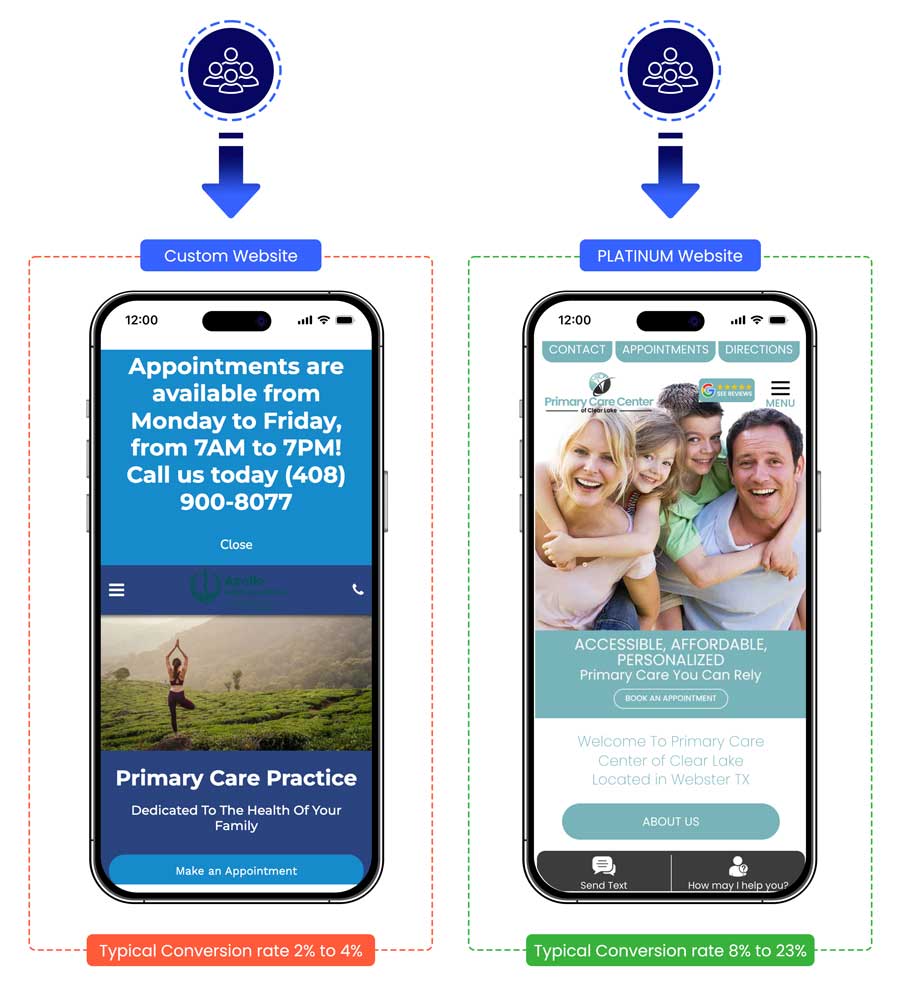
- A/B Tested design: This is a common missed area. Because over 98% of medical websites are never A/B tested, most healthcare websites have a low average conversion rate of 2% to 4.2%. Due to the lack of optimization, many sites fall into this range due to visual-focused, non-tested designs, while A/B tested and optimized sites can often achieve higher conversion rates, frequently exceeding 10%. Examples include PatientGain.com’s PLATINUM websites.
- Mobile-First Design: Ensuring full responsiveness, as over 70% of patients research healthcare options on mobile devices.
- Intuitive Navigation: Simple, clear, and patient-focused structure that helps users find information (services, doctors, locations) in a few clicks. Even the navigation of the menus should be A/B tested.
- Trust-Building Elements: Detailed bio of the providers. Separate page for new patients, separate page for existing patients, separate page for billing questions and insurance and payments (common complaints from patients is that website does not have enough information about billing practices of the clinic). Separate page for directions and proximity and location.
4. Content Strategy and SEO
- Local SEO: Optimization with “near me” keywords, Google Business Profiles, and location-based pages to attract local patients.
- Posting on Google Business Profile at least 20 times per month – also called high frequency posting.
- Educational Content: Providing accurate, reviewed, and regularly updated health information, service pages, and FAQs to build authority.
5. Development Process
- Discovery & Planning: Defining goals, user personas, and project scope (3–8 month typical timeline).
- EHR/EMR Integration: Connecting the website with Electronic Health Records for seamless data flow.
- Testing and QA: Rigorous testing for security, functionality, and performance.
Commonly, healthcare websites are built using robust Content Management Systems (CMS) like WordPress (with custom secure plugins) or specialized healthcare web platforms like PatientGain.com’s PLATINUM service.
Medical Website Development Costs and Approaches
Category 1: Medical Website Development Custom Solutions
These companies develop a custom solution for your direct needs. They will often consult with you, your staff, and and provide ideas. Then ideas can be converted to visual examples first. Once the visual examples are “approved” by your practice’s team then the will hire coding experts, or may have this service in house. These are expensive and can cost anywhere from $8000 to $50000 for healthcare practice website, for a single location. If you have multi-location, telemedicine and some other type of practice that requires specific custom requirements, then it will cost even more. There thousands of good companies who offer these services.
Category 2: Medical Website Development Template Based Solutions
These offerings are very common. In fact majority of the practice websites are based on these. Example can be a company that uses WordPress, or WebFlow or Framer website development system. These are very good options. The most advanced and complete system we have seen in the last 10+ years of experience is WordPress (wordpress.org) So you cannot go wrong with WordPress. The issues we have seen are when website development companies use inexpensive templates on top of WordPress. If used incorrectly, these additions can make your website slow and certain cases too heavy by adding many plugins. These solutions can be $2000 to $3000 for an inexpensive medical practice websites. These could work for your health care practice if you are looking for a place-holder or you are in a rural area and there is very little competition. The main issues you still need to worry about isHIPAA compliance of the website, and any information that initiates from the website. It is important that your website company provides you with a BAA. (Business Associate Agreement)
Category 3: Design driven solutions – For Ease of Use and DIY
These solutions are very attractive options for those practices who want to do-it-yourself. The costs are very reasonable.
- Wix: Offers a drag-and-drop interface, a vast template library, and built-in tools for SEO, forms, and bookings, making it ideal for beginners.
- Squarespace: A popular choice for its professional templates, user-friendly interface, and integrated features, particularly for bloggers.
- Weebly: An extremely simple platform, great for those who need to get a basic website up and running quickly.
Category 4: Proven A/B Tested Data driven solutions – with focus on ROI (Return-on-Investment)
These solutions are typically offered by professional companies like PatientGain.com. These are tested for A/B results and ROI. They typically go through thousands on iterations and many hundreds of tests. These solutions include websites, apps, AI based automation, excellent human customer support and HIPAA compliance.
PatientGain.com’s medical marketing solutions are unique due to their integration of HIPAA-compliant AI, automation, and a full suite of tools on a single platform specifically for healthcare practices. Instead of requiring multiple vendors, PatientGain offers a comprehensive system for patient acquisition and engagement that includes AI-powered websites, apps, SEO, advertising, patient communication, and a CRM, all backed by human expertise and support.
Key Differentiators
- Specialized Healthcare Focus: PatientGain is not a general marketing company; it is a specialized platform for the healthcare marketing, understanding the unique complexities and regulatory requirements, especially HIPAA compliance.
- Integrated Platform: It provides an all-in-one solution, consolidating various services like website creation, SEO, advertising, social media apps, patient communication apps, and a HIPAA-compliant CRM into one platform. All this is offered for a subscription pricing, with no upfront costs.
- AI and Automation: The PatientGain.com platform heavily utilizes AI-powered agents and machine learning to automate tasks, improve website performance, and optimize marketing campaigns for better conversion rates and ROI.
- Human Support and Expertise: In addition to its technology, PatientGain provides top-tier human customer service, including assigned project manager and a senior technical resource, to ensure practices get the personalized attention and support they need without having to hire extra staff. Project managers and technical lead staff are assigned to your account. And you work with the same team.
- Regulatory Compliance: All of its websites and applications are built to be HIPAA compliant, adhering to strict healthcare data privacy and protection regulations.
- Focus on Patient Experience: The solutions are designed to enhance the patient journey, from their initial online interaction to seamless contacting your practice (SPOC app) and communication, building trust and improving patient care.
Examples of PatientGain Marketing
Example 1: Medical website designs with A/B tested results.
PatientGain-designed websites are unique in their integration of a patient-centric, HIPAA-compliant, and high-conversion design strategy focused on driving patient acquisition and engagement. Key features include a user-friendly, mobile-optimized design, AI-powered engagement app like SPOC app, two-way texting, A/B tested layouts for effectiveness, data-driven insights via dashboards, and built-in features for social proof and clear calls-to-action to build trust and encourage appointment booking.
Example 2: Healthcare website designs with live AI based dashboards for your practice
Your medical and dental practice needs advanced real-time AI based medical marketing dashboards (Based on AI Agents and Apps). Marketing dashboards that provide real-time data are handy for those in charge of marketing. Many dashboards are set up with top key performance indicators (KPIs) updating in real-time for them. The priorities for each marketing manager will be different for each dental practice. The priorities for a marketing manager may change throughout the year. Customization allows them to get the data they need right now for that time of year.
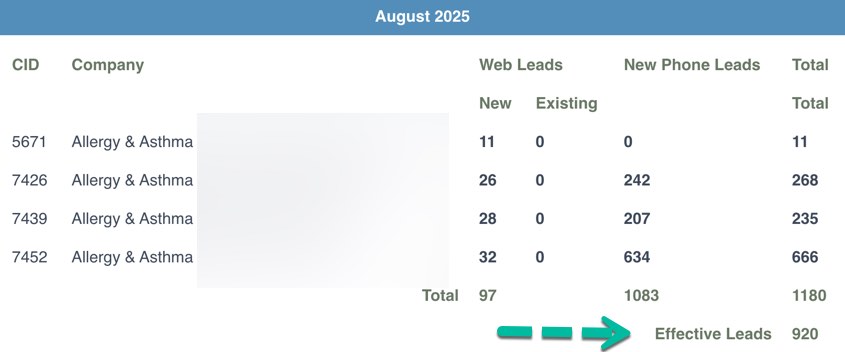
Example of a real customer medical marketing that offers allergy and asthma services in one of the most competitive areas of US. In the month of August, there are total of 920 new patient website inquiries, leads, referrals, contact-us, new patient calls, and appointments.
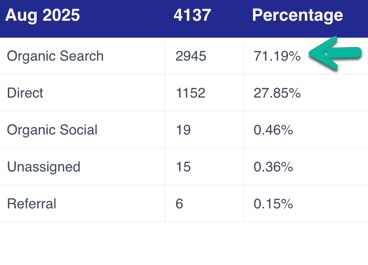
Digging deeper, you will see that 91.19% of all new patient website inquiries, leads, referrals, contact-us, new patient calls, and appointments are coming from the SEO of this practice. Hence the website and SEO, and conversion strategies are working very effectively. This customer is using PLATINUM monthly service.
Example 3: Healthcare website with Social Auto Pilot app
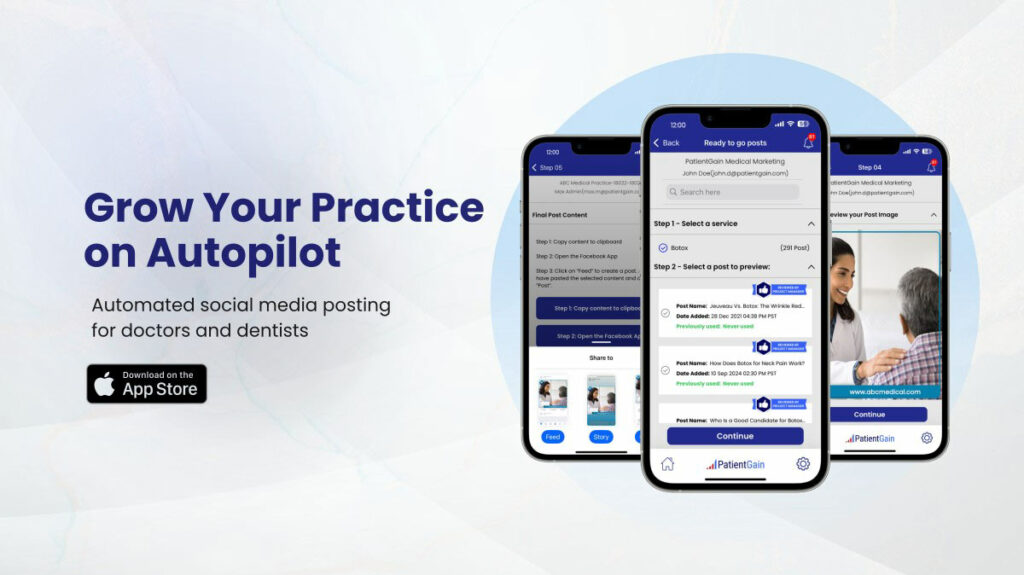
PatientGain’s Social Autopilot is a comprehensive social media management tool specifically designed for medical and dental practices. It’s a content AI application that aims to streamline and enhance a practice’s social media presence. For a monthly fee, it offers a range of features and benefits to help healthcare professionals save time, increase patient engagement, and stay current with social media trends. It is also included as a part of the PLATINUM service.
Key Features:
- Multi-Platform Management: It provides a centralized dashboard for services specific content for your medical or dental practice. Your staff does not need to “CREATE CONTENT” every month. PatientGain AI App creates the content, and then a human Project Manger reviews the content. This includes Facebook, Instagram, and Google Posts. This eliminates practice manager’s worries about creating content for 3 most important social media platforms.
- AI-Powered Content Optimization: The application utilizes artificial intelligence to analyze the services you offer and content is based on your services. For example if your medical clinic offers treatment for medical weight loss using GLP-1, you will see posts related to GLP-1 and your practice, with specific Call-To-Action for your practice.,
- Specific Customization: Social Autopilot creates customized content, however, you can still further customize the content to align with your specific brand identity and messaging. This ensures that the automated posts still reflect the unique voice and style of the practice.
- Time-Saving Automation: By automating the content creation and posting process, Social Autopilot frees up valuable time for healthcare professionals and their staff, allowing them to focus on patient care and other essential tasks.
 Send Text
 How may I help you?