

What is a Good Marketing ROI (Return On Investment) for Dental Practices?
A good marketing ROI for dental practices is generally considered to be 300%-500% or better, meaning for every $1 spent, the practice generates $3-$5 in return. High-performing campaigns can even exceed this, sometimes reaching 9x, meaning 900% or more. Scroll down below and see some examples from PatientGain’s PLATINUM service for dental practices.
Table of Contents
Why a dental practice should know the ROI?
Understanding LTV (Life Time Value) of Patients
Dental Practice Marketing ROI (Return On Investment) Calculation
What is dental FVS?
What is dental patient LTV?
What is dental patient conversion rate for your dental practice?
Use Case Example – Single location, general dentist with focus on Invisalign and dental implants
Use Case Example – 2 locations, general dentist with focus on bridges, clear aligners, dental implants
Introduction to PLATINUM monthly service
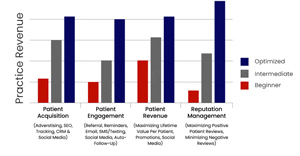

Why a dental practice should know the Dental Practice Marketing ROI?
- Effective Budgeting: Knowing the ROI helps a practice determine how much to spend on marketing and where to allocate the budget for the best results. It prevents wasting money on underperforming channels.
- Informed Decision-Making: Tracking ROI provides the data needed to make informed decisions about which marketing campaigns to continue or cut, rather than relying on guesswork.
- Maximizing Profitability: By focusing on high-ROI activities, a practice can increase patient acquisition and overall profitability. It helps identify which channels bring in the most valuable patients, not just the most leads.
- Justifying Marketing Spend: It provides a clear way to show that marketing is an investment that generates a return, rather than just an overhead cost.
- Measuring Success: ROI provides a clear metric to gauge the success of marketing efforts. For example, a campaign that costs $1,000 should ideally generate more than $1,000 in revenue to be considered successful.
- Improving Patient Acquisition: Understanding the cost per lead and conversion rate can help a practice improve its sales process and reduce the cost of acquiring each new patient.
Understand LTV (Life Time Value) of Patients VS FVS (First Visit Spend). Conversion Rate is Important to Measure Also.
Dental Practice Marketing ROI (Return On Investment) Calculation
First, the formula
Dental Marketing Return On Investment (ROI) Formula
(Total revenue generated Minus $ spend on campaign ) Divided by $ spent on a a campaign


Assuming in this example, the dental practice spends $2795 per month on dental marketing.
What is dental FVS?
FVS stands for first visit spend. For example 1 if Susan (a patient) saw your ad on Google search, and clicked on your ad, then requested an appointment, and finally became your patient. She spent $149 on special cleaning offer. Her FVS is $149.
For example 2 if Bob (a patient) saw your ad on Google search, and clicked on your ad, then requested an appointment, and finally became your patient. He spent $300 on a filling and $50 on X-ray. His FVS is $350.
In this example below, assume average FVS is $200.
The value of a new dental patient can range from hundreds to thousands of dollars, depending on factors like location, services offered, and patient loyalty. A conservative estimate for the first year is about $1,000, while the average lifetime value (LTV) for a general dentist is often cited between $$4,000 and $10,400 or higher especially when factoring in referrals and long-term care. On average, each new dental patient is worth $6,700.
What is dental patient LTV?
LTV stands for Life Time Value of each patient.
For example 1 if Susan (a patient) stayed with you for 6 years as a patient, and she spent $600 per year on routine dental services, her LTV is $3600
For example 2 if Bob (a patient) stayed with you for 6 years as a patient, and he spent $1600 per year on routine dental services, his LTV is $9600
In this example below, assume average LTV is $6700.
What is dental patient conversion rate for your dental practice?
The information here is from real customers and your results will vary.
If you have 100 new patient inquiries per month, and you are able to convince 30 patients to visit your practice for the first time as a new patient, then your conversion rate is 30%. inquiries/appointments/questions/leads etc originate from the websites. Hence a very successful dental practice not only provides excellent dental services, but also provides excellent intake and conversion experience for patients. Consider SPOC app from PatientGain, which replaces 5+ apps with a single point of contact app.
Example: 100 new patient inquiries per month resulted from a digital dental campaign using PatientGain’s PLATINUM Service
Assuming a conversion rate 30% – Dental practice has a very good staff, and they convert 30% on new inquiries to paying patients. This is equal to 30 new patients per month. Average is 30% conversion rate, for dental practices. Top dental practices are at 40+% rate. Low performing are typically at 20% or less. The main difference is how you answer the phones and how the incoming calls from patients are handled. Majority of new patients will call you. See data from a very successful practice – this practice receives hundreds of “new” patient inquiries every month. In the month of September, there are 569 new patient calls, and 31 new patient appointments (web leads) – This data is very similar from hundreds of practices. The typical ratio is 1 to 3 – so for each 1 new patient appointment request, we see 3 new patients who actually call the dental practice and want to ask questions and speak to a human person (not a Chat Bot). And if a call is missed, then you should an app called Missed Call for healthcare practices.
Use Case Example – Single location, general dentist with focus on Invisalign and dental implants
This dental practice is located in the eastern US, has been using PLATINUM+ monthly service for 5+ years. Majority of the new leads are from organic SEO ( Free) there is a $1800 per month Google PPC ads budget for Invisalign patients only. There is no other marketing spend.
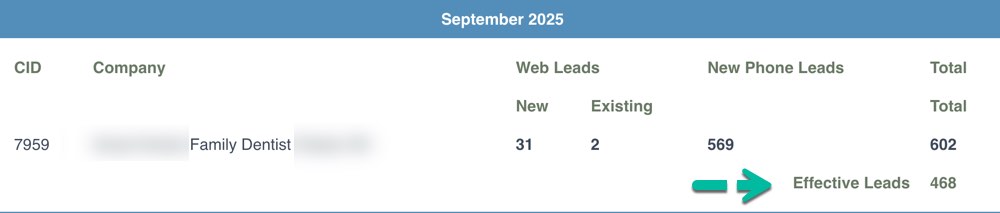
PLATINUM+ service $2000/mon + $1800 Google ads = $3800 /mon marketing spend. Effective leads is 468 in the month of September. Assuming good staff and good phone system, out of every 100 leads – 30 are converted to new patients – means 30% conversion rate. This is 140 new patients per month. Each new dental patient’s value is $6700.
Formula: (Total revenue generated Minus $ spend on campaign ) Divided by $ spent on a a campaign
140 x $6700 – $3800 divided by $3800 = 245 times or 24584 percentage.
Even if your front desk staff needs training and is not trained on how to convert incoming new patient inquiries, referrals & leads, and you convert only 15% as opposed to 30% the results are as follows:
Formula: (Total revenue generated Minus $ spend on campaign ) Divided by $ spent on a a campaign
70 x $6700 – $3800 divided by $3800 = 122 times or 24584 percentage.
1- General dentistry – Initial visit is $200 – LTV of each dental patient is $6700 (assuming you keep each patient for 6 years)
2- Cosmetic dentistry services – primarily Invisalign – Initial visit is $5000 and if you are good and convert and keep this patient for 5 years, LTV of each dental patient is $14000 (assuming you keep each patient for 5 years, and expand by referrals) – however we will not use this for this calculation.
Average LTV = $6700
So in each month ROI of marketing is:
Using Initial visit and revenue generated from each new patient:
34 new patients x $2600 = $88,400 – Divided by $2795 = 31 X (Calculated 31 X, or 31 times or 3100 %)
So your ROI is 31 Times = Using 34 new patients per month.
Using LTV – Life Time Value of each new patient:
34 new patients x $6700= $224,4000 – Divided by $2795 = 80 X
So your ROI is 80 Times = Using LTV 34 new patients per month.
This is an example based on 34 new patients generated. Your results may be lower or higher. There is no guarantee that you will see similar results. This is for illustration purposes only. The information here is from real customers and your results will vary.
Use Case Example – 2 locations, general dentist with focus on bridges, clear aligners, dental implants
Located in California, very competitive market. 2 locations, 4 providers, 6 dental assistants. Using PLATINUM+ solution
Marketing Dashboard – Month 1 to Month 8
In this dashboard, based on a real dental practice, the progress is documented with clear dashboards, and a project manager, plus a technical resource is available for any questions.
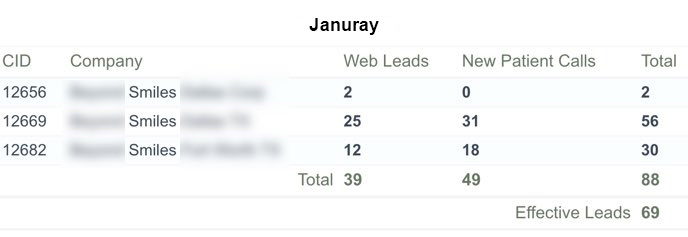
Month 1 data : 88 new patient inquiries, after subtracting repeat callers and sales calls, there are 69 real leads in the funnel system. Assuming conversion rate of 30%, this means 20 new patients. Assuming conversion rate of 20%, this means 14 new patients. 20% conversion rate means that out 69 new leads from phone calls, text messages, appointments, 14 new patients are acquired. If a dental practice has very good staff, and they are trained, the the conversion rate should be around 31% or higher.
………… Fast forward to month 7 and month 8
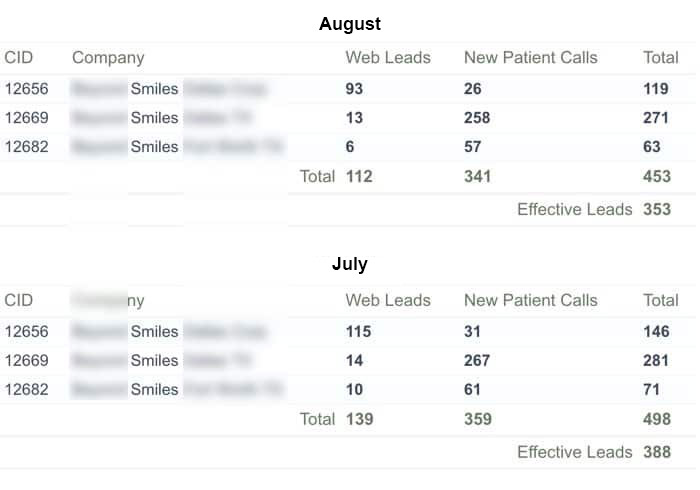
Month 7 data: 498 new patient inquiries / 388 effective leads.
Month 8 data: 453 new patient inquiries / 353 effective leads.
Using the data from month 8 / August :
Month 8 data: 453 new patient inquiries, after subtracting repeat callers and sales calls, there are 353 real leads in the funnel system. Assuming conversion rate of 30%, this means 105 new patients. Assuming conversion rate of 20%, this means 70 new patients.
General dentistry – Initial visit is $200 – LTV of each dental patient is $6600 (assuming you keep each patient for 6 years)
This customer is using PatientGain’s PLATINUM+ service, which is $2000/mon, in addition there is Google PPC campaign for $4000 per month.
PatientGain has hundreds of examples like these. Please set up a Zoom meeting and see ho we can add value to your practice.

 Send Text
 How may I help you?