

When building an intelligent and interactive healthcare website for a healthcare practice, what are the key important areas should addressed for HIPAA compliance?
When building a functional interactive healthcare website, you must address three main categories of safeguards defined by the HIPAA Security Rule: Technical, Administrative, and Physical.
1. Technical Safeguards (Systems & Software)
Technical safeguards focus on the technology used to protect electronic Protected Health Information (ePHI).
- Encryption Everywhere: Implement end-to-end encryption for all data. Use SSL/TLS certificates (TLS 1.2 or higher) for data in transit and AES-256 for data at rest on servers.
- Access Controls: Limit ePHI access to authorized personnel only. Use Multi-Factor Authentication (MFA) for all logins and implement role-based permissions so staff only see what is necessary for their job.
- Audit Controls & Logging: Maintain detailed logs of who accessed which records, what actions they took (viewing, editing), and the exact timestamps.
- Interactive Tools: Any interactive features like appointment schedulers, intake forms, patient portals, or live chats must be built on secure, encrypted infrastructures.
2. Administrative Safeguards (Policies & People)
Administrative safeguards are the internal procedures and oversight that ensure technology is used correctly.
- Risk Analysis: Conduct regular assessments to identify potential vulnerabilities in your website’s infrastructure.
- Business Associate Agreements (BAAs): You must have a signed BAA with every third-party vendor that “touches” your ePHI, including your web hosting provider, form builders, or email services.
- Workforce Training: All employees must receive regular HIPAA training on how to handle patient data and recognize threats like phishing.
- Incident Response: Establish a clear plan for detecting and reporting data breaches as required by the Breach Notification Rule.
3. Physical Safeguards (Facility & Equipment)
Physical safeguards protect the actual hardware and locations where ePHI is stored or accessed.
- Secure Infrastructure: Ensure your website is hosted in a data center with restricted physical access, video surveillance, and environmental controls.
- Workstation Security: Implement policies for screen locks and secure device disposal to prevent unauthorized viewing of patient data in your office.
Summary of Compliance Checklist
| Area | Key Requirement |
|---|---|
| Hosting | Choose a HIPAA-compliant hosting provider that signs a BAA. |
| Forms | Use encrypted healthcare web forms rather than standard contact forms. |
| Apps | Apps like ChatBots, Voice agents, Appointmnet apps, Texting apps, all must have a BAA with your healthcare practice. |
| Tracking Apps | Tracking and analytics apps like Meta Pixel, Google Tag manager, Google analytics are not HIPAA compliant. You must user server side tracking or obfuscation of PHI to protect PHI. |
| Login | Enforce strong passwords and MFA for patient portals. |
| Policy | Post a clear Notice of Privacy Practices and a HIPAA-compliant privacy policy. |
| Consent Management | As patients visit your practice website, you should have “consent” app collect the consent and store it in a HIPAA compliant database. This protects your practice and patients. Just accepting “cookies policy” is not sufficient per HIPAA guide lines |
| Backups | Ensure automated, encrypted data backups and test recovery regularly. |
Custom healthcare marketing solution VS Pre-built and conversion optimized solution (with your own branding)
Comparing building a custom healthcare marketing solution for 10 locations practice VS PatientGain.com’s PLATINUM service for 10 locations
Scaling a healthcare practice to 10 locations is a massive operational achievement, but it introduces a major structural challenge: you are no longer just trying to attract patients. You are managing a multi-clinic corporate brand, coordinating 10 different front desks, and multiplying your federal HIPAA liability by ten.
When comparing PatientGain’s PLATINUM Service to building a Custom Healthcare Marketing Solution (typically via a traditional boutique agency) for a 10-location enterprise, you are choosing between a highly efficient, fully managed software ecosystem, proven to produce results VS a bespoke, luxury-built mansion, just for your exact taste and requirements. However Custom Healthcare Website Builders usually focus on looks first, and sometime they have to introduce many visual elements to the design to please the practice owners. This typically results in 1) slow loading websites 2) lower conversion rates. As aesthetics are driving the build process, not ROI and best practices. This is true of mos Custom Healthcare Website Builders process. PatientGain started out as a Custom Healthcare Website Builder so we know how the process works.
Here is the breakdown of how these two paths compare at scale.
1. The Financial Reality (Cost at Scale)
Traditional custom agencies scale their pricing linearly (charging for human labor per location), while Software-as-a-Service (SaaS) companies like PatientGain scale horizontally.
- PatientGain PLATINUM: They use a specific “Multi-Location” pricing structure. You pay the base tier price for the main corporate hub (starting around $1,399/month) and a heavily reduced add-on fee for the additional locations (typically $500/month to $800/month per location).
- Estimated Monthly Cost: ~$5,899 approximately for all 10 locations.
- Upfront Setup Cost: Usually $0 (waived if you sign a 12-month contract).
- Custom Agency: Building a custom, 10-location HIPAA-compliant web architecture from scratch requires a massive upfront web development fee. Furthermore, agencies charge a monthly retainer per location for SEO, CRM management, and content generation. Cost of HIPAA compliance among different technology stacks can be extra.
- Estimated Monthly Cost: $10,000 to $20,000+ approximately per month.
- Upfront Setup Cost: $20,000 to $50,000+.
2. “HIPAA Leakage” and Vendor Sprawl
Managing patient data securely across 10 different physical clinics is your biggest operational liability.
- PatientGain PLATINUM (The Efficient Route): PatientGain operates as a “Walled Garden.” Because they natively built and own the website hosting, CRM, chatbots, intake forms, and 2-way texting apps, you sign one single Business Associate Agreement (BAA) that covers the entire 10-location enterprise. If a front-desk employee at Location #4 quits, your corporate manager revokes their access in one centralized dashboard, instantly cutting them off from all 10 clinics’ patient communications.
- Custom Agency (The High-Risk Route): Custom agencies build “franken-stacks.” They stitch together WordPress, HubSpot (CRM), CallRail (phone tracking), Birdeye (reviews), and Zapier. You must secure and legally manage individual BAAs with every single software vendor. If data “leaks” through an insecure integration between your web form and your CRM at Location #7, your corporate entity is on the hook for the federal HIPAA violation.
3. Design, Branding, and Creative Control
Your website is the digital face of your enterprise. How important is a completely unique aesthetic?
- Custom Agency (The Winner for Aesthetics): Your massive upfront investment buys you a bespoke website that looks like no other practice who competes with you. Every pixel, video background, and interactive element is custom-coded to build specific brand prestige. If you demand 100% creative control, this is the only way to get it.
- PatientGain PLATINUM (The Performance Approach): PatientGain uses semi-custom, A/B-tested designs. While these designs are statistically proven to convert traffic into booked appointments at a very high rate, they are semi-custom and fully custom. Your website will look clean and professional, but it will share a similar structural layout to hundreds of other PatientGain clients. You are trading bespoke design for proven data and performance. However you can choose to pay extra (starting at $10K minimum) for PatientGain to create a CUSTOM bespoke design for you. So this is your CUSTOM bespoke design WITH PLATINUM services.
4. Multi-Location SEO Operations
With 10 locations, you are competing in 10 different local “Google Map Packs” simultaneously.
- PatientGain PLATINUM: The system is built for corporate roll-ups, MSOs, multiple locations and multiple practice managers who want control over their locations. It uses AI based and automated apps and workflows to push SEO-optimized content and posts and updates to all 10 of your Google Business Profiles simultaneously. Your corporate team logs into one “Single Point of Conversion” dashboard to see exactly which of the 10 locations is closing the most leads, and which front desk is ignoring text messages. Basically you have complete marketing and conversion, leads visibility from a single dashboard. Each location has its own marketing dashboard.
- Custom Agency: You get highly localized, white-glove strategy. A dedicated account manager will run hyper-local PR campaigns, build local backlinks, and customize the SEO strategy for each specific neighborhood, giving each clinic a unique local flavor rather than a standardized corporate push.
Head-to-Head Summary
| Feature | PatientGain PLATINUM (10 Locations) | Custom Marketing Agency |
| Estimated Upfront Cost | $0 (with 12-month contract) | $20,000 – $50,000+ |
| Estimated Monthly Cost | ~$5,899 approximately | $10,000 – $20,000+ approximately |
| Deployment Speed | ~30 Days | 3 to 6 Months |
| Tech Architecture | Walled Garden (All-in-One) | Stitched together (Vendor Sprawl) |
| Compliance Liability | Low (Single BAA) | High (Multiple BAAs to manage) |
| Marketing Management | Your staff deals with one company, one project manager and one technical lead. | Your staff deals with multiple companies, agencies, software vendors (Email marketing, Texting) and ads or social media companies. |
| Design Style | Semi-custom (Built for conversion) | 100% Bespoke (Built for brand prestige) |
Multi-Location Dashboard Features of PLATINUM Service
- Single Point of Conversion (SPOC) App: This is the core “unified inbox.” It centralizes all inbound inquiries—phone calls, SMS, website forms, and AI chatbot chats—into one interface. For 10 locations, this prevents “lead leakage” by ensuring staff across all sites use the same response protocols.
- Centralized Analytics & ROI Tracking: You can view the digital performance of all 10 locations from a single screen. This includes tracking Patient Acquisition Cost (PAC), cost-per-lead, and conversion rates across the entire network or drilled down by site.
- Role-Based Access Control: Admins can assign different access levels for each clinic. For example, a manager at Location A can only see their own leads and appointments, while the corporate marketing director has a global view of all 10 sites.
- Reputation Management at Scale: The dashboard allows you to monitor and respond to reviews across all Google Business Profiles from one hub. You can automate review requests via SMS following appointments at specific locations to ensure local sentiment remains high.
- Omnichannel Communication: The platform integrates HIPAA-compliant two-way texting and email marketing. You can run regional campaigns across all 10 locations simultaneously or tailor promotions to a single underperforming site.
- Integrated CRM: All patient interactions are logged in a centralized, HIPAA-compliant CRM. This is critical for groups that share patients between locations, as it maintains a single source of truth for communication history.
By using the Multi-Location services from PatientGain, a 10-location practice can effectively replace 5 to 8 disconnected vendors with one integrated “digital clinic” dashboard.
The Verdict
If your primary goal is rapid expansion, centralized operational efficiency, and capturing a high volume of patients without drowning your corporate team in IT and compliance headaches, PatientGain PLATINUM is the most cost-effective machine.
However, if you are building an exclusive, ultra-premium healthcare brand (like a luxury concierge practice or high-end aesthetics group) where bespoke visual perfection is required to justify your pricing, you will need to
Option A: Absorb the heavy costs of a Custom Agency
Option B: Use PLATINUM or PLATINUM+ service but use a CUSTOM designed website for your healthcare practice.
Example of high performing healthcare websites using standard PLATINUM service.
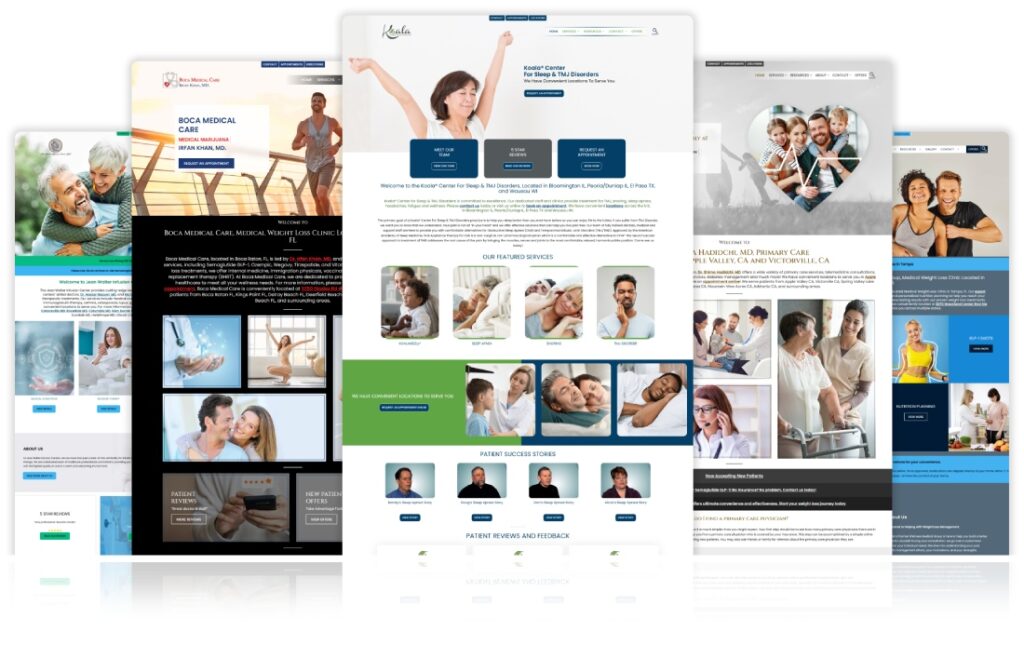
Example of a multi-location practice using Multi-Location PLATINUM service from PatientGain
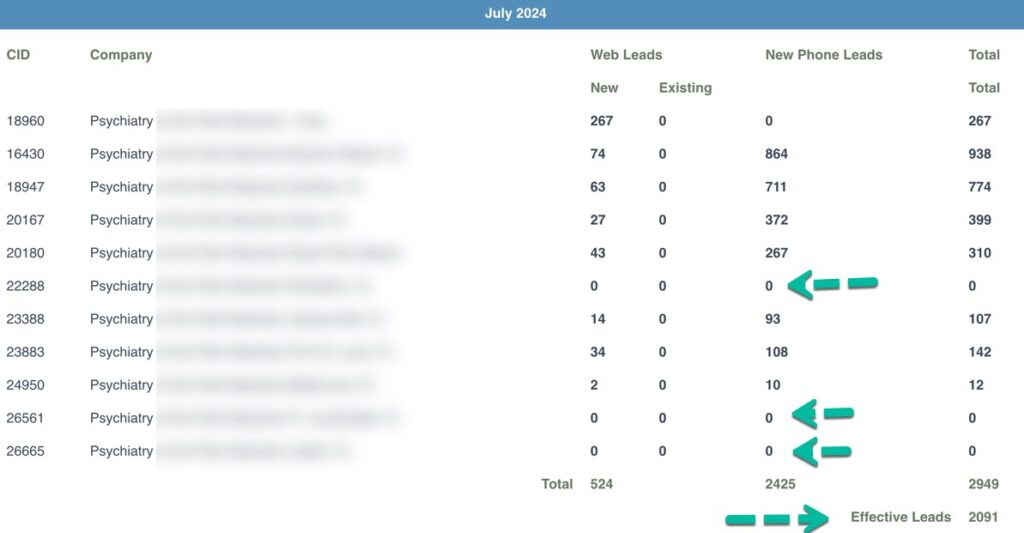
Case study results, 10 locations example of mental health medical practice.
During Covid, a lot of healthcare providers were trying to salvage their practices. This provide had a small practice, with 2 providers and 1 location, in the eastern US. They started using PLATINUM+ service for one location, and with the help of PatientGain, we launched telemedicine offering also. From the data below in the month of of July there are 2091 new leads, after subtracting sales calls and repeat callers. There are 7 active locations, and 3 new locations. Each of 7 location has $1000 / month advertising budget ( on Google ads ) and according to leads funnel data, 52% of new leads from organic SEO, 35% from Google ads.
Case study results, 8 locations example of urgent care + walk in practice.
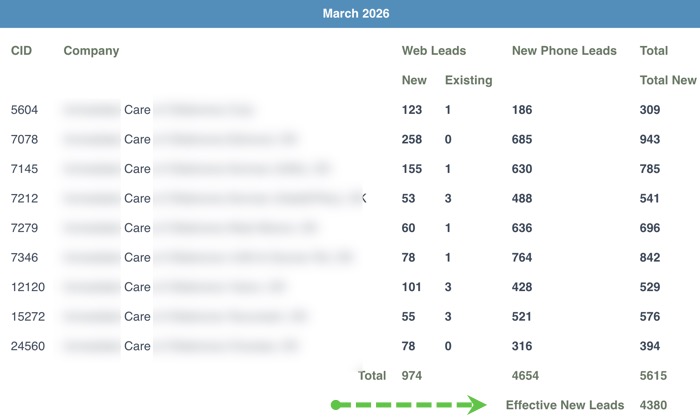
Located in a very competitive area, with dozens of urgent care locations around your locations – How do you keep the patient acquisition costs low. You build excellent urgent care SEO and urgent care local SEO for each of your locations, using PatientGain’s PLATINUM service for urgent care clinics. From the data, you can see 5615 recorded new patient inquiries, out of which 4380 are effective leads.
 Send Text
 How may I help you?