

Healthcare Marketing Strategy for Multi Location Practices
Comparing PatientGain.com‘s PLATINUM service to a traditional multi-vendor strategy reveals significant savings in both hard costs (software/fees) and soft costs (staff time and security risk), and higher ROI with measurable results.
There are 4 important areas for multi location practices, MSOs, franchise networks, and healthcare practices owned by investors.
- Financial cost to have multiple vendors performing services for your multi location practices.
- Operational ROI for have multiple vendors performing services for your multi location practices.
- Conversion performance of the healthcare websites
- Risk Mitigation (HIPAA Compliance) for have multiple vendors performing services for your multi location practices.

1. Financial Cost Comparison
A typical practice using multiple marketing service providers, typically 5–8 separate marketing vendors, usually incurs high upfront fees and redundant monthly subscriptions, plus lower conversion rates and lower number of ROI and new patients for each dollar spent for your marketing budget.
| Cost Category | Traditional Multi-Vendor/Custom Agency | PatientGain PLATINUM Service |
|---|---|---|
| Upfront Setup | $6,000 – $15,000+ (Design, Strategy, Integration) | $0 (with 12-month contract) |
| Monthly Fees | $3,000 – $10,000+ (Agency management fees) | Starts at ~$1,399 |
| 3rd Party Software | $800 – $1,500/mo (Separate CRM, SMS, Reviews) | $0 (20+ native apps included) |
| Ad Management | 15% – 30% of spend | 18% of spend |
| Total Annual Cost | $45,000 – $130,000+ | ~$16,800 – $24,000 |
2. Operational ROI (Staff Efficiency)
Managing multiple disconnected platforms creates “vendor sprawl,” requiring staff to manually transfer data between systems.
- Time Savings: Practices save an average of 32 hours per month (range: 21–44 hours) by using a single integrated dashboard.
- Opportunity Cost: At an average rate of $47/hour, this equals roughly $18,000 per year in saved administrative time.
3. Conversion Performance
Fragmented marketing often suffers from “lead leakage” where inquiries are lost between separate website, chat, and CRM tools.
- Conversion Rate: PLATINUM websites utilize A/B-tested layouts and the SPOC (Single Point of Conversion) app to reach 10%–15%+ conversion rates, compared to the 2%–4.2% industry average for standard builds.
- Lead Volume: Practices often report a 30% increase in phone inquiries within the first 6 months due to integrated AI Intelli*Connect apps and automated SEO strategies.
4. Risk Mitigation (HIPAA Compliance)
Using multiple vendors significantly increases the risk of “HIPAA Leakage”—the exposure of patient data during transfers between non-integrated systems.
- Unified BAA: PatientGain provides a single Business Associate Agreement (BAA) for all 20+ apps, eliminating the need to manage and vet security for 8 different companies.
For multi-location healthcare practices, a successful marketing strategy balances centralized brand authority with hyper-local relevance. The goal is to ensure each clinic ranks for “near me” searches while maintaining a unified patient experience across the entire network. All of these strategies are covered by PatientGain.com’s PLATINUM or PLATINUM+ monthly service.
1. Digital Infrastructure & Local SEO For Each Location
- Unified Website with Location Pages: Use a single “hub” website to build overall domain authority, but create dedicated, SEO-optimized landing pages for every office. These should feature unique addresses, local phone numbers, maps, and specific provider profiles.
- Google Business Profile (GBP) Management: Claim and optimize a separate GBP for every physical location. Post on GBP atleast 20 times per month, for each location GBP. Regularly update hours, post local news, and ensure NAP (Name, Address, Phone) consistency across all directories like Healthgrades and your Local Chamber of Commerce.
- Location-Specific Keywords: Target “geo-modified” search terms (e.g., “pediatrician in [City Name]”) in your metadata and service descriptions rather than just general medical terms.
![For multi-location healthcare practices, a successful marketing strategy balances centralized brand authority with hyper-local relevance. The goal is to ensure each clinic ranks for "near me" searches while maintaining a unified patient experience across the entire network. All of these strategies are covered by PatientGain.com's PLATINUM or PLATINUM+ monthly service.
1. Digital Infrastructure & Local SEO For Each Location
Unified Website with Location Pages: Use a single "hub" website to build overall domain authority, but create dedicated, SEO-optimized landing pages for every office. These should feature unique addresses, local phone numbers, maps, and specific provider profiles.
Google Business Profile (GBP) Management: Claim and optimize a separate GBP for every physical location. Post on GBP atleast 20 times per month, for each location GBP. Regularly update hours, post local news, and ensure NAP (Name, Address, Phone) consistency across all directories like Healthgrades and your Local Chamber of Commerce.
Location-Specific Keywords: Target "geo-modified" search terms (e.g., "pediatrician in [City Name]") in your metadata and service descriptions rather than just general medical terms.](https://www.patientgain.com/wp-content/uploads/2026/06/app-proximity-11-desktop.gif "For multi-location healthcare practices, a successful marketing strategy balances centralized brand authority with hyper-local relevance. The goal is to ensure each clinic ranks for \"near me\" searches while maintaining a unified patient experience across the entire network. All of these strategies are covered by PatientGain.com's PLATINUM or PLATINUM+ monthly service. 1. Digital Infrastructure & Local SEO For Each Location Unified Website with Location Pages: Use a single \"hub\" website to build overall domain authority, but create dedicated, SEO-optimized landing pages for every office. These should feature unique addresses, local phone numbers, maps, and specific provider profiles. Google Business Profile (GBP) Management: Claim and optimize a separate GBP for every physical location. Post on GBP atleast 20 times per month, for each location GBP. Regularly update hours, post local news, and ensure NAP (Name, Address, Phone) consistency across all directories like Healthgrades and your Local Chamber of Commerce. Location-Specific Keywords: Target \"geo-modified\" search terms (e.g., \"pediatrician in [City Name]\") in your metadata and service descriptions rather than just general medical terms.")
![For multi-location healthcare practices, a successful marketing strategy balances centralized brand authority with hyper-local relevance. The goal is to ensure each clinic ranks for "near me" searches while maintaining a unified patient experience across the entire network. All of these strategies are covered by PatientGain.com's PLATINUM or PLATINUM+ monthly service.
1. Digital Infrastructure & Local SEO For Each Location
Unified Website with Location Pages: Use a single "hub" website to build overall domain authority, but create dedicated, SEO-optimized landing pages for every office. These should feature unique addresses, local phone numbers, maps, and specific provider profiles.
Google Business Profile (GBP) Management: Claim and optimize a separate GBP for every physical location. Post on GBP atleast 20 times per month, for each location GBP. Regularly update hours, post local news, and ensure NAP (Name, Address, Phone) consistency across all directories like Healthgrades and your Local Chamber of Commerce.
Location-Specific Keywords: Target "geo-modified" search terms (e.g., "pediatrician in [City Name]") in your metadata and service descriptions rather than just general medical terms.](https://www.patientgain.com/wp-content/uploads/2026/06/app-proximity-11-mobile.jpg "For multi-location healthcare practices, a successful marketing strategy balances centralized brand authority with hyper-local relevance. The goal is to ensure each clinic ranks for \"near me\" searches while maintaining a unified patient experience across the entire network. All of these strategies are covered by PatientGain.com's PLATINUM or PLATINUM+ monthly service. 1. Digital Infrastructure & Local SEO For Each Location Unified Website with Location Pages: Use a single \"hub\" website to build overall domain authority, but create dedicated, SEO-optimized landing pages for every office. These should feature unique addresses, local phone numbers, maps, and specific provider profiles. Google Business Profile (GBP) Management: Claim and optimize a separate GBP for every physical location. Post on GBP atleast 20 times per month, for each location GBP. Regularly update hours, post local news, and ensure NAP (Name, Address, Phone) consistency across all directories like Healthgrades and your Local Chamber of Commerce. Location-Specific Keywords: Target \"geo-modified\" search terms (e.g., \"pediatrician in [City Name]\") in your metadata and service descriptions rather than just general medical terms.")
2. Reputation Management at Scale
- Automated Review Cycles: Implement systems to automatically request patient reviews via SMS or email following appointments at specific locations.
- Local Sentiment Tracking: Use centralized tools to monitor and respond to reviews across all sites, ensuring patient feedback is addressed quickly and professionally at the local level.
3. Hyper-Local Content & Advertising
- Localized Content Strategy: While your core services are the same, your content should reflect local community involvement, such as sponsoring local sports teams or participating in area health fairs.
- Geo-Targeted Paid Ads: Run Google and Facebook Ads with strict “geofencing” around each clinic’s radius to avoid wasting budget on distant audiences. Use dynamic ad copy that mentions the specific neighborhood or landmark near the office.
4. Operational & Brand Consistency
- Brand Style Guides: Distribute clear guidelines for logos, tone of voice, and clinical messaging so a patient feels the same “brand promise” whether they are in a city center or a rural satellite clinic.
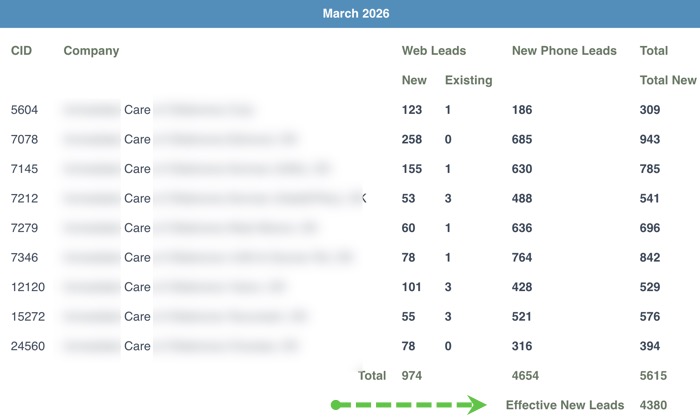
- Centralized Analytics: Use a unified dashboard to compare performance (e.g., cost-per-lead, call volume) across different regions to identify which locations need more marketing support
Example: Healthcare Marketing ROI Dashboard for Multi Location Practice With 9 Locations. There are 5615 recorded new leads in the month of March. Out of which 4380 leads are effective leads. We have many examples to show you. Please setup an introduction meeting.
 Send Text
 How may I help you?