

Are Google Ads HIPAA Compliant? Answer is Generally NO.
Google Ads is fundamentally not HIPAA compliant because Google explicitly refuses to sign a Business Associate Agreement (BAA) for its advertising platform. Under the Health Insurance Portability and Accountability Act (HIPAA), any third-party vendor that handles, transmits, or processes Protected Health Information (PHI) must sign a BAA to legally share liability for safeguarding that data. Without this contract, sending any patient data to Google Ads is a direct violation of federal privacy laws.
If Google ads are not HIPAA compliant then how can PatientGain.com run Google ads for healthcare practices?
Google itself will not sign a BAA for Google Ads. Because Google won’t take legal responsibility for your patients’ data, PatientGain.com essentially acts as a “Security Buffer” or “Walled Garden” between your practice and Google.
HIPAA Compliant Google PPC Ads: Table Of Contents
1. The “Obfuscation Layer”
2. The “Walled Garden” CRM – Leads Funnel App
3. Server-Side Lead Attribution
4. Bypassing “Enhanced Conversions”
5. Managing Google’s Own Restrictions
Here is how PatientGain runs and manages Google Ads for healthcare practices while maintaining HIPAA compliance:
1. The “Obfuscation Layer”
PatientGain uses a proprietary obfuscation server. When a patient clicks a Google Ad and lands on your website, PatientGain’s technology “masks” or “scrambles” the sensitive data before it can be sent back to Google’s ad network. All leads go through SPOC app. This SPOC app is the only, and central way to track ANY Lead. Regardless of origination of a patient inquiry, phone call, text message, appointment etc.
- Standard Way: Google’s tracking pixel “scrapes” the page and sends the user’s IP address and health intent directly to Google (Non-Compliant).
- PatientGain Way: The tracking data is intercepted by PatientGain’s secure server. It strips out identifying information and then it obfuscates the data and then encrypts it, and then it stores in a secure CRM hosted on AWS HIPAA Servers.
2. The “Walled Garden” CRM – Leads Funnel App. All leads, inquiries end up in one place – The Leads Funnel App.
When a patient fills out a form or uses the chatbot from a Google Ad, that data never goes to Google, or Meta or any other app.
- Instead, it is captured and stored directly in the PatientGain CRM Leads Funnel App, which is hosted on encrypted, HIPAA-compliant AWS Cloud servers.
- PatientGain signs a Business Associate Agreement (BAA) with you, meaning they take legal liability for that data. Since the Protected Health Information (PHI) stays inside their secure “wall” and never reaches Google’s non-compliant ad dashboard, you remain legal.
3. Server-Side Lead Attribution
PatientGain uses Server-Side Tracking rather than traditional “browser-side” tracking.
- Browser-side (Risky): The patient’s web browser talks directly to Google. Google can “see” what the patient is doing on your site.
- Server-side (Safe): Your website talks to PatientGain’s secure server first. PatientGain then sends a “sanitized” and minimum information to Google. This prevents Google from ever linking a specific person’s identity (like an IP address or email) to a specific medical condition.
4. Bypassing “Enhanced Conversions”
Google Ads often asks for “Enhanced Conversions,” which involves sending a patient’s hashed email or phone number to Google to improve ad accuracy.
- For a non healthcare regular business, this is fine. For a doctor, it’s a HIPAA violation.
- PatientGain’s system is configured to disable or bypass these non-compliant data-sharing features while still providing you with the ROI data you need in their own secure SPOC (Single Point of Conversion) dashboard.
5. Managing Google’s Own Restrictions
Beyond HIPAA, Google has strict “Sensitive Interest” policies (e.g., you cannot “remarket” to someone who looked at a page about HIV or cancer).
- PatientGain’s adwords staff are trained to setup campaigns only in certain format to ensure your campaigns are built to follow Google’s internal rules so your account doesn’t get banned, while simultaneously using their technology to keep the data flow HIPAA-compliant.
Summary: The “Shield” Model
| Feature | Standard Google Ads | PatientGain Managed Ads |
| Who sees the Patient Data? | Google (Violation) | PatientGain CRM (Compliant) |
| Who signs the BAA? | No one | PatientGain signs it |
| Tracking Method | Google Pixel (Direct) | Obfuscation Server (Shielded) |
| Data Storage | Google Ads Dashboard | Secure Medical CRM |
In short: PatientGain doesn’t make Google Ads compliant; they make the interaction with Google Ads compliant by trapping all the sensitive data in their own secure environment and only giving Google “anonymous” stats to optimize the ads.
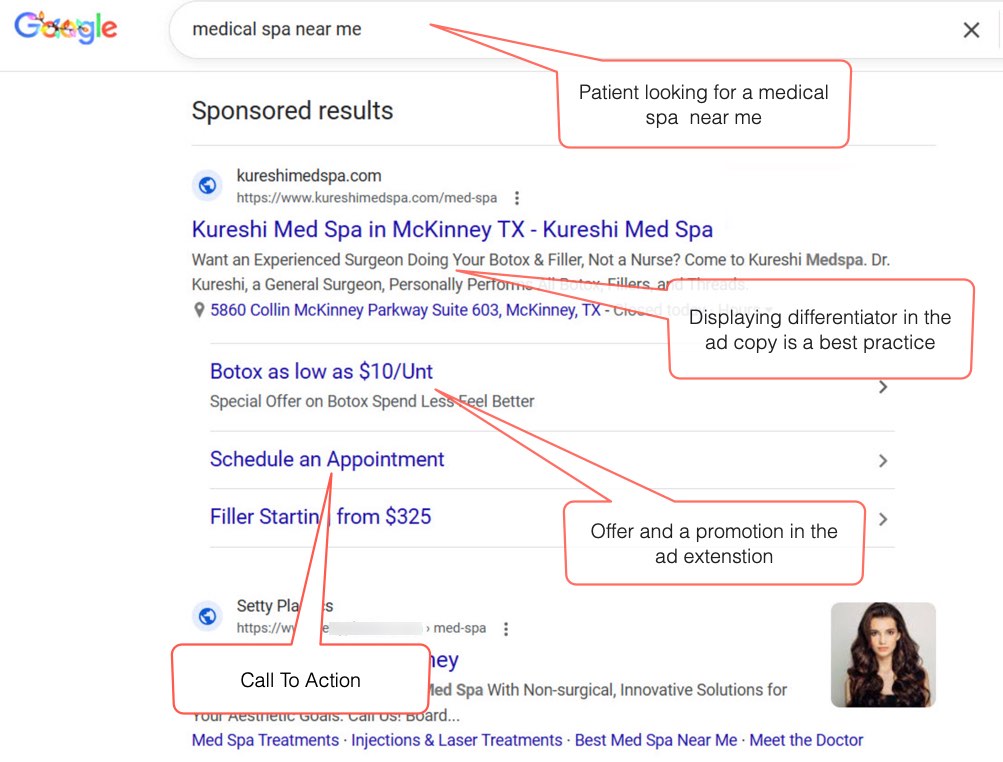
Example 1 – of a Google PPC ad: A patient is looking for “med spa near me” – 1) displaying differentiator in the ad copy 2) Offer and promotion in the ad copy 3) Catt to action (CTA) in the ad extension. This ad has an excellent conversion rate, and high quality score. If an ad has high quality score, generally the cost of the click is less than with a similar ad with low quality score.
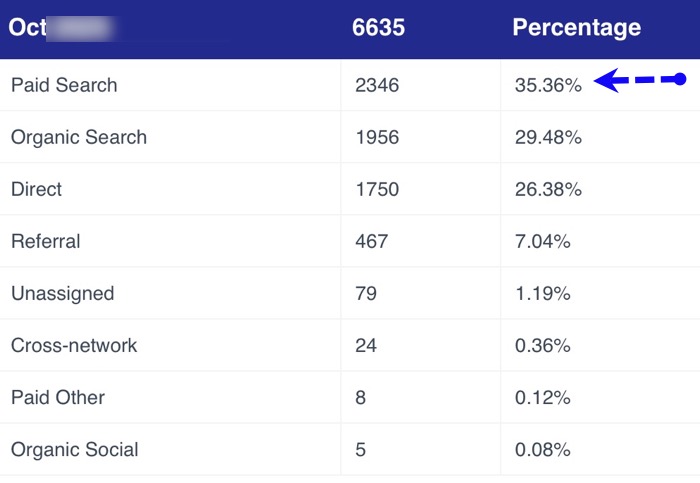
Example 2 – ROI from Google ads. Data from SPOC dashboard – (SPOC is Single Point Of Conversion App) . You can see from the data that from in the month of October, 35.36 % of the traffic originated for this hair replacement medical practice. This practice is a very competitive area. Is using PLATINUM-Plus service from PatientGain.
 Send Text
 How may I help you?