

AI Based Website Conversions For Healthcare Practices – Do They Work? And Why Patients Still Keep On Calling?
Almost every week, PatientGain gets this question from medical and dental practice managers and practice owners: I have a added a Voice based AI and Auto-Responder AI ChatBot on my healthcare website, but patients are still calling the practice, why don’t they “book now” or talk to the AI Agent?
Answer: This is common problem – This is not unique to your practice.
Patients are still calling your practice because healthcare requires trust, empathy, and seamless technology, which AI tools often fail to provide on their own. When people are sick, injured, or anxious, their natural instinct is to talk to a live human being who can comfort them and solve their problems right away.
Why Patients Avoid the AI Agent
- Lack of Trust and Empathy: Patients dealing with health issues are often anxious. A robotic text script or an AI voice cannot replicate the warm, calming reassurance of a trained front-desk coordinator.
- The “Expensive Voicemail” Trap: If your AI tools do not directly connect to your staff – If a patient does not want to continue to “deal with AI” allow them to speak to a real human. This is called HITL – Human In The Loop technology. If an AI agent just insists on helping the patient, you will lose patients, not gain patients. Patients know this , so they may hangup and call a competitor or call your main phone line anyway, so they prefer to call directly to get an immediate answer.
- Fear of Medical Errors: Many patients are deeply skeptical of sharing private health symptoms with an algorithm. They worry the AI will not understand their specific medical history or will give them incorrect scheduling information.
- Complex Health Needs: Insurance, complex symptoms, and custom booking requests are highly nuanced. If a patient feels their situation is unique, they will immediately abandon a chatbot to speak with a human.
- According to most recent PatientGain data from 329 clinics who use PatientGain’s AI apps – 76% of the patients will still call the clinic. Regardless of how many “Book Now” or “Talk To AI Agent” buttons you add to your website. You must have a Human-In-The-Loop (HITL) strategy.
Real Example: Mobile conversion app from PatientGain – This app allows patients to contact your practice for appointments and insurance check, billing, asking questions and more.
Option A: patient can start with an
1) Interactive Agent ( AI based agent )
2) Voice Agent ( AI based agent )
Both agents are similar – key difference is “voice based” vs SMS/Texting based. These AI agents can take appointments, answer non-medical questions, insurance check, billing and more. It can text you back and Email you back. Notice that this does not give an option to the patient to “break away from AI agent”.
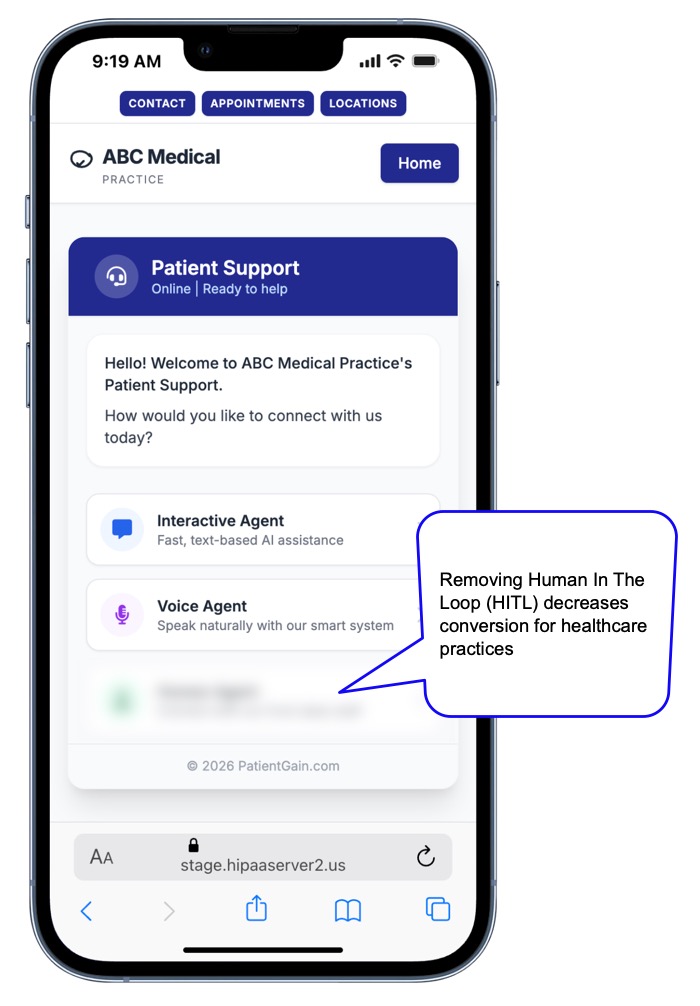
Now consider the following – Use case where a HITL is provided.
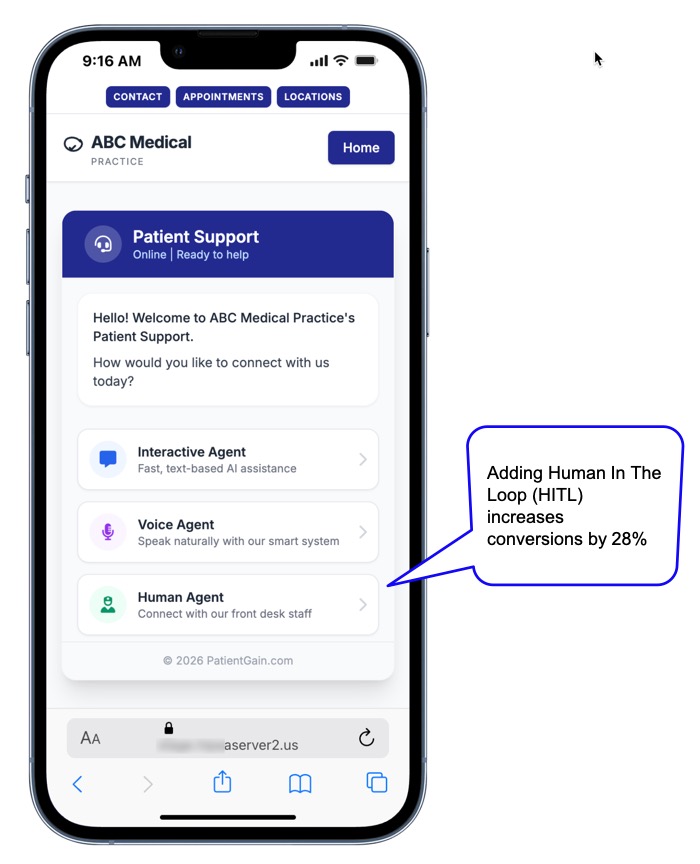
Option B: patient can start with an
1) Interactive Agent ( AI based agent )
2) Voice Agent ( AI based agent )
3) Speak to a Human – No AI – Simple call to a human
First 2 agents are similar – key difference is “voice based” vs SMS/Texting based. These AI agents can take appointments, answer non-medical questions, insurance check, billing and more. It can text you back and Email you back.
Notice that option 3 allows the patient to “break away from AI agent”. We have found that by adding HITL the conversion increase by 17% to 39% – Averaging 28%. This is a combination of many different type of healthcare practices. If you have very complex services, for example a pain clinic, a MedSpa – It is more likely you will have patients who simply want to call you, regardless of how AI you use.
Comparison of Patient Preferences
| Patient Priority | Why They Choose a Phone Call | How to Make Them Choose the AI |
|---|---|---|
| Speed | They want a guaranteed answer now. | Ensure the AI offers instant, real-time answers, and uses polite responses. |
| Anxiety | They need a calming human voice to feel safe. | Tone down the “robotic” script; use warm, empathetic AI phrasing. |
| Complexity | They have tricky insurance or symptom questions. | Train the AI on specific FAQs, but provide an easy human hand-off. Human handoff is called HITL |
Question: most of my patients are 30 to 55 age – Why hardly anyone is using AI features?
Patients between 30 and 55 years old are highly tech-savvy. They use apps and online booking for almost everything else in their lives. If this specific age group is still bypassing your AI to call your office, it usually means one thing: the AI is creating more friction than a phone call, not less.
Why This Age Group Is Bypassing Your AI
- They Have High Tech Standards: This group knows what good technology feels like. If your AI feels clunky, uses robotic phrasing, or misunderstands them once, they lose trust immediately. They will assume the system is broken and call the office to be safe.
- They Value Speed Above All: This age group is often busy balancing careers and families. If your AI chatbot takes too long to get to the point, or if your voice AI makes them listen to a long menu, they will hang up. They know a live receptionist can solve their problem in 60 seconds.
- They Expect “Click-and-Buy” Simplicity: They do not want to chat with a bot just to book an appointment. They want a clean, visual calendar where they can tap a time slot and be done. If your AI makes them type out sentences or “speak” to find a time, it feels like extra work. Allow them to “Request an Appointment” – Rather that rigid “Book Now”
Question: Most of my patients are 45 to 65+ age – Why hardly anyone is using AI features?
An older patient base changes the situation completely. Patients aged 45 to 65+ are bypassing your AI because they do not trust algorithms with their personal health, and they find text-based chatbots frustrating to navigate.
For this age group, a phone call is not an inconvenience. It is their preferred, most trusted way to do business. Here is why your 45 to 65+ patients are ignoring the AI features, and how you can actually get them to use your online tools.
Why Older Patients Avoid AI Features
- Deep Trust in Human Connection: Patients in this age group value relationships. When they are sick or worried, they want to hear a friendly, reassuring human voice. They do not feel safe or cared for when talking to a computer script.
- Privacy and Security Worries: This generation is highly sensitive to online scams, identity theft, and medical privacy. Many feel deeply uncomfortable typing their name, birthdate, and symptoms into a chat box. They worry their private data will be leaked.
- Frustration with Small Screens and Menus: Voice AI menus can move too fast for someone trying to write down information. Web chatbots often use small fonts or require too much precise typing. If the AI misunderstands them just once, they feel frustrated and call the front desk.
- The Habit of Calling: For decades, the only way to see a doctor was to call the office. This is a deeply ingrained habit. They will automatically look for a phone number on your website and completely ignore a chat bubble in the corner.
How to Make Online Engagement Work for Older Patients
You can still get this age group to engage online, but you have to change your approach. You must trade the “AI chatbot” experience for a simple, clear, and highly secure web page.
Suggestion 1: Ditch the “Book Now” – Change to “Contact Now” – What this means is to do not forece them to “book now” – Just give them options on how to contact you. See SPOC example below:
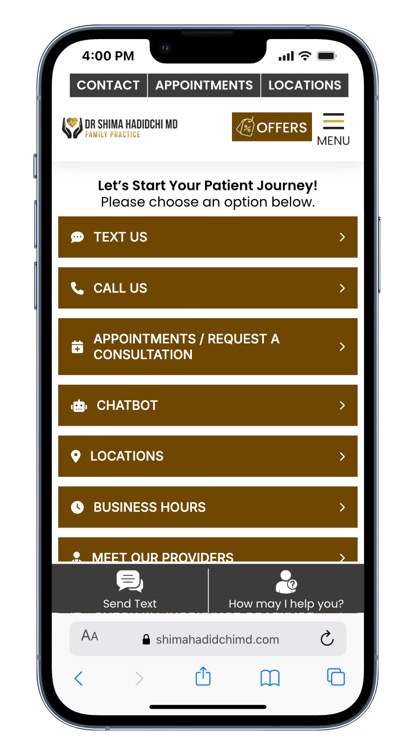
Suggestion 2: Instead of Chatbot, Use a Large visual Scheduler
Instead of making patients type back and forth with an AI bot, put a large, clear scheduling form directly on your webpage. Make sure the text is large and easy to read. Let them click a clear box for their doctor, click a date on a big calendar, and type their info into a standard form. This feels familiar, safe, and easy.
Suggestion 3: Reassure Them About Privacy
Older patients need explicit permission to trust your technology. Right next to your booking tools, add a clear, prominent note with a lock icon. For example: “Your privacy matters. Our online scheduler is 100% secure and HIPAA-compliant to protect your medical information.”
Suggestion 4: Use Your Phone Line to Teach Them
When patients call your front desk, have your staff gently introduce the online option. Your receptionist can say: “I can get you booked right now. Just so you know for next time, we have a brand new scheduler on our website that lets you pick your exact time in seconds without waiting on hold!” Hearing a trusted human endorse the technology will give them the confidence to try it next time.
If I use PatientGain’s Human-In-The-Loop (HITL) agents, will this help in conversions?
Yes, using PatientGain’s Human-in-the-Loop (HITL) agents will help improve your conversion rates. However, you need to understand how they work so you can apply them to the right problem.
The PatientGain HITL system is a hybrid model. It combines the speed of AI with human oversight. The AI creates a draft response or a marketing message, but a human must review and approve it before the patient sees it. Here is how this setup can help fix your conversion drop with your 45 to 65+ age group, along with the limits you should keep in mind.
How HITL Agents Will Help Your Conversions
- Builds Essential Trust: Your older patients do not want to talk to a robot when they have serious health questions. A human reviewer ensures that the AI answers sound warm, accurate, and deeply empathetic. This makes patients feel safe enough to complete their bookings.
- Stops AI Errors and Hallucinations: Older patients will abandon technology completely if it makes a single mistake. Because a human checks the information first, your practice avoids frustrating errors regarding your services, schedules, or insurances.
- Clears the Multi-Channel Inbox: PatientGain features a Single Point of Conversion (SPOC) app. This tool channels your phone calls, text messages, and website forms into one simple dashboard. This prevents patient leads from slipping through the cracks.
The Catch: HITL is Not For Instant, Live Chat Booking
While HITL agents are highly effective, they do not completely solve the problem of a live patient trying to book an appointment right this second. HITL is already used in SPOC app. It allows patients to by-pass AI and directly go to the traditional “Phone Call”.
How to Use PatientGain to Maximize Bookings
To get the full conversion power out of PatientGain for your older demographic, combine their tools with these strategies:
- Use Two-Way Texting Over Chatbots: Older patients often dislike website chat bubbles, but they love standard text messaging. Use PatientGain to move conversations from the website to secure SMS.
- Rely on the SPOC Dashboard: Use the platform’s dashboard to catch the patients who do start an online interaction but drop off before finishing. Your staff can see the open lead immediately and send a quick text message to finish the booking manually.
- Promote HIPAA Safety: Older patients care deeply about privacy. Make sure your website proudly displays that your booking funnel uses PatientGain’s secure, HIPAA-compliant AWS cloud servers.
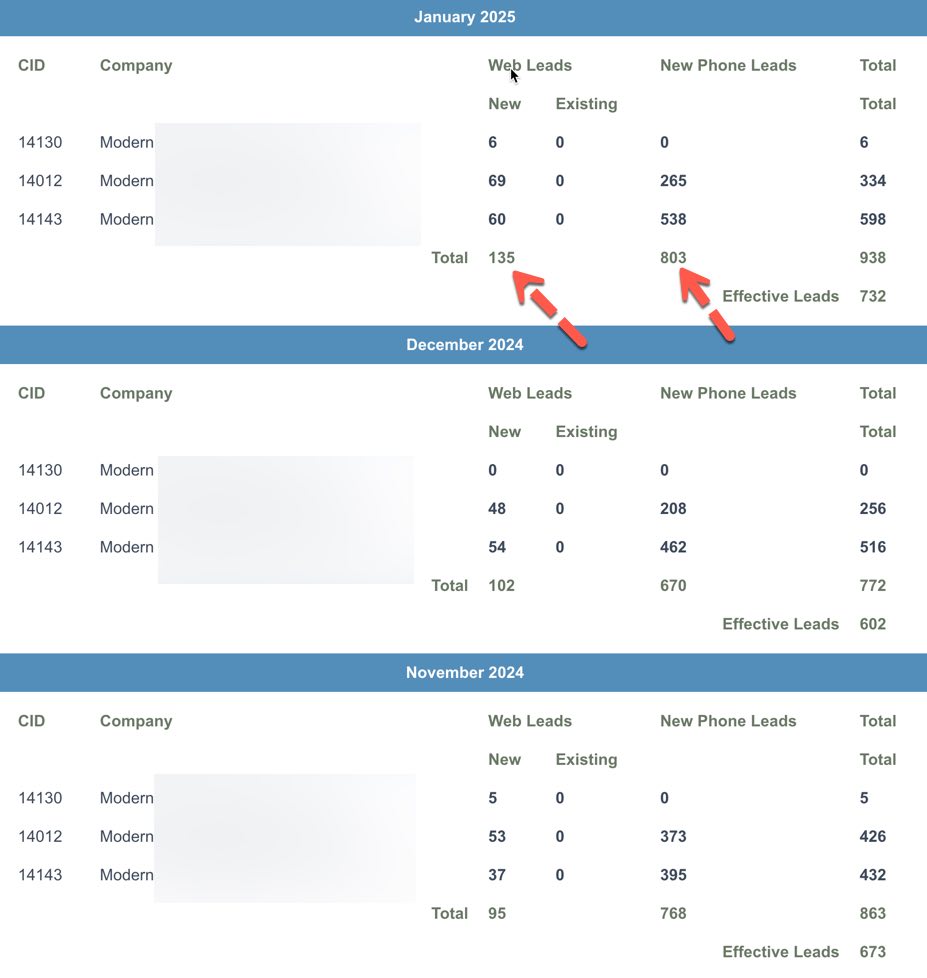
Real data from a real practice. This data shows that there is typically 1 to 8 ratio of how patients contact your practice. For 135 new appointments, AI chats, Text messages, there are 803 documented new patient calls.
 Send Text
 How may I help you?