

What are the the hidden costs of DIY healthcare website building and management?
Managing a healthcare website yourself might seem like a way to save money, but “free” or low-cost DIY options often hide significant financial and operational burdens. Beyond a $15–$30 monthly platform fee, the true cost can quickly escalate due to technical requirements and lost professional time.
The hidden costs of DIY healthcare website management include:
1. Regulatory & Legal Risks
Healthcare sites must follow strict laws that DIY templates often ignore.
- HIPAA Compliance: Ensuring patient data (PHI) is encrypted and secure can cost $2,000–$8,000 for initial setup, with monthly monitoring fees between $200–$800.
- Accessibility (ADA): Making your site usable for patients with impairments (WCAG 2.1) typically adds $300–$1,000 for audits and implementation.
- Legal Documentation: Compliant privacy policies and consent notices (cookie notices are no long sufficient for healthcare websites) specifically for medical practices cost roughly $150–$500.
2. Operational Inefficiency & “Time Drain”
The most significant hidden cost is the opportunity cost of your or your staff’s time.
- Productivity Loss: Business owners often spend 60–80 hours building and troubleshooting a site, which can equate to $4,000–$6,000 in lost billable time.
- “Toggling” Waste: Staff jumping between unintegrated apps (e.g., separate booking, CRM, and chat) can waste up to 200 hours annually, costing an estimated $10,000/year in labor and missed leads.
- Knowledge Loss: If a single staff member manages the site and leaves, you face a major setback in institutional knowledge.
3. Technical & Performance Gaps
DIY platforms often lack the specialized “medical-grade” infrastructure needed for growth.
- Security & Maintenance: Ongoing security scans and plugin updates typically cost $60–$300/month. Neglecting these can lead to breaches or site crashes.
- Performance Optimization: Slow-loading sites lose search engine rankings (SEO). Fixing “messy” DIY code or setting up CDNs can add $300–$1,500.
- System Integrations: Connecting to Electronic Health Records (EHR) or specialized booking systems can range from $3,000+.
4. Reputation & Growth Impact
- Generic Branding: Using common templates can make a practice look unprofessional, eroding patient trust.
- SEO Failures: Without professional SEO (starting at $800–$1500/month), patients may never find your site, leading to massive long-term revenue
What options are available from PatientGain.com?
PatientGain.com offers a fully managed, HIPAA-compliant website and healthcare marketing automation platform designed to consolidate multiple vendors into a single system. Their options range from individual apps to comprehensive service tiers tailored to a practice’s local competition and growth goals. The pricing starts at $800/mon.
1. Main Service Tiers (Subscription Packages) – No upfront costs with 12 month contract.
These bundles typically include a HIPAA-compliant website, a dedicated account manager, and a technical lead.
- GOLD Service (~$899/mo): Best for practices in low-competition areas. It includes a HIPAA-compliant, SEO-optimized website, a leads funnel CRM, and ~10 essential marketing apps.
- PLATINUM Service (~$1699/mo): The most popular tier, adding monthly SEO content creation, broader social media posting, and ~20 total apps, including the Single Point of Conversion (SPOC) centralized inbox.
- PLATINUM PLUS (~$2499/mo): Designed for high-competition markets or telemedicine practices. It includes more aggressive SEO content, a Consent Management App, and advanced engagement tools like referral and rewards programs.
- Enterprise Service (~$5,000/mo+): Tailored for large, multi-location healthcare organizations and MSOs.
2. Standalone Apps & Specialized Options
If you already have a website, you can use PatientGain’s “Silver” services or individual tools.
- Silver/Silver Plus (~$1699–$2499/mo): Provides the platform’s apps and intelligence for practices that want to keep their existing website.
- À la Carte Apps: Individual modules such as AI Chatbots (from ~$149/mo), Two-Way Texting (from ~$199/mo), and Reputation Management for reviews.
- FastStart Bundles (~$250–$499/mo): Entry-level app bundles for specific needs like advertising, reputation management, or basic patient communication.
3. Key Platform Features
- HIPAA Compliance: Provides a Business Associate Agreement (BAA) and uses secure infrastructure (AWS/Google Cloud).
- Integrated CRM: A centralized dashboard to manage leads, emails, and patient interactions.
- Managed Services: Includes human support for setup, content creation, and monthly audits, reducing the need for in-house marketing staff.
- Patient Engagement: Tools for online appointment scheduling, paperless intake forms, and automated reminders.
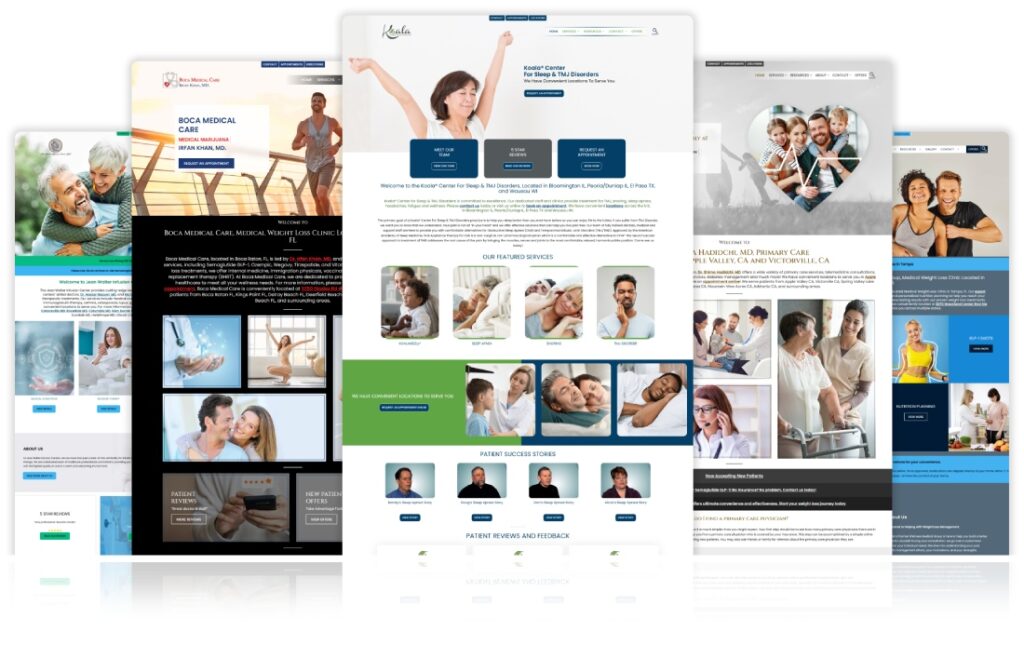
Example of PLATINUM websites, PatientGain.com offers a fully managed, HIPAA-compliant website and healthcare marketing automation platform designed to consolidate multiple vendors into a single system. Their options range from individual apps to comprehensive service tiers tailored to a practice’s local competition and growth goals. The pricing starts at $800/mon.
Why providers use PatientGain?
Healthcare providers primarily use PatientGain.com to consolidate multiple marketing and communication tools into a single HIPAA-compliant platform. By replacing 5 to 8 separate vendors—such as web developers, SEO agencies, and texting app providers—practices can reduce administrative complexity and software costs.
Key reasons providers choose this platform include:
1. Vendor Consolidation & Cost Savings
Instead of managing “vendor sprawl,” providers use one system for their website, SEO, CRM, and patient communications.
- Time Savings: Clinics save an average of 32 hours of staff time per month by using integrated tools.
- Financial ROI: Consolidation is estimated to save practices roughly $18,000 per year in overlapping software fees and labor.
2. Reducing “Lead Leakage”
The platform’s Single Point of Conversion (SPOC) App funnels all inquiries—phone calls, texts, and website forms—into one unified dashboard. This ensures no patient inquiry is missed, which is a common problem when using disconnected tools.
3. Built-In HIPAA Compliance
Providers often struggle with the legal risks of DIY or general-market tools. PatientGain provides:
- Business Associate Agreements (BAA): Legally obligating them to protect patient data.
- Secure Infrastructure: All data is encrypted and stored on secure, medical-grade servers (AWS and Google Cloud).
4. AI-Driven Patient Acquisition
Providers use AI “agents” to handle 24/7 patient interaction without increasing staff headcount.
- Intelligent Chatbots: Answer common questions about hours, insurance, and services using only practice-approved content.
- Specialized SEO: Uses a “reverse search engine” strategy that targets how patients search for specific medical symptoms or treatments rather than just general keywords.
5. Managed Service Model
Unlike DIY platforms, PatientGain assigns each practice a dedicated project manager and technical lead. This “do-it-for-you” approach allows doctors to focus on patient care while experts manage their online reputation, social media, and advertising campaigns.
 Send Text
 How may I help you?