

What Makes PatientGain HIPAA‑Compliant?
Everyday PatientGain gets inquiries from healthcare practice managers and providers – asking “I am looking for a healthcare marketing expert company who specializes in HIPAA compliant marketing for my practice”. What should I look for ?
When hiring a HIPAA-compliant healthcare marketing agency, look for companies and firms who can provide you with a full a Business Associate Agreement (BAA), (Not a Pass-through BAA) offer a proven track record in medical marketing, and prioritize data security with encrypted, server-side analytics rather than reliance on third-party trackers.
Key Components of PatientGain’s HIPAA Compliance
1. Business Associate Agreement (BAA)
A BAA is a legally required contract between a covered entity and a business associate. PatientGain provides a standard Business Associate Agreement (BAA) to its customers, which legally obligates PatientGain to protect PHI in accordance with HIPAA regulations. This is a fundamental requirement for any vendor handling PHI on behalf of a healthcare practice.
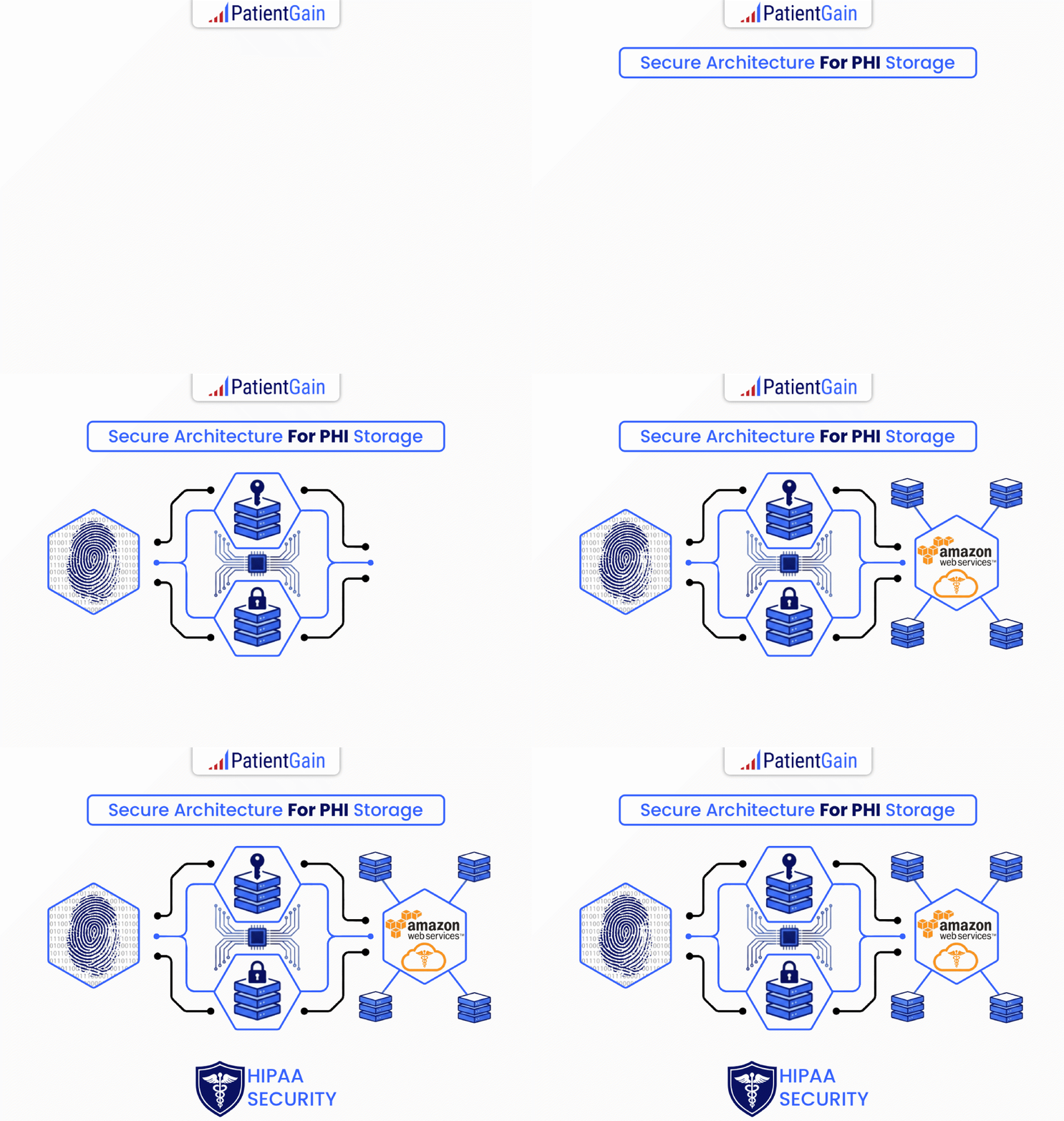
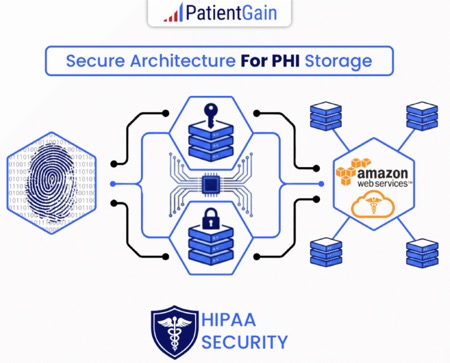
PatientGain’s platform and applications are hosted on secure cloud infrastructure, primarily Amazon Web Services (AWS), which is designed to be compliant with HIPAA and HITECH standards. A BAA-backed, SOC 2 Type II certified platform that allows healthcare practices to run performance marketing. PatientGain’s HIPAA server is hosted on AWS Cloud (with BAA). PatientGain also uses Google’s GCP cloud (With BAA). Any app level access is logged, and managed based on roles. Practice users are segregated into different levels and roles, per HIPAA guidelines. Even PatientGain’s internal staff have roles and every staff cannot see every account, it is strictly based on need-to-know basis. Internal staff’s activity is logged also, for internal auditing. All internal staff members are background checked.
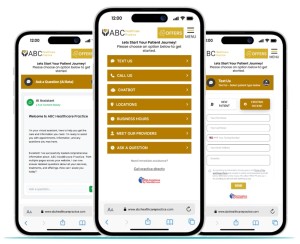
Example of HIPAA compliant SPOC app – Singe Point of Conversion, covered by the BAA provided by PatientGain to healthcare practices. This app is included individually for your healthcare website, or a part of the PLATINUM monthly service.

2. Secure Infrastructure and Hosting
PatientGain’s platform and applications are hosted on secure cloud infrastructure, primarily Amazon Web Services (AWS), which is designed to be compliant with HIPAA and HITECH standards. A BAA-backed, SOC 2 Type II certified platform that allows healthcare practices to run performance marketing. PatientGain’s HIPAA server is hosted on AWS Cloud (with BAA). PatientGain also uses Google’s GCP cloud (With BAA). Any app level access is logged, and managed based on roles. Practice users are segregated into different levels and roles, per HIPAA guidelines. Even PatientGain’s internal staff have roles and every staff cannot see every account, it is strictly based on need-to-know basis. Internal staff’s activity is logged also, for internal auditing. All internal staff members are background checked.
- Data Encryption: ePHI is protected using encryption both “at rest” (when stored) and “in transit” (when transmitted, e.g., via HTTPS/SSL).
- Secure Storage: Patient data collected through PatientGain apps, such as their CRM, is stored on secure, HIPAA-compliant servers, not in less secure locations like standard website database tables (e.g., in WordPress itself).
3. Technical Safeguards
PatientGain employs several technical controls to secure ePHI within its software and systems:
- Access Controls: Access to PHI is strictly limited through role-based access controls, ensuring that only authorized personnel can view or manage sensitive information based on their job functions. Shared logins are not permitted.
- Audit Logs: The platform maintains audit trails that record user activity, enabling the monitoring of access to PHI and helping to detect potential security breaches.
- Secure Communication: All patient communication (e.g., via secure forms, SMS/texting, chatbots) is handled within an encrypted environment to prevent unauthorized interception.
- Secure development: PatientGain uses AWS secrets manager for its development of AI agents and apps. Security of the apps and AI agents is an important step. The service satisfies three absolute necessities for modern medical software: strict HIPAA compliance, secure multi-platform AI integration, and automated security guardrails. HIPAA-eligible service. AWS provides a Business Associate Agreement (BAA) covering it, allowing PatientGain to safely handle the credentials that unlock medical CRM databases.
It logs every single data access event via AWS CloudTrail, which provides the exact audit trails required by the Office for Civil Rights (OCR) to maintain compliance .
4. Administrative Safeguards
PatientGain implements internal policies and procedures to enforce compliance:
- Staff Training: All PatientGain staff members are required to undergo regular HIPAA security and privacy training.
- Background Checks: All staff members are subjected to background checks.
- Security Audits: PatientGain conducts regular self-audits and security log reviews to identify and mitigate vulnerabilities. Security logs are reviewed by 2 different staff members.
HIPAA-Compliant Services
PatientGain integrates these compliance features into specific services designed for the healthcare industry, such as:
- HIPAA-Compliant Web Forms: Forms used to collect patient information (like appointment requests or medical history) are secure and encrypted.
- Marketing Automation and CRM: The PatientGain CRM stores prospective and existing patient information securely, allowing for compliant marketing and communication activities, such as automated reminders, provided patient consent is obtained.
- Secure Patient Portals/Communication: Features like secure messaging and virtual assistants are built to ensure the secure exchange of information between providers and patients.
- HIPAA Compliant Analytics: PatientGain provides native, HIPAA-compliant website tracking and analytics designed specifically for medical and dental practices, backed by a signed Business Associate Agreement (BAA).
How PatientGain Ensures HIPAA Compliance For Healthcare Practice Website Analytics
- Business Associate Agreement (BAA): Issues a legally binding BAA covering the analytics app, dashboard access, data storage, and platform services.
- Data Obfuscation & PHI Protection: Obfuscates patient data to sanitize Google Analytics (GA4) traffic, or replaces GA4, Google Tag Manager, and ad pixels entirely with its self-hosted, PHI-safe tracking engine.
- Secure Cloud Architecture: Stores analytics data on HIPAA-compliant AWS (Amazon Web Services) and Google Cloud Platform (GCP) servers using end-to-end encryption.
- Role-Based Access Control (RBAC): Restricts dashboard access strictly to authorized practice managers/owners, logs user activity, and automatically blocks unauthorized access attempts (such as IP traffic from outside the U.S.).
Service Options & Pricing
| Option | Approximate Cost | Scope & Features |
| Standalone Analytics App – HIPAA Compliant | Starts at $199/month | Embeds tracking code into your existing website; includes a full BAA, RBAC, and turnkey setup. |
| Bundled (GOLD / PLATINUM) – HIPAA Compliant | Included in tiers ($899 – $1,699+/month) | Bundled into full-service healthcare marketing packages alongside medical websites, AI communication tools, and CRM workflows. |
SOC 2 framework on AWS Servers
PatientGain utilizes AWS servers that carry SOC 2 certification, effectively blending SOC 2 frameworks with HIPAA rules. While HIPAA dictates what must be protected (the legal mandate), the SOC 2 framework on AWS structures how PatientGain physically and operationally executes those safeguards.
PatientGain’s SOC 2-backed AWS architecture meets and maintains HIPAA compliance through distinct operational integrations:
1. Mapping SOC 2 Trust Services to HIPAA Rules
SOC 2 measures operational controls across five Trust Services Criteria (Security, Availability, Processing Integrity, Confidentiality, and Privacy). PatientGain inherits these audited AWS controls to satisfy the HIPAA Security Rule:
- Security & Confidentiality (HIPAA Technical Safeguards): SOC 2 audits enforce that AWS infrastructure uses rigorous, multi-factor authentication (MFA) and strict role-based access. This ensures that only authorized PatientGain system administrators or specific medical practice managers can access data pools.
- Availability (HIPAA Administrative Safeguards): SOC 2 requires documented disaster recovery and emergency backup protocols. PatientGain leverages AWS’s audited, redundant server nodes to ensure patient forms, CRMs, and scheduling communications never suffer unmitigated downtime or data loss.
2. Standardized Independent Audits over Self-Attestation
HIPAA compliance does not offer an official government certification; it relies on self-attestation or third-party risk assessments. Because PatientGain runs its apps on SOC 2 Type II audited AWS servers, it provides mathematical and operational proof of compliance. The SOC 2 framework means an independent CPA firm regularly tests the AWS hardware to verify that the security policies protecting electronic Protected Health Information (ePHI) are functioning perfectly over time.
3. Structural Enforcement via the “Secure Bubble”
PatientGain leverages its SOC 2 AWS backend to enforce its proprietary Single Point of Secure Analytics (SPOSA). When a user interacts with a healthcare website, the SOC 2 cloud infrastructure isolates the ingestion. It routes raw telemetry away from standard public networks directly into an isolated AWS cluster covered under the Business Associate Agreement (BAA). The server then obfuscates tracking data (like scrubbing IP addresses or masking browser fingerprints) before passing anonymized metrics to the main marketing dashboards.
4. Continuous Audit Trails
Under SOC 2 infrastructure rules, continuous system monitoring is required. This directly fulfills the HIPAA requirement for immutable audit logs. Every API call, database query, or login attempt on the PatientGain AWS platform is logged automatically. These logs are monitored daily by a compliance team to detect anomalies or unauthorized attempts to view patient records.
5. Additional Steps
Security log files are created by AWS tools. A technical IT Staff reviews them, and a secondary human staff double checks the log files. Every staff member once a month must attest to and report 1) Are you aware of any HIPAA violations? (Yes/No) 2) Are you aware of any type of illegal activity within the company? (Yes/No). This is required for all staff members to report. HIPAA and security Zoom training call is required for all staff members – This training call is held at least 10 times per year.
PatientGain’s HIPAA-compliance case is not based on a single feature or a “HIPAA certificate.” It is based on a combination of contractual, technical, administrative, and data-handling controls designed for healthcare marketing. PatientGain currently describes itself as a Business Associate to healthcare practices and says its platform is designed so PHI can be handled under a signed Business Associate Agreement (BAA).
What makes PatientGain HIPAA-compliant
| Component | What PatientGain says it does | Why it matters |
|---|---|---|
| 1. Business Associate Agreement | PatientGain signs a BAA with healthcare-practice customers covering PHI handled by its services. | HHS requires an appropriate BAA when a business associate creates, receives, maintains, or transmits PHI for a covered entity. |
| 2. HIPAA-oriented cloud infrastructure | PatientGain says it uses AWS and Google Cloud infrastructure under BAAs for its protected environment with SOC2 servers. | HIPAA requires safeguards protecting the confidentiality, integrity, and availability of ePHI. |
| 3. Encryption | PatientGain states that ePHI is encrypted in transit and at rest. | Encryption is an important technical safeguard for preventing unauthorized access to ePHI. |
| 4. PHI kept out of the normal website database | PatientGain says patient submissions are routed into its secure environment instead of being stored directly in ordinary WordPress/database tables. | This reduces exposure of PHI through CMS vulnerabilities, plugins, backups, or ordinary website administration. |
| 5. “Secure Bubble” / HIPAA Server | Forms, chatbot interactions, conversion information and other sensitive activity can be routed into an isolated PatientGain server-side environment. | It creates separation between identifiable patient information and ordinary advertising/marketing systems. |
| 6. HIPAA-oriented analytics | PatientGain says its SPOSA/Secure Bubble architecture performs analytics server-side rather than simply placing standard third-party analytics trackers everywhere. | HHS specifically warns healthcare organizations about disclosures of PHI through online tracking technologies. |
| 7. PHI stripping before advertising platforms | PatientGain says identifying information such as IP addresses and sensitive URL/query information can be stripped or obfuscated before conversion signals are transmitted externally. | This distinction is important because Google/Meta advertising platforms generally aren’t simply made HIPAA-compliant by sending PHI to them and removing it afterward. HHS says de-identifying information after a tracking vendor receives PHI does not cure the original disclosure. |
| 8. Role-based access | Individual accounts and permissions restrict which practice and PatientGain personnel can access PHI; PatientGain says shared accounts are prohibited. | HHS requires technical access controls allowing only authorized individuals to access ePHI. |
| 9. Audit logging | PatientGain says access and actions involving protected information are logged and available for auditing. | HIPAA’s Security Rule requires mechanisms for recording and examining activity in systems containing or using ePHI. |
| 10. Workforce controls | PatientGain says staff receive HIPAA training, are subject to access restrictions, undergo background checks, and internal activity is monitored. | Administrative safeguards and workforce security/training are important components of HIPAA compliance. |
| 11. Secure communications/apps | PatientGain says its CRM, forms, texting, chatbot and other patient-conversion applications operate within its protected environment. | PHI shouldn’t leave the compliant environment simply because a patient moves from a website form to texting or CRM follow-up. |
| 12. Consent management | PatientGain provides tools intended to record and manage patient marketing consent. | HIPAA marketing rules can impose authorization requirements beyond merely protecting the database technically. |
By implementing these comprehensive technical, administrative, and contractual measures, PatientGain has engineered a solution to provide a platform that allows healthcare practices to manage patient engagement and marketing while adhering to federal HIPAA standards.
 Send Text
 How may I help you?