

Outpatient Marketing Experts Help Your Practice Acquire New Outpatients
What is outpatient marketing in healthcare?
Outpatient marketing (also known as ambulatory care marketing) is the strategic process of attracting and retaining patients for medical services that do not require an overnight stay in a hospital or facility. Because the healthcare landscape has shifted dramatically toward consumer-driven care, patients now shop for outpatient services the same way they shop for a restaurant or a retail product. They prioritize convenience, cost, online reviews, and location.
Who Uses Outpatient Marketing?
This type of marketing applies to a massive sector of the healthcare industry, including:
- Urgent Care Centers & Walk-in Clinics
- Ambulatory Surgery Centers (ASCs)
- Primary Care & Private Specialty Practices (Dermatology, Orthopedics, Podiatry)
- Dental & MedSpa Practices
- Physical Therapy & Diagnostic Imaging Centers (MRI, X-ray)
The 4 Pillars of Outpatient Marketing
Because outpatient care is highly competitive and localized, the marketing strategies must be aggressive, digital-first, and consumer-focused.
1. Local SEO & “Near Me” Dominance
When a patient twists their ankle or needs a dermatologist, they don’t research hospital networks; they pull out their phone and search “urgent care near me” or “best dermatologist in [City].”
- The Strategy: Outpatient marketing heavily focuses on optimizing Google Business Profiles, ensuring the clinic ranks in the “Google Local Pack” (the top 3 map results), and building highly specific, localized web pages for every service offered.
2. Aggressive Reputation Management
For outpatient clinics, online reviews are life or death. A clinic with a 3.5-star rating will bleed patients to a competitor down the street with a 4.8-star rating, even if the clinical care is identical.
- The Strategy: Implementing automated software that texts patients immediately after their appointment, asking them to leave a Google or Yelp review while their positive experience is still fresh.
3. High-Intent Digital Advertising (PPC)
Outpatient marketing capitalizes on immediate patient needs.
- The Strategy: Running highly targeted Google Ads for specific symptoms or treatments (e.g., “teeth whitening cost,” “STD testing,” or “knee pain doctor”). The goal is to capture the patient at the exact moment they are looking for a solution and route them to a landing page where they can book instantly.
4. “Frictionless” Patient Experience Messaging
Outpatient consumers value their time. If your marketing promises great care but your website makes it impossible to book an appointment, the marketing fails.
- The Strategy: Outpatient marketing highlights convenience. Ad copy and website messaging heavily feature phrases like “Walk-ins Welcome,” “Book Online 24/7,” “Same-Day Appointments,” and “Short Wait Times.”, Text us now is another example.
Outpatient vs. Inpatient Marketing: The Big Difference
| Feature | Outpatient Marketing | Inpatient (Hospital) Marketing |
| The Decision Maker | The patient (Direct-to-Consumer). | Often driven by physician referrals or emergency situations. |
| Sales Cycle | Very Short. (Minutes to days). A patient feels sick and books an appointment instantly. | Long. (Months). Researching cancer centers or major bypass surgeries takes time. |
| Primary Appeal | Convenience, location, online reviews, and out-of-pocket costs. | Prestige, specialized technology, top-tier surgeons, and survival rates. |
PatientGain’s PLATINUM Service is an all-in-one digital platform designed specifically to help outpatient healthcare practices, improve patient acquisition, engagement, and retention. The platform combines several patient engagement, marketing automation, and analytics tools that are particularly beneficial for outpatient marketing.
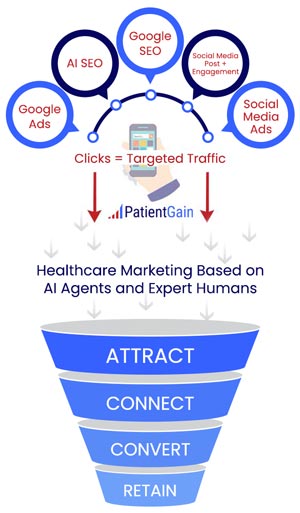
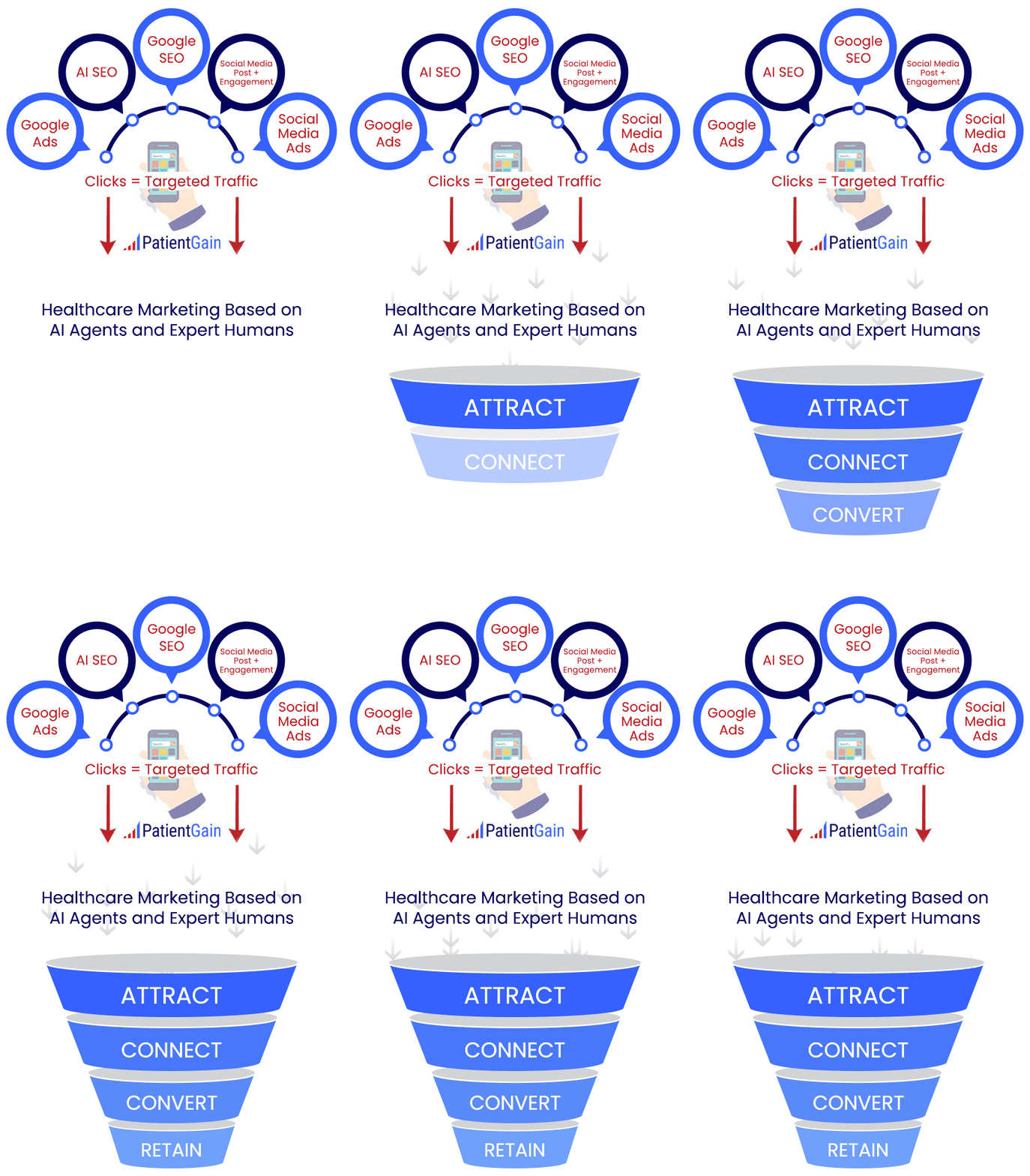
Outpatient marketing is fundamentally about capturing a patient at the exact moment they realize they have a problem—whether it is a sprained ankle, a toothache, or a desire for Botox—and making it ridiculously easy for them to choose your clinic over the one down the street. It is fast, highly competitive, and consumer-driven.
PatientGain’s PLATINUM Service facilitates this by essentially turning a medical practice into a high-speed, frictionless, retail-like conversion machine, all while keeping the data locked down under HIPAA.
PLATINUM features map directly to the core strategies of outpatient marketing:
1. Dominating the “Near Me” Search (Local SEO & AEO)
Outpatient consumers do not research for months; they search “urgent care near me” and click the top result.
- The PLATINUM Solution: The service includes ongoing, managed SEO and AEO (Answer Engine Optimization). Their team writes and publishes fresh, symptom-specific content pages every month (e.g., “Cost of Dental Implants in Austin”).
- The Tech Advantage: Because PLATINUM sites are hosted on Google Cloud C2 servers, they load in under 1.5 seconds. Google’s local algorithm heavily favors ultra-fast, mobile-optimized sites, pushing your clinic to the top of the map pack.
2. Automating the 5-Star Reputation
In outpatient care, your online reputation is your most valuable asset. A patient will bypass a 3.5-star clinic that is one mile away to drive to a 4.8-star clinic three miles away. Also note that you do not need have 5.0-star clinic on Google.
- The PLATINUM Solution: The platform includes an automated review generation app. After an appointment is completed, the system automatically sends a secure text or email to the patient asking about their experience. Positive experiences are routed directly to your Google Business Profile or Yelp to build a massive wall of 5-star social proof, while negative feedback is routed internally for your office manager to handle privately.
3. Frictionless, 24/7 Booking (The Zero-Click Funnel)
Outpatient consumers expect the convenience of booking an Uber or ordering Amazon Prime. If they land on your site at 10:00 PM and have to wait until 9:00 AM the next day to call your front desk, they will just find a competitor with online booking.
- The PLATINUM Solution: The platform deploys an AI Medical Chatbot and secure Online Appointment Scheduling. A patient can land on your site at midnight, ask the bot if you accept BlueCross BlueShield, and instantly book an open slot for the next morning.
- The SPOC Advantage: Every one of these late-night digital interactions is funneled into the SPOC (Single Point of Conversion) dashboard, so your front desk arrives in the morning to a clean list of booked appointments and secured leads.
4. Tracking High-Intent Ads Legally (Data Obfuscation)
Outpatient clinics rely heavily on Google Ads (PPC) to capture high-intent searches (e.g., “same day STD testing”). However, standard tracking pixels violate HIPAA by sending that medical search data back to Meta or Google.
- The PLATINUM Solution: As discussed, PatientGain acts as a Patient Privacy Data Platform. It uses Data Obfuscation to track exactly which Google Ad generated a phone call or form submission, allowing you to double down on the ads that actually make money. It then strips the patient’s identity and medical symptoms before pinging Google, keeping your ad campaigns optimized and compliant.
5. Patient Retention (The “Recall” Loop)
Outpatient marketing is not just about new patients; it is about bringing existing patients back for preventative care, annual exams, or recurring treatments (like MedSpa injections).
- The PLATINUM Solution: Using the built-in email marketing and 2-way texting apps, you can run automated, legally compliant recall campaigns. The system can automatically text a patient 11 months after their last visit: “Hi Sarah, it’s time for your annual checkup with Dr. Smith. Click here to grab a time that works for you!”
Conclusion
In outpatient healthcare, the clinic that removes the most friction wins the patient. PatientGain’s PLATINUM service facilitates this by providing the high-speed website to win the Google search, the SPOC app to capture the lead 24/7, the automated reviews to build trust, and the SPOC dashboard to ensure your front desk never misses a follow-up—all while acting as a HIPAA compliant app.
 Send Text
 How may I help you?