

What is a Dedicated Healthcare Marketing Agency?
A Dedicated Healthcare Marketing Agency is a marketing firm that specializes exclusively in promoting medical, dental, and healthcare services. Unlike general marketing agencies, these firms understand the unique regulatory, ethical, and compliance requirements of healthcare, including HIPAA, patient privacy, and medical advertising guidelines.

Table of Contetens
Unlike a generalist agency that splits its attention between retail, real estate, and restaurants, a dedicated healthcare marketing expert firm designs solutions specifically built for the clinical patient journey, healthcare economics, and hyper-strict regulatory laws, like HIPAA and PHI protection and FDA guidelines. The definition of these healthcare marketing expert firm has shifted. They are no longer viewed as just creative shops that run ad campaigns; they are seen as patient-acquisition infrastructure partners who protect practices from legal liabilities while optimizing their visibility across modern search engines and AI networks. For example, PatientGain.com’s Consent Management App acts a HIPAA compliant app that stores patient’s consent in a secure database for you medical or dental practice.
General Agency vs. Dedicated Healthcare Agency
| Core Dimension | Generalist Marketing Agency | Dedicated Healthcare Marketing Agency |
| Client Portfolio | Plumbers, E-commerce, SaaS, Retail | Doctors, MedSpas, Hospitals, Health-Tech, MSOs, Medical Franchises |
| Legal Architecture | Standard Terms of Service | Signs a BAA (Business Associate Agreement) |
| Tracking Compliance | Drops raw pixels (Meta/Google Tags) | Server-side, anonymized tracking to prevent leaks |
| Content Strategy | High-volume, general freelance copy | Clinically vetted medical writers (E-E-A-T sound) |
| Primary Metric | Clicks, Traffic, and Impressions | EBITDA growth, CAC compression, and booked consultations, Patient Conversion Tracking with data security. |
5 Key areas of focus for a dedicated healthcare marketing expert firm:
1. Specialized Healthcare Knowledge
- Experts understand medical terminology, common healthcare services, and patient behaviors.
- They can craft marketing campaigns that are accurate, ethical, and patient-friendly.
2. Regulatory Compliance
- Knowledge of HIPAA and other privacy laws ensures that patient information is protected.
- Ensures advertising campaigns, email marketing, and website forms are compliant with medical regulations.
3. Targeted Marketing Services
- Local SEO for clinics to appear in searches like “urgent care near me.”
- PPC and Google Ads designed to attract patients without violating regulations.
- Email and SMS marketing with automated patient engagement and consent management.
- Content marketing including blog posts, service pages, and patient education content.
- Reputation management through review generation and response strategies.
4. Multi-Channel Approach
- Handles digital advertising, website management, social media, and patient outreach in a coordinated manner.
- Ensures messaging is consistent, professional, and effective across all patient touchpoints.
5. Analytics and Optimization
- Tracks patient acquisition metrics, website visits, campaign engagement, and ROI.
- Continuously optimizes campaigns for higher conversion rates and better patient engagement.
6. Benefits for Healthcare Practices
- Saves time and reduces the need for in-house marketing expertise.
- Ensures compliant and effective patient outreach.
- Improves online visibility, patient acquisition, and retention.
- Provides strategic guidance for long-term growth.
- Marketing solutions that help you acquire new patients, retain existing patients, provide HIPAA based BAA for the service + applications used.
Why Healthcare Practices Outsource and Use PatientGain as a Dedicated Healthcare Marketing Agency?
Healthcare practices outsource their marketing to a dedicated agency like PatientGain.com to eliminate operational chaos, minimize legal liabilities, and capture revenue that busy internal staff accidentally drop. Managing a modern medical clinic requires undivided clinical attention. When a practice tries to handle its own digital presence internally or uses generalist agencies, it faces significant invisible costs.
The 5 Core Reasons Practices Outsource to PatientGain
1. Massive Vendor Consolidation (The “5-to-8” Factor)
Historically, to run an aggressive digital footprint, a practice had to buy a patchwork of individual software tools: a website host, an SEO company, review software (like Birdeye), a chatbot platform, an email software (like Mailchimp), an SMS tool, and a CRM.
- The PatientGain Advantage: PatientGain replaces 5 to 8 different vendors with a single subscription. This eliminates “vendor sprawl,” unifies your monthly data, and yields 30% to 80% cost savings compared to paying for separate platforms.
2. Stopping “HIPAA Leakage”
When a clinic strings multiple separate software applications together using middleware or plugins (e.g., connecting a WordPress contact form to a non-compliant email or CRM app), they risk HIPAA leakage—the accidental transmission of Protected Health Information (PHI) across non-secure networks.
- The PatientGain Advantage: Compliance is built directly into PatientGain’s infrastructure. They sign a single, comprehensive Business Associate Agreement (BAA) that covers their website servers, communication tools, and CRM. The entire patient path exists within a secured “walled garden,” removing the legal risk of data exposure.
3. Eliminating “Lead Leakage” via the SPOC Dashboard
The front desk of a busy pediatric, primary care, or MedSpa clinic is frequently overwhelmed. When the staff is checking in a patient or handling billing, they miss phone calls, web chats, and text inquiries. In healthcare, an unanswered lead almost immediately books with a local competitor.
- The PatientGain Advantage: All inbound inquiries are fed into the Single Point of Conversion (SPOC) dashboard. Coupled with the QuickSend App, the system flags missed calls and automatically texts back, or allows the AI Chatbot to capture the patient’s intent instantly. This structural safety net helps clinics achieve an average lead conversion rate of roughly 20% by ensuring no prospect slips through the cracks.
4. Erasing the “Staff Opportunity Cost”
A doctor’s or office manager’s time is highly valuable when spent on clinic production and patient retention. If an office manager spends 10 hours a week trying to design email templates, write medical blog copy, or configure Google Ads, the practice is effectively losing thousands of dollars in clinical revenue.
- The PatientGain Advantage: PatientGain operates on a Done-For-You (DFY) model. Every client is assigned a dedicated project manager and a technical lead. The platform’s AI tools handle the bulk content generation, and your team simply acts as the clinical validator—spending only a few minutes a month reviewing and clicking “Approve.”
5. Clinical SEO Authority (YMYL & E-E-A-T)
General marketing agencies often write superficial content stuffed with keywords that can trigger a Google algorithmic penalty. Because health sites are graded under strict YMYL (Your Money or Your Life) parameters, content must exhibit true clinical authority.
- The PatientGain Advantage: PatientGain employs specialized medical writers who understand clinical nuances. Furthermore, their Reverse SEO engine focuses on how sick or injured patients actually search—mapping out symptom-based landing pages (“Where to get stitches open late” or “GLP-1 providers near me”) rather than just generic industry terms, driving highly qualified intent directly to your practice.
Strategic Financial Overview
| Operational Metric | Internal DIY / Generalist Agency | PatientGain Outsourced Platform |
| Software Subscriptions | High ($400 – $1,500/mo across multiple tools) | Bundled into one fixed monthly rate |
| Staff Labor Burden | High (15–20 hours/mo managing tools) | Minimal (under 1 hour/mo for compliance review) |
| Legal Agreements | Multiple fragmented BAAs required | Single BAA covering the entire technical stack |
| Lead Tracking | Disconnected data; uncertain ROI calculations | Consolidated SPOC Dashboard tracing raw ads to revenue |
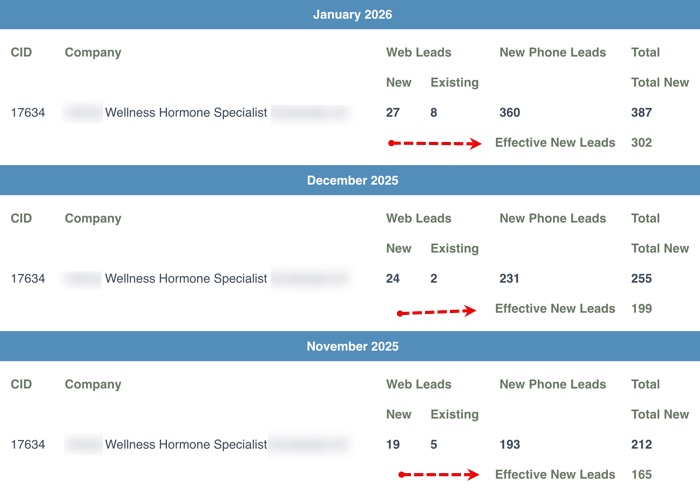
Example of a marketing ROI dashboard of Wellness practice using PatientGain’s PLATINUM service. As data shows, in the month of January, there are 387 recorded new patient leads. Out of which, 302 are effective leads.
What is an Example Pricing for Dedicated Healthcare Marketing Agency like PatientGain?
A dedicated healthcare marketing agency like PatientGain typically operates on a tiered, monthly subscription model ranging from $899 to $2,499+ per month for all-in-one software and services. Traditional boutique agencies usually charge a flat $3,000 to $10,000+ per month with high upfront setup fees.
Because medical marketing requires strict HIPAA-compliant tools, secure lead management, and specialized SEO, pricing is heavily dictated by your geographic location’s market competition and the number of clinic locations.
PatientGain’s framework highlights how tiers scale by competitive needs:
- Gold Tier (Starting at $899/month): Best for practices in low-competition areas. It generally includes a foundational HIPAA-compliant website, basic SEO, a patient CRM, and roughly 10 core marketing apps (like basic email marketing and social media scheduling).
- Platinum Tier (Starting at $1,699/month): Designed for medium-competition urban or suburban markets. It adds aggressive monthly SEO content creation, advanced reputation management, automated chatbots, and 2-way texting.
- Platinum Plus Tier (Starting at $2,499/month): Targeted at high-competition metro areas or telemedicine-focused practices. It features deeper SEO strategies, patient referral widgets, and automated email drip campaigns.
Core Cost Breakdown
| Service Category | Standard Managed Agency Model – PatientGain | Traditional Boutique Agency Model |
|---|---|---|
| Upfront Setup Fees | $0 upfront (usually tied to a 12-month contract) | $5,000 to $15,000+ one-time fee for custom web development and branding. |
| Monthly Service Fee | $899 – $2499/mo | $3,000 – $10,000+/mo |
| Paid Ads Management | Paid directly to Google/Meta with a flat ~18% management fee. | Typically 15% to 30% of total ad spend or a high flat retainer. |
| Multi-Location Add-ons | Scaled down to $500 – $800/moper additional location by cloning architecture. | Often multiplied linearly (e.g., $2,000/mo per individual location). |
| Software Integrations | Included. Native CRM, texting, forms, and reviews. | $800 – $1,500/mo extra to stitch together third-party tools (e.g., Podium, Mailchimp). |
| HIPAA Compliance and BAA | Single BAA included at no extra cost – Low chances of HIPAA Leakage | Multiple BAA’s from multiple companies – Hence high chances of HIPAA Leakage |
À La Carte & Custom Options
If a healthcare practice does not need a full-service plan, alternative structures apply:
- Standalone Apps: Single software tools (like an intelligent medical chatbot or a HIPAA-compliant SMS app) can be purchased individually from $199 to $499/month.
- Fully Custom Enterprise Builds: For multi-location urgent cares, medical franchises, or complex plastic surgery practices requiring highly personalized WordPress builds, upfront development costs generally range from $8,000 to $50,000+
 Send Text
 How may I help you?