

Online Marketing for Doctors vs AI Marketing for Doctors
Traditional online marketing uses digital channels — websites, SEO, Google Ads, social media, email — operated by human teams making manual decisions based on periodic data review. AI marketing uses machine learning, natural language processing, and predictive algorithms to make those same decisions continuously, faster, and at a scale no human team can match — while a Human-in-the-Loop (HITL) framework ensures clinical accuracy and HIPAA compliance at every output.
Online marketing for doctors is the broader strategy used to promote a medical practice online. AI marketing for doctors is the use of artificial intelligence tools to make that marketing faster, smarter, and more automated. In simple terms: Online marketing is the full system. AI marketing is a tool inside that system.
Best Approach: Online Marketing + AI + Human Oversight
Online Marketing for Doctors vs AI Marketing for Doctors: Table of Contents
How are they different?
Example of a leads dashboard of a medical weight loss practice
Details of traditional online marketing for doctors
Details of AI marketing for doctors
Over-reliance on AI & automation
How are they different?
| Dimension | Traditional Online Marketing | AI Marketing |
|---|---|---|
| Content creation | Human writers produce 2–4 pieces/month | AI generates content in few minutes; humans review and approve (Human In The Loop – HITL) |
| SEO strategy | Keyword research done quarterly; applied manually | AI continuously analyzes real patient search patterns and updates targeting in real time (Predictive Reverse Search Engine) |
| Patient response | Front desk responds during business hours | AI responds 24/7 in seconds; escalates to human when needed (Human In The Loop – HITL) |
| Lead follow-up | Staff calls or emails leads on next business day | AI triggers follow-up text within minutes of inquiry — day or night |
| Reporting | Monthly PDF reports from each vendor | Real-time dashboard updated continuously across all channels – Live marketing and ROI dashboards, available 24×7) |
| Personalization | Same message to all patients | AI tailors message by patient type, search intent, behavior, and stage in decision journey |
| Cost | High human labor cost; linear scaling | Lower per-unit cost; scales without adding staff |
| HIPAA compliance | Depends on individual staff training, usually multiple BAAs involved | Systematic — AI-generated content reviewed at two checkpoints before patient delivery – Single BAA |
| Speed to insight | Weeks | Minutes |
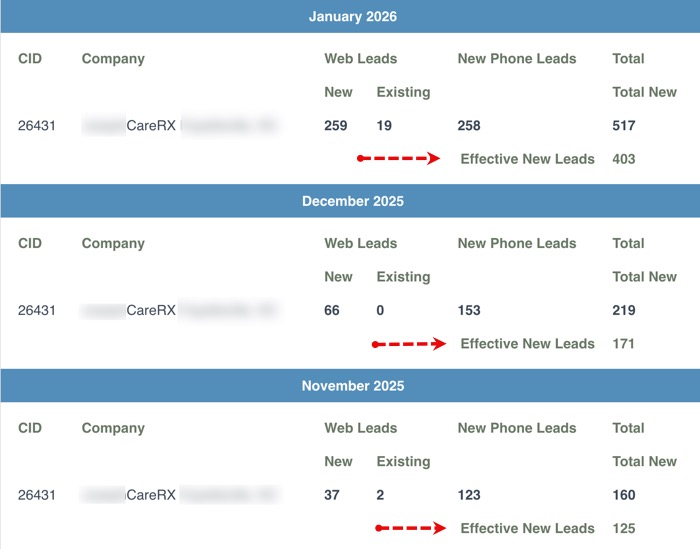
Example of a leads dashboard of a medical weight loss practice
This practice has been in practice for 6+ years, 3 full time providers, 6 exam rooms and is located in a very competitive area of North-West US. From the dashboard data, in the month of Jan, there are 517 total new recorded leads. After subtracting duplicates, sales calls, 403 effective leads are captured. This customer is using PatientGain’s PLATINUM service.
Details of Traditional Online Marketing for Doctors
Traditional online marketing for doctors is the model that has dominated healthcare for the past 15 years. It works — but it operates on a human-speed, calendar-driven cycle that creates consistent gaps in patient acquisition.
How It Works
Step 1 — Monthly content calendar: A marketing coordinator or agency plans 4–8 blog posts, social media posts, and email campaigns per month. Topics are chosen based on the marketing team’s judgment, not real-time patient search behavior.
Step 2 — Manual keyword research: An SEO specialist runs keyword analysis once per quarter, identifies targets, and assigns them to writers. By the time content is published, search behavior may have shifted.
Step 3 — Google Business Profile (GBP) Posting: A marketing manager or the practice front desk posts on GBP when they have time. The result is sporadic posting on GBP – may be 1 to 2 times per week or worst 1 to 2 times per month or sometimes never.
Step 4 — Human response during business hours: A patient submits a contact form at 8:47 PM. The front desk sees it at 8:15 AM — nearly 12 hours later. Per Harvard Business Review research, the odds of qualifying a lead drop by 400% if the follow-up is delayed more than 5 minutes.
Step 5 — Monthly Email Marketing: A marketing manager or the practice front desk has to come up with ideas and content for the monthly news letters. This is a low priority item as they will get to it when they have time. The result is no news letetrs per month, or may be 1 per month.
Step 6 — Monthly reporting: Vendors deliver separate PDF reports. The practice owner receives 4–8 reports from 4–8 vendors, each using different metrics, and still cannot answer “what is my cost per new patient this month?”
What Traditional Online Marketing Does Well
- Brand-building and storytelling — experienced human marketers understand narrative and patient empathy
- Complex strategic decisions — market entry, positioning, competitive response
- Relationship-driven content — provider spotlights, community involvement, practice culture
- Regulatory judgment calls — experienced healthcare marketers know what crosses the HIPAA and FTC line
What Traditional Online Marketing Does Poorly
- Speed — human cycles cannot match the pace of patient search behavior
- Scale — adding more locations or services requires proportionally more staff
- 24/7 coverage — patients search for care at all hours; human teams work business hours
- Real-time optimization — ads continue underperforming between weekly reviews
- Predictive personalization — one message for all patients, regardless of their stage or intent
Details of AI Marketing for Doctors
AI marketing for doctors uses machine learning algorithms, natural language processing (NLP), predictive analytics, and generative AI to execute marketing tasks at machine speed with a human oversight layer that ensures clinical accuracy and HIPAA compliance.
Capability 1 — Predictive Patient Search Analysis
Traditional SEO asks: “What keywords should we target this month?”
AI marketing asks: “What are patients in this specific market actually searching for right now — and which of those searches produce patients who book?”
PatientGain’s Predictive Reverse Search Engine continuously analyzes real patient search patterns, filters for queries with 70%+ conversion rates (meaning 7 out of 10 patients who arrive via that search take a booking action), and produces content targeting only those high-converting patterns. Low-traffic, low-converting keywords are deprioritized regardless of how logical they seem to a human strategist.
The result: content that is built backward from the patient’s booking behavior, not forward from a marketer’s assumption.
Capability 2 — 24/7 AI-Powered Lead Capture and Response
The most consequential gap in traditional online marketing is the after-hours response window. A patient searching for a dermatologist at 10 PM is ready to book. A traditional marketing system shows them a website with a “We’ll contact you within 1 business day” contact form. An AI marketing system:
- Detects the patient inquiry in real time
- Responds via AI chatbot within seconds — answering insurance questions, service questions, and hours
- Captures contact information and intent
- Triggers an automated HIPAA-compliant text follow-up
- Routes the lead to the appropriate provider’s schedule
- Logs the entire interaction in the CRM for the morning team to review
Per PatientGain’s HITL framework: AI handles 80% of patient interactions automatically; humans are inserted at two specific checkpoints before any clinical or compliance-sensitive content is delivered to a patient. This is the Human-in-the-Loop (HITL) model .
Capability 3 — Local SEO Optimization – GBP Posting
Traditional Google Business Profile (GBP) Posting: Manual process.
AI based GBP posting – 20 to 30 times per month – using the services which are more likely to be searched by patients in your target area.
Capability 4 — Personalized Patient Communication at Scale
Traditional email marketing: One newsletter sent to all patients on the list every month.
AI marketing: Behavior-based, personalized communication triggered by patient actions:
| Patient Action | AI-Triggered Response |
|---|---|
| Visits Botox page but does not book | Automated follow-up text: “Still considering Botox? Would you like 10% off for new clients?” |
| Books appointment but does not complete intake form | Automated reminder text with digital intake form link |
| Attends consultation but does not schedule treatment | 48-hour and 7-day follow-up sequence |
| Has not visited in 14 months | Reactivation email with personalized re-engagement message |
| Leaves a 5-star review | Automated thank-you text with referral program information |
Each of these sequences is triggered with HITL, personalized to the patient’s behavior, and delivered via HIPAA-compliant channels — without any manual staff action.
Capability 5 — AI Content Generation with HITL Review
Generating the volume of medically accurate, SEO-optimized content needed to win local search is beyond what any human team can produce cost-effectively. A single comprehensive healthcare SEO strategy requires:
- 40–80+ individual procedure and condition landing pages
- Monthly new content targeting current search trends
- 20+ social media posts per month per location
- Email newsletters and drip sequences
- Provider bio pages and Q&A content
AI generates this content at scale. But in healthcare, AI-generated content that is not reviewed by clinical experts creates three risks: medical inaccuracy, HIPAA exposure, and FTC deceptive advertising liability.
PatientGain’s HITL solution:
  AI generates content draft
        ↓
PatientGain content manager reviews
        ↓
Project manager reviews and approves
        ↓
Content published with IP-logged audit trail
AI handles 80% of the production burden. Humans provide the compliance oversight. The audit trail protects the practice if OCR or FTC ever investigates.
Capability 6 — Unified Real-Time Intelligence Dashboard
Traditional marketing reporting: 4–8 separate monthly PDF reports from 4–8 vendors, delivered 2–4 weeks after the period ends.
AI marketing dashboard: Every lead, call, text, form submission, chat interaction, ad click, GBP view, and review — from every channel, every location — unified in one real-time dashboard updated continuously.
What doctors and practice managers can answer in real time:
- Which channel produced the most new patient leads today?
- What is this month’s cost per lead ?
- Which front desk staff member is responding to texts fastest?
- Which location is underperforming vs. the rest of the network?
- What is the conversion rate from web visitor to booked appointment this week?
This transforms marketing from a monthly reporting exercise into a live operational intelligence system.
The HITL Framework — Why It Matters for Doctors
AI marketing for healthcare without human oversight is dangerous. The specific risks:
| AI Risk | Healthcare Consequence |
|---|---|
| Medical hallucination | AI claims a treatment cures a condition — FTC deceptive advertising violation |
| HIPAA violation | AI includes patient-identifiable information in a marketing output |
| Clinical inaccuracy | AI describes a procedure incorrectly — patient misinformed before appointment |
| Bias amplification | AI targets cosmetic procedures to demographics in a discriminatory pattern |
| Tone misalignment | AI generates content that feels automated and impersonal — destroys patient trust |
The Human-in-the-Loop (HITL) model is not a limitation on AI — it is what makes AI safe to use in healthcare marketing. Per PatientGain’s AI agents page: “The most advanced AI agents do the heavy lifting using AI algorithms, and then pass the final answers to a human before it is passed to patients. This hybrid model combines the operational speed of generative AI with the clinical judgment and ethical guardrails of human medical marketing experts.”
Which Approach Is Right for Which Practices
| Practice Profile | Recommended Approach | Why |
|---|---|---|
| Solo practice, any specialty, growth-focused | AI marketing (PatientGain PLATINUM) | 24/7 coverage, lower CPL, faster launch, single vendor |
| Multi-location group / MSO | AI marketing (PatientGain Multi-Location) | Network-level reporting, per-location optimization, $0 upfront |
| PE-backed network, brand-building priority | AI platform + boutique brand agency | AI for operational marketing; human agency for positioning and brand work |
| Hospital system / enterprise | AI platform + enterprise customization | Custom AI workflows at scale; PatientGain Enterprise from $10,000/month |
| Practice with $300K+ marketing budget seeking maximum customization | Traditional specialist agency + AI tools | Agency for bespoke strategy; AI tools embedded in execution |
Over-reliance on AI & automation
Over-reliance on AI and automation in healthcare practices – like front desk, mainly refers to automation bias: clinicians may trust AI
Traditional online marketing for doctors is sequential, human-speed, and calendar-driven. It works — but it leaves money on the table every night, every weekend, and every time a patient inquiry sits unanswered for more than 5 minutes. AI marketing for doctors is continuous, adaptive, and available at 2 AM when a patient is researching their options. With a proper HITL framework, it is also safe — clinically accurate, HIPAA-compliant, and audit-trailed.
While online marketing for doctors is the complete digital strategy used to attract and convert patients. AI marketing for doctors is a newer set of tools that helps automate and improve parts of that strategy.
For medical practices, the best choice is a HIPAA-compliant online marketing system that uses AI carefully, with expert human oversight. AI can help doctors grow faster, but it should not replace strategy, compliance, trust, or patient-focused communication.
The practices winning new patient acquisition are not choosing between digital marketing and AI marketing. They are using AI to execute digital marketing better, faster, and at a lower cost per patient — with humans ensuring every patient-facing output meets the clinical and compliance standard medicine requires.
 Send Text
 How may I help you?