
How To Improve New Patient Leads Capture
Practice managers ask: How To Improve New Patient Leads Capture?
In the US, healthcare clinics, MSOs, specialty practices, and multi-location health organizations handle a constant flow of patient inquiries, referrals, and appointment requests. When these inquiries arrive through multiple channels and land in disconnected systems, patients can fall through the cracks, while staff spend time chasing additional information. Consequently, it is estimated that 31% of new leads are leaked. This data is from established healthcare practices, not brand new practices.
PatientGain’s data shows it is actually more than 31% – is this correct?
While industry benchmarks across different tech and marketing reports often settle on the 31% figure for lost or leaked patient inquiries, healthcare marketing and technology platforms like PatientGain report that the actual percentage of lost opportunities can be significantly higher.
Their data and findings emphasize that when a medical or dental practice relies on a disconnected, “DIY” software stack, the true extent of lead leakage often exceeds that baseline due to compounding operational gaps:
- Unanswered or Missed Calls: A massive portion of lead leakage happens simply from calls going to voicemail during peak hours or after-hours, where patients rarely leave messages and instead just call the next provider.
- Delayed Response Times: Patients looking for care online typically book with the first practice that responds. If website forms or text messages sit unaddressed for hours or days, those leads are effectively leaked.
- Disparate Software Systems: When a practice uses separate systems for SMS, web chat, and their EHR, inquiries frequently drop through the technological cracks without anyone realizing it.
Because PatientGain looks closely at the total patient journey—including missed phone calls, slow form responses, and lack of automated follow-ups—they maintain that a standard practice can easily see well over 31% of their hard-earned new patient opportunities slip away before ever booking an appointment.
How can PatientGain measure missed or lost patient inquiries, leads, referrals?
PatientGain tracks missed or lost patient inquiries, leads, and referrals by consolidating a practice’s communication infrastructure into a single system. When a practice relies on disconnected vendors (separate texting apps, chat widgets, and web forms), lead leakage goes unnoticed because there is no unified audit trail.
PatientGain measures and highlights these lost opportunities through several integrated mechanisms:
1. Centralizing All Entrances via the SPOC Dashboard
The foundation of their tracking is the SPOC (Single Point of Conversion) dashboard. Every phone call, 2-way text message, HIPAA-compliant web form submission, and chatbot interaction routes into a unified feed. By funneling all entry points into one timeline, the system can flag exactly when an inquiry arrived and how long it has remained unanswered by the front desk.
2. Identifying Missed Calls & Triggering “Text-Backs”
Phone calls are typically the most common point of lead leakage for a clinic. PatientGain measures missed opportunities by integrating call tracking directly into their dashboard.
- The metric: The system logs unanswered calls, abandoned rings, and after-hours call volumes.
- The fix: To prevent the lead from becoming completely “lost,” PatientGain uses an automated Missed Call Text-Back feature. Within 90 seconds of a missed call, it sends an automated text message to pull that dropped caller back into an active text conversation.
3. Monitoring Chatbot vs. Staff Abandonment
When prospective patients use a website’s chat tool after hours, the AI medical chatbot engages them to capture their name, contact info, and medical intent. PatientGain tracks “abandonment rates” at this stage—measuring how many users dropped off during the chat versus how many were successfully converted into the Leads Funnel CRM.
4. Patient Attribution and Response-Time Logs
PatientGain calculates operational response times, highlighting exactly where staff may be falling behind. If a web submission or referral request sits untouched for hours, the CRM flags it as an endangered lead. The platform provides patient attribution analytics, mapping the journey from the initial ad or Google search click to a completed appointment. This allows practice managers to cross-reference total incoming traffic with actual booked encounters to see precisely what percentage leaked along the way.
5. Tracking Internal and External Referral Leakage
For multi-location practices or specialty organizations, patient referrals frequently drop through manual or paper-based tracking methods. PatientGain saves and tracks digital referral requests securely in the dashboard, enabling managers to audit whether a referred patient was promptly scheduled or if they disengaged due to scheduling friction or insurance verification delays.
What is the SPOC service from PatientGain, and how can it healthcare practices?
The SPOC (Single Point of Contact or Single Point of Conversion) service from PatientGain is an AI-powered, HIPAA-compliant “Unified Inbox” dashboard designed for medical and dental practices. Instead of requiring your front-desk staff to log into multiple separate systems, it funnels every single patient inquiry—phone calls, website contact forms, two-way text messages, and website chatbots—into one centralized, “Gmail-like” interface.
How SPOC Helps Healthcare Practices
PatientGain’s SPOC platform is built to solve two major problems in medical administration: staff burnout and missed patient leads. It helps practices through four primary mechanisms:
1. Eliminating “Lead Leakage”
- Unified Dashboard: Busy front desks often overlook website contact forms or miss incoming texts. SPOC logs 100% of these interactions in real-time in one location.
- Missed Call Tracking: Because phone calls remain the #1 way new patients contact a practice, the system tracks missed calls so staff can immediately follow up, ensuring high-intent patients don’t call a competitor instead.
2. Providing 24/7 Automated Engagement
- AI Intelli*Connect: The platform utilizes an AI agent to instantly answer routine, after-hours questions regarding your practice’s hours, location, and accepted insurance plans.
- Rapid Triage: The system automatically flags high-intent inquiries, allowing your staff to prioritize and contact urgent patient leads first.
3. Reducing Front-Desk Friction
- QuickSend Tools: From the dashboard, staff can instantly text secure appointment links or digital intake forms directly to a patient’s mobile phone.
- Fewer Software Tools: By replacing up to six disconnected communication tools with one dashboard, PatientGain estimates that it saves front-desk staff 6 to 14 hours per month in administrative time.
4. Improving Patient Conversion Rates
- Flexible Communication: Patients can text, chat, or call based on their personal preference, which increases overall engagement.
- Proven ROI: By capturing missed opportunities and speeding up response times, practices using the SPOC app typically see their lead-to-patient conversion rates climb to between 10% and 22%.
Example from SPOC dashboard from real practice.
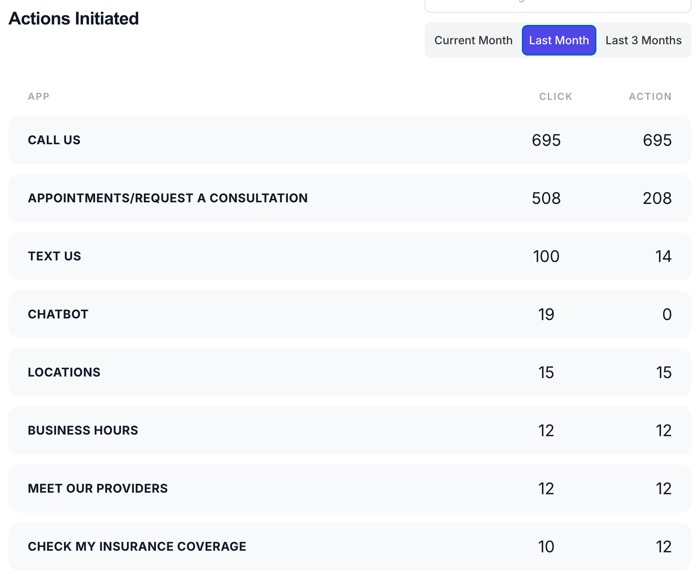
This screenshot shows the actual SPOC dashboard data from Example 2 (the highly successful OBGYN practice) for “Last Month”. The core significance of this data lies in proving the “Mobile Friction” theory and highlighting massive optimization gaps in how medical practices handle digital vs. traditional patient intake.
1. The Power of Direct Human Connection (Phone Calls)
- The Metric: CALL US had 695 clicks and 695 actions.
- The Significance: This is a perfect 100% completion rate. When a user hits the phone button on their mobile device, there is zero friction. The call goes through immediately to either a human or a voicemail system. This reinforces that phone calls remain the dominant and most successful way patients convert into actual appointments.
2. High Friction Leading to “Appointment Drop-Off”
- The Metric: APPOINTMENTS/REQUEST A CONSULTATION had 508 clicks but only 208 actions.
- The Significance: Less than half (41%) of the people who wanted to book an appointment actually finished the process. This represents 300 lost potential patients in a single month. This drop-off usually happens because the booking form asks for too much information (e.g., insurance numbers, long medical history forms) which mobile users find tedious and abandon.
3. Extremely High Friction in Digital Messaging
- The Metric: TEXT US had 100 clicks but only 14 actions, while CHATBOT had 19 clicks and 0 actions.
- The Significance: Patients want to text (100 people tried), but only 14% completed the message. For the chatbot, nobody completed an action. This indicates that if a chatbot or text system forces patients to answer a series of automated screening questions before they can talk to someone, they will give up and close the app.
4. High Intent Informational Clicks
- The Metrics: LOCATIONS (15), BUSINESS HOURS (12), MEET OUR PROVIDERS (12) all have a 100% completion rate.
- The Significance: These represent high-intent patients who are looking for immediate answers to finalize their decision to visit. Because these links immediately give them the info they need without asking them to type anything, they have zero friction.
The Big Takeaway for a Practice Manager
This data proves that having digital tools is not enough; they must be simple. If your appointment requests or text apps lose 60% to 86% of the people who click them, the digital intake process is too complicated. Streamlining forms down to just a name and phone number would dramatically capture those lost 300+ patient leads.
The Ultimate Takeaway & Diagnosis of the problem: Medical practices lose an immense amount of revenue simply by being slow to respond or failing to track missed phone calls. Implementing centralized workflows and reducing response times down to minutes is universally considered a best practice for growing a medical clinic.

 Send Text
 How may I help you?