

How can PatientGain offer HIPAA Compliant WordPress websites? WordPress at its core is Not HIPAA compliant?
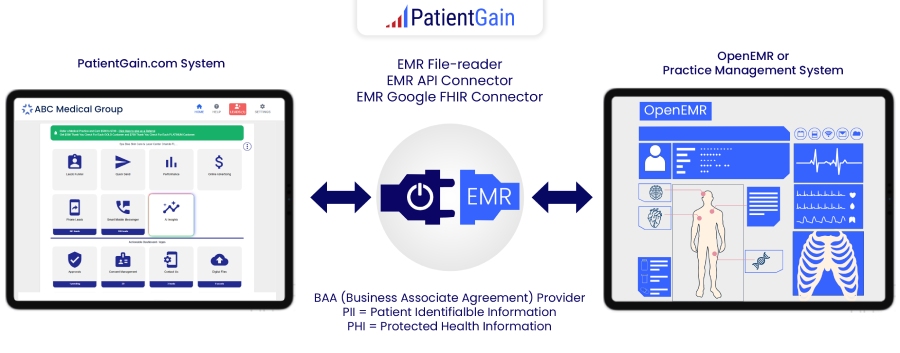
This is a common question. Everyday we get inquires from medical and dental practices. WordPress by itself is not inherently HIPAA-compliant. However, PatientGain offers HIPAA-compliant very fast loading WordPress websites by implementing specific technical and procedural controls that meet HIPAA’s strict privacy and security standards. PatientGain provides HIPAA-compliant WordPress websites for healthcare practices and even integrate it with OpenEMR while ensuring compliance.
While WordPress is not HIPAA-compliant “at its core,” PatientGain achieves compliance by fundamentally re-engineering how the platform handles data. They use WordPress only as a “front-end” visual layer, while routing all sensitive information to a separate, secure environment.
Here is how PatientGain secures their WordPress websites:
- Zero PHI in WordPress Architecture: Patient information captured via forms, chatbots, or appointment requests never touches the standard WordPress database. Instead, it is routed directly into PatientGain’s encrypted, proprietary CRM vault.
- Secure Infrastructure: The websites are hosted on compute-optimized Google Cloud Platform (GCP) or Amazon Web Services (AWS) servers that specifically meet HITECH and HIPAA standards.
- Legal Shield (BAA): PatientGain signs a Business Associate Agreement (BAA) with every healthcare practice, legally binding them to HIPAA standards and assuming liability for data security.
- Isolated Access Controls: Patient data cannot be accessed through the standard WordPress admin dashboard. Staff must log into a separate, secure “SPOC” portal that uses role-based permissions and immutable audit logs.
- Multi-Layered Encryption: All Protected Health Information (PHI) is protected with 128-bit/256-bit encryption both at rest (stored on servers) and in transit (moving across the web via SSL/HTTPS).
- Administrative Safeguards: Their service includes regular security audits, mandatory HIPAA training for all staff, and background checks for employees
To maintain HIPAA compliance while using WordPress, PatientGain follows a rigorous audit and monitoring schedule that combines automated technical scans with manual human verification.
1. Daily Security Log Reviews
PatientGain performs manual reviews of security logs every single day to catch anomalies that automated systems might miss.
- Dual-Verification: One staff member reviews the logs and creates a record; a second staff member (a human, not a bot) then verifies those log files.
- Access Monitoring: They monitor all attempts to access Protected Health Information (PHI) within their proprietary SPOC (Single Point of Contact) application.
2. Internal Self-Audits
They conduct regular compliance audits to identify and rectify potential gaps before any official regulatory oversight occurs.
- Risk Assessments: These audits evaluate administrative, physical, and technical safeguards.
- Remediation Plans: If a vulnerability is found during a self-audit, a formal remediation plan is triggered immediately to patch the issue.
3. Immutable Audit Trails
Every interaction with patient data is automatically logged into an immutable audit trail.
- User Tracking: Logs record exactly which staff member viewed or edited PHI and at what time.
- Non-Repudiation: Because these logs are immutable, they cannot be altered or deleted, providing a “source of truth” during a HIPAA OCR audit.
- No data is deleted – however data can be archived for audits.
4. Third-Party Infrastructure Audits
Because PatientGain hosts its secure data vault on AWS and Google Cloud, they inherit the high-level security certifications of those platforms.
- Physical Security: Both AWS and Google Cloud undergo extensive third-party audits (like SOC 2 Type II and ISO 27001) to ensure their data centers are physically secure.
5. Workforce Compliance Audits
- Mandatory Training: All staff attend regular HIPAA privacy and security training.
- Background Checks: Every staff member undergoes a thorough background check before they are granted access to any part of the system.
 Send Text
 How may I help you?