
Google PPC Ads Services For Urgent Care Clinics
Top healthcare marketing agencies build Google PPC strategies for urgent care clinics around one reality: urgent care is an immediate, high-intent need. Unlike primary care or specialty medicine, patients do not spend weeks researching options. They search from a mobile device while in distress and choose whoever is closest, open, and fastest.
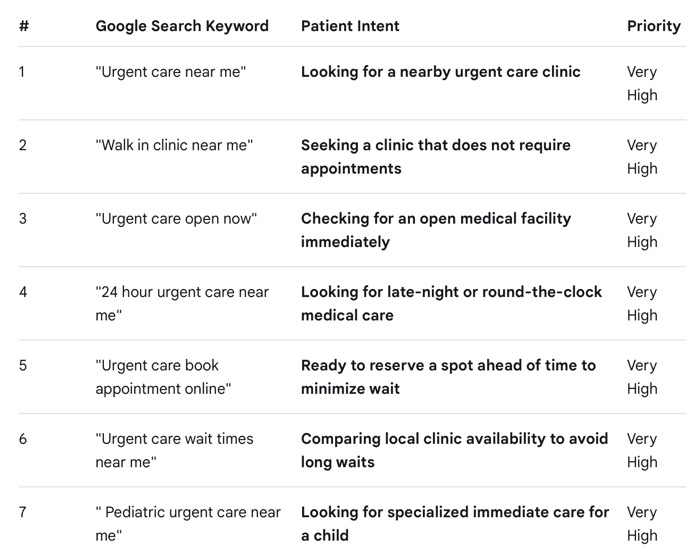
Good examples of high-intent, high conversion keywords for urgent care clinics.
Google Ads generally charges you when someone clicks your ad, rather than simply when it appears. Ad placement depends on factors including your bid, ad relevance, and landing-page experience.
This approach is particularly valuable for urgent care, dental practices, dermatology, physical therapy, primary care, and other appointment-driven healthcare services.
What makes a high-intent campaign successful?
- Location-specific campaigns: Separate budgets and targeting for each clinic, so one busy location doesn’t consume another’s advertising budget.
- High-intent keywords: Prioritize searches such as “urgent care near me” and “walk-in clinic open now.” Start with exact and phrase match, then expand based on performance.
- Negative keywords: Filter irrelevant searches such as “urgent care jobs,” “medical school,” and “free medical courses.”
- Dedicated landing pages: Direct patients to the correct location page with its address, accurate hours, services, accepted insurance, and booking options.
- Conversion measurement: Measure qualified calls, completed bookings, and actual new patients—not simply clicks.
- HIPAA compliant implementation: Ensure tracking, call analytics, forms, and agencies are reviewed for PHI handling. A BAA is important where required, but a BAA alone does not make every advertising technology or data-sharing configuration compliant.
How PatientGain Manages PPC Advertising Campaigns for Urgent Care Clinics
PatientGain promotes an integrated, location-specific patient acquisition system rather than simply managing Google Ads keywords and bids. For urgent care clinics, this approach makes sense because the buying behavior is very different from elective medical services. Patients often need care the same day, and their decisions depend on location, operating hours, insurance acceptance, and whether they can get help promptly.
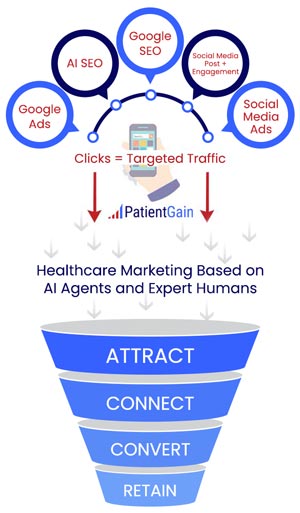
PatientGain strategy is much more than just setting up campaigns. It is a system that is HIPAA compliant, combining PPC specialists, AI-assisted optimization, local targeting, landing pages, patient communication tools, conversion tracking, and healthcare-focused analytics. These are the company’s published capabilities; their actual effectiveness should be verified through clinic-level campaign data.
Data is for urgent care clinics only – PatientGain has 10+ years of experience in Google PPC ads, display ads, you tube ads, Meta ads, and now also ChatGPT ads.
1. Focus on High-Intent Google Search (and Dropping Social Media)
PatientGain relies heavily on their own internal performance data, which shows that social media advertising for urgent care yields exceptionally low conversion rates. Because urgent care is an immediate, need-based service, patients are not scrolling Facebook or Instagram looking for a clinic; they are actively searching Google. When taking over new accounts, PatientGain frequently stops Meta (Facebook/Instagram) ad spending entirely and redirects that budget directly into Google PPC to capture high-intent searches like some examples below:
Example of 20 High-Intent Google PPC Keywords for an Urgent Care Clinics
These keywords focus on prospective patients who are actively experiencing acute symptoms, looking for a nearby walk-in clinic, checking wait times, or ready to seek immediate medical attention.
| # | Google Search Keyword | Patient Intent | Priority |
|---|---|---|---|
| 1 | “Urgent care near me” | Looking for a nearby urgent care clinic | Very High |
| 2 | “Walk in clinic near me” | Seeking a clinic that does not require appointments | Very High |
| 3 | “Urgent care open now” | Checking for an open medical facility immediately | Very High |
| 4 | “24 hour urgent care near me” | Looking for late-night or round-the-clock medical care | Very High |
| 5 | “Urgent care book appointment online” | Ready to reserve a spot ahead of time to minimize wait | Very High |
| 6 | “Urgent care wait times near me” | Comparing local clinic availability to avoid long waits | Very High |
| 7 | “Pediatric urgent care near me” | Looking for specialized immediate care for a child | Very High |
| 8 | “Urgent care that takes [Insurance Provider]” | Searching for an in-network facility to minimize out-of-pocket costs | Very High |
| 9 | “Affordable urgent care no insurance” | Seeking transparent, low self-pay pricing for immediate care | High |
| 10 | “X-ray near me urgent care” | Suspecting a fracture or sprain and needing immediate imaging | Very High |
| 11 | “Where to get stitches near me” | Seeking immediate treatment for a laceration or deep cut | Very High |
| 12 | “Rapid strep test near me” | Searching for fast diagnosis of a severe sore throat | High |
| 13 | “STD testing urgent care near me” | Seeking confidential, fast-turnaround medical testing | High |
| 14 | “Flu test near me walk in” | Experiencing acute illness symptoms and needing a quick diagnosis | High |
| 15 | “Covid test urgent care near me” | Seeking immediate viral screening due to exposure or symptoms | High |
| 16 | “Urgent care for ear infection” | Experiencing acute pain and seeking prescription treatment | Very High |
| 17 | “UTI treatment near me open today” | Seeking immediate relief and antibiotics for painful symptoms | Very High |
| 18 | “Sports physicals near me urgent care” | Looking for a fast, walk-in clearance form for school or sports | High |
| 19 | “TB test walk in clinic” | Needing rapid testing for employment or school compliance | High |
| 20 | “Medical clinic open Sunday near me” | Seeking weekend care when primary doctors are closed | Very High |
2. Exclusion of PMAX and Broad Tactics
Rather than relying on automated, black-box campaign types like Google’s Performance Max (PMAX)—which spreads budget across display networks, YouTube, and Gmail—PatientGain keeps targeting tightly focused on Search and Maps. They ensure that the ads drive traffic to highly optimized landing pages designed to immediately answer the five things an urgent care patient is looking for: Location, Contact, Directions, Services, and Appointments.
3. Multi-Location Strategy and “Hub-and-Spoke” Architecture
For urgent care brands with multiple clinics, routing the right ad to the right clinic is essential. PatientGain utilizes a “Hub-and-Spoke” website architecture. A single parent domain acts as the “hub” to build cumulative SEO authority, while each individual clinic location has its own hyper-local microsite. This infrastructure allows them to point localized PPC ads directly to the microsite of the nearest clinic, making it easier to dynamically shift budgets to specific geographic locations that need more patient volume.
4. Action-Based Conversion Tracking & Page Speed
PatientGain emphasizes that urgent care campaigns should never be judged simply by clicks or overall website traffic. PatientGain tracks concrete actions like new phone calls, text messages, and appointment bookings through a centralized dashboard. PatientGain offers a centralized lead capture app called SPOC. Crucially, they tie PPC conversion rates directly to mobile website performance. Their data shows that if a mobile site takes longer than 4 seconds to load, conversion rates drop significantly. To ensure ad spend isn’t wasted on bounced clicks, PatientGain targets strict mobile load times of 1.7 to 2.3 seconds.
5. Strict HIPAA Compliance & Custom Analytics
This is one of their most distinct technical strategies. Standard Google Analytics (GA4), Google Tag Manager, and native Google Ads conversion tracking are not HIPAA compliant out of the box, as Google refuses to sign a Business Associate Agreement (BAA) for GA4. Passing a patient’s IP address along with their search behavior (like looking up specific illness treatments) to Google or Meta can constitute a HIPAA violation.
To solve this, PatientGain replaces standard Google Analytics with their own proprietary, HIPAA-compliant analytics platform.
- Their infrastructure is hosted on secure AWS and Google Cloud (GCP) servers backed by a SOC 2 Type II certification and a BAA.
- The system strips out Protected Health Information (PHI) so practice managers can accurately track ad ROI without illegally leaking patient data to third-party ad networks.
- Every API call, database query, and login attempt is logged to create an immutable audit trail.
6. “Done-For-You” Execution and Budgets
PatientGain is a a “Done-For-You” platform built for practice managers who do not have the time or technical skills to juggle multiple software vendors. For a new urgent care clinic, they stress that Google PPC is highly critical for the first 6 to 12 months to generate immediate cash flow while local SEO builds up.
What are the pricing of PPC ads management from PatientGain?
If a customer uses any of PatientGain’s services, PatientGain simply charges 18% of the total ads spend.
If a customer does not use any of PatientGain’s services, PatientGain charges a base fee of $299 to $499 per month + 18% of the total ads spend.
 Send Text
 How may I help you?