

Centralized Marketing Performance Management For Healthcare MSOs, Practice Networks, Franchises, and Rapidly Expanding Specialty Groups
PatientGain offers Centralized Marketing Performance Management (CMPM) for healthcare MSOs, practice networks, franchises, and rapidly expanding specialty groups. This platform is HIPAA compliant and it is specifically designed to manage marketing efforts across multiple locations from a single, integrated system. Professional support is also offered. Support consists of a project manager and a senior technical resource. Typical pricing is $500/mon per location to $999/mon per location, with no upfront setup costs.
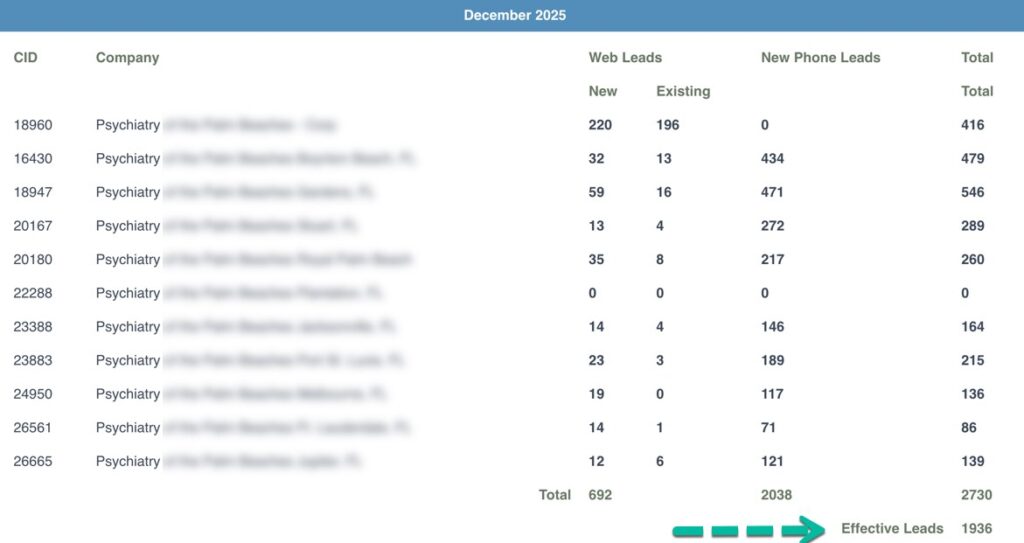
Example of a marketing performance dashboard of a 11 location practice network. This is live, real-time dashboard so you can see the performance or lack there-of of each location. This is included in the monthly service, without any extra cost to you. Our system is designed to handle up to 200 locations and it is a highly scalable system with HIPAA compliance and we issue BAA for our apps and service.
For Healthcare MSOs (Management Services Organizations), Practice Networks, and Franchises, “Centralized Marketing Performance Management” is not just a software tool—it is an operational strategy designed to solve the “Chaos of Scale.” When a group expands from 3 to 30+ locations, the old method of “each clinic doing its own thing” breaks down. Centralized management replaces fragmented vendors with a Unified Command Center. Here is what is typically included in a comprehensive Centralized Marketing Performance Management Solution for MSOs, based on enterprise-tier offerings like PatientGain Enterprise.
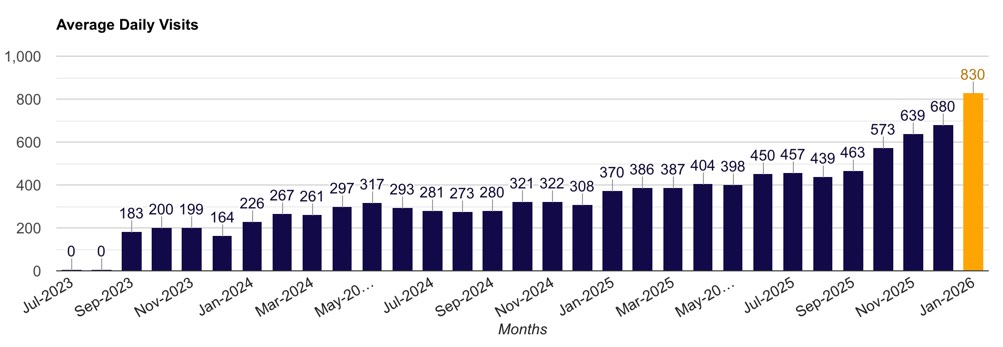
Example of average daily visits for a multi location, franchise based, healthcare provider. In Sep 2023 at the start of the Multi-location service ($500/mon per location) there are 183 average daily visits. There are no ads. This is SEO based organic growth. In Jan 2026, it is increased to 830 average daily visits. All by using SEO and AEO strategies.
1. The “Roll-Up” Executive Dashboard
The most critical feature for the C-Suite (CEO, CMO, PE Investors). It aggregates data from all locations into a single view to answer high-level questions instantly.
- Global View: See total “New Patient Acquisition” across the entire network.
- Regional Filtering: Compare the performance of the “Texas Region” vs. the “Florida Region.”
- Drill-Down Capability: Click on a specific underperforming clinic (e.g., Austin North Location) to see why their conversion rate dropped last week.
- Unified ROI Reporting: A single report showing Customer Acquisition Cost (PAC) blended across the whole group, and broken down by location.
2. Multi-Location Reputation Management
Managing reviews for 50+ Google Business Profiles (GBP) is impossible manually.
- Centralized Feed: A single stream of all reviews coming in from every location.
- Templated Responses: “Approve” pre-written, HIPAA-compliant responses for local practice managers to use, ensuring brand voice consistency. Included in the QuickSend app.
- Leaderboards: Internal ranking of clinics (e.g., “The Miami location has the highest 5-star velocity this month”), used to gamify staff performance.
3. A/B Tested, Proven Website Architecture, Hosted on Extremely Fast Google Cloud
Instead of managing 50 separate WordPress sites, MSOs use a centralized architecture.
- Global Updates: If you need to change a disclaimer or update a “COVID-19 Policy” across all 50 sites, you push one button in the central dashboard, and it updates everywhere instantly. PatientGain performs these type of tasks, not your staff.
- Local Landing Pages: Each location gets a highly optimized local sub-site (e.g.,
brand.com/dallasandbrand.com/houston) that shares the main domain’s “SEO Authority” while ranking for local keywords.
4. Brand Compliance & Asset Control
Ensures that a clinic in Ohio isn’t using an old logo or making non-compliant medical claims.
- Digital Asset Management (DAM): A shared library of approved photos, videos, and ad copy. Local managers can only use pre-approved assets.
- Locked and Approved Assets: Each location has local dashboards and can use any of the “Corporate” assets. Local managers can change the “Office Hours” or “Doctor Bio” on their page, but they cannot break the layout, change the colors, or alter the core medical service descriptions.
5. Centralized Call Call Tracking and Leads Management
For MSOs that use a central call center rather than front-desk receptionists.
- Smart Control: The marketing leads funnel tags the lead source – and each location manage its own new leads or the the central office can manage the leads with a simple setting.
- Call Data & Scoring: AI automatically transcribes missed calls, average call time, and all missed calls are automatically followed up by a Texting/SMS app.
6. Economies of Scale (Cost Management)
- Vendor Consolidation: Instead of paying 50 separate subscriptions for “Podium” or “Mailchimp,” the MSO pays for one Enterprise License.
- Shared Ad Audiences: Data from the “Mature” locations (who have thousands of patients) is used to build “Lookalike Audiences” to jumpstart ads for “De Novo” (brand new) locations, lowering their launch costs.
Comparison: Independent vs. Centralized MSO Model
| Feature | Independent Strategy (Chaos) | Centralized MSO Strategy (Order) |
| Vendors | 50 locations 5 vendors = Dozens of contracts to manage. | 1 Enterprise Partner (e.g., PatientGain). |
| Reporting | 50 different Excel sheets emailed by 50 office managers. | 1 Real-Time Dashboard accessible by HQ. |
| SEO Authority | 50 weak domains fighting for authority alone. | 1 Powerhouse Domain lifting all locations up. |
| Speed | Launching a new clinic takes 3 months of web dev. | Launching a new clinic takes 1 to few days – All work done by PatientGain |
| Compliance | High Risk (Did the new manager post a HIPAA violation?). | Minimum Risk (Central controls prevent unauthorized posts). |
Summary
A Centralized Marketing Performance Management (CMPM) system is not just marketing—it’s operational infrastructure for growth.
It provides:
• Control without micromanagement
• Consistency without killing local SEO
• Visibility without manual reporting
• Compliance without friction
• Scalability without vendor sprawl
For healthcare organizations growing beyond a few locations, CMPM is no longer optional—it’s how growth stays profitable, compliant, and predictable. Set up a Zoom meeting so we can show you examples.
 Send Text
 How may I help you?