

What are the differences between AI Search vs Traditional Search for healthcare providers and practice managers of clinics?
The Fundamental Shift in One Sentence: Recommendations (AI) VS Options (SEO Results)
Traditional search gives patients a list of links and makes them do the work of clicking, reading, and deciding. AI search synthesizes information from multiple sources, answers the patient’s question directly, and often recommends a specific provider — without the patient ever visiting a website. For healthcare practices, this is not a minor technical update. It is a complete restructuring of how patients discover and choose providers.
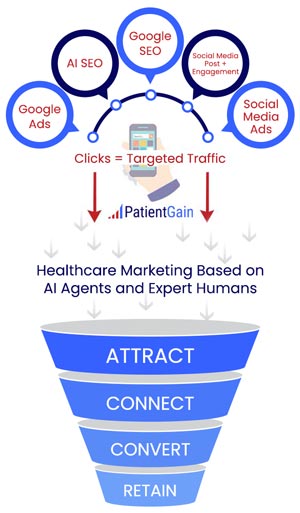
AI Search vs Traditional Search For Healthcare Practices: Table Of Contents
Practice managers need to know basics
Difference 1 — How Patients Search
Difference 2 — What Determines Who Gets Recommended
Difference 3 — The Role of Your Website
Difference 4 — Where Local Provider Searches Still Live
Difference 5 — Voice Search and AI Assistants as a Third Channel
The Tactics: Keywords vs. Structured Data
Generic Content vs Structured Medical Content
What Should Healthcare Clinics Do Now?
Do You Still Need Traditional SEO?
Practice managers need to know basics: Google treats different types of healthcare searches completely differently in AI Overviews.
| Query Type | AI Overview Coverage | What This Means for Your Practice |
|---|---|---|
| Treatment and procedure queries (“how is eczema treated”) | 100% — AI answers everything | Patients researching conditions get AI answers; your content must be the source AI cites |
| Pain and symptom queries (“knee pain causes”) | About 90% — near total AI coverage | Educational content must be structured to be cited by AI, not just ranked |
| Symptoms and conditions (“psoriasis symptoms”) | About 80% AI coverage | Condition pages need AI-optimized structure (AEO) not just traditional SEO |
| Local provider intent (“dermatologist near me”) | About 40% — AI appears | Traditional local SEO + GBP still wins here — Google reversed course specifically for local provider searches |
| Sensitive health topics (mental health, crisis, example adhd psychiatrist in palo alto) | 0% — consistently excluded | Google protects these from AI; traditional search rules apply |
The critical implication: For patient acquisition (local “near me” searches, “accepting new patients,” “open now”), traditional Local SEO and Google Business Profile still dominate — Google removed AI Overviews from these queries entirely. But for the educational research phase that precedes booking, AI now controls 93–100% of results.
The Zero-Click Search Problem
- About 58.5% of all U.S. Google searches now end without a click
- When Google AI Overviews appear, that rate rises to 83%
- In Google’s newer AI Mode, 93% of searches end without a click
What this means practically: A patient searching “what causes eczema” reads Google’s AI Overview answer — synthesized from multiple sources — and may never visit any website. Your clinic’s carefully written eczema page may never be seen.
But here is the opportunity: If your content is the source Google’s AI cites in its overview, you gain authority and visibility without the patient having to click at all. The goal shifts from “get them to click my link” to “become the source the AI quotes.”
The 5 Biggest Differences — Side by Side
Difference 1 — How Patients Search
| Traditional Search | AI Search |
|---|---|
| Short keyword phrases: “dermatologist Dallas” | Full conversational questions: “What’s the best dermatologist in North Dallas who treats psoriasis and accepts UnitedHealthcare?” |
| Patient browses results and self-filters | AI filters and recommends based on the full question |
| Patient visits 2–4 websites before deciding | Patient may book from the AI answer without visiting any website |
| Search is a starting point | AI search is often the endpoint |
For practice managers: Your content and GBP data must answer the complex, specific questions patients are now asking — not just the short keyword. “Dermatologist in Plano TX accepting UnitedHealthcare with evening appointments” should be findable from your location page, your GBP attributes (“accepting new patients” toggle, hours), and your insurance page.
Difference 2 — What Determines Who Gets Recommended
| Traditional Search Ranking Factors | AI Search Recommendation Factors |
|---|---|
| Keyword density and page relevance | Entity authority — how well Google understands your practice as a trusted medical entity |
| Backlinks and domain authority | Structured data (schema markup) — physician credentials, conditions treated, procedures offered |
| GBP completeness and review velocity | Review sentiment analysis — not just star rating but the specific language patients use in reviews |
| Page speed and Core Web Vitals | Citation in authoritative healthcare sources — Healthgrades, Zocdoc, WebMD |
| NAP consistency across directories | Consistency across the entire web entity — website, GBP, directories, schema all saying the same thing |
| Click-through rate from search results | Content structured as direct answers — FAQ format, Q&A schema, concise first-paragraph summaries |
AI engines are becoming like a “search engine agents” – They are making decisions for you – they evaluate your practice’s entity authority, physician credentials, peer-reviewed content, and patient outcomes before recommending a provider. Hence your website and additional relevant sources are checked first. Then AI engines recommend. Common question is: What if AI engine’s logic is flawed? Yes this can happen – This is PatientGain’s view.
Difference 3 — The Role of Your Website
| Traditional Search | AI Search |
|---|---|
| Website is the primary destination — patient reads it and decides | Website is a data source — AI reads it and synthesizes; patient may never visit |
| More pages = more ranking opportunities | Well-structured pages cited by AI = visibility without clicks |
| Long-form content wins on keyword density | Concise, authoritative, structured answers win — AI extracts and quotes |
| Meta descriptions written for human scanners | First 50–100 words of content written to be quoted by AI verbatim |
| Internal linking structure passes PageRank | Schema markup tells AI what the entity is, who the providers are, what they treat |
The new website goal: Build content that AI wants to cite. Every condition page, procedure page, and FAQ should open with a crisp, authoritative, medically accurate answer to the most likely patient question — then expand into detail below.
Difference 4 — Where Local Provider Searches Still Live (The Protected Zone)
This is the most practically important finding for practice managers. Google made a deliberate policy decision: “near me” and local provider intent queries return traditional results — not AI Overviews. Google recognized that recommending a specific doctor via AI for someone who is sick and needs care is too high a stakes action to automate without local, real-time, verified data.
Searches still in the traditional Local SEO / GBP zone:
- “dermatologist near me”
- “urgent care open now”
- “pediatrician accepting new patients [city]”
- “family doctor near me open Saturday”
- “dentist that takes Cigna near me”
Searches now dominated by AI Overviews:
- “how is eczema treated”
- “what are symptoms of psoriasis”
- “Botox vs. filler what’s the difference”
- “how long does laser hair removal take”
- “is urgent care or ER better for stitches”
Strategic implication: There are now two distinct optimization strategies running in parallel: The practices that win invest in both tracks simultaneously. PatientGain’s PLATINUM and PLATINUM+ Services are designed for this.
| Goal | Strategy |
|---|---|
| Capture patients ready to book | Traditional Local SEO — GBP, NAP, reviews, local content, proximity signals |
| Build authority in the research phase that precedes booking | AEO — Answer Engine Optimization — structured, citable content for AI to quote |
Difference 5 — Voice Search and AI Assistants as a Third Channel
Voice search sits at the intersection of traditional and AI search — and over 60% of healthcare searches are now voice- or conversational-based.
| Traditional Text Search | Voice / AI Assistant Search |
|---|---|
| “Botox near me” | “Hey Siri, where can I get Botox near me?” |
| Returns list of results | Returns one spoken answer — the AI picks for the patient |
| Patient scans and clicks | Patient hears one recommendation and calls directly |
| Visual result — website, photos, reviews visible | Audio result — only the spoken answer, no visual context |
| Multiple results shown | One result delivered |
For voice-based local healthcare searches, your GBP is the primary data source the AI assistant pulls from. Correct hours, correct category, high review velocity, and accurate services are what determine whether Siri says your practice name or your competitor’s.
The Tactics: Keywords vs. Structured Data
How you build your digital presence is completely different for each model.
| Strategy | Traditional SEO | AI Search (GEO) |
| Content Focus | Keyword density (repeating “urgent care Dallas”). Long-form blog posts meant to keep people reading. | Direct, factual Q&A formatting. Short, scannable answers to specific patient questions. |
| Authority Signals | Backlinks (how many other websites link to yours). | E-E-A-T (Experience, Expertise, Authoritativeness, Trustworthiness). AI looks for verified physician credentials and cited medical sources. |
| Technical Focus | Fast page loading speeds and mobile optimization. | Schema Markup. This is backend code that explicitly tells the AI, “This is a doctor, this is their specialty, these are the exact insurances they accept.” |
| Reputation | A few good reviews help click-through rates. | Crucial. AI synthesizes review sentiment. If an AI reads that 50 patients complained about your front desk, it will actively warn patients away from your clinic. |
Generic Content vs Structured Medical Content
Traditional SEO can sometimes rank with long blogs. AI search prefers content that is easier to extract and summarize.
Better AI-friendly healthcare content includes:
- Direct answers
- Short paragraphs
- FAQs
- Provider credentials
- Location details
- Service availability
- Patient eligibility
- Insurance/payment information
- Clear disclaimers where needed
- Schema markup
- Updated content
PatientGain’s AEO guidance says healthcare AEO should focus on structured content creation, FAQ pages, schema markup, voice search optimization, and direct answers to patient needs.
What Should Healthcare Clinics Do Now?
| Strategy | Why It Helps |
|---|---|
| Keep doing local SEO | Google Maps and “near me” searches still drive calls and visits. |
| Optimize Google Business Profile | Hours, reviews, services, photos, and posts help local visibility. |
| Create service-specific pages | AI and traditional search both need clear pages for each service. |
| Add FAQs to every service page | Matches how patients ask AI and voice-search questions. |
| Use schema markup | Helps search engines and AI systems understand your content. |
| Publish condition and treatment content | Builds relevance for patient questions. |
| Show provider credentials | Supports trust and medical authority. |
| Improve reviews | Reviews still influence local patient decisions. |
| Use HIPAA-safe tracking | Protects patient data while measuring ROI. |
| Track calls and bookings, not just traffic | AI search may reduce some clicks, so conversion tracking matters more. |
HHS warns that online tracking technologies used by healthcare entities can raise HIPAA concerns when they collect or disclose protected health information, so clinics should review analytics, pixels, forms, chat, and advertising tools carefully.
Do You Still Need Traditional SEO?
Yes. You cannot optimize for AI without a strong traditional SEO foundation. AI engines still scrape the internet to find their answers; if your website is broken, slow, or invisible to Google, the AI bots will never find your content to begin with. The most successful clinics use a hybrid approach—SEO to ensure the site is found, and GEO to ensure the content is trusted and cited by AI.
How much does all this cost for an medical or dental practice?
Traditional SEO Agencies vs. PatientGain
A comparative look highlights the architectural differences between a standard boutique agency model and PatientGain’s software-driven framework:
| Feature | Custom Boutique Agency | PatientGain (PLATINUM Tier) |
|---|---|---|
| Average Monthly Cost | about $3,000 – $6,000 / mo | about $1,699 / mo |
| Upfront Setup Fees | $10,000 – $15,000+ | $0 (with a standard 12-month contract) |
| Software Integrations | Extra $800 – $1,500/mo (Third-party tools for CRM, reviews, text) | Included (20+ native PatientGain apps built-in) |
| HIPAA Compliance and BAA | Requires complex custom configurations | Built-in natively across all infrastructure – Full BAA covers the monthly service, apps, hosting and CRM |
| Customization Flexibility | High; custom code and tailored design asset generation | Moderate; “semi-custom” layouts tailored strictly around proven clinical conversion models |
| Design Options | Fully custom – based on your exact requirements. | Standard PLATINUM is semi-custom. There are limitations on designs as all designs are A/B tested and changing payouts will result if lower conversions. However you can opt for PatientGain PLATINUM Service with CUSTOM Design. However this service requires upfront costs for the custom website deisgn. |
 Send Text
 How may I help you?