

How Does PatientGain’s ReputeMD Connect With Over 100 EMR/EHR Systems?
PatientGain’s ReputeMD app connects with over 100 EMR (Electronic Medical Record) and EHR systems primarily through its proprietary, HIPAA-compliant integration utility called the EMR-Xtract Connector.
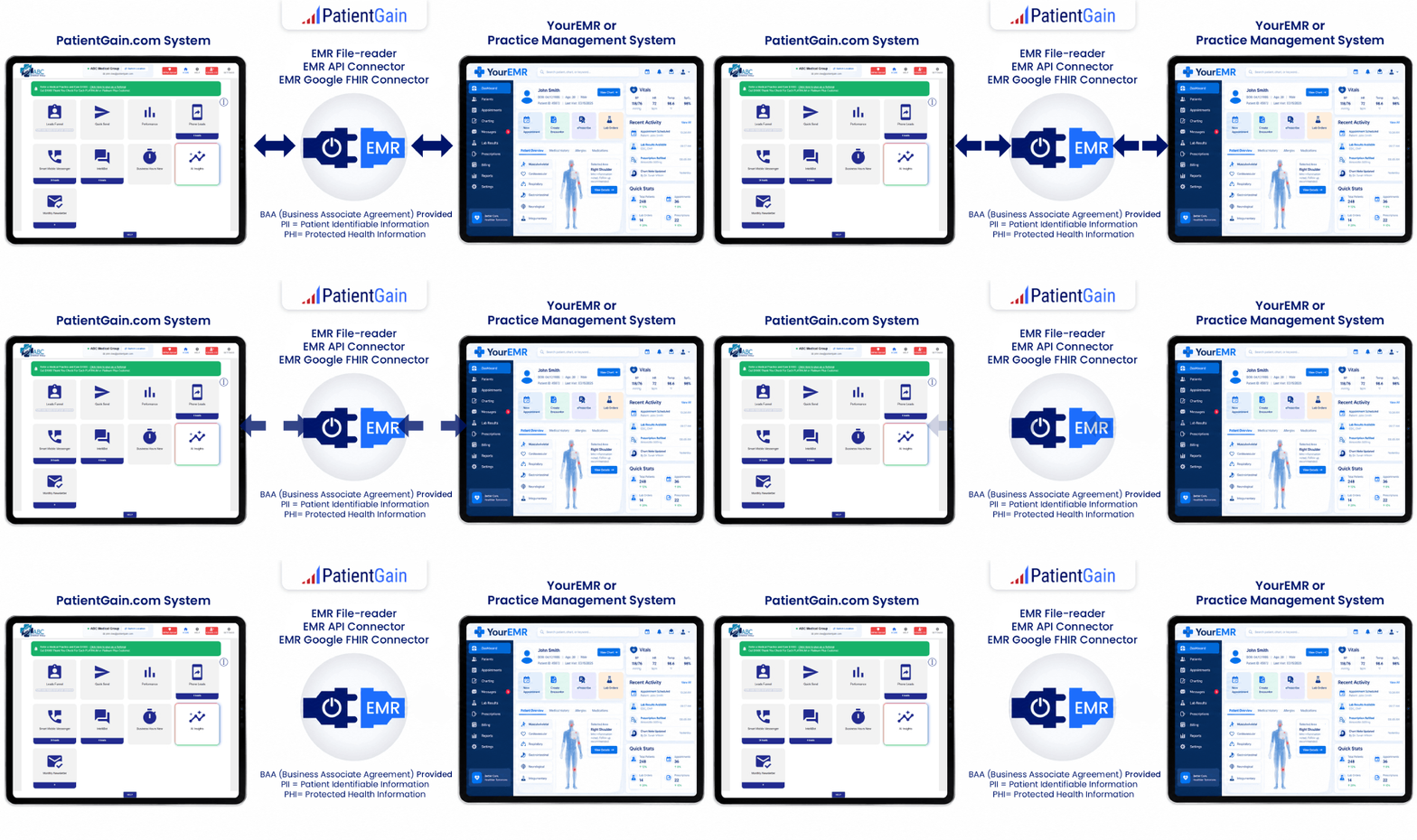
Instead of requiring manual staff entry or raw static data exporting, PatientGain hooks into various systems using three distinct methods depending on the specific infrastructure of the clinic’s EMR:
1. Real-Time Developer APIs
For modern, cloud-based electronic health record platforms (such as AdvancedMD or OpenEMR), PatientGain utilizes direct developer APIs. This creates an automated, continuous handshake with the system’s backend workflow to automatically capture when an appointment is booked, completed, or a patient checks out without staff intervention.
2. HL7 Data Feeds
For traditional or server-based systems, the EMR-Xtract Connector establishes a direct interface to receive standardized HL7 (Health Level 7) feeds. Whenever an appointment concludes or an administrative trigger occurs, the EMR pushes standard ADT (Admission, Discharge, Transfer) or scheduling messaging directly to the PatientGain ecosystem.
3. Secure File Readers & SFTP
For rigid or highly legacy architectures that lack direct APIs or open streaming capabilities, PatientGain deploys an automated file-reading app and data auto-loader. This program reads secure CSV exports or pulls encrypted data batches over SFTP feeds on a preset routine, ensuring data moves cleanly from the clinic’s internal records to the marketing dashboard.
NOTE: Most EMR and EHR systems provide some type of SFTP feeds or HL7 based files for patient appointment data transfers to another system like PatientGain’s ReputeMD
Most major EMR/EHR and Practice Management (PM) systems support HL7 feeds or automated SFTP file transfers to send patient appointment data to third-party reputation management platforms like rater8 and PatientGain’s ReputeMD. These third-party platforms rely on these specific methods to track when a patient is checked out or finishes an appointment so they can automatically trigger a text or email review request.
The integration methods break down into distinct setups depending on the capability of the EMR/EHR:
| Integration Method | How It Works for Appointment Transfers | Common Use Case |
|---|---|---|
| HL7 Data Feeds | The EMR automatically transmits a real-time SIU (Scheduling Information Update) or ADT (Admission, Discharge, Transfer) message immediately after an appointment is booked, changed, or completed. | Used by enterprise or local EMRs (e.g., Epic, Cerner) to feed data into tools like PatientGain’s EMR-Xtract Connector. |
| SFTP File Transfers | The EMR dumps an encrypted batch file (such as a daily CSV client list) onto a secure server, which the reputation system pulls from automatically. PatientGain provides a secure area for the SFTP file to your EMR/EHR. Usually your EMR/EHR runs a daily process that will place the file in the secure area provided by PatientGain. | Used by older or highly restrictive server-based PM systems that do not support live streaming data. Majority of the system prefer this method, as it is an industry practice and provides a clean separation of HIPAA responsibilities. |
| Real-Time APIs | The reputation tool uses modern, secure Web APIs (like FHIR or proprietary REST endpoints) to pull appointment details directly. | Used heavily by cloud-native EMRs like athenahealth or AdvancedMD. |
Automation + AI Agents + Human Oversight Drives the ReputeMD Service
Once patient contact data is securely mapped and synchronized through these methods, the ReputeMD app utilizes the data to execute automated workflows:
- Automated Post-Visit Triggers: As soon as the EMR marks a patient’s checkout or encounter as complete, the integration automatically prompts ReputeMD to text (SMS) or email a review request.
- Data Cleaning: The automated integration engine automatically deduplicates files, fixes minor spelling errors, and isolates specific subsets of patients (such as filtering for Gmail addresses) to intelligently pace review requests.
- Regulatory Compliance: Because moving patient data out of a clinical database carries regulatory risk, PatientGain encrypts data both at rest and in transit via HTTPS and provides a legally binding Business Associate Agreement (BAA) to maintain strict HIPAA compliance.
The core engine behind PatientGain’s ReputeMD (and broader marketing platform) is a highly structured Human-in-the-Loop (HITL) architecture.
This specific framework divides the workload between Automation, AI Agents, and Human Experts to achieve maximum speed while maintaining strict HIPAA compliance and clinical safety.
Because healthcare marketing carries steep legal and privacy risks, pure automation or unchecked AI is dangerous. The workflow operates through a precise three-tier structure:
| The Operational Layer | Who/What Handles It | Specific Role in ReputeMD & Marketing |
|---|---|---|
| 1. Back-End Automation | Deterministic Software Rules | Listens to your EMR/EHR via HL7 or SFTP. The moment a patient finishes an appointment, the automation instantly extracts the encrypted contact detail and logs it into a secure, HIPAA-compliant database. |
| 2. AI Agents | Generative & Agentic AI | Analyzes patient data patterns, tracks incoming review metrics, and automatically drafts digital assets—such as response drafts for reviews, email campaigns, or localized keyword optimizations. |
| 3. Human Oversight | Assigned Project Managers | Acts as the ultimate safety net. No AI-generated marketing content, public review replies, or broad communication updates automatically push live. A dedicated, healthcare-trained PatientGain Project Manager manually reviews and modifies the text inside a secure dashboard before hitting send. |
Why This Framework is Mandatory in Healthcare
If an AI agent autonomously responds to a patient’s public review or sends an unvetted text broadcast, it could accidentally reveal Protected Health Information (PHI) or make unverified clinical claims. By using Human-in-the-Loop (HITL) technology, the software achieves a 80/20 split: AI handles 80% of the heavy lifting (the tedious drafting, sorting, and scheduling), while human experts provide the final 20% of context, empathy, and medical compliance verification. This hybrid architecture keeps your practice protected under their Business Associate Agreement (BAA).
 Send Text
 How may I help you?