

Why HL7 Data Feeds Are Standard in Healthcare Interoperability Standards
Health Level Seven (HL7) is the definitive standard for healthcare interoperability because it provides the universal framework and structural rules necessary to package and communicate health data across fundamentally different software systems. It provides connectivity in real-time or almost real-time between hundreds of healthcare applications, including ReputeMD. Without it, the healthcare industry would rely on a fragmented web of expensive, custom point-to-point connections between every vendor’s software.
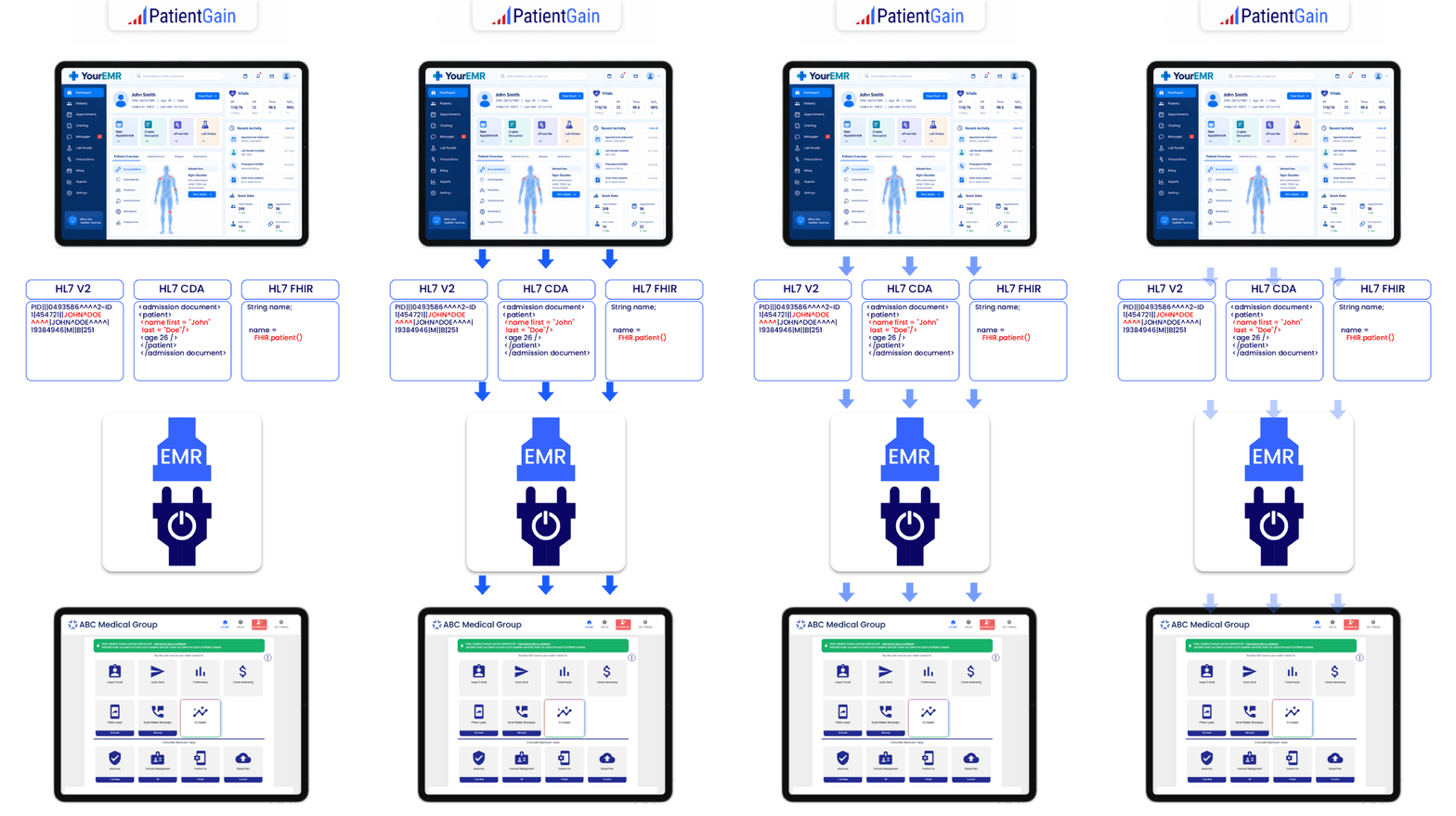
HL7 (Health Level Seven) data feeds have become a foundational standard in healthcare interoperability because they allow different healthcare software systems to exchange clinical, patient, and administrative information using standardized message structures. Hospitals, medical practices, Electronic Health Record (EHR) systems, laboratories, pharmacies, billing platforms, and patient engagement applications often use different technologies. Without standardized data exchange, connecting these systems would require extensive custom integration.
HL7 helps solve this problem by establishing a common framework for transmitting healthcare information.
According to HL7 International, HL7 Version 2 is among the most widely implemented healthcare messaging standards worldwide, with the organization reporting adoption by approximately 95% of U.S. healthcare organizations. This is an HL7-reported adoption figure, not a measure of how many systems are fully interoperable.
An important distinction: HL7 is a data exchange standard, not the physical network connection or a security system. HL7 messages may be transported through interfaces using technologies such as MLLP over TCP/IP, often with additional secure network protections.
Key reasons HL7 data feeds became so widely adopted
| Reason | Benefit to healthcare organizations |
|---|---|
| 1. Standardized messaging | Provides a common structure for transmitting healthcare information. |
| 2. Broad EHR adoption | Enables connections with many established hospital and practice systems, including majority of the small to medium sized EMR and EHR and Practice Management system support HL7 Version 2 |
| 3. Reduced custom development | Lessens the need to invent entirely new data formats for every connection. |
| 4. Automated workflows | Supports event-driven information exchange rather than repeated manual entry. |
| 5. Clinical coordination | Makes patient information available to authorized downstream systems. |
| 6. Long-term compatibility | Supports established healthcare infrastructure and generally backward-compatible messaging. |
| 7. Multiple message types | Covers patient admission, discharge, transfer, orders, results, and other workflows. |
| 8. Operational efficiency | Can reduce duplicate data entry, transcription errors, and administrative work. |
| 9. Integration flexibility | Can connect large hospital systems and smaller specialized applications. |
| 10. Established ecosystem | Benefits from experienced interface teams, integration engines, implementation guides, and vendor support. |
These advantages help explain why HL7 Version 2 continues to be extensively used, even as modern FHIR-based APIs grow in importance.
How HL7 data feeds support real healthcare workflows
Common HL7 Version 2 message families include:
| Message type | Typical purpose | Practical example |
|---|---|---|
| ADT | Admission, discharge, transfer, patient updates | Notify another system of a patient registration or demographic change |
| SIU | Scheduling information | Communicate appointment scheduling events |
| ORM | Orders (in applicable older workflows) | Transmit certain medical or laboratory orders |
| OML | Laboratory orders | Send an order to a laboratory |
| ORU | Observation results | Send laboratory or other clinical results |
| DFT | Financial transactions | Send charge information to a billing system |
| MDM | Medical document management | Communicate clinical document information |
Actual support depends on the EHR vendor, HL7 version, interface configuration, and local implementation. For example, an allergy practice could potentially use an HL7 interface to share appointment information with an authorized patient communication platform, reducing the need for staff to manually maintain multiple schedules.
The practical approach for many healthcare software companies, including PatientGain, is to support both HL7 Version 2 and FHIR, rather than assuming a single integration technology can satisfy every EHR workflow
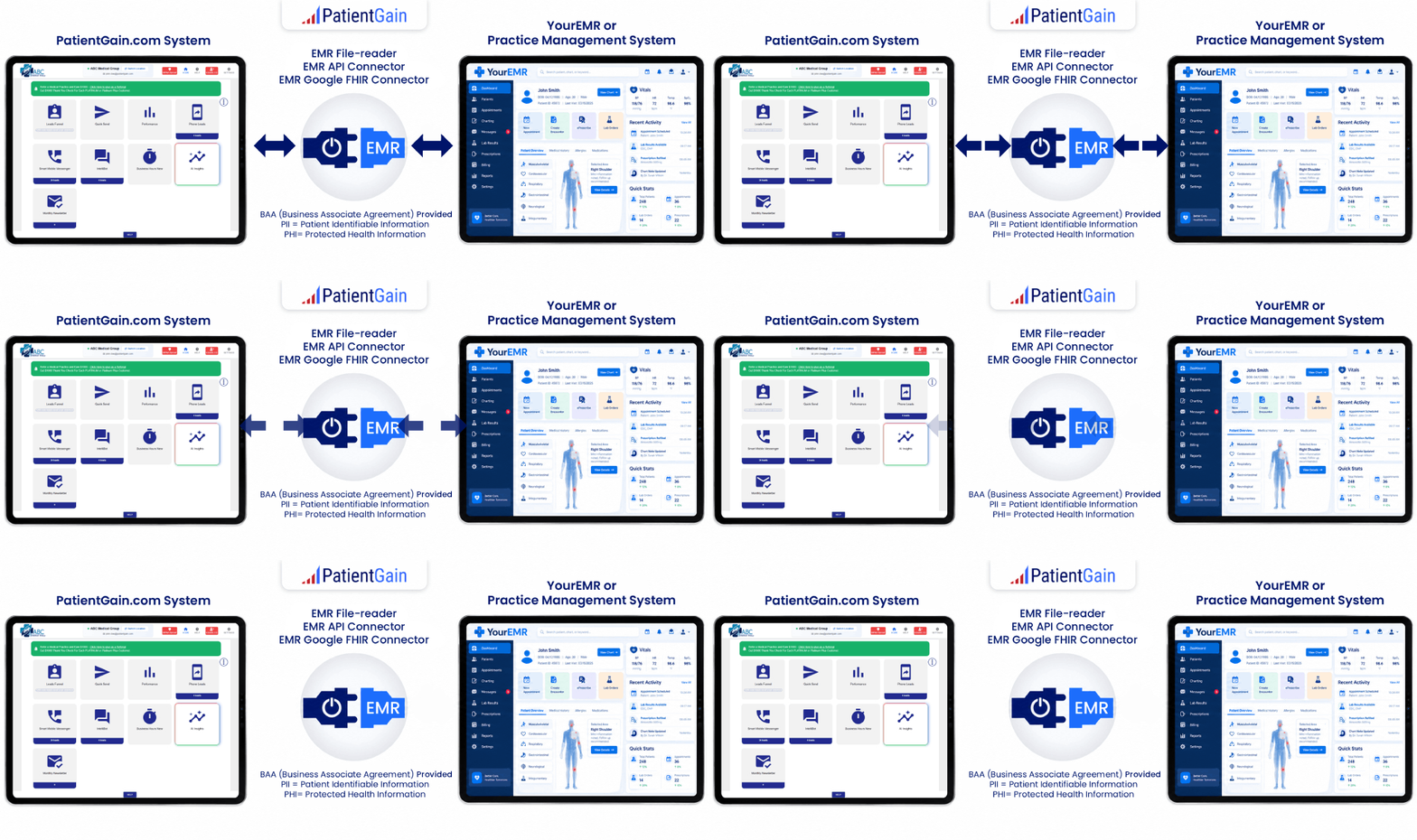
How does PatientGain’s apps use EMR data and HL7 standards to help medical and dental practices?
PatientGain’s healthcare marketing and patient engagement platform uses Electronic Medical Record (EMR/EHR) integrations and HL7 data feeds to bridge the gap between a practice’s clinical backend and its front-end patient acquisition tools.
By operating under a signed Business Associate Agreement (BAA), these applications maintain strict HIPAA compliance while automating tedious administrative tasks for medical, dental, and specialized wellness clinics. PatientGain uses EMR/EHR integration, HL7 data feeds, APIs, and secure file transfers to connect patient information from medical and dental practice management systems with its patient engagement, reputation management, and marketing applications.
The principal benefit is that medical and dental practices can automate routine administrative activities without requiring front-desk staff to repeatedly export patient lists, manually enter contact information, or operate multiple disconnected applications. PatientGain describes its proprietary EMR-Xtract Connector as the technology connecting these systems. According to its published documentation, the ReputeMD reputation management application supports integrations with over 100 EMR/EHR systems through a combination of connection methods, although this is a vendor-reported claim rather than an independently verified list of live integrations.
1. How PatientGain’s EMR integration works
Medical / Dental Practice EMRPatient contact details, scheduling, appointment status
HL7 feeds · APIs · Secure SFTP files
PatientGain EMR-Xtract ConnectorReceives, processes, and synchronizes permitted data
PatientGain Patient Engagement PlatformAuthorized contact data and workflow events
ReputeMDReview invitations
Patient MessagingSMS and email
SchedulingAppointment follow-ups
ReportingOperational insights
Illustrative integration architecture. Individual applications and workflows require appropriate configuration, vendor support, and authorization.
2. Three methods PatientGain uses to connect with EMRs
PatientGain’s identifies three primary integration approaches.
| Integration method | How PatientGain uses the data | Typical advantage |
|---|---|---|
| HL7 data feeds | Receives standardized scheduling, registration, and other configured event messages | Event-driven automation using established EHR interfaces |
| EMR APIs | Connects through supported software interfaces to retrieve or synchronize authorized information | Modern, selective data access and potentially two-way workflows |
| SFTP / secure auto-loader | Imports scheduled patient or appointment files – These can be in HL7 Format or flat files. | Compatibility with older EMR or practice management systems |
For example, if a practice management system supports a daily export of completed appointments, PatientGain can potentially process that file and initiate follow-up requests without staff manually preparing a patient list. An important technical distinction: an HL7 scheduling feed does not inherently contain a completed-checkout event. The EHR must support the necessary status field, trigger, or other configured message.
3. Which PatientGain applications can benefit from EMR data?
| PatientGain app or capability | Potential use of EMR data | Value to the practice |
|---|---|---|
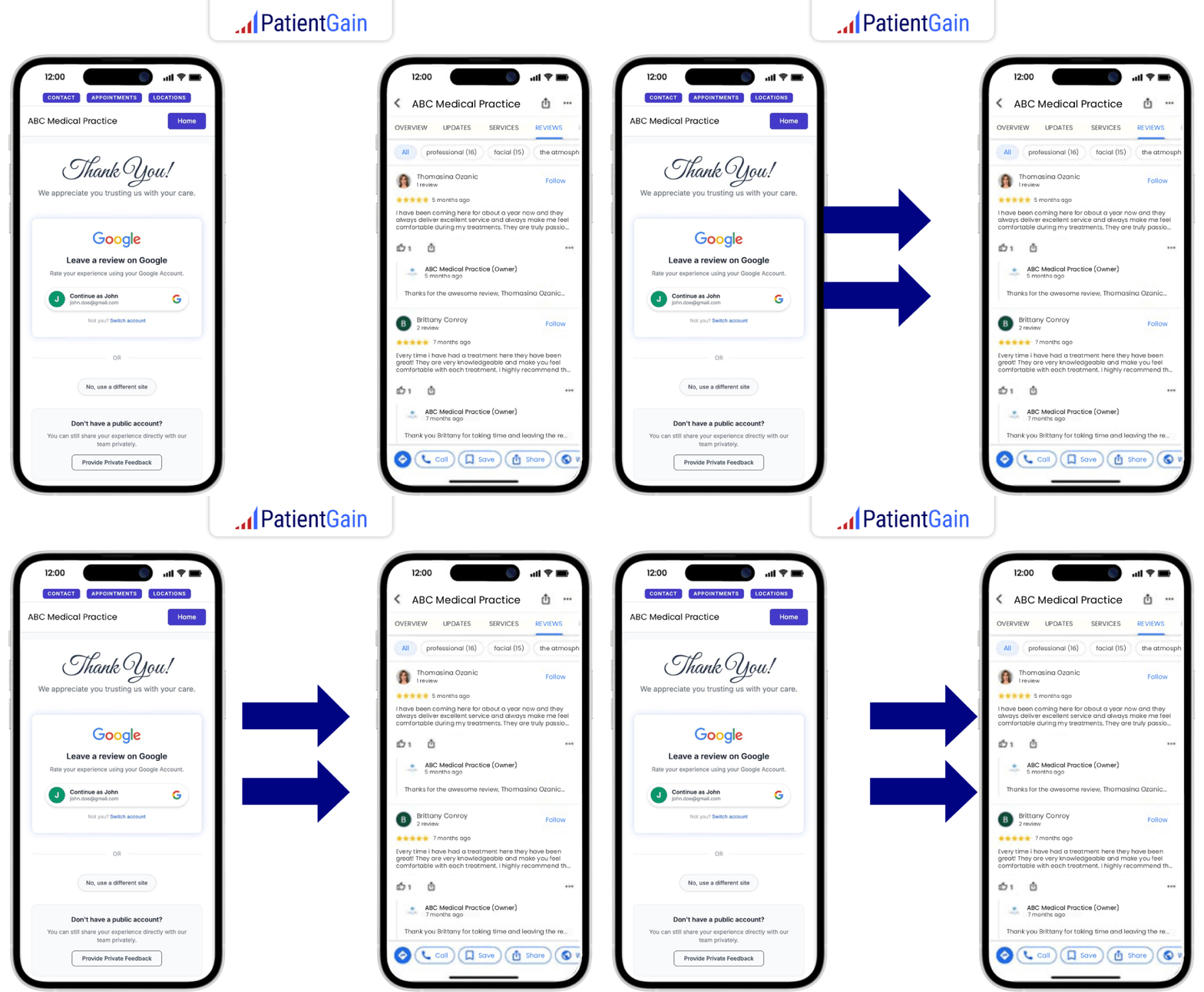
| ReputeMD | Patient contact details and completed-visit events | Automated review invitations |
| Patient SMS / Email | Approved contact data and communication preferences | More efficient patient follow-ups |
| Appointment Management | Scheduling events and appointment status | Fewer manual scheduling updates |
| Patient Intake / Lead Capture | Transfers information to supported EMRs when configured | Reduces duplicate data entry |
| Patient CRM / SPOC | Combines permitted patient communications and lead activity | Better front-office visibility |
| Operational Reporting | Uses eligible events and appointment activity | Better administrative performance monitoring |
PatientGain ReputeMD integration, OpenEMR workflows, appointment communications, and its SPOC patient engagement system. Not every application is confirmed to consume HL7 feeds directly; some operate through PatientGain’s internal platform after a separate integration.
4. Example: How PatientGain’s ReputeMD automates patient review requests
Consider a healthcare practice seeing 40 patients per day.
- Patient completes a dental appointment.The dental practice updates the patient’s appointment status in its EMR or practice management system.
- EMR-Xtract receives the appointment event.Depending on the supported integration, PatientGain receives an HL7 message, API update, or scheduled file transfer.
- ReputeMD processes the eligible patient record.The system uses appropriate contact details, duplicate detection, and configured communication rules to prepare a review invitation.
- An SMS or email invitation is sent.Based on the practice’s configured schedule and applicable privacy and messaging requirements, an invitation may be delivered automatically.
- The practice monitors its reputation.Staff can monitor review activity and reputation management performance without manually preparing every invitation.
This can benefit dental offices, dermatologists, primary care practices, urgent care centers, medical spas, and other eligible healthcare providers.
An important safeguard is that review invitations should not disclose treatment information or confirm someone’s patient status publicly. Practices should also avoid review gating or selectively soliciting only positive reviews.
Why this is particularly valuable for multi-location medical groups
For a healthcare group with 20 locations, the benefit grows because the same integration approach can support standardized patient engagement processes across participating locations.
ILLUSTRATIVE MULTI-LOCATION EXAMPLE
20
Locations
40
Visits per location/day
800
Total daily visits
Estimate potential administrative time savingsNumber of locations
20 Completed visits per location/day
40 Manual follow-up processing time per visit
2 min
POTENTIAL MANUAL WORKLOAD AVOIDED PER MONTH
587 hours
Illustrative upper-bound workload based on 22 business days, assuming every visit otherwise requires the selected manual processing time and automation eliminates it. Actual time saved depends on existing workflows, eligible visits, exceptions, and integration reliability.
For larger medical and dental groups, automated synchronization may also improve consistency between locations and reduce dependence on individual staff members remembering to initiate follow-up workflows.
6. How PatientGain approaches EMR isolation and HIPAA safeguards
One particularly relevant part of PatientGain’s published architecture is its emphasis on keeping the clinical EMR separate from marketing systems. PatientGain uses a separate patient engagement environment and controlled interfaces, rather than giving every marketing application unrestricted access to clinical records.
Appropriate approach when implemented properly like RBAC access to apps, AI agents and human staff.
- Data minimization: Review and appointment reminder applications generally need only specific contact and event information, not full medical records.
- Controlled integration: Restrict the connector to authorized fields and workflows.
- Business Associate Agreement: PatientGain advertises BAAs for applicable services, including ReputeMD and its EMR connector.
- Secure communications: Apply appropriate safeguards for PHI in transit and at rest.
- Separate operational responsibilities: The EMR remains the clinical system of record, while PatientGain manages authorized patient engagement activities.
 Send Text
 How may I help you?