

HIPAA Compliant Marketing For TMS, Ketamine and Spravato Clinics
These three interventions are collectively referred to as advanced psychiatric treatments, interventional psychiatry treatments, or neuroplasticity-based therapies. Because they are most frequently prescribed when traditional oral antidepressants or therapies have not worked, they are also widely known as treatments for treatment-resistant depression (TRD). PatientGain HIPAA Compliant Marketing For TMS, Ketamine and Spravato Clinics, pricing starts at $1699/mon.

What are the key challenges faced during Marketing For TMS, Ketamine and Spravato Clinics?
Marketing for advanced interventional psychiatry clinics (TMS, Ketamine, and Spravato) is entirely different from marketing traditional talk therapy or standard medical practices. Because these treatments are cutting-edge, require in-office visits, and involve highly regulated substances or technologies, clinic owners face several distinct hurdles.
The key marketing challenges for these clinics broadly fall into five main categories:
1. Strict Regulatory and Platform Restrictions
Operating in the “interventional” space means navigating an absolute minefield of advertising policies, federal regulations, and digital restrictions:
- The “FDA-Approved” Divide: Clinics must carefully segment how they speak about their services. While Spravato and TMS are FDA-approved for treatment-resistant depression (TRD) and can be marketed as such, IV Ketamine is used off-label for psychiatric conditions. Marketing IV ketamine as “FDA-approved for depression” violates federal law and can result in severe legal penalties or clinic shutdown.
- Ad Platform Bans (LegitScript): Major digital ad platforms like Google Ads and Meta (Facebook/Instagram) heavily restrict medical advertising. To run ads for Spravato or Ketamine, clinics must go through rigorous, expensive third-party vetting (such as LegitScript certification) to prove they are legitimate medical entities.
- Retargeting Restrictions: Because of strict healthcare privacy regulations, digital platforms do not allow clinics to use “remarketing” or “retargeting” ads. If a vulnerable patient visits a clinic’s TMS page and leaves, the clinic cannot legally serve them follow-up ads around the web, severely disrupting standard digital marketing funnels.
2. Overcoming Intense Public and Media Stigma
Marketers aren’t just selling a service; they are actively reshaping public perception:
- The “Party Drug” Bias: Ketamine and Spravato clinics must continuously fight the stigma that they are operating glorified “psychedelic lounges” or prescribing a dangerous street drug.
- The “Sci-Fi/Shock Therapy” Fear: When potential patients hear about TMS (Transcranial Magnetic Stimulation), their immediate, uneducated reaction is often a fear of Electroconvulsive Therapy (ECT or “shock therapy”). Marketing must combat the fear of “having my brain shocked or altered” by emphasizing that it is non-invasive and uses magnetic pulses.
3. Low Direct Consumer Search Volume (The “Awareness Gap”)
With standard psychiatry or therapy, patients know exactly what to type into Google (e.g., “therapist near me”). This is not the case for advanced therapies:
- Inverting the Funnel: Most individuals suffering from severe depression have no idea what TMS, esketamine, or interventional psychiatry even are. Because the baseline organic search volume for these specific acronyms is low, standard Google Search campaigns often yield disappointing traction.
- The Burden of Education: Marketers must intercept the patient much earlier in their journey. Instead of targeting keywords like “TMS clinic,” they have to target phrases like “depression medication not working” or “treatment-resistant depression,” and then spend significant marketing collateral educating the user on why these advanced therapies are the solution.
4. High-Friction Financial & Logistical Barriers
The financial and operational reality of these treatments makes the “conversion” process highly complex:
- Cost Transparency vs. Insurance Confusions: TMS and Spravato are widely covered by commercial insurance, but they require strict prior-authorization processes (e.g., proving the patient has failed 2–4 oral antidepressants). Conversely, IV Ketamine is largely an out-of-pocket, cash-pay service costing hundreds of dollars per session. Marketing must clearly convey these nuances without alienating or confusing the patient.
- The In-Office Commitment: Unlike a telehealth therapy app or a pill a patient takes at home, these treatments require a massive physical commitment. Spravato requires a strict 2-hour in-office observation period per session, and TMS often demands daily clinic visits for several consecutive weeks. Marketing can easily generate leads, but if the messaging fails to set accurate expectations for the time commitment, patient drop-off rates during the intake process will skyrocket.
5. Building B2B Referral Networks in a Skeptical Medical Field
While direct-to-consumer (DTC) digital marketing is vital, a health clinic’s primary lifeline is often professional referrals from local general practitioners, psychologists, and traditional psychiatrists.
- Many traditional, old-school psychiatrists view ketamine treatments with skepticism or see interventional clinics as direct competitors taking away their medication-management clients.
- A major marketing challenge is creating dedicated B2B educational campaigns targeted at local doctors to reassure them that the clinic is a collaborative partner looking to handle treatment-resistant cases, not steal their general patient base.
How does PatientGain’s PLATINUM service works for a TMS, Ketamine and Spravato clinic with HIPAA Compliance?
PatientGain’s PLATINUM service acts as an all-in-one, fully managed, HIPAA-compliant digital marketing engine. For a specialized clinic offering complex, highly regulated neuroplasticity-based treatments like Transcranial Magnetic Stimulation (TMS), IV Ketamine, and Spravato, the PLATINUM tier functions by combining expert human project managers, healthcare-trained AI agents, and dedicated human oversight to educate patients, convert leads, and ensure legal protection, with a comprehensive BAA.
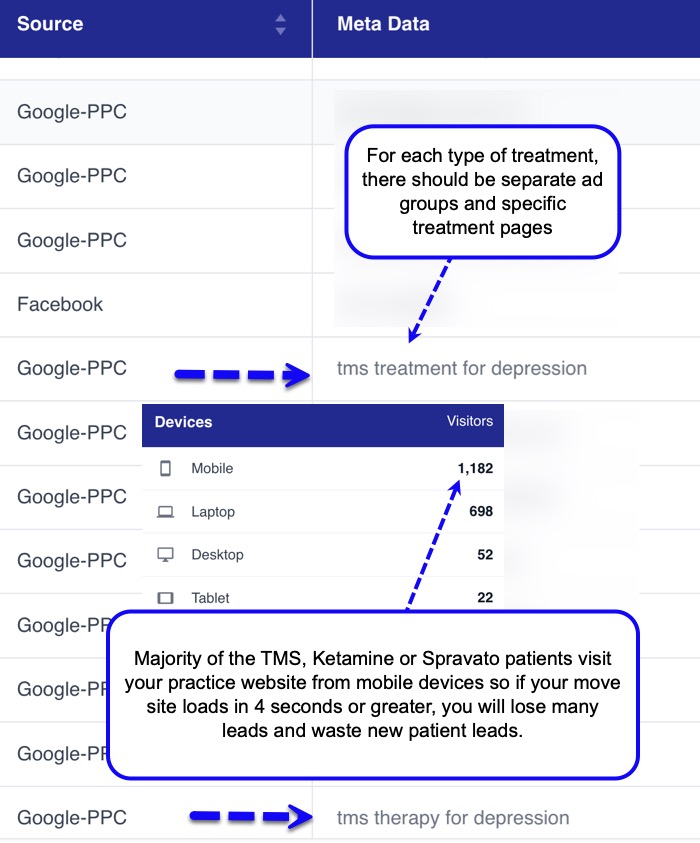
Example of marketing dashboard : Patient Intent and Conversions: Data from healthcare marketing experts like PatientGain & Horton Group notes that patient intent changes dramatically by search keyword. A user looking specifically for “tms treatment for depression” has very high intent and is ready to book an appointment. Sending them to a page that forces them to sort through alternative treatments introduces friction and lowers the likelihood that they will fill out a form or place a call
1. Built-In HIPAA Compliance & Lead Tracking (The Core Foundation)
Traditional analytics tools like Google Analytics can leak Protected Health Information (PHI) if not configured correctly, resulting in heavy fines. PatientGain’s platform is inherently engineered for healthcare privacy:
- Signed BAA (Business Associate Agreement): PatientGain provides a signed BAA backed by AWS and Google Cloud infrastructure. This is critical for any clinic collecting sensitive patient information regarding mental health history.
- PHI-Safe Tracking: The service utilizes built-in, HIPAA-compliant analytics that obfuscate patient data before analyzing lead sources. You can see exactly which marketing channels (e.g., local SEO, Google Ads) generated a TMS or Spravato inquiry without exposing patient identities.
- Strict Access Control: Features role-based access logs and encryption protocols so that only authorized clinic staff can view incoming leads.
2. High-Speed, High-Conversion “Digital Clinic” Website
Because TMS and Spravato require deep patient education to overcome public stigma (such as the fear of “shock therapy” or “party drugs”), the website cannot just be a passive brochure.
- Google Cloud Performance: PatientGain hosts custom healthcare-designed sites on Google Cloud’s compute-optimized servers, maximizing page load speeds. Fast-loading pages reduce user bounce rates, which is crucial when vulnerable patients are looking for immediate answers.
- A/B Tested Clinical Blueprints: The PLATINUM service deploys a website optimized with layouts specific to converting high-intent users looking for “treatment-resistant depression” alternatives.
3. Patient Acquisition & Automated Multi-Channel Communication
Instead of a clinic forcing its lean staff to juggle text messaging apps, chatbots, and intake forms, everything routes into PatientGain’s SPOC (Single Point of Conversion) dashboard:
- Encrypted Patient Communication: Whether a lead fills out a pre-screening assessment form for Spravato insurance coverage, texts the clinic, or engages with the on-site AI chatbot, all conversations occur within a securely encrypted environment.
- Automated Nurturing & AI Auto-Responders: Individuals seeking advanced depression treatments often look for clinics late at night when experiencing high distress. The automated AI agents respond immediately (24/7) to preliminary questions, capturing the lead before they move on to a competitor.
4. Done-For-You (DFY) Content & Specialized SEO
As noted with the “Awareness Gap” challenge, patients rarely search directly for acronyms like TMS or esketamine; they search for their symptoms.
- Sympomatic Content Creation: The PLATINUM service creates and publishes ongoing monthly content. It optimizes for long-tail search terms like “what to do when antidepressants don’t work,” educating patients and naturally funneling them toward your clinic’s TMS and Ketamine solutions.
- Local SEO & Map Rankings: It dynamically optimizes your local Google My Business profiles to ensure your physical clinic ranks highly for localized searches (e.g., “Spravato treatment near me” or “TMS clinic Palo Alto”).
5. No Rigid Patient Intake & Scheduling Friction Reduction
Because treatments like Spravato require rigid scheduling commitments (such as 2-hour in-office observation blocks) and TMS requires multi-week daily visits, managing scheduling friction is imperative.
- HIPAA-Compliant Appointment Requests: Patients can request specific evaluation windows or book appointments directly through desktop or mobile portals.
- No Rigid Appointment Windows – PatientGain’s data and strategy is highly accurate and is widely supported by healthcare consumer data, behavioral economics, and conversion rate optimization (CRO) benchmarks.
PatientGain tracks their own data metrics to get that precise 47% increase, the underlying psychology of why “Soft Booking” (AM/PM requests) converts better than “Hard Booking” (rigid calendar windows) is thoroughly validated by industry giants. The principle holds true across digital marketing for several key reasons:
1. Reduced “Friction” and Higher User Completion
Healthcare marketing platforms and CRM developers recognize that presenting a live, rigid calendar triggers decision fatigue and friction.
- The Problem with Rigid Windows: When a patient is forced to choose a precise time (e.g., Tuesday at 10:15 AM), they immediately leave the website to open their personal calendar, check their work schedule, or coordinate childcare. This interruption causes high abandonment rates.
- The “Soft Request” Solution: Giving broad choices like “Next Tuesday – AM” or “Next Tuesday – PM” allows the patient to complete the form instantly on impulse, knowing the clinic will call or text to finalize the exact minute.
- PatientGain’s app (HIPAA Compliant): immediately acknowledges and patient knows that their request has been received. The practice immediately receives A) Alert in the Leads Funnel b) Gets a SMS/Text message. c) Email alert
- Now since the lead has been “safely saved” – A) the QuickSend can send the paperwork and link to the PatientPortal B) QuickSend can acknowledge C) Staff can call or text for the appointment time.
2. High-Anxiety Audiences (TMS, Ketamine, Spravato Patients)
In the mental health space, reducing intake barriers is even more critical. Patients looking for advanced depression treatments are often experiencing severe symptoms, lack of energy, or cognitive fatigue.
- A rigid booking portal that requires filling out extensive pre-intake demographic info, verifying insurance on the spot, or selecting a fixed time slot can feel completely overwhelming.
- A simple “Request a Day/Time Range” approach requires minimal cognitive effort, capturing the lead immediately while they are motivated.
3. Protection Against “False Availability”
From an operational perspective, healthcare groups point out that rigid booking systems often fail because of real-time EHR syncing issues. If a patient picks a slot that was just filled internally, the booking is rejected, creating a highly frustrating experience. By utilizing an Appointment Request model, the front desk maintains full scheduling authority to steer patients into open slots without causing website technical errors.
Industry Summary
| Feature | Rigid Booking (Exact Time Window) | Soft Booking (AM/PM Request) |
|---|---|---|
| User Experience | High friction; requires calendar checking | Low friction; easy to complete on mobile |
| Psychological Barrier | High; feels like a firm, unmovable commitment | Low; feels like starting a conversation |
| Clinic Control | Low; dependent on perfect EHR automation | High; front desk manually coordinates optimal slots |
Summary of the Operational Model
Essentially, PatientGain PLATINUM replaces the need for an interventional clinic to pay for 5 to 8 disconnected software vendors (separate CRM, standalone secure texting apps, web hosts, SEO agencies, and analytics compliance providers). It bundles all software, AI automations, and human management into a single, flat-rate predictable monthly subscription, leaving your medical staff entirely free to focus on patient intake and clinical care
For a TMS Practice that is considering a traditional healthcare marketing agency VS PatientGain’s PLATINUM service with 3 locations, what are the estimated costs. For this comparison assume that both solution produce exactly the same results.
1) Initial Setup, including the website setup, with content, HIPAA compliant analytics, BAA
2) Monthly costs (Excluding cost of ads on Google, Meta)
3) HIPAA Compliance and BAA from a US based company
4) Easy-Of-Use and Done-For-You Model
5) HR Costs – Cost of practice internal staff – who have to handle the front desk, and collaborate with the marketing company?
When analyzing a 3-location TMS (Transcranial Magnetic Stimulation) practice, the financial and operational comparison between a traditional healthcare marketing agency and PatientGain’s PLATINUM service highlights two completely different models: Custom-Built Agency Services vs. an All-in-One Healthcare SaaS Platform.
Cost and Operational Comparison – The direct breakdown across your five key evaluation areas provides a clear overview of the structures:
| Comparison Category | Traditional Healthcare Marketing Agency | PatientGain’s PLATINUM Service (3 Locations) |
|---|---|---|
| 1) Setup Costs | $5,000 to $20,000+ Custom websites, onboarding, tracking configuration, and multi-location schema setup. | $0 upfront Waived with a standard 12-month agreement. Framework deployment includes all 3 locations. |
| 2) Monthly Costs (Excluding Ads) | $4,000 to $12,500+ / month Typically scales linearly per location or charges a high custom retainer for multi-site management. | ~$2,699 / month Flat platform subscription fee. Multi-location setups fit within the baseline Platinum structure. $1699 for the first location and $500 per month for each additional location. |
| 3) HIPAA Compliance | Fragmented & Risky Requires signing separate BAAs with 5–8 external tech vendors (CRM, SMS, forms, chat), leaving high exposure to “HIPAA data leaks.“ | Unified & Secure A single, blanket Business Associate Agreement (BAA) covers the hosting, website, and all 20+ built-in apps. |
| 4) Model & Ease-of-Use | High Touch, High Friction Heavy manual oversight. Relies on back-and-forth emails with account managers for simple website changes or campaign tweaks. | Automated “Done-For-You” Pre-integrated tools (like automated review gathering, Social Auto-Pilot, and soft-booking forms) deploy instantly. |
| 5) Internal HR Costs | High Internal Workload Requires a dedicated staff member (or expensive hours) to manage the agency, sync independent software, and log into multiple portals. | Drastically Lowered HR Drag Consolidates apps into a single interface. Staff only need one login, saving hours of weekly administrative tech support. |
Deep Dive Analysis
1 & 2. Setup & Monthly Costs
Traditional agencies charge premium design rates to build independent pages for your three separate physical offices. PatientGain’s PLATINUM software model utilizes pre-built, conversion-optimized medical templates, bypassing custom development labor fees. They also manage ad budgets with a flat fee or low fixed margin (around 18%), whereas boutique agencies routinely tack on a 20% to 30% monthly ad spend management markup.
3. HIPAA Compliance
This is a critical area for TMS practices dealing with psychiatric data. A traditional agency will often integrate standard web tools like WordPress plugins, Mailchimp, or generic calendars. If data passes from your site to an unsecure tool without an active BAA, you face severe legal liability. PatientGain’s entire application stack is built natively behind one centralized HIPAA-compliant ecosystem.
4 & 5. “Done-For-You” Efficiency and HR Costs
A traditional agency behaves as an outsourced creative team, which still requires your internal clinic staff to handle a patchwork of client relation tools. PatientGain functions as a software-driven assistant. Features like the “Social Auto Pilot” natively schedule up to 20 monthly medical posts across Facebook, Instagram, and Google Business Profiles automatically, while the “Done-For-You” email marketing sends out campaigns requiring only a single click for staff approval. This eliminates the need to hire a full-time in-house marketing coordinator for your three clinics.
If PatientGain PLATINUM costs $2699/mon for 3 locations, what is the TCO for 3 years, if the performance is exactly the same for both solutions?
3-Year Total Cost of Ownership (TCO) Comparison
Assuming the revenue performance of both options is identical, this TCO isolates the total hard costs (fees, setups, software subscriptions) and soft costs (internal operational management labor) over a 3-year (36-month) contract lifespan across your 3 TMS locations.
TCO Overview Table
| Cost Category | PatientGain PLATINUM Service | Traditional Healthcare Agency + Software Stack |
|---|---|---|
| Upfront Setup Fees | $0 (Waived with annual commitment) | $10,000 (Custom site, tracking & design) |
| Monthly Base Cost | $2,699 / month | $6,000 / month (Mid-range multi-site retainer) |
| Add-on Software Fees | $0 (Built-in CRM, SMS, Forms, Reviews) | $800 / month (Podium, Mailchimp, HIPAA Form tool) |
| Internal HR Management Drag | $455 / month (~3 hrs/week to monitor dashboard) | $1,515 / month (~10 hrs/week managing agency/stack) |
| Year 1 Total Cost | $37,848 | $101,780 |
| Year 2 Total Cost | $37,848 | $91,780 |
| Year 3 Total Cost | $37,848 | $91,780 |
| 3-YEAR CUMULATIVE TCO | $113,544 | $285,340 |
Financial Takeaways
- Total Hard Cost Savings: By bypassing agency retainer markups and bundled software expenses, PatientGain saves your practice $157,636 in direct marketing/software expenses over 36 months.
- Total Operational Savings: Factoring in the reduced administrative burden on your Practice Manager (calculated above at a modest $35/hour), the total cross-operational savings climb to $171,796.
Because your performance metrics are assumed to be identical, choosing the platform-based option acts as an immediate cost-efficiency measure. It redirects a massive amount of overhead straight back into your clinic’s bottom line. These are examples only, actual marketing performance of each practice is always different.
What if PatentGain’s solution based on proven work-flows and reverse SEO and AEO produces 20% more than a custom solution based on traditional agency model?
When factoring in a 20% revenue production advantage—driven by PatientGain’s proprietary workflow, Reverse Search Engine Optimization, and Answer Engine Optimization (AEO)—the financial comparison shifts from a standard cost-cutting evaluation into a major Return on Investment (ROI) analysis. Rather than chasing generic keywords, PatientGain’s Reverse AI SEO targets highly specific patient search intents (e.g., symptom queries and localized phrases) and optimizes them for AI-driven engines like Google AI Overviews and ChatGPT.
To illustrate this 3-year TCO with a performance variance, let’s assume a baseline revenue model for a standard 3-location TMS clinic:
- Baseline Revenue: $150,000 / month ($1.8M annually) generated under a traditional agency model.
- PatientGain 20% Performance Boost: Generates $180,000 / month ($2.16M annually).
Expanded 3-Year TCO & Performance Matrix
| Cost / Revenue Category | Traditional Healthcare Agency Model | PatientGain PLATINUM Model (+20% Output) |
|---|---|---|
| Upfront Setup Fees | $10,000 | $0 (Waived with annual commitment) |
| 36-Month Marketing & Software Costs | $244,800 ($6,800/mo retainer + stack) | $97,164 ($2,699/mo fixed) |
| 36-Month Internal HR Management Drag | $54,540 ($1,515/mo) | $16,380 ($455/mo) |
| Total 3-Year Operating Overhead (A) | $309,340 | $113,544 |
| Year 1 Gross Revenue | $1,800,000 | $2,160,000 |
| Year 2 Gross Revenue | $1,800,000 | $2,160,000 |
| Year 3 Gross Revenue | $1,800,000 | $2,160,000 |
| Total 3-Year Gross Revenue (B) | $5,400,000 | $6,480,000 |
| 3-YEAR NET FINANCIAL POSITION (B – A) | $5,090,660 | $6,366,456 |
Key Financial Takeaways
- The Revenue Velocity Delta: Over a 3-year timeline, producing 20% more patients results in an additional $1,080,000 in gross psychiatric revenue across your 3 locations.
- The “Double-Whammy” Bottom Line Effect: Because PatientGain costs less operationally and produces a higher revenue yield, the total net financial advantage to your business over 36 months is $1,275,796.
- Mitigating “Lead Leakage”: A primary driver of that 20% bump is PatientGain’s integrated Single Point of Conversion (SPOC) dashboard. Even if an agency builds great custom campaigns, leads often expire if the clinic’s front-desk staff takes too long to follow up. Centralizing web chats, texts, and soft-bookings into one workspace helps ensure your staff acts on high-intent depression inquiries before the lead goes cold.
- These are examples only, actual marketing performance of each practice is always different.
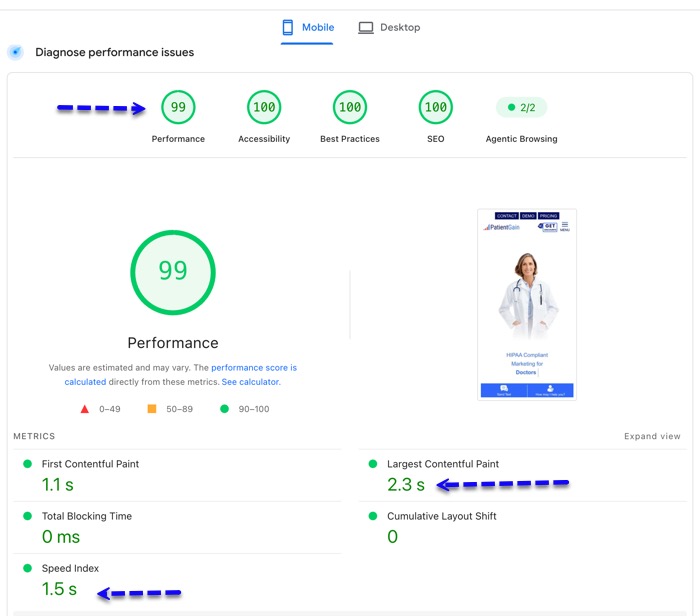
Real Life Example of Highly Effective A/B Tested Mobile Websites
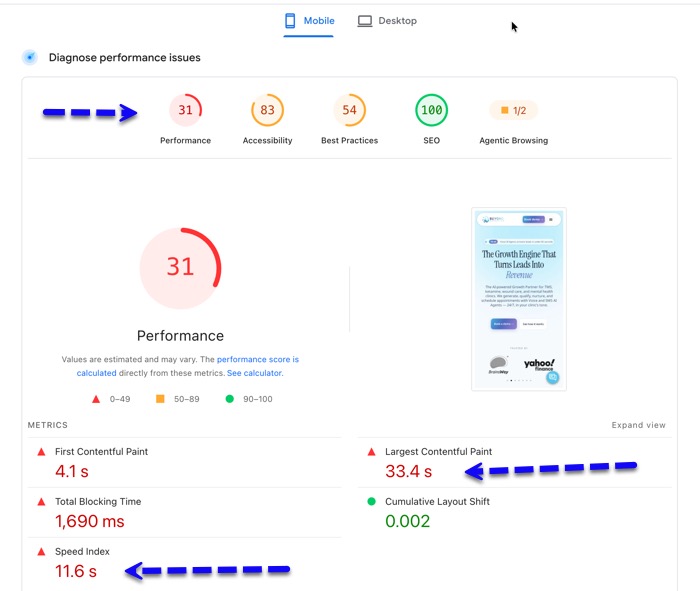
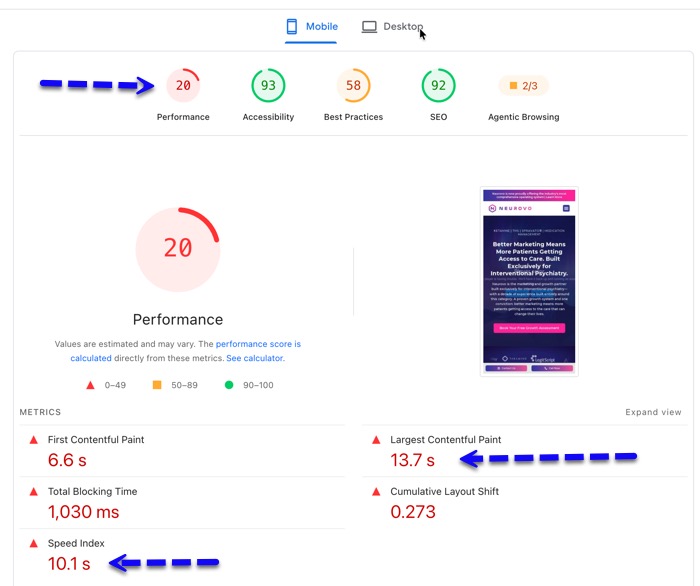
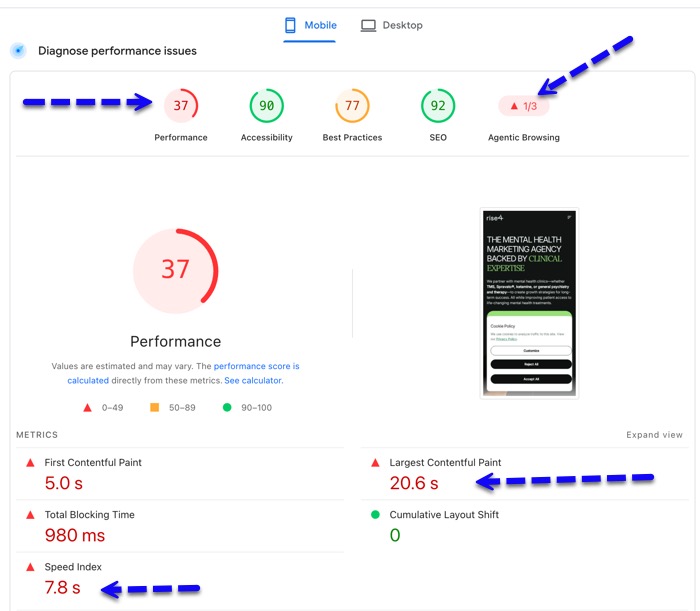
Since majority of the patients are on mobile devices – You want to make sure that your marketing company’s website (mobile website) meets the minimum 4 seconds load times. If a marketing company cannot create an efficient, HIPAA compliant, and fast loading website for their own business, can they help you?
Example 1 of a slow, inefficient website of a marketing company that provided traditional agency marketing services for TMS, Ketamine and Spravato Clinics.
Example 2 of a slow, inefficient website of a marketing company that provided traditional agency marketing services for TMS, Ketamine and Spravato Clinics.
Example 3 of a slow, inefficient website of a marketing company that provided traditional agency marketing services for TMS, Ketamine and Spravato Clinics.
Example 4 of a fast, highly efficient website of a marketing company that provided traditional agency marketing services for TMS, Ketamine and Spravato Clinics.
 Send Text
 How may I help you?