

What is Human-In-The-Loop (HITL) AI Apps For Healthcare Marketing?
Human-in-the-loop (HITL) healthcare applications are AI-driven systems designed so that human expertise remains a mandatory component of the decision-making process. Unlike fully autonomous AI, HITL apps ensure clinicians or specialized staff review, validate, or override AI-generated outputs before they impact patient care. Alternative names and closely related concepts for Human-In-The-Loop (HITL) AI apps include hybrid intelligence, interactive machine learning, and augmented intelligence. These terms describe systems where human oversight and machine learning work together.
What is Human-In-The-Loop (HITL) AI Apps from PatientGain?
Human-in-the-Loop (HITL) from PatientGain is a deliberate software design framework that combines automated Artificial Intelligence (AI) with mandatory human oversight to protect healthcare practices from legal, clinical, and HIPAA violations. Instead of letting AI run entirely on autopilot, PatientGain integrates specialized “HITL Apps” into most of their AI based apps, for example the Single Point of Conversion (SPOC) dashboard to function as safety checkpoints.
PatientGain deploys this hybrid HITL framework across two primary areas:
1. Patient Communication & The “AI Intercept”
When a patient interacts with a clinic’s automated website chatbot or text messaging agent, the AI is explicitly restricted from acting like a doctor.
- The Trigger: If a patient asks an open-ended medical question or begins typing Protected Health Information (PHI) like symptom descriptions or medical histories, the AI immediately pauses its automated responses.
- The App Intervention: The conversation is instantly routed away from the AI agent and into the staff’s QuickSend App or unified SPOC Leads Funnel App.
- The Human Action: Your front-desk staff or clinical team receives a notification to manually take over the thread, ensuring that no unvetted clinical advice is accidentally generated by a machine.
2. Marketing & Content Generation Safeguards
PatientGain uses AI agents to cross-reference localized, high-conversion search keywords and compile monthly patient newsletters (e.g., an educational guide on pediatric health). To ensure safety, they apply a strict human approval chain:
- Step 1 (AI Generation): The system drafts the core educational text and template layout.
- Step 2 (PatientGain Expert Review): The draft is routed to a PatientGain Project Manager who specializes in your clinical vertical (such as dentistry, dermatology, or pediatrics) to check for clarity and layout.
- Step 3 (Clinic Provider Approval): The final draft appears in the practice manager’s portal and an EMail is also sent to the practice manager. The campaign cannot be sent until a human clicks “APPROVED”.
- Step 4 (HIPAA Timestamping): Upon clicking approve, the HILT application securely logs and records the reviewer’s IP address and a digital timestamp to fulfill HIPAA auditing requirements before deploying the Email blast.
Core Benefits of HITL Apps
- Eliminates AI Hallucinations: Prevents software from delivering incorrect clinical guidance or answering questions beyond its scope.
- Protects Compliance: Restricts automated processing of sensitive PHI unless a secure, human-led workflow is activated.
- Reduces Staff Burnout: The AI does 90% of the tedious structural work (drafting, formatting, filtering), leaving clinic staff to handle only the final 10% requiring clinical judgment.
- Patients still do not trust AI – So if your AI app or AI agent allows patient to “stop interacting” with AI and speak to a human person, like your front desk, you will increase patient conversions.
What percentage of patients do not want to talk to AI Agents?
Between 55% and 78% of patients explicitly do not want to interact with or rely on AI for their healthcare, depending on the specific application. Furthermore, up to 80% of patients strongly prefer seeing or talking to a human professional over an AI for active medical and scheduling decisions.
1. General Discomfort with Healthcare AI (55% to 60%)
- National polls indicate that 58% of patients report having negative sentiment or general distrust toward AI integration in healthcare.
- According to an Ohio State Wexner Medical Center poll, 58% of adults are not open to AI being used as a part of their medical care.
- 60% of Americans feel deeply uncomfortable with their healthcare providers relying on AI for their care, according to data from the Pew Research Center.
2. Strict AI Rejection (~40%)
- Industry data indicates that 38.5% of patients state they would outright refuse healthcare AI under any circumstances due to deep concerns regarding data privacy, autonomy, and a lack of clinical oversight. [1]
3. Absolute Preference for Human Interaction (Over 80%)
- Even among patients who tolerate AI for basic tasks, over 80% explicitly prefer a human medical professional when making decisions like managing emergency care or addressing specific health concerns.
- When it comes to trust, 85% of adults turn exclusively to a human health provider for accurate and reliable medical advice.
Patients between 30 to 55 years of age
For adults between 30 and 55 years of age, approximately 54% to 62% do not want to rely on AI or talk to an AI bot for their personal healthcare needs. While this demographic (primarily Millennials and Gen X) is highly tech-savvy and actively uses AI for daily workflows, their comfort drops sharply when AI crosses into medicine and scheduling.
1. The Discomfort Baseline (60% to 62%)
- According to demographic data from the Pew Research Center, 60% of adults aged 30 to 49, and 62% of adults aged 50 to 64, report feeling explicitly uncomfortable with AI being utilized in their medical care.
- They are significantly more skeptical than adults under 30, who show much higher baseline acceptance of health chatbots.
2. High Initial Search, Low Final Trust
- Adults in this age range are the most likely to search online or look at summaries for health symptoms.
- Despite using technology to research, national tracking data reveals that only 33% of adults over 30 trust the advice they get from AI chatbots, while the rest remain deeply unsure or highly skeptical.
3. The “Busy Professional” Bottleneck
- Patients aged 30 to 55 are often managing tight schedules, career demands, or scheduling care for both their children and aging parents.
- If your AI app loops, misunderstands a complex insurance question, or fails to find a custom appointment slot, this specific age demographic will not tolerate the friction—they will instantly drop off to find a clinic with a phone number or a live chat option.
Patients between 55 and 70+ years of age
For adults between 55 and 70+ years of age, approximately 62% to 74% do not want to interact with or rely on AI for their personal healthcare needs. This demographic (older Gen X and younger Boomers) represents the sharpest rejection of digital automation in clinical environments. While they are highly capable of using smartphones, their patience with AI barriers in medical contexts is exceptionally low.
The behavioral and statistical breakdown for the 55-to-70 age segment outlines the critical need for a human off-ramp:
1. Massive Trust Deficit (74%)
- According to a University of Michigan National Poll on Healthy Aging, 74% of adults over 50 report having very little or no trust in healthcare information generated by AI.
- Demographics from the Pew Research Center track closely, showing that over 62% of this demographic feel deeply uncomfortable with an AI system driving any aspect of their medical care.
2. High Anxiety Over Loss of Human Interaction (68%)
- National tracking data from the AARP highlights that 68% of older adults are actively concerned that AI integration will completely remove the human touch from services.
- When this age group interacts with an AI bot, they often perceive it not as a convenient shortcut, but as a deliberate barrier designed to keep them from talking to a real person.
3. The “Complex Health” Drop-Off
- Patients in the 55–70 age tier are statistically more likely to manage chronic issues, schedule multiple routine screenings, or have complex insurance questions regarding Medicare or secondary providers.
- Because an AI chatbot often struggles to parse complex, multi-sentence explanations about medical histories or insurance networks, these patients will experience immediate frustration. If a visible “Talk to Front Desk” button isn’t immediately present, they are highly likely to hang up or close the browser window.
So What is the solution? I do not want my patients to call the clinic, I want them to talk to the AI agent and book appointments?
Unfortunately there is no solution for “force patients to talk to the AI agent and book appointments” . However, you can steps to improve the conversion rates – However you cannot simply change the human, patient behaviour. The way is to accommodate all patients using current AI technology. Basically you cannot convert 100% of every patient who visits your website. So the next best approach is to use AI to help patients with AI distrust.
Why Conversion Strategy from PatientGain by using HITL technology works?
The PatientGain conversion strategy using Human-in-the-Loop (HITL) technology increases patient conversions by up to 28% because it bridges the gap between digital automation and patient trust. By combining the rapid execution of generative AI with a mandatory human review and fallback layer, it directly overcomes the skepticism patients feel toward pure-AI systems. However, understand that there is no technology or AI agent that can completely understand humans and convert 100% of every patient who visits your website. So the next best approach is to use AI to help patients with AI distrust.
The HITL architecture deployed in applications like the PatientGain PatientQuickConvert App works through several foundational mechanisms:
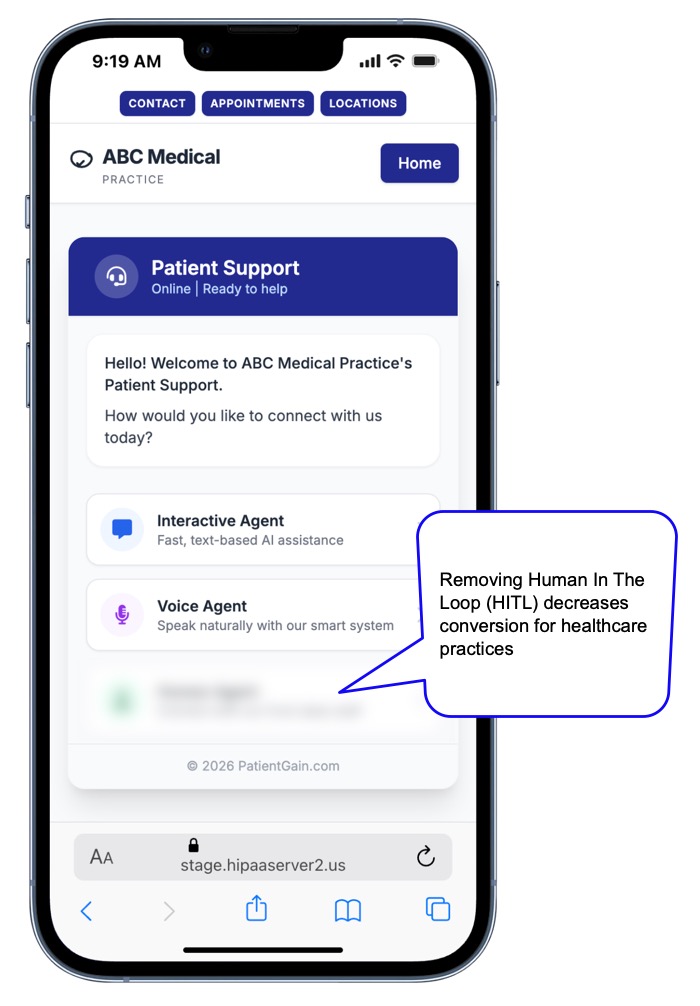
1. Multi-Option Interface Options
When a prospective patient lands on a practice’s website, the system avoids forcing them into an automated corner. Instead, it presents three explicit pathways:
- AI-Based Interactive Agent (for fast, automated texting/chat)
- AI-Based Voice Agent (for automated phone routing)
- Human Agent (direct access to a real front-desk operator)
By deliberately providing a clear escape hatch to a live human, the system captures skeptical demographics who would otherwise abandon a pure-AI interface immediately.
2. The Internal “Draft and Approve” Safeguard
For patient communications, email campaigns, or appointment-related text interactions, the AI acts as a background processor rather than a completely automated gatekeeper.
- The AI does the heavy lifting: It drafts response options or structures medical marketing inquiries instantly.
- The HITL Block: The response is held in a dashboard. A clinic staff member or marketing specialist must review, edit, and hit “Approve” before the message reaches the patient.
- The Result: This process eliminates clinical inaccuracies, preserves human empathy, and strictly protects patient privacy.
3. Centralized Communication Dashboard (SPOC)
To prevent patient drops during a handoff, PatientGain integrates its HITL technology into a Single Point of Conversion (SPOC) application. This tool channels incoming web inquiries, text messages, and phone calls into a single dashboard. If a patient drops out of an AI sequence or requests a real person, the front-desk staff can instantly view the full AI transcript history and seamlessly take over without losing context.
Summary of Why it Succeeds
Without HITL technology, conversion rates plummet. Patients demand clinical accuracy and data safety. The PatientGain hybrid strategy delivers the speed of 24/7 automation while respecting the consumer reality that a majority of healthcare patients refuse to engage blindly with non-human software.
 Send Text
 How may I help you?