

Google Pay-Per-Click (PPC) Advertising Experts For Healthcare Providers
Every day practice managers of medical and dental practices contact PatientGain and ask these common questions:
Google Pay-Per-Click (PPC) Advertising Experts For Healthcare Providers: Table of Contents
1) Does Google Pay-Per-Click (PPC) Advertising works for healthcare practices?
2) What is a Google Pay-Per-Click (PPC) Advertising Expert?
3) How much Google Pay-Per-Click (PPC) Advertising Experts charge?
4) How Much Healthcare Practices Spend On Advertising Per Month?
5) Is Google Pay-Per-Click (PPC) Advertising HIPAA compliant?
6) If Google ads are not HIPAA compliant then how can PatientGain.com run Google ads for healthcare practices?
7) How long does it take to any results from Google Pay-Per-Click (PPC) Advertising?
8) How can I make sure that I am not leaking any PHI?
Question 1) Does Google Pay-Per-Click (PPC) Advertising works for healthcare practices?
Yes, Google Pay-Per-Click (PPC) advertising remains one of the most effective patient acquisition channels for healthcare practices in 2026. However, its “workability” is no longer about just buying keywords—it is about detailed understanding of the algorithms, years of experience in understanding patient behavior, regulations around PHI, website optimizations, speed of mobile websites, AI-driven automation and strict HIPAA privacy buffers. By default, Google Pay-Per-Click (PPC) ads are not HIPAA compliant. Your PPC expert must be well versed in HIPAA compliance and PPC ads for doctors.
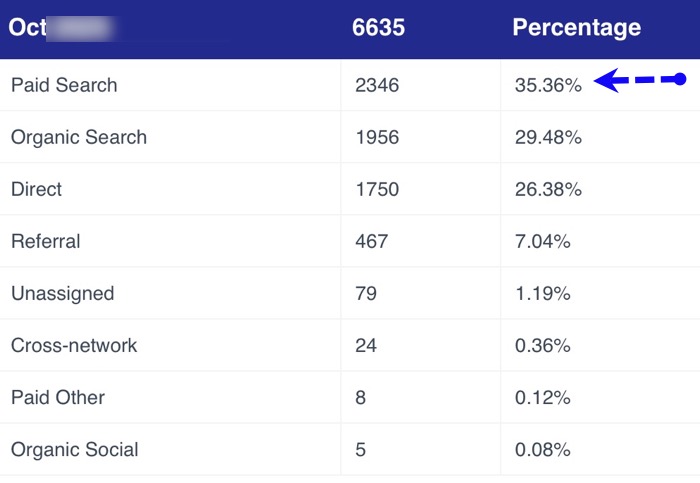
Example of a ROI marketing dashboard of a PLATINUM customer. You can see that 35.36 % of the new leads are originating from the Google PPC ads. This is a 1 year old Wellness practice, located in the northwest US.
Benefits of Google PPC for Healthcare Practices
- Immediate Visibility and Patient Acquisition
- Instant Traffic: Google PPC ads can drive immediate traffic to your website, making it an excellent tool for generating leads quickly. When patients search for healthcare services like pediatricians, dentists, or weight loss clinics, PPC ads ensure your practice appears at the top of the search results. This is most important aspect of an efficient Google PPC adwords campaign, that it can be extremely effective when you do not have SEO build up (which takes a long time). With instant useful traffic, time to be profitable can be shortened, however Google PPC ads are very expensive for healthcare providers.
- Targeted Reach: You can target specific search terms and geographic locations, ensuring you reach potential patients who are actively searching for the services you provide. This is particularly useful for healthcare practices in highly competitive markets.
- Cost Control
- Budget Flexibility: With PPC, you have full control over your ad spend. You can set daily or monthly budgets, making it possible to control costs and only pay for the actual clicks your ads receive.
- Pay Only for Results: Unlike traditional advertising (e.g., print, radio), PPC works on a performance-based model where you only pay when someone clicks your ad. This makes it cost-effective for healthcare practices, especially for practices with a limited marketing budget. However, the catch over here is that you must have an experienced PPC expert for healthcare who can focus on high intent and high value keywords, not general keywords.
- Local Targeting
- Geo-Targeting: Google PPC allows for geo-targeting, which means you can specifically target patients in your local area. This is especially useful for healthcare practices like pediatricians, dentists, and primary care providers who want to attract local patients.
- Local Search Ads: By bidding on location-based keywords (e.g., “best pediatrician in [City]”), your practice can target people in your service area who are actively looking for healthcare services nearby.
- Measurable Results and Analytics
- Performance Tracking: Google Ads provides detailed analytics to track the performance of your campaigns, including metrics such as click-through rate (CTR), conversion rate, and cost-per-click (CPC). This allows you to adjust and optimize your campaigns for maximum efficiency.
- Lead Conversion Tracking: For healthcare practices, it’s important to track how many clicks actually convert into patient appointments. Google Ads can integrate with conversion tracking tools, allowing you to measure the success of your campaigns in terms of actual bookings and inquiries.
Question 2) What is a Google Pay-Per-Click (PPC) Advertising Expert for Healthcare Providers?
A Google Pay-Per-Click (PPC) Advertising Expert for Healthcare Providers is a specialized digital marketer who manages paid search campaigns to drive patient acquisitions for clinics, doctors, and hospitals. They optimize ad spend on Google to place medical services at the top of search results, ensuring high-intent patient engagement while adhering to HIPAA compliance.
Key Responsibilities and Expertise:
- Keyword Strategy: Identifying high-value searches patients use to find specific treatments or local, immediate care.
- HIPAA Compliance & Privacy: Ensuring all ad copy and landing pages protect patient data and adhere to legal standards.
- Campaign Management: Setting up, monitoring, and adjusting bid strategies for Google Ads to maximize return on investment (ROI).
- Targeting: Utilizing geographical and demographic targeting to reach potential patients near specific locations.
- Conversion Optimization: Turning clicks into scheduled appointments by directing traffic to optimized landing pages.
By specializing in the healthcare vertical, these experts navigate competitive, high-intent searches (e.g., orthopedic surgery, dentistry) to ensure cost-effective patient acquisition compared to traditional advertising.
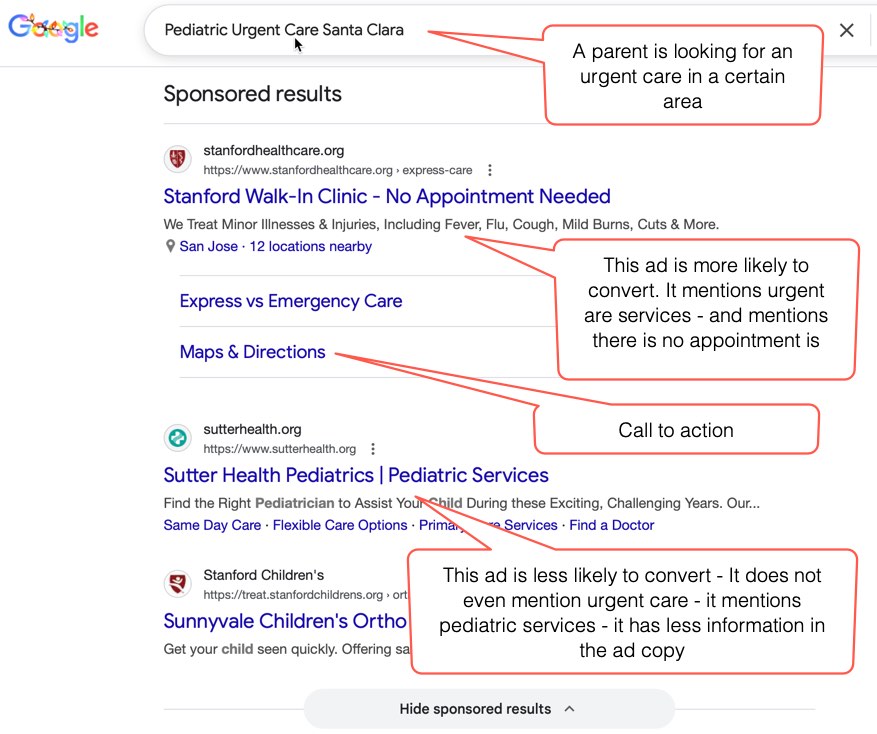
Example of a PPC ad. Patient is looking for a Pediatric Urgent Care in certain area.
Question 3) How much Google Pay-Per-Click (PPC) Advertising Experts Specializing in Healthcare Charge?
Google Pay-Per-Click (PPC) advertising experts specializing in healthcare typically charge between $1,500 and $7,500 per month for standard agency management, or $100 to $200 per hour for consulting. Fees depend strictly on the billing model, the complexity of the medical specialty, and your overall monthly ad spend.
Common Pricing Models
Healthcare PPC experts use four primary pricing frameworks:
- Percentage of Ad Spend: The expert charges 12% to 20% of your total monthly Google Ads budget. For a practice spending $10,000/month on ads, the specialist’s fee is $1,200 to $2,000/month.
- Flat Monthly Retainer: A fixed fee starting at $500 to $1,500/month for small local clinics, scaling up to $3,500 to $7,500+/month for multi-location medical groups.
- Hybrid Model (Base + Percentage): A standard baseline fee (e.g., $299 to $500/month) combined with a 15% to 18% cut of the ad spend.
- Hourly Rate: Freelancers and consultants charge $50 to $150/hour, while premium U.S. healthcare marketing agencies charge $150 to $250+/hour.
- PatientGain’s Pricing : structures its standalone expert Google PPC advertising pricing using a hybrid model consisting of a flat monthly base fee plus a percentage of ad spend:
- Management Fee: $299 per month.
- Ad Spend Markup: 18% of your total monthly ad spend.
- This pricing applies to single-location practices, including doctors, dentists, medical spas, surgeons, and general healthcare operations.
- The 18% fee scales directly with your ad budget:
- $1,000 monthly ad spend: You pay $180 (18%) + $299 base fee = $479 total management cost.
- $3,000 monthly ad spend: You pay $540 (18%) + $299 base fee = $839 total management cost.
- $5,000 monthly ad spend: You pay $900 (18%) + $299 base fee = $1,199 total management cost.
- PatientGain’s Key Features of the PPC Plan
- No Keyword Markups: You pay the direct cost of the keywords straight to Google without hidden vendor inflations.
- Flexible Budgets: You retain the ability to change your monthly Google Ads budget at any point.
- No Setup Fees: Available under standard 12-month agreements. Month-to-month alternatives require a setup fee.
Upfront Setup & Onboarding Fees
Most experts (other than PatientGain) require a one-time initial setup fee ranging from $1,000 to $5,000. In healthcare, this cost covers mandatory, specialized tasks including:
- Building HIPAA-compliant landing pages.
- Integrating secure, privacy-first conversion and call tracking.
- Navigating Google’s strict healthcare advertising certification policies.
Question 4) How Much Healthcare Practices Spend On Advertising Per Month?
Cost Differences by Medical Specialty. The complexity of your medical field directly influences the amount of management time required. Specialties with high patient lifetime values trigger intense keyword competition and dictate higher expert fees:
| Medical Category | Average Cost-Per-Click (CPC) | Management Complexity & Cost Drivers |
|---|---|---|
| Primary & Urgent Care | $3 – $15 | Lower complexity; localized, high-volume consumer intent. |
| Mental Health & Addiction | $5 – $25+ | High complexity; requires rigorous LegitScript certification. |
| Dermatology & Orthopedics | $8 – $25 | Moderate-high; specialized treatments require granular keyword funnels. |
| Plastic Surgery & Luxury Dental | $15 – $50+ | Maximum complexity; requires deep competitive bidding and high-end ad assets. |
Total Budget Expectations
To see a measurable return on investment, a local independent practice should expect an overall monthly commitment of $2,200 to $9,000— Details of each specialty range from low end of $2000/mon to $15000/mon, for a single location.
Are Google Ads HIPAA Compliant?
Answer is Generally NO. Google Ads is fundamentally not HIPAA compliant because Google explicitly refuses to sign a Business Associate Agreement (BAA) for its advertising platform. Under the Health Insurance Portability and Accountability Act (HIPAA), any third-party vendor that handles, transmits, or processes Protected Health Information (PHI) must sign a BAA to legally share liability for safeguarding that data. Without this contract, sending any patient data to Google Ads is a direct violation of federal privacy laws.
If Google ads are not HIPAA compliant then how can PatientGain.com run Google ads for healthcare practices?
Google itself will not sign a BAA for Google Ads. Because Google won’t take legal responsibility for your patients’ data, PatientGain.com essentially acts as a “Security Buffer” or “Walled Garden” between your practice and Google.
How long does it take to any results from Google Pay-Per-Click (PPC) Advertising for healthcare PPC campaigns?
For doctors and medical practices, it takes 30 to 90 days (1 to 3 months) to see consistent, predictable, and profitable results from Google PPC advertising. While your ads can go live and generate your very first phone call or appointment request within 24 to 48 hours of launching, a new campaign requires a multi-month maturity runway to stabilize its costs. There are a lot of details that happen behind the scenes to optimize a healthcare clinic’s ads, including optimizing your website content to improve the quality score and to improve the speed of the website pages.
How can I make sure that I am not leaking any PHI?
To ensure you are not leaking Protected Health Information (PHI) through your medical marketing, you must implement a strategy called data minimization. This ensures that identifiable user data and clinical intent never meet on an unencrypted server.
Follow this six-step checklist to completely lock down your tracking infrastructure:
1. Route Data Through a Server-Side BAA Container
- Do not install the standard Google Ads tag or Google Analytics tracking code directly on your website.
- Implement a Server-Side Google Tag Manager (sGTM) hosted on a compliant cloud network (like AWS or Google Cloud under a signed BAA).
- Route all web traffic to your secure server first. This server strips away user IP addresses and exact URLs before forwarding anonymous event data to Google.
2. Implement a HIPAA-Compliant Customer Data Platform (CDP)
- Use specialized healthcare middleware like Freshpaint, PatientGain, MetaRouter.
- These platforms sit between your website and Google Ads.
- They act as a digital “gatekeeper,” automatically blocking or masking PHI attributes (such as names, emails, and phone numbers) from being transmitted to third-party ad networks.
3. Audit and Restrict Web Forms
- All web forms must be HIPAA compliant.
- Do not use any forms that collect any patient information and then send you an Email – Emails when travel through different “servers” are not HIPAA compliant, even though you may have a Email service that collects Emails in a HIPAA compliant server.
- Do not use any forms that collect any patient information and then send you an Email.
- Remove Conditional Fields: Do not include text boxes on contact forms where patients can type in their medical symptoms, past history, or reasons for visiting.
- Keep Fields Basic: Only collect the bare minimum information required to schedule a callback (e.g., Name, Phone, Email).
- Separate the Data: Once a patient clicks “Submit,” route that data directly into an encrypted, HIPAA-compliant CRM or Electronic Health Record (EHR) system—never pass it into web URLs or analytics trackers.
4. Sanitize Page URLs and Titles
- Ensure your website’s URLs do not contain specific clinical terms.
- Bad URL:
://exampleclinic.com/std-clinic-for-students - Good URL:
://exampleclinic.com - If a URL contains a clinical term, a standard browser tracking pixel will read that URL and pass the user’s specific health intent directly to Google.
5. Disable Invasive Ad Features
Turn off tracking features within your Google Ads account that rely on collecting personal data:
- Disable Enhanced Conversions: This feature matches customer data by sending hashed emails and phone numbers to Google.
- Turn Off User-ID Tracking: Ensure you are not passing internal database identifiers or patient IDs to your analytics platform.
- Deactivate Call Recording: Switch off native Google call recording features that route patient conversations through unencrypted networks.
6. Deploy a Privacy-First Consent management App on your healthcare website – Cookies are not enough.
- Implement a Consent Management App (CMA) configured specifically for healthcare privacy.
- Block all marketing tracking tags from firing until a user explicitly clicks “Accept.”
- Ensure patients can easily opt out of advertising cookies entirely without losing access to the website’s functionality.
 Send Text
 How may I help you?