

Pain Management Marketing Example For 4 Location Pain Management Clinic
Sometimes it is not true that “you get what you pay for”. In this use case, Dr Steele, operating 4 clinics with pain management focus, has been in business for 16 years. They have used multiple strategies over the years and have seen success. They are using the same local marketing company for the last 4 years.

Here is Dr Steele’s process of evaluating and modernizing her marketing strategy for 4 locations.
Question: I have 4 pain management clinics and I am currently paying $8000 per month excluding the ads spend on meta and google ads. PatientGain’s pricing is about $3200 per month for 4 pain management clinics excluding the ads spend How can this be possible?
It is completely understandable to be shocked by that price difference. Seeing a proposal for $3,200 a month when you are currently paying $8,000 a month feels like there must be a catch, or that someone is doing the math wrong.
The math is correct, but you are looking at two entirely different business models. Your current setup is likely a Traditional Agency Model, while PatientGain operates on a Software-as-a-Service (SaaS) Model.
Here is exactly how PatientGain can run 4 pain management clinics for $3,200 a month, and why your current agency is charging you $8,000.
1. Multi-Location Scalability (The “Clone” Effect)
- How your $8k Agency charges: Traditional agencies often charge a flat fee per location because of how they structure their teams. If they charge $2,000 a month for Clinic 1, they simply multiply that by 4 for your other clinics ($2,000 x 4 = $8,000).
- How PatientGain charges: PatientGain has a specific “Multi-Location” pricing structure. Because they use a centralized corporate website with sub-location pages for each clinic, focusing on local SEO for each location, adding Locations 2, 3, and 4 requires very little extra work for them. They aren’t building 4 separate websites; they are cloning the architecture. They pass that operational efficiency on to you, which is why their multi-location packages often start at around $500 to $800 per additional location.
2. Eliminating the “Technology Tax” (Vendor Sprawl)
- How your $8k Agency works: To market 4 clinics, your agency has to buy third-party software licenses. They are likely paying monthly fees for CallRail (call tracking for 4 locations), Birdeye or Podium (review management for 4 locations), COnstant Contact for Emails, HubSpot or Salesforce (CRM), and WP Engine (secure hosting). They bundle all those separate software bills, mark them up for profit, and pass the $8,000 bill to you. It is very likely they are paying about $2000 per month for just for the software, and adding $1000 markup. That leaves them $5000 per month.
- How PatientGain works: PatientGain built their own apps over the last 10+ years, spending millions. Their CRM, texting, chatbots, review requests, and hosting are all proprietary. Because they don’t have to pay a middleman for third-party software, their overhead is drastically lower. The cost of the apps, human labor, servers, HIPAA compliance, and best practices is probably about $100 dollars a month, rather than paying another company $2000 per month, and charging you $1000 markup.
3. AI Automation vs. Manual Human Labor
- How your $8k Agency works: If your agency is writing SEO content about “Sciatica Treatments,” tracking leads, and posting to your 4 Google Business Profiles, they are paying human copywriters, SEO managers, and account executives by the hour to do it manually. You are paying for dozens of hours of human labor every month.
- How PatientGain works: PatientGain is heavily automated. They use AI to generate the baseline SEO content (which a human then reviews) Then it passes through another software layer for plagiarism check, and finally your assign project manager checks it. They have thousands and thousands of healthcare based posts for hundreds of conditions. They use algorithms to automatically deploy posts across your 4 Google Profiles. Their AI chatbots handle patient triage automatically. They use technology to do the heavy lifting, which drastically lowers their costs. In Fact they are using AI internally more than 10 next similar companies combined together. They are engineering type of a company.
4. Focused on Healthcare & Specialized Solutions
- Current $8,000 Service: Traditional agencies may not specialize in healthcare marketing and might provide generic services that aren’t tailored to the specific needs of pain management clinics. As a result, they may need to spend more time on research, testing, and trial and error, which leads to higher costs.
- PatientGain ($3,200): PatientGain is a healthcare-focused platform, specifically designed to address the needs of medical and dental practices. It offers tools that are built to optimize patient acquisition, compliance with HIPAA, and streamline operations. Because PatientGain specializes in healthcare marketing, its platform is optimized for this niche, which increases efficiency and reduces costs.
- Result: Specialized expertise in healthcare allows PatientGain to offer more targeted and efficient marketing solutions, reducing the need for costly trial and error.
5. Reduced Overhead with In-House Software Engineering
- Current $8,000 Service: Many agencies use third-party tools for various aspects of SEO, content creation, reputation management, and PPC campaigns. These tools can incur extra costs for your practice, either through licensing fees or additional markups.
- PatientGain ($3,200): PatientGain’s platform includes its own in-house software staff working on apps for CRM, SEO, PPC management, reputation management, and patient engagement, so there are no additional costs for external tools or licenses. This allows them to offer a more cost-effective solution. Although the company is based in Los Altos, California – Silicon valley, their staff are located in multiple cities and almost all staff works remotely.
Result: Lower operational costs since there is no need for third-party tools, keeping overall pricing lower.
6. Streamlined Customer Support and Reporting
- Current $8,000 Service: With a custom approach, traditional agencies may assign a dedicated team to your account, resulting in higher costs for support, custom reports, and strategic consultation.
- PatientGain ($3,200): PatientGain provides automated reporting and dedicated customer support as part of its monthly subscription. In fact every customer receives 2 primary staff members 1) project manager 2) technical lead. The platform’s analytics dashboard provides easy-to-understand insights, and one of the top support is included without additional fees, meaning you don’t have to pay for personalized reporting or meetings. Every customer gets monthly Zoom meetings for complete review of the service. There is no limit on how many times you contact support or have zoom meetings. In addition the project manager generates a summary of PMA (Project Manager Analysis) report and it is sent to every customer.
Result: Automated reporting and standardized support help PatientGain keep pricing lower while providing efficient customer service.
7. Pricing Transparency
- Current $8,000 Service: Traditional agencies might break down costs into multiple line items (SEO, PPC, content creation, etc.), which can be difficult to understand and inflate overall pricing.
- PatientGain ($3,200): PatientGain’s pricing is transparent and listed publicly. The monthly subscription covers most of the required marketing and automation services, with no hidden fees for basic features. You can add additional services, or pay for ad spend separately, which is not a typical industry practice.
- PatientGain publishes their transparency page – which is not a practice adopted by other companies.
8. What type of results pain management clinics have seen?
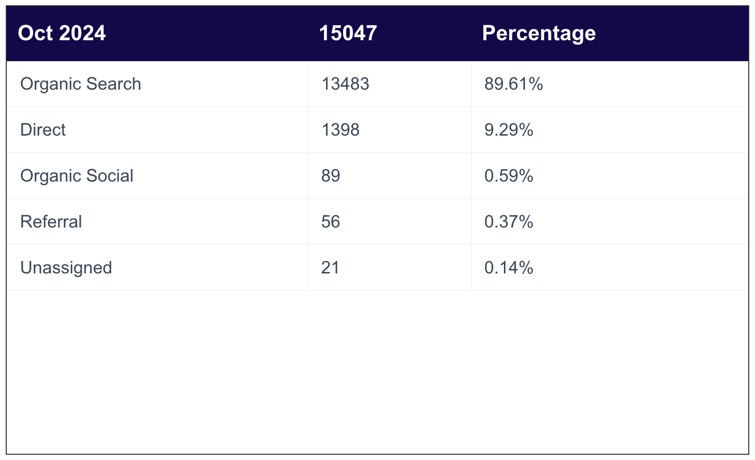
- Example of a 4 location pain management practice – Using PLATINUM-PLUS solution. This pain management practice has 4 locations, and is using the PatientGain PLATINUM service. 89.61% of the leads are coming from SEO Organic search from Google. There are no Google PPC ads or Meta ads. This customer provides good service to patients. 90% of the patients are insurance based and approx 10% are self pay / cash pay. In The past year, they have also started PRP and stem cell therapies for pain management. 5 years ago when they started with PatientGain PLATINUM service – They were spending approx $6000 per month on Facebook ads and Google PMAX ads. PatientGain’s advertising team stopped the Facebook ads. Then Google PMAX ads were stopped and Google PPC Search ads were started, – $2000/mon for 2 locations – meaning total of $4000 PPC ads budget, for the 2 locations,that required more patients. The other 2 locations were doing fine with new patients. So $4000 per month were directed towards the 2 struggling locations. After 1 year, the ads budget was further reduced to $2000 per month for 1 location only, as SEO rankings and new leads from SEO had increased significantly. At the end of 2 years, all ads were stopped. As of this writing, the customer has increased from 11 providers to 20 providers, within the same 4 locations.
Conclusion: Why PatientGain’s Pricing is Lower
- Automation: The automation built into PatientGain’s platform streamlines the marketing process, reducing the need for manual labor and resulting in lower costs.
- All-In-One Platform: PatientGain integrates various services (SEO, PPC, content, patient engagement, and reputation management) into a single, cost-effective package, eliminating the need for separate vendors or third-party tools.
- Specialized for Healthcare: PatientGain’s healthcare-specific focus allows for more efficient strategies, targeting the unique needs of pain management clinics without the learning curve or inefficiency that might exist in a more general marketing agency.
- Scalability: As your practice grows, PatientGain’s platform can scale seamlessly, without additional costs for each new location, making it an affordable solution even for practices with multiple clinics.
 Send Text
 How may I help you?