

What is the difference between Medical SEO and AI Visibility (AEO) for medical and dental practices
Medical SEO is the practice of optimizing a healthcare organization’s website and online content to improve its visibility in search engine results pages (SERPs) when potential patients search for health information, conditions, treatments, or local providers.
AI Visibility (also referred to as AI SEO or Answer Engine Optimization – AEO) is the specialized approach to ensure that a medical practice’s information is found and cited by artificial intelligence systems, such as Google’s AI Overviews, ChatGPT, and other AI assistants. This goes beyond traditional rankings to focus on being the direct, authoritative source that AI uses to generate quick answers or summaries for users.
Medical SEO
Medical SEO involves a range of techniques tailored to the unique requirements of the healthcare industry, which prioritizes accuracy, credibility, and patient privacy (HIPAA compliance):
- Content Creation: Producing high-quality, informative content that addresses patient questions and concerns, often in the form of detailed articles, FAQs, and guides.
- Local SEO: Optimizing the practice’s online presence (especially Google Business Profile, local directories, and review platforms) so it appears prominently for location-specific searches like “urgent care near me”.
- Technical SEO: Ensuring the website is fast, mobile-friendly, secure, and well-structured, making it easy for both users and search engine crawlers to navigate.
- E-E-A-T: Emphasizing Experience, Expertise, Authoritativeness, and Trustworthiness. This is crucial in the medical field (“Your Money or Your Life” topics), requiring content to be written by or clearly attributed to qualified medical professionals and supported by credible sources like peer-reviewed journals.
AI Visibility
AI has shifted the search paradigm from simply showing a list of links to providing synthesized, direct answers (zero-click searches). Key aspects of AI visibility include:
- Structured Data (Schema Markup): Implementing specific code (e.g.,
MedicalCondition,Physician,MedicalProcedureschema) that clearly labels content, making it effortless for AI to understand the context and extract accurate information. - Answerability: Structuring content with clear headings, bullet points, and concise summaries that directly answer potential patient questions in a conversational tone, making it easy for AI to pull into its own summaries.
- Reputation Management: AI models use patient reviews and mentions on third-party sites as primary signals for trustworthiness. A steady stream of positive, recent reviews across multiple platforms directly influences AI rankings.
- Content Authority: AI prioritizes content from highly credible sources. Being recognized as an authoritative source through credentials, certifications, and high-quality backlinks increases the chances of being cited in AI-generated overviews.
- Optimizing for Conversational Search: Creating content that matches the natural language and long-tail questions users ask when interacting with AI assistants or voice search devices.
In essence, medical SEO is the foundational work for being found online, while AI visibility is the adaptation of those principles to thrive in a search landscape dominated by generative AI.
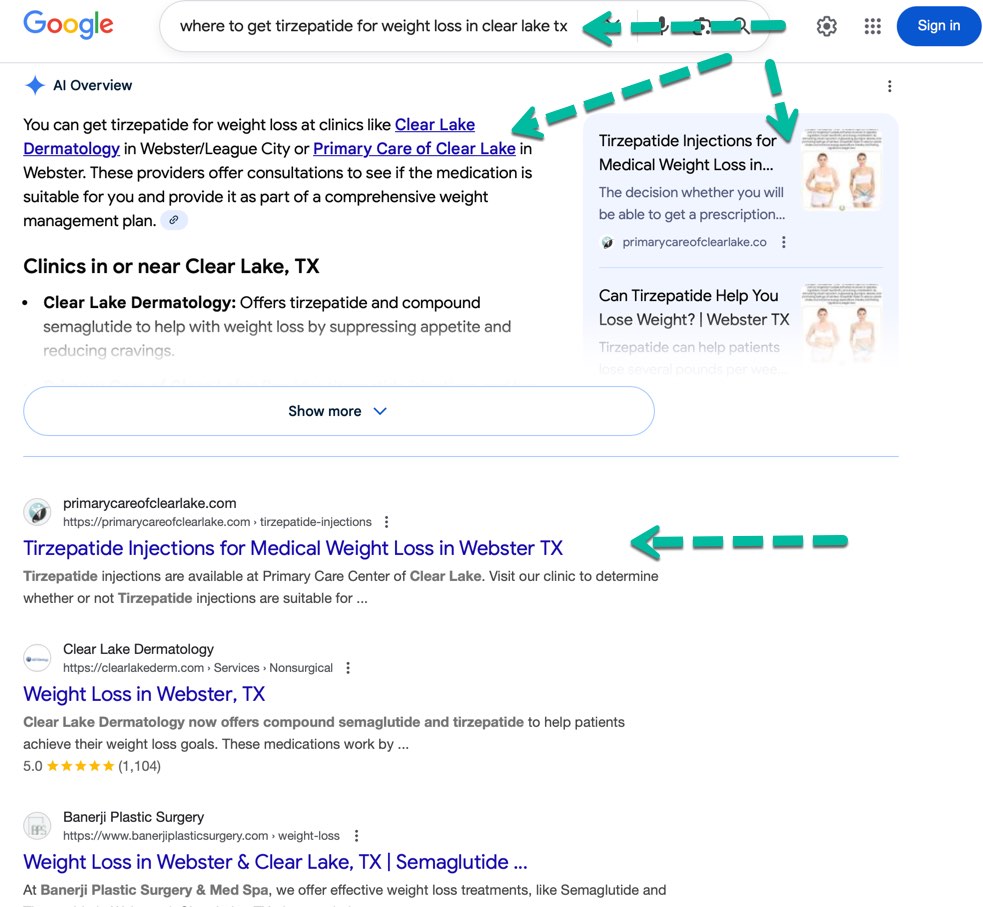
Example of a good AEO :
How does PatientGain’s PLATINUM service works on Answer Engine Optimization?
PatientGain’s PLATINUM service utilizes a specialized Answer Engine Optimization (AEO) infrastructure designed to secure “Zero-Click” search results and AI-generated summaries. This service focuses on positioning a medical practice as the definitive authority for clinical queries.
The PLATINUM service works on AEO through the following core mechanisms:
- Reverse AEO Strategy: Instead of starting with keywords, PatientGain’s AI analyzes high-intent patient problems (e.g., “painful red rash on face”). It then automatically generates deep-content service pages that provide direct, comprehensive answers to these specific clinical needs.
- Advanced Medical Schema Markup: The service implements specialized code—including Physician, MedicalClinic, and MedicalProcedure schema—to label website content. This allows AI engines to instantly extract and cite accurate information for “AI Overviews” and voice assistants.
- High-Volume Monthly Content: The PLATINUM tier includes aggressive, ongoing content creation tailored to medium-to-high competition markets. Fresh, non-plagiarized content is added monthly to answer common patient questions and establish Expertise, Authoritativeness, and Trustworthiness (E-A-T).
- Intelligent AI ChatBot: Included in the PLATINUM package, this HIPAA-compliant chatbot provides 24/7 instant answers to patient inquiries. It functions as a localized “answer engine” within the practice’s own website to improve conversion rates.
- Trust Signal Integration: The service automates the collection and display of patient reviews via the QuickSend App, creating strong trust signals that AI engines prioritize when selecting authoritative answers.
- Technical Performance: Websites are hosted on Google Cloud’s C2 (Compute-Optimized) VMs to ensure maximum loading speeds, which is a critical factor for AI engines evaluating site quality for AEO rankings.
 Send Text
 How may I help you?