
10 Proven Channels for Patient Acquisition
No medical or dental practice can thrive without an effective approach to new patient acquisition. There are hundreds of strategies, apps, consultants, experts you can use or hire to provide you with “how to”. However the following is compiled from 10+ years of PatientGain’s exclusive focus on working with medical and dental practices of all sorts, single location to dozens of locations, and even some 100+ location healthcare companies.
The most important step is your own practice and how you genuinely take care of your patients, staff, and your reputation. This is the most important prerequisite.
Where do patients look and where do patients come from?
10 proven channels for new patient acquisition – Your patients come from these:
For a healthcare practice manager, patient acquisition is often just one of many responsibilities alongside staff management, operational efficiency, budget oversight, and compliance. Navigating multiple marketing channels can easily become overwhelming if not managed systemically.
By utilizing an integrated platform—which can consolidate 5 to 8 different vendors into a single Single Point of Conversion (SPOC) dashboard—a practice manager can leverage these 10 channels to drive growth while simultaneously reducing front-desk workload and maintaining strict HIPAA compliance.
1. Google AI/GEO SEO (Organic Search)
- The Practice Manager Benefit: Lowering Long-Term Acquisition Costs (CPA). While SEO takes time to build, organic traffic does not charge a “per-click” fee. By securing high organic rankings, the practice manager creates a stable, predictable flow of new patients that protects the practice’s budget from rising ad costs. It provides the highest long-term ROI, making it easier to report consistent financial health to practice owners.
- Practical Example: A dermatology practice manager works with their marketing team to publish a comprehensive, doctor-reviewed article on their website titled “Prescription Adult Acne Treatments vs. Over-the-Counter Options.” Over the next six months, this page climbs to the first page of Google. The practice now receives a steady, predictable flow of new patients booking acne consultations without the manager having to spend a single dollar on ad clicks.
2. Google Local SEO + Google Business Profile (GBP) Optimization
- The Practice Manager Benefit: Capturing High-Intent “Ready to Book” Patients. Patients searching Google Maps for a “doctor near me” are usually ready to make an immediate appointment. When a practice manager optimizes the GBP, they capture this bottom-of-the-funnel traffic. Furthermore, an optimized profile displays operating hours, accepted insurances, and a direct booking link, which drastically reduces the number of administrative questions the front-desk staff has to answer over the phone.
- Practical Example: A pediatric practice manager updates the clinic’s Google Business Profile to include a direct “Book Appointment” link, current photos of the waiting room, and accurate holiday hours. When a parent searches “pediatrician open near me” on a Saturday morning, the practice appears at the top of the Google Maps results. The parent clicks the link and books an appointment instantly, without front-desk staff needing to answer the phone.
3. Google Ads (PPC)
- The Practice Manager Benefit: Immediate Volume Control and Measurable ROI. If a new provider joins the clinic or a specific schedule is empty, the practice manager can use Google Ads to instantly generate new patient inquiries. Because integrated CRM tools track the exact source of a lead, the manager can prove exactly how many booked appointments resulted from a specific ad campaign, allowing for data-driven budget requests.
- Practical Example: An orthopedic practice manager notices that the clinic’s MRI machine is underutilized for the upcoming week, meaning lost revenue. The manager logs into their platform and temporarily turns on a targeted Google Ads campaign for keywords like “knee pain doctor” and “MRI clinic near me.” The ads place the practice at the top of search results immediately, filling the schedule gap within 48 hours. The manager then pauses the campaign.
4. Social Media Ads (Facebook, Instagram, YouTube, TikTok)
- The Practice Manager Benefit: Promoting High-Margin, Elective Services. Social media ads excel at visual storytelling, making them the perfect tool for a practice manager looking to push cash-pay or high-margin services (such as aesthetics, advanced dental work, or specialized treatments). This allows the manager to strategically influence the type of revenue the clinic generates, rather than just relying on standard insurance-based primary care volume.
- Practical Example: A medspa practice manager wants to boost high-margin, cash-pay services. They run a targeted video ad on Facebook and Instagram showing a time-lapse of a successful Botox treatment. The ad is shown only to local users matching their target demographic and features a “Claim Your Free Consultation” button. This captures patients who weren’t actively searching for Botox but were convinced by the visual proof while scrolling their feeds.
5. AI Agents Optimization (Gemini, ChatGPT, Copilot)
- The Practice Manager Benefit: Future-Proofing Market Share. With platforms like PatientGain reporting that 2% to 4% trackable leads are already originating from conversational AI tools, optimizing for AI ensures the practice doesn’t lose ground to competitors. For the manager, this means staying ahead of the technology curve and capturing early-adopter patients who tend to have higher lifetime values.
- Practical Example: A dental practice manager ensures the clinic’s website explicitly lists their specific credentials in clear, structured text (e.g., “Award-Winning Invisalign Platinum Provider in Palo Alto”). When a prospective patient types into ChatGPT or Gemini, “Who is a highly rated Invisalign dentist in Palo Alto?”, the AI agent easily reads the site’s structured data and generates a response recommending the practice over competitors with vague websites.
6. Digital Ads on Secondary Directories (Healthgrades, Vitals, etc.)
- The Practice Manager Benefit: Protecting Provider Reputation and Conversion Rates. Patients frequently cross-reference doctors on medical directories before committing to an appointment. By managing and occasionally advertising on these secondary sites, the practice manager ensures that when a patient double-checks a provider’s credentials, they see accurate information and positive reviews. This prevents “leakage,” where a patient finds the practice on Google but abandons the booking after seeing an unclaimed or poorly rated Healthgrades profile.
- Practical Example: A cardiology practice manager realizes that patients referred by primary care doctors are looking up their specialists online before booking. The manager claims the practice’s profiles on Healthgrades, Vitals, and WebMD, ensuring the accepted insurance lists are perfectly up to date. When a referred patient double-checks the doctor on Healthgrades, they see their insurance is accepted and proceed to book instead of abandoning the referral.
7. Offline Traditional Advertising (Print, TV, Mailers)
- The Practice Manager Benefit: Broad Community Awareness with Digital Tracking. While traditional media is historically hard to track, modern practice managers can assign unique, HIPAA-compliant digital tracking phone numbers and custom QR codes to offline mailers or billboards. This bridges the gap between offline outreach and digital analytics, finally allowing the manager to definitively measure the return on investment of local community advertising.
- Practical Example: An urgent care practice manager decides to send a USPS direct mailer to 5,000 local homes promoting flu shots and sports physicals. Instead of using the clinic’s main phone number, the manager generates a unique, HIPAA-compliant tracking phone number specifically for the flyer. At the end of the month, the manager checks the CRM dashboard and sees exactly 42 calls came from that specific number, proving the direct ROI of the print campaign.
8. Referrals and Relationship Marketing
- The Practice Manager Benefit: High-Quality, Pre-Qualified Patient Flow. Referrals from other providers are typically the highest-converting leads a practice can get. Using a unified CRM dashboard, a practice manager can track exactly which local doctors or businesses are sending them the most patients. This data allows the manager to strategically allocate time and resources toward nurturing the most profitable B2B relationships (e.g., sending thank-you notes or hosting referral dinners).
- Practical Example: An oral surgery practice manager uses their CRM to run a referral report and discovers that a specific local orthodontist sent them 15 high-value wisdom teeth cases last quarter. Armed with this data, the manager orders a catered lunch to be delivered to the orthodontist’s staff with a thank-you note, nurturing the B2B relationship and ensuring the profitable referral pipeline continues.
9. Influencer Marketing
- The Practice Manager Benefit: Generating Authentic User-Generated Content (UGC). Managing a practice’s social media can be a massive time sink. By leveraging local influencers or highly engaged patients to post about their positive experiences, the practice manager gains access to authentic, compelling marketing assets that can be repurposed across the practice’s own digital channels without requiring expensive professional photoshoots.
- Practical Example: A wellness clinic manager offers a complimentary IV hydration drip to a local yoga instructor who has 12,000 active local Instagram followers. In exchange, the instructor posts a short video of their experience, tagging the clinic. The clinic immediately sees a spike in bookings from local fitness enthusiasts who trust the instructor’s wellness recommendations.
10. Word of Mouth Marketing
- The Practice Manager Benefit: Automated Reputation Growth and Front-Desk Relief. Traditionally, generating word-of-mouth required front-desk staff to awkwardly ask patients to leave reviews or tell their friends. By implementing automated post-visit workflows, the practice manager can systematize this process. Software automatically sends an SMS or email thanking the patient and requesting a Google review, driving organic growth without adding any manual labor to the administrative team’s daily workload.
- Practical Example: A family medicine manager sets up an automated text messaging workflow in their PatientGain dashboard. Two hours after a patient checks out from a successful physical exam, the system automatically texts: “We’re so glad you chose us! If you had a great experience, please take 30 seconds to leave us a Google review [Link].” This turns quiet, happy patients into public advocates, driving up the practice’s rating and attracting new patients via digital word-of-mouth, all without the front desk lifting a finger.
Insights from PatientGain for medical and dental practices
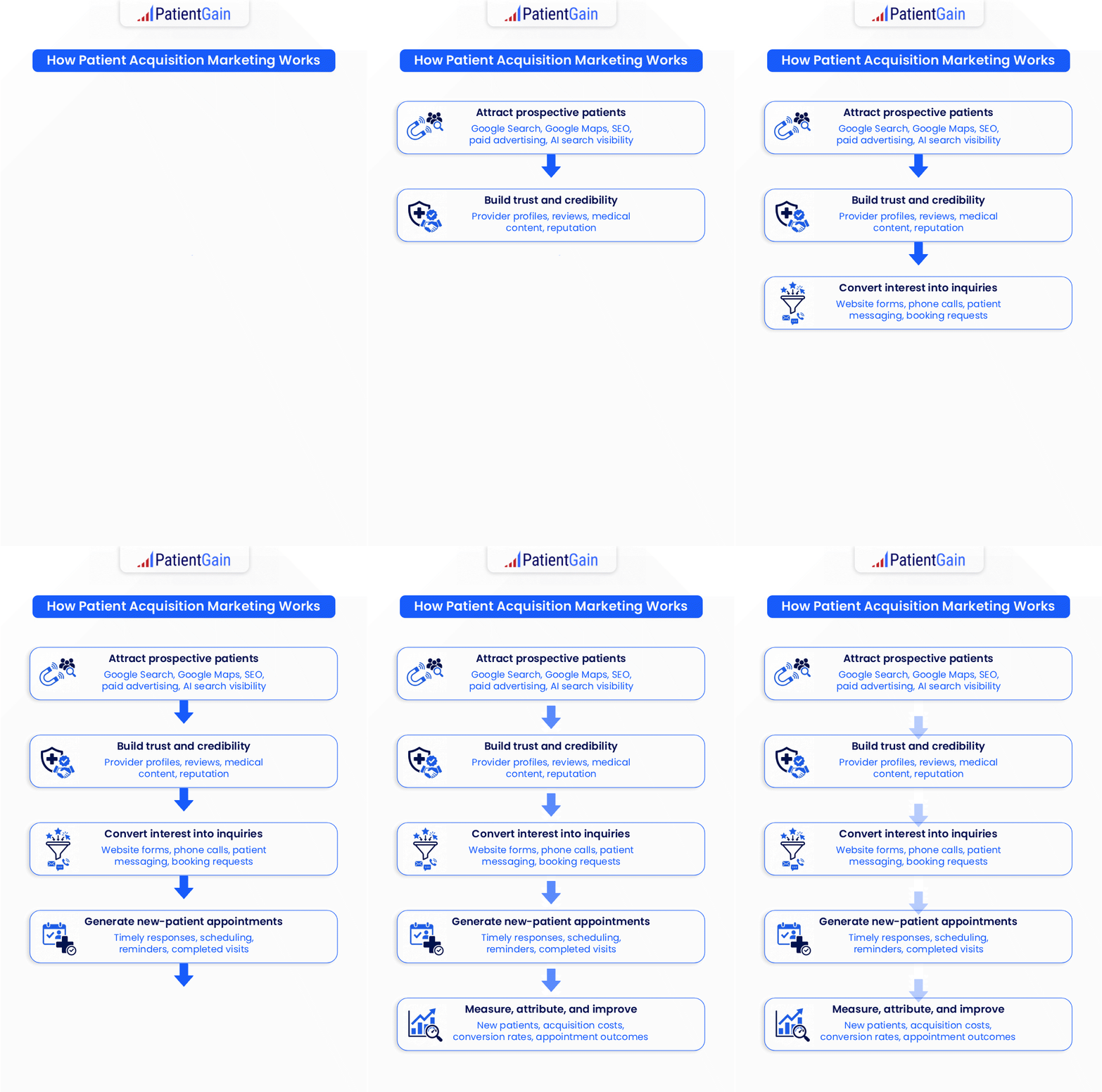
The first five points are the most important mediums for your online success. Also note: If used properly, conversion from Google search is 3 times higher than from social media sites. However, if you are building your brand, then social media is a better channel. Facebook, Instagram, Tik-Tok and YouTube ads are the best way to increase awareness, do promotional marketing, and interact with patients. Google ads and Bing ads are the best search PPC platforms that can quickly convert new patients. Overall the best marketing tool with high ROI is marketing automation solution, based on AI agents, apps, HIPAA compliance, high performance website and professional services. A patient focus website that caters to your existing patients and attracts new patients, every day for your healthcare practice. We are seeing 2% of the leads coming from Gemini, ChatGPT and Copilot-OpenAI.
 Send Text
 How may I help you?