You cannot copy content of this website, your IP is being recorded.
WordPress is not HIPAA Compliant
WordPress Core is not HIPAA Compliant
WordPress by itself is not inherently HIPAA-compliant. However, PatientGain offers HIPAA-compliant very fast loading WordPress websites by implementing specific technical and procedural controls that meet HIPAA’s strict privacy and security standards.PatientGain can provide HIPAA-compliant WordPress websites for healthcare practices and integrate it with OpenEMR while ensuring compliance.
Standard WordPress is not HIPAA compliant. If a patient submits a contact form on a regular WordPress site, that medical data is saved in a standard, unencrypted database and often emailed to the front desk— both of which are massive HIPAA violations.
PatientGain solves this by fundamentally changing how WordPress handles data. They essentially use WordPress for the “front-end” visual design but completely replace its “back-end” engine with enterprise healthcare technology. WordPress compliant, and how they securely connect it to an open-source clinical system like OpenEMR.
Part 1: How PatientGain “Cures” WordPress
To make WordPress legally compliant, PatientGain implements a strict “Zero PHI in WordPress” architecture alongside a legal shield.
The Database Bypass: When a patient fills out an appointment request, uses the chatbot, or submits an intake form on a PatientGain WordPress site, that data never touches the WordPress database. It bypasses WordPress entirely and is routed directly into PatientGain’s heavily encrypted, proprietary CRM vault. Using SPOC app all requests are routed to AWS HIPAA Secure servers. While the WordPress website is running on extremely fast GCP C4D servers.
Enterprise Cloud Hosting: The website and the secure data vault are hosted on compute-optimized Google Cloud (GCP) C4D servers or Amazon Web Services (AWS) servers. These environments enforce 128-bit/256-bit encryption for data both “at rest” (in the server) and “in transit” (moving across the web).
Role-Based Access & Audit Logs: You cannot access patient data through the standard WordPress admin dashboard. Staff must log into PatientGain’s separate, secure “SPOC” portal, which features role-based permissions and immutable audit logs (tracking exactly who viewed what data and when). There are audit logs and leads funnel app is obfuscated for higher security.
The BAA (Business Associate Agreement): Most importantly, PatientGain signs a BAA with the practice. This legally binds PatientGain to HIPAA standards, making them liable for the security of the server, the website, and the integrated apps. The BAA is shared responsibility, so as a practice you must take all required steps to protect patient data. PatientGain’s project managers are available to assist you.
Part 2: The OpenEMR Integration
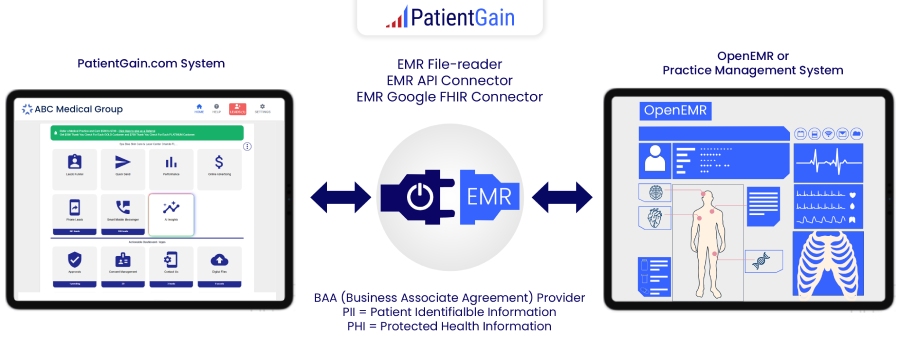
OpenEMR is a highly regarded, free, open-source Electronic Medical Record (EMR) system. It is fantastic for saving money on licensing fees, but it can be difficult to connect to modern marketing tools. PatientGain bridges the gap between their HIPAA-compliant WordPress front-end and the clinical OpenEMR back-end using a secure EMR Connector API.
Here is how they work together for PLATINUM tier customers:
Real-Time, Bi-Directional Sync: When a patient interacts with your WordPress website (e.g., books a slot or updates their phone number), that data lands in the PatientGain secure CRM. The EMR Connector then uses encrypted HTTPS REST APIs to push that data directly into the OpenEMR patient chart and schedule.
Eliminating Double Data Entry: Because the marketing CRM (PatientGain) and the clinical database (OpenEMR) “talk” to each other securely, your front desk doesn’t have to manually copy-paste leads from the website into the EMR.
Free OpenEMR Installation: Because OpenEMR is open-source, you normally have to pay an IT team to install and host it securely. For their Platinum customers, PatientGain actually offers free installation of OpenEMR directly onto their secure Google Cloud servers, putting your marketing and clinical software under one secure, high-speed roof. (Note: While they install it for free, they usually refer out for deep clinical workflow customizations).
Summary
PatientGain uses WordPress because it is the fastest, most flexible platform for SEO and design. However, they strip out its insecure data-handling features and replace them with a hardened AWS/Google Cloud vault that seamlessly feeds into clinical systems like OpenEMR.
*****By using this website and sending us your information, you are giving us permission to contact you by electronic and non-electronic means. (Permission for SMS/Text messaging is only obtained via explicit opt-in checkboxes on our contact forms). We also track conversions and collect user data to improve services, excluding mobile numbers and SMS consent data.
******3rd party tracking services, like Google Analytics, Google Tag manager, Facebook, Instagram, Meta Pixels track, collect and use IP address and other data and location data about patient PHI.
*******If you are vision-impaired or have some other impairment covered by the Americans with Disabilities Act or a similar law, and you wish to discuss potential accommodations related to using this website, please contact us.




 Send Text
 How may I help you?