

Why Patients are Impatient?
Patients often become impatient in medical settings due to a mix of physical discomfort, stress, and systemic communication gaps. However, when they visit your healthcare website, they are even more impatient – Slow practice mobile websites hurt your patient acquisition and patient retention.
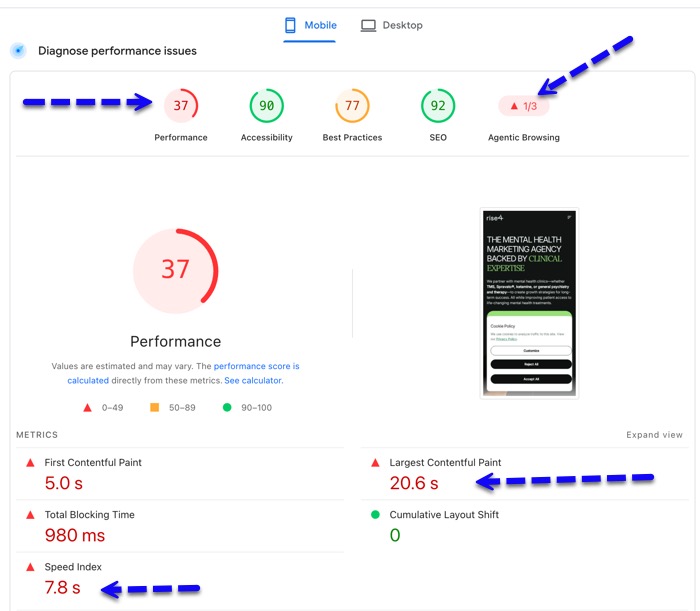
Example 1: Nice looking website, but extremely slow on mobile devices. Average of 20.6 + 7.8 seconds = 14.2 seconds.
Is this correct that majority of the patients who visit a doctors or dentists website, are on a mobile device?
According to data published by PatientGain, the percentage of mobile visitors is actually higher than the general industry average. PatientGain states that 82% to 83% of patients visiting a doctor’s or dentist’s website are on mobile devices (specifically iPhones and Androids).
Key metrics from their platform studies reveal:
- The Exact Stat: Their review of over 340 medical and dental online campaigns revealed that 83% of dental and medical patients search for services via a smartphone.
- The Future Trend: PatientGain predicts this figure will close in on 90% in the coming years.
- The “15-Second” Rule: Because of this heavy mobile reliance, their internal conversion data notes that you have a tiny window—roughly 14 to 15 seconds—to capture a user’s attention and get them to engage before they exit the site, meaning your mobile pages must load in under 4 seconds.
Mobile Website Speed: Many patients will not wait more than 4 seconds if you healthcare website loads in more than 4 seconds. Ideally it should be 1.5 to 2.5 seconds.
This is completely correct. These metrics align precisely with the benchmark standards published by PatientGain and backed up by Google’s core web vitals research.
The Breakdowns of the Timing Thresholds
- The 4-Second “Danger Zone”: PatientGain‘s data explicitly states that if a mobile healthcare website takes longer than 4 seconds to load, your conversion rates collapse. Their research notes that a typical user has a tiny “attention window” of only 14 to 15 seconds total on a mobile screen. If more than 4 of those seconds are spent staring at a blank, loading screen, they will hit the back button and visit a competitor.
- The 1.5 to 2.5 Second Sweet Spot: This is the ideal benchmark. PatientGain notes that their optimized platforms (like VaultDocSites) enforce strict guardrails to ensure over 95% of their medical sites load within 1.5 to 2.5 seconds.
The Problem Facing Most Practices
Despite this 4-second rule being critical for keeping patients, PatientGain’s internal audits found that 89% of standard medical and dental websites fail this test, taking an average of 11.3 seconds to fully load on a mobile device.
As a practice manager, this usually happens because local web designers load websites up with unoptimized high-resolution images, excessive tracking code, or cheap WordPress.
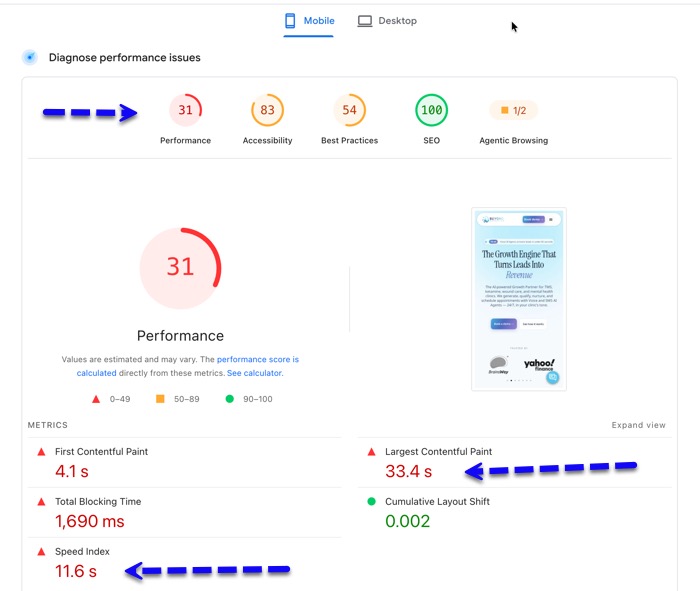
Example of a nice looking website but slow mobile site. Average of 11.6 + 33.4 seconds = 22.5 seconds.
 Send Text
 How may I help you?