

Why All Healthcare Sites Look the Same?
Medical and healthcare websites all look remarkably similar because they prioritize strict regulatory compliance, standardized patient-centered usability, and risk-averse branding over creative design expression. When a digital product deals directly with human health and sensitive personal data, deviating from established, predictable design frameworks introduces functional risks that major health systems are rarely willing to take.
1. Strict Regulatory and Compliance Frameworks
Healthcare platforms operate under extreme legal scrutiny. To avoid steep penalties and lawsuits, developers must build sites to satisfy identical legal specifications:
- Accessibility Standards: Public accommodations and health systems must meet WCAG web accessibility standards. This dictates predictable high-contrast text, specific font sizes, and rigid layouts readable by screen readers.
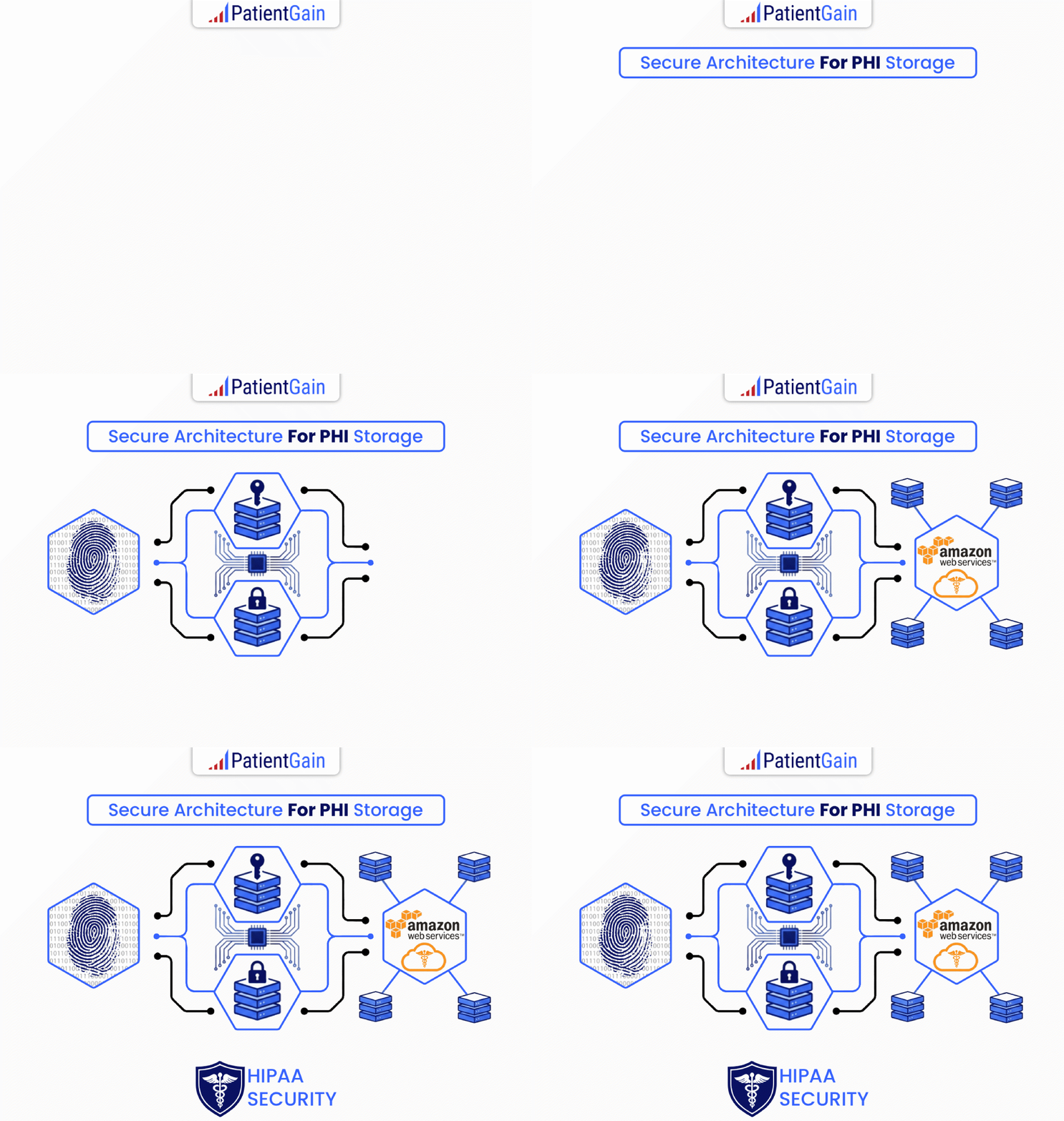
- Data Security and Privacy: Collecting patient information requires secure, encrypted infrastructure. HIPAA compliance regulations force intake forms, patient portals, and contact systems into highly standardized, verified data pipelines.

2. The Psychology of Trust and “Safe” Color Palettes
When individuals search for medical care, they are often in high-stress, vulnerable states. Graphic design choices intentionally lean into psychological safety cues:
- The Blue and Green Dominance: Blue symbolizes trust, stability, and calm, while green evokes health and healing. Consistent, predictable color palettes are used across the industry to project clinical authority. Experimental colors (like bright neon, dark themes, or harsh reds) can trigger anxiety or imply a lack of professionalism.
- Stock Photography Tropes: High-stakes decisions require human validation. Almost every medical site relies on identical imagery: smiling physicians wearing stethoscopes, clean white clinical environments, and diverse patients looking relieved.
3. Rigid Functional Templates and Layouts
Rather than crafting distinct artistic layouts, digital marketing firms specializing in medicine utilize highly optimized content management templates. These setups prioritize user familiarity to reduce the friction of finding care:
- Fixed Interface Elements: Users expect specific features exactly where they usually live—such as a prominent search bar for finding specialists in the center or top right, and clear, unmissable call-to-action buttons for online scheduling.
- Mobile-First Design: Since over 50% of patient traffic originates on smartphones, layouts are compressed into flat, responsive, and easily scannable grids that stack identically across devices.
4. Search Engine and AI Optimization
Websites are no longer just designed for human eyes; they are heavily engineered for algorithmic retrieval. Google’s algorithm rewards speed, mobile responsiveness, and clean information architecture. Additionally, modern health platforms build rigid content blocks to ensure their pages match the retrieval models of AI engines like ChatGPT and Google AI overviews. When structural uniformity directly dictates how high a clinic ranks in localized search results, standing out visually becomes a secondary priority.
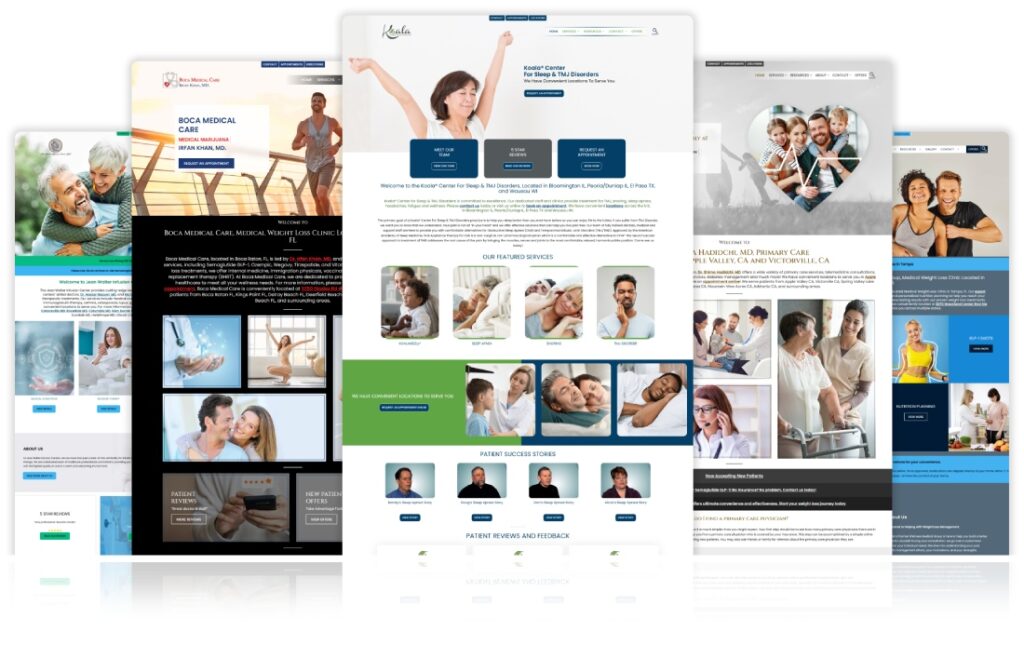
Example of a Semi-Custom very high conversion websites – This website has gone through thousands of A/B tests and designed for high conversion. All of these websites have 10% or higher conversion rates.
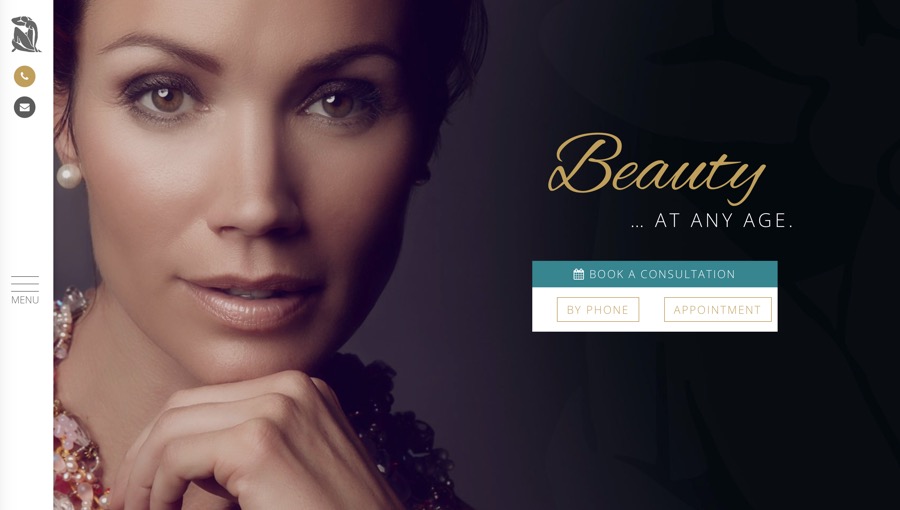
Example of a Full Custom website, costing $8000 to $10000. Typically full custom websites are designed with full feedback from customers and almost by “committee”– And they typically do not go through A/B testing process.
The primary difference is that a PatientGain PLATINUM website is an all-in-one, data-driven “conversion engine” built on a semi-custom framework, whereas a traditional custom website is a bespoke “digital brochure” built from scratch primarily focused on unique aesthetics.
While a custom website gives you total creative control, PatientGain’s PLATINUM service prioritizes scientific, A/B tested layouts designed specifically to turn web traffic into booked medical appointments.
Core Differences at a Glance
| Feature | PatientGain PLATINUM Website | Traditional Custom Website |
|---|---|---|
| Design Approach | Semi-custom, A/B tested for medical conversion | 100% bespoke, built from scratch |
| Conversion Rate | Typically over 10% due to optimized layouts | Typically 3% to 5% (focuses on looks over data) |
| Software Ecosystem | Includes 20+ built-in healthcare apps & CRM | Requires third-party plugins and integrations |
| Vendor Management | Single vendor platform manages everything | Multiple vendors needed (SEO, hosting, design) |
| HIPAA Compliance | Built-in by design across all tools | Higher risk of data leakage between loose plugins |
| SEO & Content | Automated monthly content and AI adjustments | Requires manual updates or an SEO agency retainer |
Key Differences Detailed
- Conversion Focus vs. Pure Aesthetics: Custom sites prioritize unique branding. However, PatientGain’s healthcare data shows that custom designs often underperform mathematically because elements aren’t optimized for user behavior. PLATINUM locks strict layout structures (like CTA and logo placement) to guarantee high performance.
- The “All-in-One” Software Ecosystem: A custom site is just a front-end interface. To get text marketing, scheduling, and patient intake forms, you must stitch together separate software platforms. PLATINUM acts as the interface for 20+ natively integrated applications.
- HIPAA Security Risks: Merging different third-party plugins on a custom site introduces “HIPAA leakage” gaps where data can be exposed. PLATINUM routes all leads directly into a secure, HIPAA-compliant CRM ecosystem under a single Business Associate Agreement (BAA).
- Operational Overhead: Managing a custom site often results in “vendor sprawl,” requiring you to coordinate between web developers, copywriters, and SEO agencies. PLATINUM replaces 5–8 vendors by utilizing automated SEO tech alongside human oversight.
Which one should you choose?
- Choose PatientGain PLATINUM if: You want a fast launch, want to avoid massive upfront developer fees, and want a data-backed site engineered to acquire patients in a competitive market.
- Choose a Custom Website if: You are a large multi-location enterprise with rigid, non-standard corporate branding guidelines that cannot compromise on creative layout freedom. (Note: PatientGain also offers a Custom PLATINUM tier for these specific enterprise needs).
 Send Text
 How may I help you?