

What is Pay Per Click Advertising For Doctors Office?
Pay Per Click (PPC) advertising for a doctor’s office is a highly targeted digital marketing strategy where a medical practice places ads on search engines and social media networks, paying a fee only when a prospective patient clicks on the ad. Unlike traditional marketing channels like billboards or print ads where you pay a flat upfront cost regardless of results, medical PPC is entirely performance-based. It allows a clinic to achieve immediate visibility by instantly appearing at the very top of local search engine results pages, capturing high-intent patients who are actively looking for healthcare services.
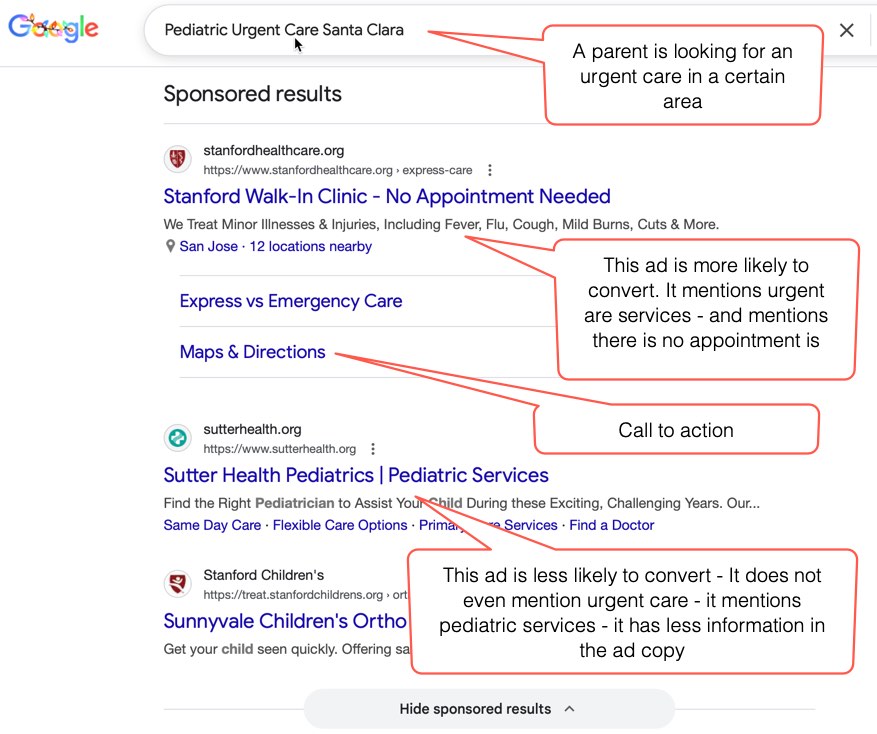
Example of a good Pay Per Click (PPC) advertising – In this example a parent is looking for a pediatric urgent care near a city. You can see that there are 2 PPC ads displayed. You can also see which PPC ad is more likely to be effective.
Pay Per Click Advertising For Doctors Office: Table of Contents
- Is PPC a Targeted digital advertising strategy
- Patient-acquisition faucet
- Why Doctor’s Offices Rely on Pay Per Click Advertising
- HIPAA and AI Constraints
- Performance Metrics: What to Expect
1) Pay-Per-Click (PPC) as a targeted digital advertising strategy
Pay-Per-Click (PPC) advertising for a doctor’s office is a targeted digital marketing strategy where a medical practice pays a fee each time a prospective patient clicks on one of their online advertisements. Instead of waiting months for organic Search Engine Optimization (SEO) to build up, PPC allows a clinic to instantly buy their way to the absolute top of search engines like Google and Bing, or into the feeds of social platforms like Facebook and Instagram.
2) For doctors, PPC is essentially a patient-acquisition faucet: when you turn it on, highly qualified local patient leads flow in; when you turn it off, the traffic stops. How PPC Works for a Medical Practice
The vast majority of healthcare PPC happens on the Google Search Network because it capitalizes on immediate medical intent.
- The Search: A local parent frantically types “pediatrician open on Saturday near me” or a patient looks for a specialized treatment like “varicose vein removal cost.”
- The Ad Placement: Google displays your doctor’s office at the top of the search page, clearly labeled as a sponsored result or featured location in the Map Pack.
- The Click & Conversion: The patient clicks the ad and is taken to a secure, dedicated landing page on your website designed to do one thing: get them to call the office or request an appointment online. You are only charged for that specific click.
3. Why Doctor’s Offices Rely on Pay Per Click Advertising
- Immediate Patient Volume: Perfect for a new clinic opening its doors, a practice expanding into a new city, or a doctor launching a new high-value service line (like body contouring or dental implants) who needs appointments filled next week, not next year.
- Hyper-Local Targeting: You can restrict your ads to show only to users within a specific driving radius (e.g., a 5-to-10-mile radius around your zip code), ensuring you don’t waste your budget on clicks from patients too far away to travel.
- Capturing High-Value Intent: You can choose exactly which keywords you want to bid on. If you are an orthopedic clinic, you can skip broad keywords like “joint pain tips” and instead spend your budget on commercial intent keywords like “best knee replacement surgeon in [City].”
4. HIPAA and AI Constraints
Running PPC for a doctor’s office is far more restrictive than running ads for a retail store or a local plumber. In 2026, healthcare PPC requires navigating two massive hurdles:
a. Google’s Sensitive Interest Policy
Google heavily restricts Remarketing (retargeting ads) for medical practices. Because of patient privacy, if someone visits your website to read about depression, infertility, or cancer, you are legally and programmatically prohibited from “following” them around the internet with ads about that condition.
b. The HIPAA Tracking Traps
The Department of Health and Human Services (HHS) strictly regulates tracking technologies. Standard Google or Meta tracking pixels automatically capture a user’s IP address and health search terms. Because Google will not sign a Business Associate Agreement (BAA) for Google Ads, sending this un-scrubbed data straight to Google is a federal privacy violation.
The Modern Fix: Successful practices use a HIPAA-compliant middleman server (like a dedicated healthcare CRM or PatientGain’s obfuscation layer) to scrub patient names and IP addresses before sending an anonymous “conversion signal” back to Google.
5. Performance Metrics: What to Expect
PPC costs fluctuate based on how competitive your local market is and what medical specialty you practice.
| Specialty Tier | Average Cost-Per-Click (CPC) | Patient Intent Profile |
| High Urgency (Urgent Care, Emergency Dentistry) | $3 – $8 | High conversion rates; patients book the first available slot. |
| Primary Care / Pediatrics | $2 – $5 | Steady, lifetime-value patients looking for local trust. |
| High-Value Elective (Aesthetics, Lasik, Implants) | $15 – $40+ | Highly competitive; requires automated nurturing funnels to convert. |
Summary
PPC for a doctor’s office is an aggressive, mathematically predictable tool for growth. When managed through a healthcare-compliant framework, it bypasses the slow timelines of organic marketing and places your clinic directly in front of local patients at the exact millisecond they are looking for medical care.
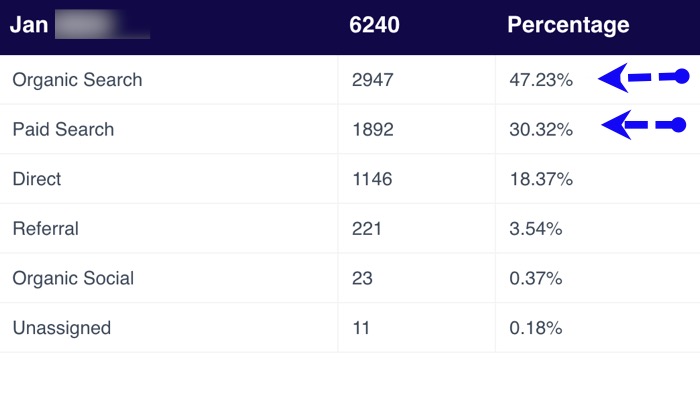
Example of Marketing ROI Dashboard of a PLATINUM customer – A Wellness practice. From the data below 30.32% of the leads are being generated from Pay-Per-Click ads with a budget of $4000/mon. Primarily on on Google PPC ads.
 Send Text
 How may I help you?