You cannot copy content of this website, your IP is being recorded.
Physician Marketing Services With BAA
Physician Marketing Services With BAA
Why does a healthcare practice needs a business associate agreement (BAA) for marketing services for my medical or dental practice?
A healthcare practice needs a Business Associate Agreement (BAA) for marketing services because marketing firms often handle, access, or store Protected Health Information (PHI)—such as patient lists for targeted campaigns or email marketing—making them “business associates” under HIPAA regulations. A BAA is legally required to ensure these vendors protect patient data and comply with HIPAA Security Rule safeguards
In modern healthcare, a Business Associate Agreement (BAA) is a legally mandated contract that ensures third-party marketing vendors protect your patients’ Protected Health Information (PHI) as strictly as your own practice does. Without this signed agreement, sharing even basic contact info for a newsletter is a HIPAA violation.
1. Legal Requirement for PHI Handling
Definition of a Business Associate: Under HIPAA regulations (45 CFR § 160.103), any vendor that creates, receives, maintains, or transmits PHI on your behalf is a “business associate” and must sign a BAA.
What Counts as PHI in Marketing: This includes more than just medical records; it covers names, email addresses, phone numbers, device IDs, and IP addresses used for targeted outreach.
Mandatory Before Service: You are legally prohibited from allowing a vendor access to patient data until a BAA is fully executed.
2. Marketing-Specific Use Cases
Email & SMS Campaigns: Platforms managing patient newsletters or appointment reminders handle identifiable data and must be bound by a BAA to ensure encryption and security.
Digital Tracking Tools: Modern tools like the Meta Pixel or Google Analytics can capture health-related behavior. If these tools link behavior to an individual, a BAA is required (though many standard providers, like Google Analytics, often refuse to sign them).
Patient Testimonials: Agencies handling patient stories or photos for your website are accessing PHI that requires both a BAA and specific written authorization from the patient.
3. Liability and Risk Management
Shifted Accountability: A BAA contractually obligates the vendor to follow HIPAA’s Privacy and Security Rules, making them directly liable to federal regulators for their own breaches.
Breach Notification: The agreement mandates that the vendor must notify you within a specific timeframe (often 24–72 hours) if a data leak occurs, allowing you to meet federal reporting deadlines.
Avoid Substantial Fines: Operating without a BAA can lead to fines from the Office for Civil Rights (OCR) .
4. Protecting Patient Trust
Data Minimization: A strong BAA explicitly limits the vendor to the “minimum necessary” data required for their specific marketing task.
Professional Standard: Having these agreements in place demonstrates due diligence to your patients, signaling that you take their privacy seriously.
How does PLATINUM service manages HIPAA for my healthcare practice?
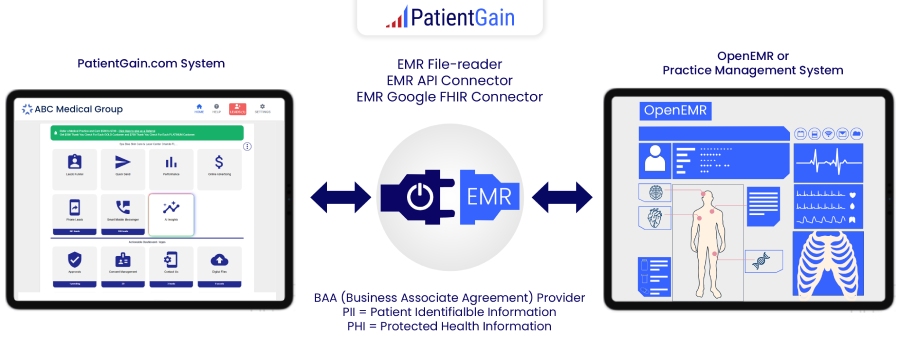
The PatientGain PLATINUM service manages HIPAA compliance through a multi-layered approach that combines legal, technical, and administrative safeguards directly into its platform.
Business Associate Agreement (BAA): PatientGain provides a signed, standard BAA to all PLATINUM customers, establishing the legal framework for protecting electronic Protected Health Information (ePHI).
Secure Infrastructure: All websites and over 20+ integrated apps are hosted on HIPAA-compliant cloud infrastructure (primarily Amazon Web Services and Google Cloud Platform).
Data Isolation: ePHI captured via forms or apps is stored in specialized, secure databases. It is never stored in the standard, less secure WordPress website database tables.
Technical Safeguards
End-to-End Encryption: Data is encrypted using SSL/TLS protocols “in transit” (during transmission) and AES-256 “at rest” (while stored on servers).
Access Controls:
Role-Based Access Control (RBAC) ensures staff only see data necessary for their specific job functions.
Multi-Factor Authentication (MFA) and session timeouts prevent unauthorized logins.
Audit Trails: Detailed logs record every instance of ePHI being accessed, modified, or downloaded. These logs are reviewed daily by two separate staff members.
Integrated Compliance Tools
Consent Management App: Automatically captures and logs informed patient consent for data capture and communication, providing an auditable trail.
Secure Communication: All patient interactions—including two-way texting, AI chatbots, and appointment scheduling—occur within an encrypted environment.
Data Obfuscation: Uses a proprietary obfuscation layer in the Leads Funnel and SPOC (Single Point of Conversion) apps to make sensitive information unreadable to unauthorized parties.
Administrative Safeguards
Staff Training & Screening: All PatientGain staff undergo regular HIPAA security training and mandatory background checks.
Ongoing Monitoring: The platform performs regular self-audits and security log reviews to identify and mitigate potential vulnerabilities.
PatientGain’s technical and administrative safeguards for HIPAA compliance, covering encryption, access controls, audit trails, staff training, and ongoing monitoring. PatientGain provides standard BAA for all covered services, however customer must follow security protocols, best practices and limit access to certain users.
*****By using this website and sending us your information, you are giving us permission to contact you by electronic and non-electronic means. (Permission for SMS/Text messaging is only obtained via explicit opt-in checkboxes on our contact forms). We also track conversions and collect user data to improve services, excluding mobile numbers and SMS consent data.
******3rd party tracking services, like Google Analytics, Google Tag manager, Facebook, Instagram, Meta Pixels track, collect and use IP address and other data and location data about patient PHI.
*******If you are vision-impaired or have some other impairment covered by the Americans with Disabilities Act or a similar law, and you wish to discuss potential accommodations related to using this website, please contact us.



 Send Text
 How may I help you?