

Why Medical SEO Strategy From PatientGain works?
PatientGain’s client websites often rank highly for medical SEO and dental SEO due to a specialized, holistic, and data-driven approach built specifically for the competitive healthcare industry. PatientGain serves medical and dental practices. See complete list here.
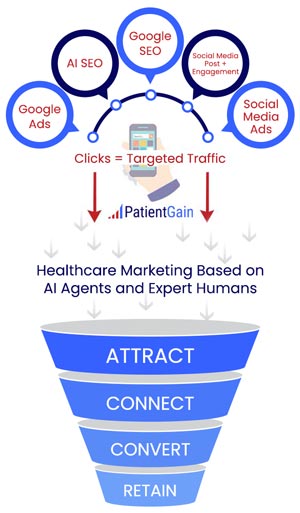
Step 1: Hyper-Local SEO Focus
PatientGain places a heavy emphasis on local search optimization to appear in “near me” and map-pack results. This involves meticulous optimization of the Google Business Profile (GBP) with service-specific information and the creation of geo-targeted service pages. In addition they post 20 posts per month on Google Business Profile (GBP) with service-specific information, and these posts are designed to provide useful information for patients, rather than “sales” promotions and offers.
Step 2: E-E-A-T & High-Quality Content
Google applies strict “Your Money or Your Life” (YMYL) guidelines to medical content, requiring high levels of Experience, Expertise, Authoritativeness, and Trustworthiness. PatientGain addresses this by ensuring all website content is unique, medically accurate, and often reviewed by qualified medical professionals. Content is created using AI agents, then it is sent to a second AI agent who checks for duplicate content, then 3rd AI agent produces “local” version of the content. Next a human content manager reviews the content, and creates a WordPress optimized page. A graphics designer may add a custom infographic. Finally a project manager reads the page as a patient would read the page. Once a project manager has approved the page, it is added to the website, with proper headings, meta-tags and it is published and submitted to search engines, and the customer is informed.
Step 3: AI-Powered “Reverse Search Engine” Algorithm
PatientGain uses its proprietary AI to analyze how patients search for medical services in natural language, optimizing their clients’ websites to match those specific patient search patterns and intents, rather than relying on general keywords. This process is constantly refined. And new content must be added every month to get top SEO rankings in Google SEO, Google AI SEO, ChatGpt mentions, Copilot mentions, and other AI agents. It is a constant process.
Step 3: Technical Excellence
Websites are built as high-performance, mobile-first assets that load quickly (under 3-4 seconds is the goal) and utilize advanced medical-specific schema markup. All PatientGain websites must pass the https://pagespeed.web.dev/ Mobile load time speeds before going live. This structured data helps Google’s AI better understand the website’s content and context, improving visibility in search results.
Step 4: High performance hosting
PatientGain.com uses a combination of secure, HIPAA-compliant cloud hosting providers, primarily Amazon Web Services (AWS) and Google Cloud Platform (GCP), to host their marketing platform, websites, and applications, ensuring data security and compliance with healthcare regulations like HIPAA and HITECH. They leverage AWS for their core infrastructure and Google Cloud for high-performance WordPress hosting, using features like data encryption and role-based access control for sensitive patient information.
Step 5: Conversion optimization & A/B testing
The entire PatientGain platform is designed to convert visitors into patients. Features like clear calls-to-action (CTAs) and the Single Point of Contact (SPOC) app streamline communication, which also improves user experience— a key ranking signal for Google. For example, every action taken or changes made to customer websites ( PLATINUM service) are scrutinized for conversions and HIPAA compliance. For example, is an application or a plugin is not HIPAA compliant, it cannot be used. Or if an application or a plugin can make the website slow, it cannot be added.
Step 6: Integrated Platform
By offering an all-in-one, HIPAA-compliant solution with continuous monitoring, monthly content updates, and dedicated human support, PatientGain ensures their clients’ online presence evolves with search trends and algorithm changes, sustaining high rankings over time.
Examples of results of ROI from PatientGain.com
Patient Acquisition (Organic SEO)
- Urgent Care Center: An urgent care clinic in a highly competitive area of California used the Platinum service for over five years. After 3.5 years, the clinic stopped all paid ads, relying entirely on organic SEO.
- Result: The clinic recorded 1,149 effective new patient leads in a single month from SEO and local optimization efforts.
- Pain Management Clinic: A pain management provider with two locations in a competitive Texas market using the Platinum service (without paid advertising) saw a high volume of leads.
- Result: The clinic generated 703 effective leads in one month, increasing to 830 effective leads the next month.
Quantifiable Revenue and Conversion Metrics (PPC & SEO)
- Dental Clinic (SEO focus): A dental clinic optimized its website for local keywords.
- Result: Organic traffic increased by 40% in six months. By converting 10% of new traffic into patients (at an average acquisition cost of $150), they generated an estimated $60,000 in new yearly revenue.
- Medical Spa (PPC focus): For a clinic using a Google Ads campaign with a budget of approximately $2,399 (including service fees), targeting “Botox in [city name]”:
- Result: The campaign generated 80 new leads, leading to 20 new paying patients with a Customer Acquisition Cost (CAC) of $119.95.
- ROI Calculation: Based on an initial average revenue of $600 per patient, the campaign generated $12,000 in initial revenue. The resulting ROI was 400% (meaning $4 return for every $1 invested in initial revenue).
- Chiropractic Clinic (SEO focus): An improved SEO strategy for a chiropractic clinic resulted in:
- Result: Organic search traffic doubled, and consultation bookings increased by 30%. This led to an estimated increase in yearly revenue of $200,000.
Performance Improvements & Key Metrics
- Increased New Patient Calls: Tracking often shows a 30% increase in phone inquiries from new patients using Google PPC Ads campaign.
- Improved Conversion Rates: PatientGain websites generally see conversion rates of 10% or higher, compared to a typical average of 5%.
- Lowered Patient Acquisition Cost: Practices have seen their average cost to acquire a new patient drop by 20% through optimized ad spend.
 Send Text
 How may I help you?