

Medical Local SEO Entity Optimization
What is Entity Optimization for a Medical Practice Local SEO?
Entity Optimization for a medical practice’s local SEO is the process of defining and connecting your practice, doctors, services, and locations as distinct, verifiable real-world concepts (“entities”) so search engines can understand and trust your organization. Instead of relying solely on repeating keywords, it aligns your digital presence with how search engines map relationships between people, places, medical specialties, and treatments.
Entity optimization for a medical practice’s local SEO means helping search engines clearly identify your practice, its providers, its locations, and its services—and understand how they connect.
An entity is a distinct person, organization, place, or concept. For a medical practice, these include:
| Entity | Example | Relationship to establish |
|---|---|---|
| Practice | Riverside Medical Group | The organization operating the offices |
| Location | Riverside Medical Group’s downtown office | Where patients receive care |
| Provider | Dr. Sarah Jones | A physician working at specific offices |
| Specialty | Dermatology | The physician’s area of practice |
| Service | Acne treatment | Care offered by particular providers at particular locations |
The goal is to make those relationships accurate and consistent across your website, Google Business Profiles, and relevant external listings.
For example, Google should be able to understand that Dr. Sarah Jones is a dermatologist at Riverside Medical Group, sees patients at the downtown office, and provides acne treatment there. Your provider biography, office page, service page, and external profiles should support that same information.
The work typically includes:
- Accurate business profiles: Correct practice names, categories, addresses, phone numbers, hours, and website links.
- Distinct location and provider pages: Explain who practices where and which services each office offers.
- Connected website content: Link providers, services, and locations so their relationships are easy to follow.
- Structured data: Add machine-readable descriptions that match the information patients can see.
- Consistent external information: Correct outdated listings, affiliations, and genuine duplicate profiles.
- Credible recognition: Build authentic reviews and relevant professional or community mentions.
Google says local results depend mainly on relevance, distance, and prominence. Entity optimization supports accurate identification and relevance; it cannot eliminate the effect of distance or guarantee rankings.
For a practice manager, the practical objective is simple: make it easy for patients and search engines to know who you are, what care you provide, and where to book it.
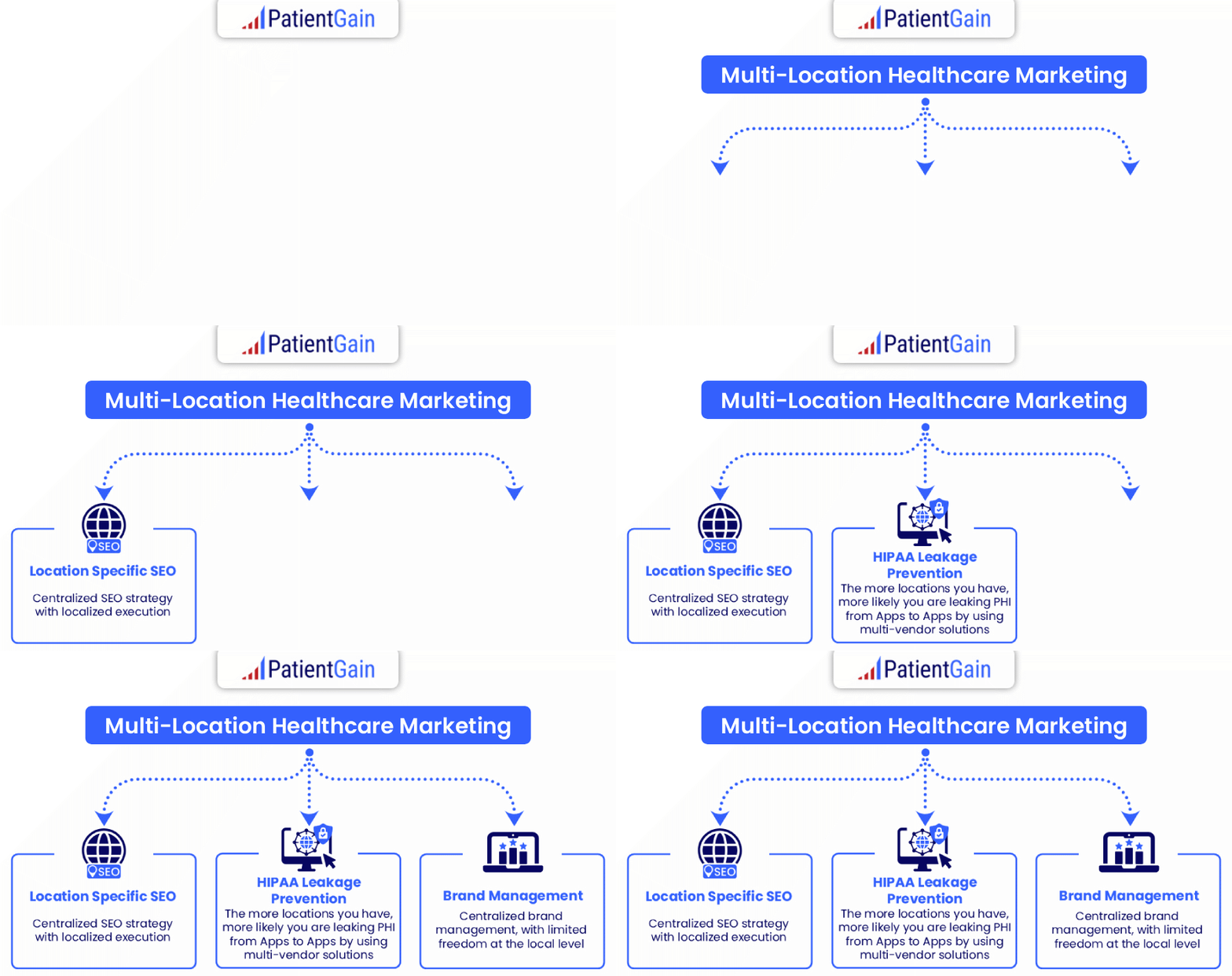
How does PatientGain implement Medical Local SEO Entity Optimization?
PatientGain implements Medical Local SEO Entity Optimization through a structured, multi-tier system that connects a practice’s physical locations, providers, and medical services directly to search engine algorithms. Their platform uses a combination of automated software and human management to establish clear healthcare entities that comply with Google’s strict “Your Money or Your Life” (YMYL) standards.
3-Tier Citation and Directory Strategy
PatientGain structures local entity authority across three specific distribution tiers to ensure 100% Name, Address, and Phone (NAP) consistency:
- Tier 1 (Core Foundation): Locks down primary search engines, mapping platforms, and Google Business Profiles (GBP), tying the practice’s website directly to core map data.
- Tier 2 (Niche Healthcare): Distributes practice and provider data to healthcare-specific directories to build high-trust local backlinks and industry validation.
- Tier 3 (Regional Citations): Broadcasts signals to broad local directories to capture surrounding neighborhood and “near me” traffic.
Advanced Medical Schema Markup
To make the practice machine-readable, PatientGain injects specialized structured data directly into the website’s code:
- They utilize
MedicalEntity,MedicalBusiness, andLocalBusinessschema to explicitly define the physical organization. - They deploy
MedicalConditionandMedicalTherapyschema to link specific service pages and procedures (e.g., dental implants or specialized surgeries) to recognized medical databases. - Medical author schema is applied to patient education content to connect pages directly to a specific physician’s credentials, satisfying Google’s E-E-A-T (Experience, Expertise, Authoritativeness, and Trustworthiness) requirements.
Google Business Profile (GBP) Automation
PatientGain treats GBP as a highly active entity rather than a static listing:
- High-Frequency Posting: The platform automatically publishes 20 custom Google Posts per month tailored to the clinic’s specific treatments to signal active relevance to Google.
- Review Accrual: A built-in, HIPAA-compliant Reputation Management App automates review requests to patients, building the consistent review volume and prominence required to rank in Google’s Local Map Pack.
- Direct Booking: They embed Google Appointment Booking directly into the local map listing so high-intent patients can schedule without leaving the search results.
Hub-and-Spoke Location Architecture
For multi-location practices or clinics with multiple providers, PatientGain uses deliberate geographic keyword segmentation to avoid cannibalization:
- They build dedicated, indexable, non-duplicate landing pages for every physical office and individual provider.
- Each location page is built around hyperlocal modifiers—targeting specific neighborhoods and zip codes rather than just broad metro areas.
- Every location page includes dynamic conversion elements, unique local content (linking to local schools or chambers of commerce), and javascript-enabled Google Maps integrations specific to that branch.
Predictive Reverse Search Engine
Instead of standard keyword guessing, PatientGain uses a proprietary AI algorithm that analyzes the exact phrasing, intent, and local modifiers real patients use when they are ready to book an appointment. The engine builds entity-focused content backward from this conversion data, mapping long-tail conversational queries directly to the practice’s verified service entities.
 Send Text
 How may I help you?