

Improving SEO for Medical Practice Using Condition-Specific Content
Every day healthcare practice managers and clinic owners contact PatientGain and ask does condition-specific content increases SEO for doctors websites? The answer is YES. It is one of the proven strategies and is one of the most over looked areas.
Condition-specific content plays a crucial role in enhancing SEO for doctor websites by providing highly targeted, relevant, and valuable information that aligns with both search intent and Google’s ranking algorithms. This type of content focuses on the specific medical conditions or specialties a doctor treats, which is vital for improving search engine visibility and driving qualified traffic to your website.
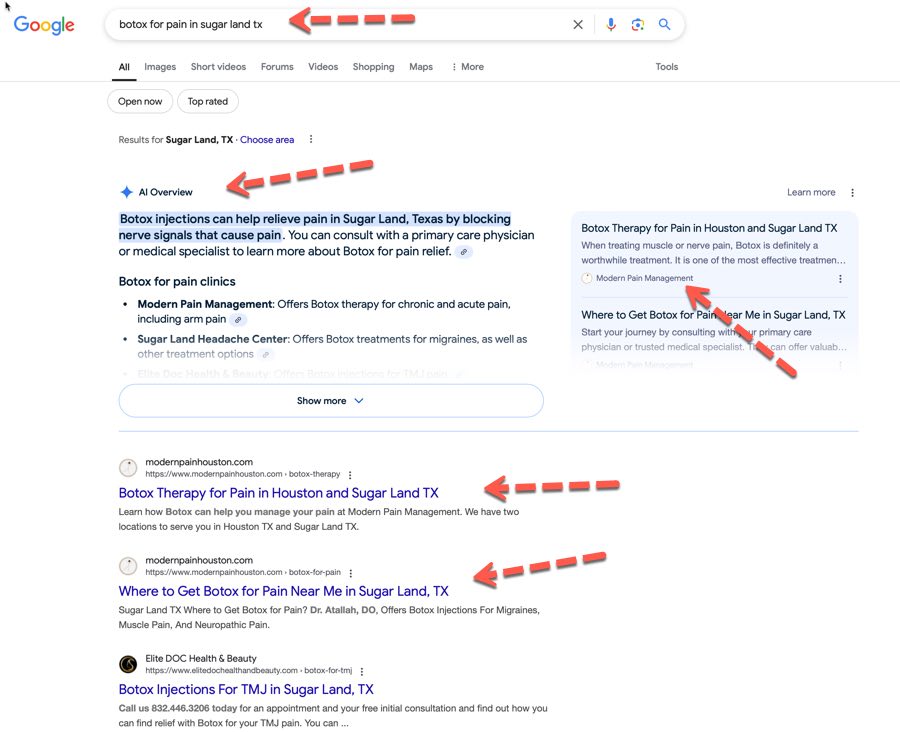
Example of a SEO based on specific condition, this pain clinic is located in Texas.
1. Improves Keyword Targeting for Specific Conditions
Condition-specific content allows doctors to target long-tail keywords that are highly relevant to their practice. These keywords reflect what patients are searching for when they experience specific symptoms or seek treatment for certain conditions.
Example:
If you are a dermatologist who specializes in eczema, creating content around keywords like:
- “eczema treatment in [city]”
- “best dermatologist for eczema near me”
- “how to manage eczema flare-ups”
helps you rank for specific, intent-based queries that patients use to find help for that condition.
Benefit: By targeting highly specific terms, your website becomes more likely to rank in search engine results for those queries, driving traffic from patients actively searching for your services.
2. Increases Website Relevance for Specific Services or Specialties
Google uses relevance as one of its core ranking factors. When your website has dedicated pages or blog posts about specific conditions you treat (e.g., arthritis treatment, cosmetic dentistry, spine surgery), it signals to Google that your website is an authoritative source on those topics.
- Dedicated Service Pages: If your site has individual pages dedicated to conditions like migraine treatments or orthopedic surgery, it enhances your website’s topical relevance.
- Rich Content: Detailed content about the causes, symptoms, treatments, and procedures for a particular condition further enhances your page’s usefulness, helping Google recognize it as a reliable source for related queries.
Benefit: Higher relevance signals improve your rankings for targeted condition-specific keywords.
3. Increases Opportunities for Featured Snippets and Rich Results
When you create detailed, well-researched content about a specific condition, it increases the chances of your content being selected as a featured snippet in search results. Featured snippets often appear in the form of paragraphs, lists, or tables above organic results, helping your website capture more visibility.
Example:
If a user searches for “what are the symptoms of gout?”, Google may pull your well-crafted content about gout symptoms into a featured snippet.
Benefit: Appearing in featured snippets gives your website significant visibility, driving more traffic and improving click-through rates (CTR).
4. Improves Local SEO for Condition-Specific Queries
Condition-specific content is especially beneficial for improving local SEO for doctor websites. By incorporating location-based keywords along with the specific condition, you enhance your practice’s visibility for patients who are looking for treatment nearby.
Example:
A cardiologist based in Miami could create content targeting:
- “cardiologist for heart disease in Miami”
- “heart disease treatment in Miami, FL”
- “best Miami cardiologists for hypertension”
By combining condition-specific keywords with local SEO strategies, your practice becomes more visible to local patients searching for nearby medical professionals who specialize in specific conditions.
Benefit: Increases the chances of appearing in local search results, improving your practice’s ability to attract nearby patients.
5. Enhances User Experience (UX) and Engagement
Condition-specific content is valuable for improving the user experience (UX) on your website. Patients who land on your website are typically seeking information about their condition. Providing them with relevant, clear, and detailed content not only helps educate them but also engages them longer on your website.
- Patient Education: Well-structured pages with information about a specific condition, treatment options, and FAQs help educate patients, making them more likely to trust your practice.
- Decreased Bounce Rate: When your content matches what users are searching for, it increases the likelihood that they will stay on your website longer, decreasing your bounce rate. A low bounce rate is a positive ranking factor for Google.
Benefit: Improved UX and patient engagement signal to search engines that your content is valuable, leading to higher rankings.
6. Strengthens Content Authority and E-A-T (Expertise, Authoritativeness, and Trustworthiness)
Google’s E-A-T (Expertise, Authoritativeness, and Trustworthiness) is an important ranking factor, especially for health-related content. By consistently publishing high-quality, evidence-based, condition-specific content, you improve your website’s E-A-T profile, signaling to Google that you are a trusted and authoritative source in your field.
- Citations and References: Citing reputable sources like medical journals, studies, or professional organizations (e.g., American Medical Association, Mayo Clinic) in your condition-specific content further improves your authority.
- Medical Credentials: Including information about your qualifications (e.g., board certification, years of experience) also boosts your credibility and trustworthiness.
Benefit: Strengthens your practice’s online authority, which helps your website rank higher and attract more patients.
7. Creates Shareable Content for Social Media and Link Building
Condition-specific content is often shareable. Patients and healthcare professionals may share informative content on social media, leading to increased brand visibility and more backlinks to your site.
- Patient Testimonials: Writing about the success stories of patients who have benefited from your treatment options for specific conditions can encourage them to share their experiences.
- Educational Content: Providing informative blog posts, infographics, or videos related to specific conditions increases the likelihood that others will link back to your content or share it on social platforms.
Benefit: Drives organic traffic through backlinks and social shares, further boosting SEO rankings.
8. Addresses Voice Search and Natural Language Queries
As voice search becomes more prevalent, people are asking questions in a more natural language format, such as “What are the best treatments for anxiety?”. Condition-specific content is ideal for answering voice search queries because it can directly match the phrasing that patients are using.
- FAQ Sections: Including question-and-answer sections related to the condition can help target long-tail, conversational queries.
- Structured Data: Using schema markup on condition pages helps search engines understand and display your content in a way that answers voice search questions.
Benefit: Optimizes your content for voice search, increasing visibility and capturing new patient traffic.
Example of a pain management practice
Let’s look at a real-world example using a clinic with locations in Houston and Sugar Land, Texas. Pain management is a highly competitive medical field in major Texas cities. If this clinic only had a generic “Our Services” page, they would struggle to capture patients. Instead, their website is built with a vast library of condition-specific pages.
Here is how the concepts of condition-specific SEO apply directly to their website architecture and patient acquisition strategy.
1. Matching High-Intent Patient Searches
When a patient is suffering from nerve pain down their leg, they do not open Google and search for “Interventional Pain Management Physician Houston TX.” They search for their symptoms or diagnosis.
Pain Management intercepts this by having highly specific condition pages such as:
- Sciatica Treatment
- Herniated Disc Treatment
- Neuropathy
- Complex Regional Pain Syndrome (CRPS)
The SEO Result: When a patient in Sugar Land searches “Why is my leg burning and numb?” or “Best sciatica treatment near me,” Google serves them Modern Pain Management’s dedicated Sciatica page. The clinic captures the patient exactly at the moment they are desperately seeking relief.
2. Capturing Long-Tail, High-Value Keywords
Generic keywords like “Pain Doctor Houston” are incredibly expensive to bid on and hard to rank for organically. Condition pages allow the clinic to capture “long-tail” traffic that competitors miss.
Looking at their menu, they have pages for:
- Arachnoiditis
- Sacroiliac (SI) Joint Pain
- Post-Laminectomy Syndrome (Failed Back Surgery Syndrome)
The SEO Result: Patients searching for “Arachnoiditis” or “Post-Laminectomy Syndrome” are usually chronic pain sufferers who have already seen other doctors and need highly specialized, high-ticket interventions (like a Spinal Cord Stimulator). Because Modern Pain Houston has a dedicated page for these obscure conditions, they easily rank #1 or #2 for these highly lucrative, low-competition searches.
3. Establishing “Topical Authority” (E-E-A-T)
Google looks at the overall depth of a website to determine if the doctors are true experts. Pain Management doesn’t just list “Back Pain.” They break the spine down into multiple distinct condition pages:
- Vertebral Compression Fractures
- Spinal Stenosis
- Lumbar Biacuplasty
- Kyphoplasty Therapy
The SEO Result: Google’s algorithm crawls this site and realizes, “Dr. Atallah and Dr. Harandi aren’t just general practitioners; they have a massive, encyclopedia-like depth of knowledge regarding spinal conditions.” Google rewards this “Topical Authority” by pushing their entire website higher in the map pack.
4. The “Hub and Spoke” Internal Linking Strategy
Condition-specific content works best when it acts as a funnel toward a treatment (the service you can actually bill for).
- The Funnel: A patient finds the “Arthritis Pain” (Condition) page via Google. They read about the symptoms of osteoarthritis in the knee. Inside that text, there is a hyperlinked bridge to the “Hyaluronic Injections” (Treatment) page. On the injection page, there is a prominent “Request an Appointment” button.
- The SEO Result: This internal linking structure keeps the patient clicking through multiple pages on the website. This increases “dwell time” (how long a user stays on the site), which signals to Google that the website is highly relevant and helpful, further boosting their SEO rankings.
The Bottom Line for Pain Clinics
By shifting their website architecture away from “Here are the doctors we have” and toward “Here are the exact painful conditions we solve,” Pain Management effectively turned their website into a 24/7 digital triage nurse. They capture organic Google traffic for almost every type of pain a Houston resident could possibly search for.
How does PatientGain.com’s PLATINUM Service uses this strategy to improve the SEO results of medical practices?
PatientGain.com’s PLATINUM service enhances medical SEO by utilizing a hybrid “Technology + Human” strategy, combining high-conversion, HIPAA-compliant websites with monthly, AI-driven content, local SEO optimization, and 20+ apps. This strategy specifically boosts rankings by targeting competitive, patient-focused keywords, structuring data for Answer Engines (FAQ snippets), and building trust through optimized E-E-A-T content.
Key strategies within the PLATINUM service include:
- AI-Driven “Reverse Search Engine” Optimization: Analyzes actual patient queries for symptoms and treatments to create content that mirrors how patients search, rather than just technical medical terms.
- Answer Engine Optimization (AEO): Structures content to appear as featured snippets or in voice search results (e.g., FAQ pages answering “what are the signs of [condition]”).
- Local SEO Dominance: Optimizes Google Business Profiles and creates location-specific landing pages, crucial for “near me” searches.
- E-E-A-T Focused Content Creation: The PatientGain content AI agent and human team produce detailed doctor bio pages, service pages, and educational content that meets Google’s standards for Experience, Expertise, Authoritativeness, and Trustworthiness.
- Comprehensive Technical SEO & Conversion Apps: Includes mobile-optimized, fast-loading websites with built-in tools like HIPAA-compliant chatbots and patient CRM to reduce lead leakage.
PatientGain +7
The PLATINUM service is designed for competitive markets and covers everything in the GOLD package while adding more monthly content, extra social media posts, and premium apps to ensure higher visibility and increased patient acquisition.
 Send Text
 How may I help you?