

What are patient acquisition apps for healthcare providers? And how much do they cost?
Patient acquisition apps are digital tools that help medical and dental practices attract, engage, and retain patients, featuring services like checking insurance, AI chatbots, Direct texting apps, HIPAA-compliant messaging (e.g., Spruce, Klara, PatientGain’s SPOC), filling-out online forms, patient consent management, online scheduling, reputation management, and automated common answers (non-medical advice) from patients while they are still on your mobile or desktop website. These apps have to HIPAA compliant, often integrated into larger platforms like Relias or PatientGain to manage the entire patient journey from first contact to a converted paying patient (insurance based or self-pay).
How much do they cost?
Patient acquisition apps for medical and dental practices can cost from $300 per month to $2000 per month. For example, PatientGain’s SPOC app costs $499/mon for a single location practice.
How to improve patient acquisition and conversions from your medical or dental website?
There are many different strategies you can use to improve the patient acquisition and conversions from your medical or dental website. Some involve coding, design changes, A/B testing or even a redesign of a website. However, if your healthcare website needs a simple, non disruptive, and effective strategy, without spending any upfront investment, consider simply adding the SPOC app (Single Point Of Conversion) on your existing website.
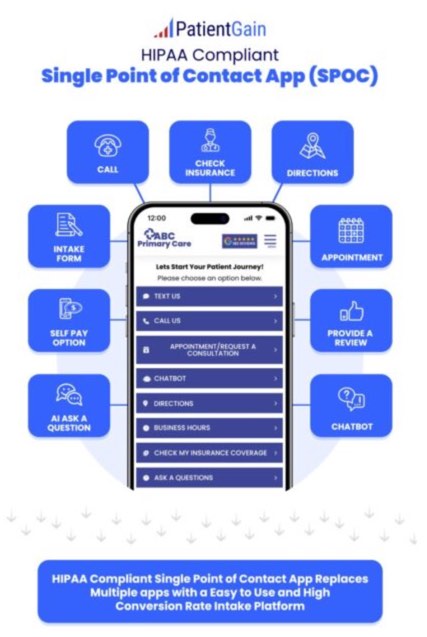
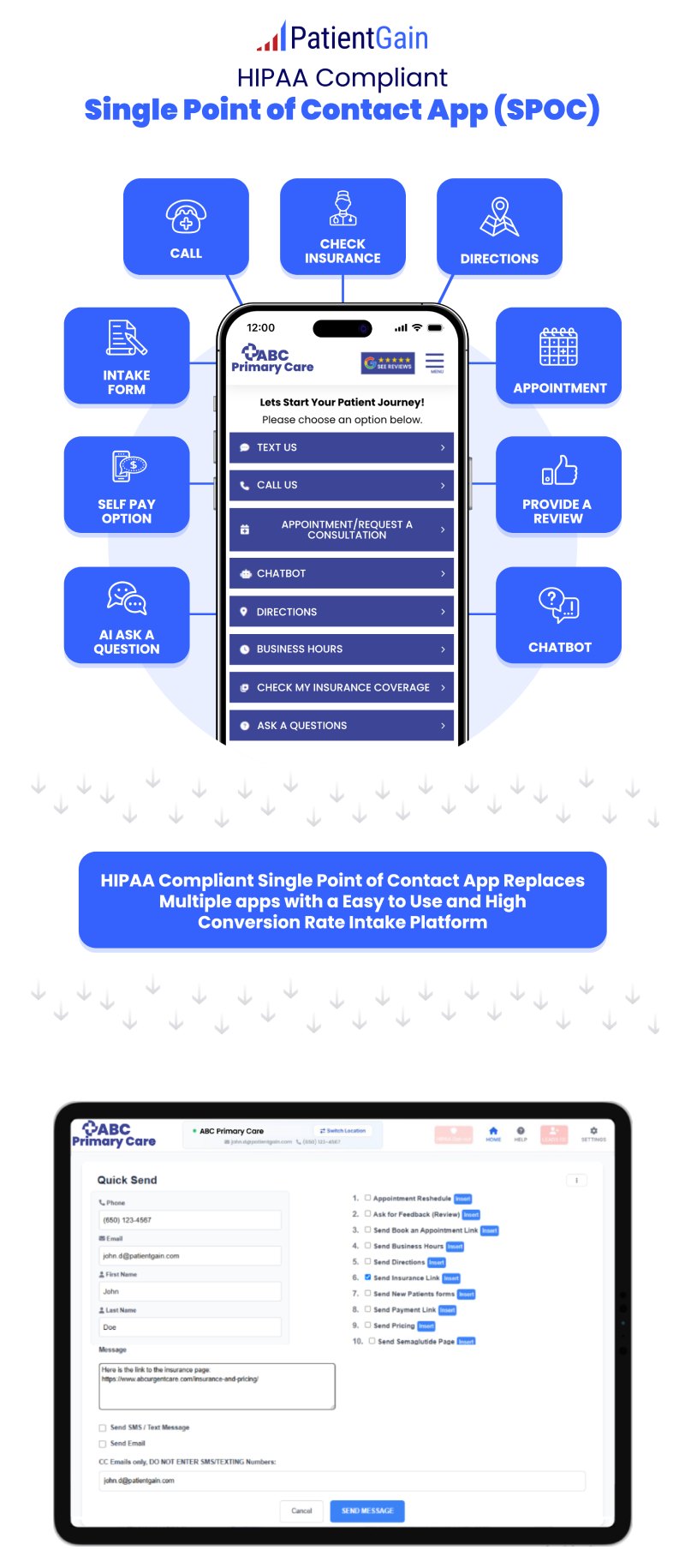
A medical practice can improve patient acquisition and conversion by adding the SPOC (Single Point of Conversion) App to their website, primarily by eliminating “lead leakage,” streamlining communication, providing 24/7 AI automation, and consolidating all patient interactions into a single, user-friendly dashboard.
Key Ways the SPOC App Improves Patient Acquisition and Conversion of a Medical or a Dental Practice
Table of Contents
1. Reduction and Minimization of “Lead Leakage”
2. Faster and Consistent Response Times
3. Enhanced Patient Experience
4. Increased Staff Efficiency and Accountability
5. Maximizes Marketing ROI (Return On Investment)
6. HIPAA Compliance
1. Reduction and Minimization of “Lead Leakage”
The SPOC app centralizes all inquiries (phone calls, text messages, website forms, chatbots, social media messages) into one system, ensuring that no potential new patient inquiry “falls through the cracks” due to busy phone lines or overlooked messages. Both medical and dental practices experience significant “lead leakage,” though the specific percentages vary based on the stage in the patient journey where the loss occurs.
Medical Practices
For a typical medical practice, the loss of potential patients is substantial and often points to operational failures in the intake and follow-up process.
- Leads leakage of new inquiries: This percentage of initial leads (e.g., from a website form or first phone call) are typically lost due to 1) inadequate 2) slow follow-up 3) Incorrect channel used – for example a patient texts and asks for text back, but the clinic front desk tries to call them 4) lack of coverage 5) lack of technology (apps) 6) lack of staff training 7) HIPAA issues. Anywhere from 17% to 42% of new patient inquires fall through the cracks, its called “leads leakage”.
- 68% of all new leads still originate from phone calls. You can put 10 buttons to book an appointment, but patients still want to “speak” to a human person. If you make it harder for patients to speak to a human, your conversion goes down. Best option is to give them options on how patients want to contact you. Do not force them to do “Book Now”. We have A/B tested this hundreds of medical and dental websites over the last 10+ years. Data tells the truth. Give patients multiple options on how they want to contact you.
- 59% of qualified callers who successfully reach the practice may still not book an appointment.
- Overall loss: When all operational failures are combined, practices can lose 25% to 48% of potential new patients.
- Revenue impact: This leakage can cost medical and dental practices an estimated 10% to 30% of their annual revenue, translating to thousands in lost income for larger systems.
Dental Practices
Dental practices also face significant leakage, often measured as an “attrition rate” of existing patients or a low conversion rate for new patient inquiries. The loss of potential patients is substantial and often points to operational failures in the intake and follow-up process.
- All aspects outlined for medical practices, apply to dental practices also. Key difference is that dental practices have also deal with annual patient attrition.
- Leads leakage of new inquiries: This percentage of initial leads (e.g., from a website form or first phone call) are typically lost due to 1) inadequate 2) slow follow-up 3) Incorrect channel used – for example a patient texts and asks for text back, but the clinic front desk tries to call them 4) lack of coverage 5) lack of technology (apps) 6) lack of staff training 7) HIPAA issues. Anywhere from 17% to 42% of new patient inquires fall through the cracks, its called “leads leakage”.
- 68% of all new leads still originate from phone calls. You can put 10 buttons to book an appointment, but patients still want to “speak” to a human person. If you make it harder for patients to speak to a human, your conversion goes down. Best option is to give them options on how patients want to contact you. Do not force them to do “Book Now”. We have A/B tested this hundreds of medical and dental websites over the last 10+ years. Data tells the truth. Give patients multiple options on how they want to contact you.
- 10% to 40% annual patient attrition: The typical attrition rate for a dental practice averages around 17%, but can range widely depending on location and patient satisfaction. This means a practice with 1,500 active patients could lose 150 to 600 patients per year just to attrition.
- Low new patient retention: The average general dentist retains only 41% of new patients after their first appointment, meaning more than half are lost after the initial visit.
- Revenue impact: Dental practices might lose an estimated 5% to 20% of potential production annually from revenue leakage caused by things like uncollected payments, coding errors, and poor follow-up on A/R.
2. Faster and Consistent Response Times
By using a combination of automation, AI and human oversight to provide prompt, automated responses to routine questions (e.g., hours, insurance queries) and quickly routing high-intent inquiries to staff, the practice can engage potential patients faster than competitors, which directly increases the likelihood of a potential patient becoming a paying patient, either self pay or insurance pay patient.
The SPOC (Single Point of Contact or Single Point of Conversion) app offers faster and more consistent response times by centralizing all incoming communications, utilizing template based responses, AI automation, and providing staff with a streamlined, unified interface. The unifies interface is very easy to use. It is designed to be like Outlook or Gmail. So if your staff can use Outlook or Gmail, they can use SPOC app.
How the SPOC App Improves Response Speed
- Centralized Communication Hub: The app routes inquiries from various channels (phone calls, website forms, text messages, chatbots) into a single, unified dashboard. This eliminates the time-consuming need for staff to check multiple platforms, ensuring all new leads and patient questions are immediately visible and trackable in one place.
- AI and Automation: The system uses artificial intelligence to provide instant, automated responses to routine queries like office hours, insurance questions, or appointment availability. This allows for 24/7 immediate engagement, drastically reducing initial response times and freeing up staff for more complex interactions. Another example is image a patient asking “Do you accept Aetna PPO?” These type of responses can be handled very efficiently using AI and automation.
- Faster Triage and Routing: When a human touch is needed, the SPOC acts as a “triage nurse,” quickly routing high-intent inquiries or critical issues to the right staff member or department. This prevents “ping-ponging” of requests between different teams and ensures the most appropriate person responds without delay. At any time, a patient has a choice of speaking to a human.
- Reduced Training Time: The app’s user interface is designed to be intuitive, often resembling familiar email platforms like Gmail or Outlook, which requires minimal training for front-desk staff. This allows front desk staff to become productive faster, maintaining a consistent level of service speed even with staff transitions. However, PatientGain provides excellent support and help, and a project manager and a technical staff is available to help you and your staff.
How the SPOC App Ensures Consistent Response Times
- Standardized Procedures: By routing everything through a single process, the SPOC app helps establish and enforce clear, standardized communication protocols. Every inquiry goes through the same steps, reducing the variability inherent in manual processes.
- Use of Templates and Saved Replies: Staff can utilize a library of pre-written responses for common questions, which helps ensure consistent tone and content, while still allowing for personalization.
- Accountability and Tracking: The app includes robust tracking and reporting mechanisms that create an audit trail for every lead. This ensures accountability, as management can monitor performance metrics, identify bottlenecks, and ensure no communication falls through the cracks, leading to reliable follow-up every time.
- Knowledge Retention: The SPOC acts as a knowledge hub, documenting communication patterns, common issues, and successful solutions. This institutionalized knowledge ensures that all staff members provide the same high standard of information, rather than responses varying based on an individual’s experience level.
3. Enhanced Patient Experience
A seamless, single point of contact provides a better user experience, as patients know exactly where to go for all their communication needs. This consistency builds trust and improves overall patient satisfaction, encouraging referrals and retention. The SPOC (Single Point of Conversion) App from PatientGain.com is designed to enhance patient experience by streamlining and simplifying key aspects of the patient journey, from initial engagement to post-appointment follow-up. By integrating AI and automation, the app helps practices deliver efficient, personalized, and seamless interactions at every touchpoint. The SPOC (Single Point of Conversion) app significantly enhances the patient experience by focusing on three key pillars: speed, convenience, and consistency in communication.
A. Speed of Response (Instant Gratification)
The primary cause of patient dissatisfaction is slow response time, especially during the initial inquiry phase. The SPOC app eliminates this lag.
- 24/7 Availability: The integrated AI Chatbot and Auto-Responders provide immediate, accurate answers to common questions (hours, location, accepted insurance) any time of day. Patients don’t have to wait until the practice opens to get basic information.
- Patient Benefit: The patient gets instant reassurance and information, making the practice feel accessible and responsive.
- Rapid Human Follow-Up: By funneling all inquiries into one place, staff are instantly alerted to new leads via the central dashboard, often prioritized by the AI. This allows the staff to respond to high-intent inquiries faster than if they were checking separate email inboxes and text platforms.
- Patient Benefit: When a patient is ready to book, they hear back from the practice right away, preventing them from calling a competitor.
B. Convenience Across All Channels
Patients want to communicate using the channel they prefer, whether it’s text, chat, or a form. The SPOC supports all these methods seamlessly.
- Channel Flexibility: A patient can use a website form, send a direct text, or start a chat—and the SPOC captures it all. The staff can then reply via the patient’s preferred method (often text via the QuickSend App).
- Patient Benefit: The patient doesn’t have to call or email if they prefer texting, leading to a frictionless experience.
- Simple Transition to Booking: The app allows staff to quickly send secure online appointment links or intake forms via text or chat directly from the centralized dashboard.
- Patient Benefit: The patient moves effortlessly from asking a question to booking an appointment without being put on hold or navigating complex phone menus.
C. Consistency and Accuracy
The SPOC ensures that every interaction is logged and every response is consistent, leading to a professional and reliable experience.
- No Lost Context: Because the SPOC integrates with the CRM, every staff member who interacts with the patient has a complete history of the communication. The patient never has to repeat their information or their initial request.
- Patient Benefit: The patient feels “known” and valued, not just like another lead being passed between different communication silos.
- Accurate Information: The AI and centralized knowledge base ensure that automated responses about prices, hours, and policies are always accurate and consistent, preventing confusion or frustration due to outdated information.
- Patient Benefit: The patient receives reliable facts, establishing trust in the practice’s professionalism from the very first contact.
4. Increased Staff Efficiency and Accountability
Staff use a single, intuitive dashboard (similar to a Gmail or Outlook inbox) to manage all patient communication, reducing time spent navigating multiple platforms and requiring minimal training. The system also tracks all interactions, creating an audit trail and improving accountability for follow-ups. The SPOC (Single Point of Conversion) app is highly effective at boosting Staff Efficiency and Accountability because it transforms a chaotic, multi-channel workflow into a streamlined, centralized, and measurable process. By eliminating manual effort and providing clear tracking, the SPOC allows staff to focus on high-value patient interactions.
Increased Staff Efficiency
A. The SPOC maximizes staff efficiency by reducing context switching and automating repetitive tasks.
- Centralized Workflow (The Single Dashboard):
- Old Way: Staff had to check four to five different platforms—a shared email inbox, a text messaging app, a website chat log, and paper notes—to find and respond to new patient inquiries. This constant “context switching” is highly inefficient and prone to errors.
- SPOC Way: All communication (forms, texts, chats, missed calls) appears in one unified, secure dashboard that functions like an easy email inbox. Staff only monitor one screen, drastically reducing the time spent locating and organizing leads.
- AI-Powered Automation:
- Old Way: Staff spent excessive time answering the same high-volume questions: “What are your Saturday hours?” or “Do you take Blue Shield?”
- SPOC Way: The AI Chatbot and Auto-Responders handle the majority of these basic, repetitive questions instantly and automatically, freeing up front-desk personnel to manage scheduling and high-priority tasks.
- Time Savings on Follow-up:
- Old Way: To send a form or schedule a patient, staff had to use three different systems (phone, email, scheduler).
- SPOC Way: Staff can reply instantly using the QuickSend Text App directly from the dashboard, sending a scheduling link or intake form immediately without leaving the SPOC interface.
B. Enhanced Accountability and Oversight
The SPOC provides transparent tracking and clear responsibilities, making it easy for practice managers to measure performance and address bottlenecks.
- 100% Lead Tracking and Logging:
- Old Way: If a new patient call was missed or an email was overlooked, it was impossible to prove who was responsible or where the lead went.
- SPOC Way: Every single incoming lead, regardless of its source (text, phone calls, form, chat), is instantly logged and date/time-stamped in the integrated CRM. This creates a transparent, non-deletable record.
- Task Assignment and Monitoring:
- Old Way: Staff would write a “check insurance” note on a sticky note, which was easily lost, leading to lost leads.
- SPOC Way: Leads that require specific action (like checking insurance or calling back) can be converted into a tracked task within the integrated Task Funnel App. The manager can see who was assigned the task, when it was assigned, and if it was completed on time, ensuring nothing falls through the cracks.
- Performance Metrics:
- Old Way: Accountability was based on guesswork or anecdotal evidence.
- SPOC Way: The practice manager gains access to clear data: Response Time per Channel, Conversion Rate by Staff Member, and the Volume of Missed Leads prevented by the system. This allows managers to identify training needs or reward high performers based on measurable data.
In summary, the SPOC app professionalizes the chaotic front-office communication process, replacing inefficiency with standardized workflows and guesswork with data-driven accountability.
5. Maximizes Marketing ROI (Return On Investment)
By ensuring a higher conversion rate from website visitors to booked appointments, the SPOC app helps the practice get more value out of its existing marketing efforts (like SEO or PPC advertising), effectively lowering the cost per patient acquisition. The SPOC (Single Point of Conversion) app is a powerful tool for maximizing Marketing ROI (Return on Investment) because it directly solves the biggest drain on marketing budgets: lead leakage and inefficient follow-up. It ensures that the money you spend driving patients to your website (via PPC, SEO, or social media) is actually converted into booked revenue, instead of being wasted on missed opportunities.
A. Maximizing Conversion of Existing Traffic
The highest ROI comes from improving the efficiency of the patients you already paid to acquire (or earned through SEO).
- Eliminating Lead Leakage:
- The Problem: Without SPOC, leads often get lost when a staff member misses a text, an inquiry email goes to spam, or a call is dropped while the front desk is busy.
- SPOC Solution: It centralizes 100% of inquiries into a single, mandatory tracking system (the dashboard). Every form fill, chat, and missed call is logged and tracked.
- ROI Impact: By capturing and tracking leads that were previously lost, the SPOC increases the total number of conversions without requiring any extra ad spending or SEO work. Your CPA (Cost Per Acquisition) drops because you get more patients from the same marketing cost.
- Speeding Up Response Time:
- The Problem: Patients shopping for care often choose the first practice that responds. Slow response times mean lost conversions.
- SPOC Solution: The AI provides instant 24/7 auto-responses, and the dashboard instantly alerts staff to high-priority leads, enabling immediate follow-up via the integrated QuickSend App.
- ROI Impact: Faster responses dramatically increase the conversion rate of high-intent leads, translating your ad clicks into revenue more reliably.
B. Optimizing Ad Spend and Channels
The SPOC provides the necessary data transparency to make smarter decisions about where to spend your marketing budget.
- Accurate Attribution:
- The Problem: Most practices don’t know if a new patient came from the Google Ad, the SEO, or the Instagram campaign. This leads to wasting money on underperforming channels.
- SPOC Solution: By logging the source of every lead into the centralized CRM, the SPOC provides accurate attribution, letting you see exactly which channel generated the inquiry.
- ROI Impact: You can confidently shift budget from a low-performing channel (e.g., a high-CPA social campaign) to a high-performing channel (e.g., local SEO), ensuring every dollar is invested where it has the best return.
- Validating Phone Call ROI:
- The Problem: Phone calls are the top source of conversion, but tracking their ROI is difficult.
- SPOC Solution: Integrated call tracking (often part of the Platinum Service) logs call duration, the patient’s intent, and whether the call was answered or missed. This data feeds into the SPOC dashboard.
- ROI Impact: You can now prove the ROI of campaigns that generate phone calls and address staff issues (like a low answer rate) that are hindering your ROI.
C. Improving Staff Efficiency (Efficiency ROI)
ROI is also measured by cost savings. The SPOC reduces the operational cost of managing patient inquiries.
- Cost of Time Savings: By automating repetitive responses (e.g., hours, insurance) and centralizing communications, the SPOC saves staff time that was previously spent checking multiple platforms and answering the same basic questions.
- ROI Impact: This time saved can be valued as a lower operating cost, or, more importantly, can be redeployed to handle more complex scheduling and follow-up tasks, further maximizing patient acquisition.
6. HIPAA Compliance
The app is designed to be HIPAA-compliant, ensuring that all patient data and communications are handled securely and confidentially, a critical factor for building patient trust in a healthcare setting. PatientGain issues standard BAA to all customers using the SPOC app. PatientGain’s SPOC (Single Point of Conversion) app ensures HIPAA compliance through robust security measures like data encryption (at rest & in transit), hosting on HIPAA-compliant cloud infrastructure (AWS), strict access controls, detailed audit trails, and secure data handling for electronic Protected Health Information (ePHI). It centralizes patient communications into one dashboard, logs all interactions, and requires a Business Associate Agreement (BAA) for healthcare providers, legally obligating them to protect patient data, making it a compliant solution for managing patient inquiries.
- Encryption: ePHI is encrypted when stored (at rest) and when sent (in transit) using HTTPS/SSL, preventing unauthorized access.
- Secure Hosting: The platform uses secure, compliant cloud servers (like AWS) for data storage, not standard, less secure tables.
- Centralized & Logged: All patient communications (website forms, texts, calls) funnel into one dashboard, with every interaction logged for accountability.
- Access Management: Access Controls limit who can view or handle sensitive patient data, and secure logins verify user identity.
- Business Associate Agreement (BAA): PatientGain signs a BAA with providers, legally committing to HIPAA rules.
- Secure Infrastructure: The app, is a marketing application designed specifically for healthcare to manage leads and patient engagement securely.
 Send Text
 How may I help you?