

Healthcare SEO For Multi-Location Practices
Healthcare SEO for multi-location practices is the digital marketing strategy of optimizing a medical group’s online presence so each individual clinic ranks highly in local search results. It ensures that when patients search for care in a specific neighborhood, the closest physical facility appears. Unlike single-clinic SEO, a multi-location strategy manages distinct digital footprints for dozens or hundreds of offices while keeping the overarching brand consistent.
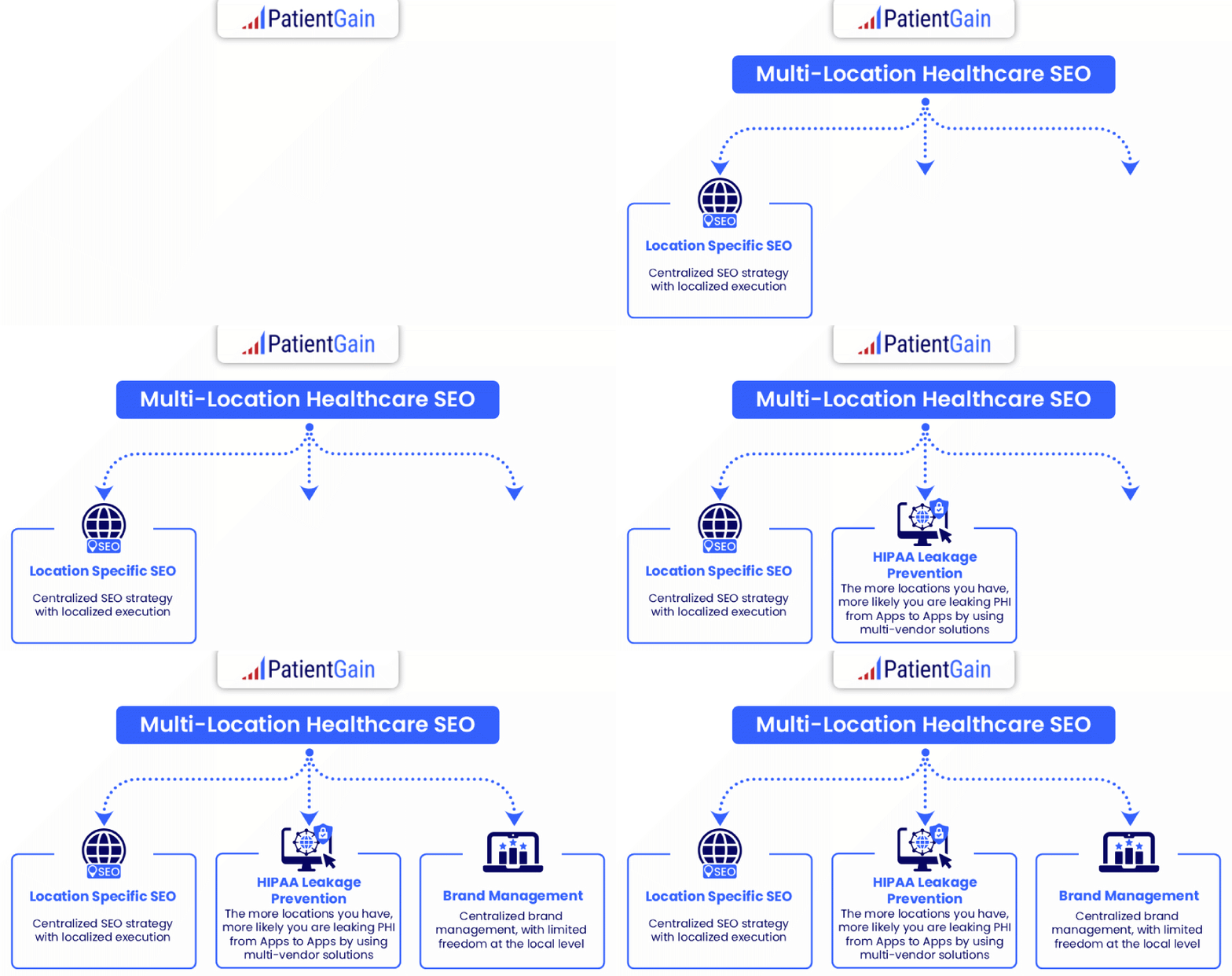
Core Strategies
- Individual Location Pages: Create dedicated landing pages for every physical office. Avoid duplicate content by tailoring each page with local staff bios, unique facility photos, and specific neighborhood-based service descriptions.
- Google Business Profile (GBP) Management: Claim, verify, and regularly update a separate GBP for every single clinic. Ensure the Name, Address, and Phone number (NAP) data matches exactly across the entire internet.
- Localized Content Marketing: Write blog posts and medical guides targeting local health trends, regional community events, or specific healthcare laws in each clinic’s state or city.
- Location-Specific Schema Markup: Implement structured data code on your website. This tells search engines exactly which doctor works at which specific address, improving rich snippet rankings.
- Consolidated Review Acquisition: Set up automated systems to gather patient reviews for each specific location’s GBP. Positive local reviews are a major ranking factor for Google’s Local Map Pack.
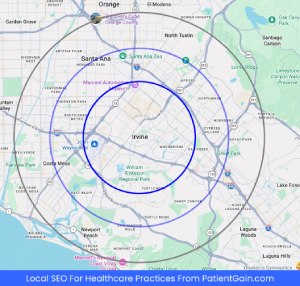
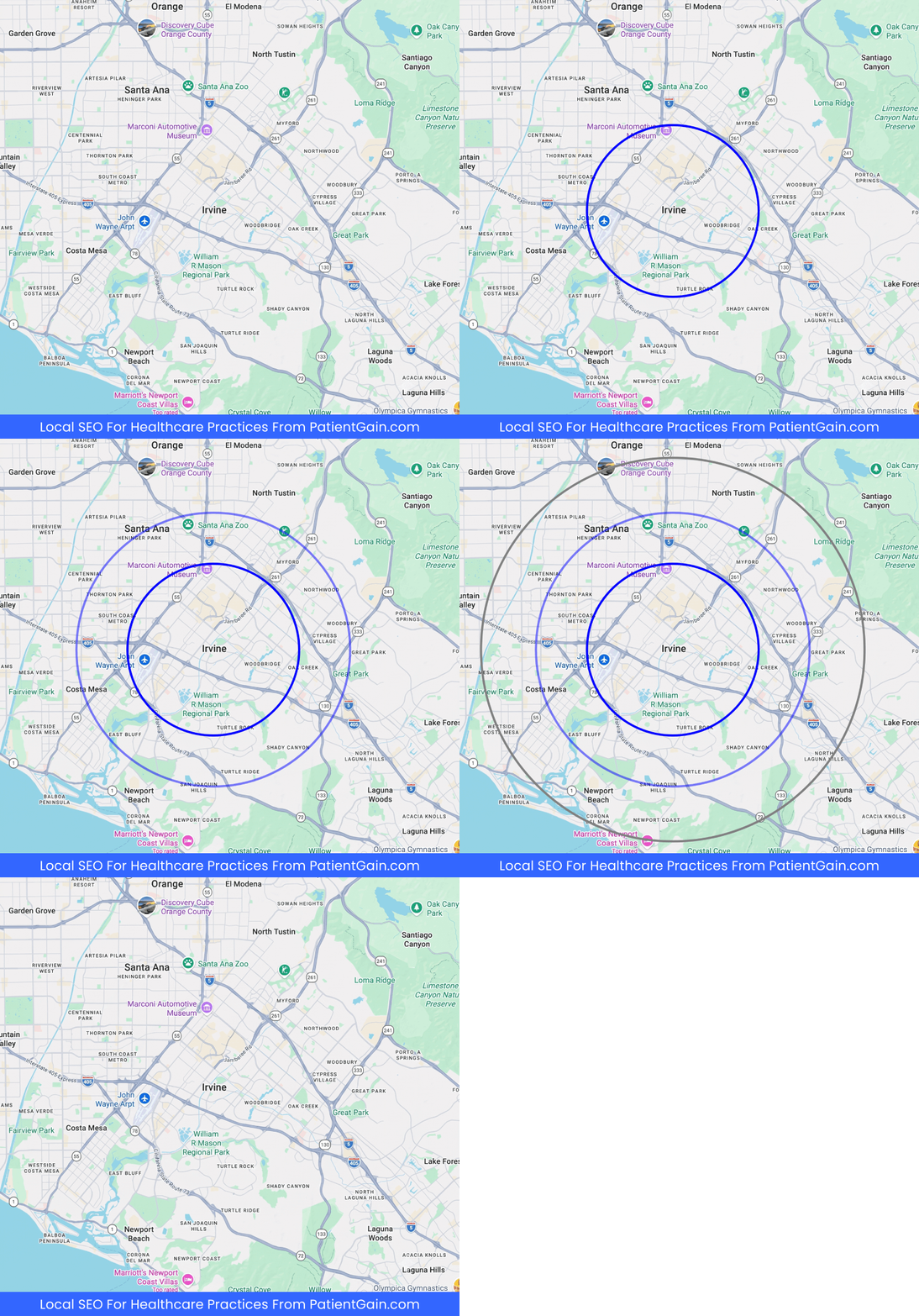
Key Operational Challenges
- Keyword Cannibalization: Clinics located within the same city might accidentally compete against each other for the same search terms if location signals are not clearly separated.
- Review Fragmentation: It is difficult to scale patient review generation evenly. Often, one flagship clinic gets hundreds of reviews while a newer satellite branch gets none.
- Data Scale and Inaccuracy: Managing shifting clinic hours, rotating doctors, and changing phone numbers across 50+ locations frequently leads to inaccurate online listings, which penalizes rankings.
Multi-Location vs. Single-Location SEO
| SEO Feature | Single-Location Practice | Multi-Location Practice |
|---|---|---|
| Website Structure | Simple architecture; one homepage optimized for one city. | Complex architecture; uses clean subfolders (e.g., /locations/city-name/). |
| GBP Strategy | One profile to monitor, optimize, and post updates on. | Bulk-verified profiles managed via a single agency dashboard. |
| Link Building | Focuses on city-wide local sponsorships and local chambers. | Requires hyper-local links for each branch to build regional authority. |
| Citation Consistency | Easy to audit and fix manually across local directories. | Requires enterprise tools to sync data automatically. |
How PatientGain’s Multi-Location Service Builds Healthcare SEO
Step 1 — The Hub Website Architecture
The entire SEO strategy starts with one foundational decision: one unified hub website instead of separate websites per location. PatientGain builds a single HIPAA-compliant WordPress website hosted on Google Cloud Platform (GCP) that serves as the domain authority engine for the entire network. Every location draws SEO power from this shared root. On top of the hub, PatientGain builds dedicated, individually optimized location pages for each location. There are multiple pages or each location, with specific purpose.
| Element | Purpose |
|---|---|
| Unique local address and phone number (New patient VS Existing patient) tracking | GBP verification signal and call tracking attribution |
| Google Maps with javascript for that specific location – rather than just a link to Google maps | Local pack eligibility |
| Location-specific provider bios and services applicable for each location | E-E-A-T authority signal per clinic |
| Local hours, insurance accepted, services offered | Reduces patient friction; GBP accuracy alignment |
| Geo-modified keywords in page title, H1, and metadata | e.g., “Dermatologist in Plano TX” — not just “Dermatologist” |
| Unique, locally relevant content – For example if a location is in Plano Texas, then links to local banks, schools, chamber of commerce. | Prevents duplicate content penalties across location pages |
| Dynamic conversion elements (SPOC chatbot, text, booking) | Each location’s leads routed to that clinic’s front desk |
Why this beats separate websites: Every piece of SEO content PatientGain publishes for any location compounds into one trusted domain — not split across 7 or 10 separate domains starting from zero authority. A new location added to the network inherits the domain authority of the entire group from day one.
Step 2 — The Predictive Reverse Search Engine
This is PatientGain’s proprietary AI-driven SEO content engine (Using predictive reverse search engine algorithm)— and it is what separates their approach from a standard “write some blog posts” content strategy. Traditional SEO starts with a keyword list and creates content around those keywords. PatientGain’s Predictive Reverse Search Engine starts from the opposite direction: it analyzes how patients actually phrase searches — the exact language, intent, and local modifiers real patients use when they are ready to book — and builds content backward from that data.
How the Process Works
Phase 1 — Patient Search Pattern Analysis
PatientGain’s Predictive Reverse Search Engine identifies how patients in each specific market phrase their healthcare queries. Not “dermatology services Dallas” — but the actual conversational, symptom-based, and outcome-based terms patients type: Objective is to predict scenarios with 70% of chance of conversion. The data comes from multiple sources. This data or final “suggestion” is sent to the human “Content Manager” staff’s dashboard. This is a healthcare content writer, who can allow the AI agent to process further so it can create a “draft SEO page”. Next AI agent will check for plagiarism. If it passes the plagiarism check, them next AI agent sends to next AI agent. Finally the “Project Manager” a human person assigned to your account, reads the page as if a patient is reading the SEO page. If she is satisfied, then the next AI agent goes into the “Publish” mode. Where the practice manager or practice owner is sent the SEO page, and search engine is alerted that there is a new page.
- “best acne treatment in Plano TX for adults”
- “Botox near Uptown Dallas open Saturday”
- “female dermatologist accepting Aetna Frisco”
- “eczema flare-up specialist near me”
Phase 2 — Conversion Rate Threshold Filter
Each identified search pattern is evaluated against conversion rate performance. Patterns that demonstrate 70% or higher conversion rate — meaning 7 out of 10 patients who arrive via that search term take a conversion action (call, text, form, book) — are flagged as priority content targets. Only the 70%+ patterns become the basis for monthly content creation. Low-converting search patterns are deprioritized regardless of search volume. This is the core insight: PatientGain optimizes for patients who book, not patients who browse.
Phase 3 — Monthly Content Production (Per Practice, Per Location)
PatientGain’s medical content specialists — using the AI pattern data — produce new SEO content every month tailored to each individual location’s market, patient mix, and service focus. Content types produced include:
- Location-specific service pages (e.g., “Russian Lip Filler in Frisco TX”)
- Condition and treatment FAQ pages
- Physician authority pages
- Infographics targeting visual search
- Seasonal and trending procedure content
Phase 4 — Continuous Learning
The system improves over time. The longer a location is on the platform, the more conversion pattern data accumulates, and the more precisely the AI can identify what content drives booked appointments in that specific market. A location in year 2 produces better-targeted content than in month 1 — the engine compounds.
Step 3 — Google Business Profile Posting at Scale
For each location in the network, PatientGain GBP posts specific content on each GBP page, 8 times or 20 times or 30 times per month, depending on the service package selected by the customer. Different packages have different frequencies. For example a customer on basic GOLD service will get less content VS PLATINUM VS PLATINUM+.
| Action | Frequency | Why It Matters |
|---|---|---|
| Publish new posts (Example of a PLATINUM customer) | 20 posts/month per location via Social Auto-Pilot | Google weights GBP post frequency as an active engagement signal |
| Update hours and services | As needed | Wrong hours = lost patients + lower GBP ranking |
| Refresh photos | Monthly or as needed (depending on the package) | Active profiles with recent photos rank above stale ones |
| Respond to reviews | Ongoing | HIPAA-compliant responses — no patient confirmation, no treatment mention |
| Monitor Q&A section | Ongoing | Unanswered patient questions are publicly visible and damage trust |
| Maintain NAP consistency | Ongoing | Name, Address, Phone identical across Google, Yelp, Apple Maps, Healthgrades, Chamber of Commerce |
| Geo-modified category optimization | Ongoing | Primary category (e.g., “Dermatologist”) directly controls local pack eligibility |
Social Auto-Pilot is the specific PatientGain app that handles GBP posting at scale. It pushes SEO-optimized, service relevant posts simultaneously to every location’s Google Business Profile, Facebook page, and Instagram account from one centralized content calendar. For a 10-location group, this means 200 GBP posts created per month. Different packages have different frequencies. For example a customer on basic GOLD service will get less content VS PLATINUM VS PLATINUM+.
Step 4 — Location-Specific Keyword Segmentation (Minimize Cannibalization)
One of the most technically damaging mistakes in multi-location SEO is having two locations target the same keyword. PatientGain’s architecture prevents this through deliberate geographic keyword segmentation:
How it works:
Each location page is built around that clinic’s specific neighborhood, suburb, and zip code — not the broad metro area. The hub domain captures metro-level terms through category pages. Individual location pages capture hyperlocal terms.
Example for a 4-location Dallas dermatology group:
| Location | Hub-Level Target (on main domain) | Location Page Target |
|---|---|---|
| Dallas Uptown | “Dallas dermatologist” | “dermatologist Uptown Dallas,” “skin doctor near McKinney Ave” |
| Plano | “Plano dermatologist” | “dermatologist Plano TX 75024,” “eczema specialist Plano” |
| Frisco | “Frisco dermatologist” | “dermatologist Frisco TX,” “Botox Frisco TX near The Star” |
| Southlake | “Southlake dermatologist” | “dermatologist Southlake TX,” “cosmetic dermatology Southlake” |
Geo-modified terms are embedded in page titles, H1 headers, meta descriptions, image alt text, and the body content of each location page — not just sprinkled in once.
Step 5 — Medical Schema Markup
PatientGain implements structured data (schema markup) — a technical SEO layer that tells Google exactly what type of business each page represents, which providers practice there, and what services are offered. Without schema markup, a location page is invisible to Google’s rich result systems — it ranks as a plain blue link with no additional information displayed. With full schema, the same page can display star ratings, provider names, hours, and service categories directly in the search results, increasing click-through rate significantly.
Step 6 — Reputation Management App Setup For Each Location
1. Sends patients review requests
2. Follows up with spaced-out reminders
3. Intercepts poor reviews
4. Ranks you high on Google, Facebook, Yelp, and all leading sites
5. Displays reviews on your website
Step 7 — The Corporate Roll-Up Dashboard
Every SEO action PatientGain takes feeds into a single real-time reporting system — one dashboard that shows performance at both the location level and the network level simultaneously.
| Question | Data Available |
|---|---|
| Which location is generating the most organic leads this month? | Yes — per location lead count by channel |
| Which location’s GBP is driving the most calls? | Yes — call tracking per location per source |
| Which location has the lowest review velocity? | Yes — review leaderboard |
| What is the cost per lead | Yes — channel attribution per location |
| Which location needs more marketing support this month? | Yes — comparative performance view |
 Send Text
 How may I help you?