

Digital Marketing For Healthcare Professionals
Digital marketing for healthcare professionals is the practice of using online, digital channels — search engines, AI agents (like ChatGPT, Google Gemini, Copilot, Perplexity and Anthropic’s Claude. ) websites, social media, email, SMS/Texting, paid advertising, and reputation marketing— to attract new patients, retain existing ones, build provider authority, and grow a healthcare practice. It replaces or supplements traditional marketing (print ads, billboards, Yellow Pages referrals) with measurable, targeted digital strategies that reach patients at the exact moment they are searching for care. Unlike marketing for consumer products or retail businesses, healthcare digital marketing operates under a distinct set of legal constraints (HIPAA, FTC, state medical board advertising rules), ethical expectations (clinical accuracy, patient privacy), and patient behavior patterns (trust-driven, symptom-motivated, reputation-reliant) that require specialized expertise.
Why It Matters: A healthcare professional or practice with no digital presence is effectively invisible to the majority of patients looking for care today.

Digital Marketing For Healthcare Professionals: Table Of Contents
Are there any stats that digital marketing for healthcare practices and professionals is important?
Why is digital marketing for healthcare practices so complex?
What are typical examples of applications, services and service providers used by digital marketing for healthcare practices?
How can PatientGain’s PLATINUM service replace 5 to 8 different apps, companies and service providers?
Are there any stats that digital marketing for healthcare practices and professionals is important?
Yes, a vast body of data proves that digital marketing is critical for the survival and growth of modern healthcare practices. As patient behavior shifts overwhelmingly online, practices that rely strictly on traditional or word-of-mouth marketing are missing out on the majority of their potential patient base.
Patient Search Behavior & Visibility
- 82% of patients use search engines like Google to find a healthcare provider.
- 77% of patients use search engines specifically to research medical symptoms before ever booking an appointment.
- New trend: 2% to 4% of patients are now using AI agents like ChatGPT, Google Gemini, Copilot, Perplexity and Anthropic’s Claude to find details about providers.
- Over 70,000 health-related searches occur on Google every single minute.
- 54% of all healthcare website traffic is driven entirely by organic search results, highlighting the massive importance of medical Search Engine Optimization (SEO).
- Data from industry authorities like BrightEdge and SearchLab confirms that over half of all web visitors arriving at medical platforms do so naturally by typing questions or symptoms into engines like Google. Because of heavy advertising restrictions on medical topics and the deeply personal nature of health inquiries, the healthcare sector maintains one of the highest organic search dependencies of any commercial industry.
- Key Drivers of Healthcare Organic Traffic 1) High-Intent Inquiries: Roughly 77% of patients type their specific medical symptoms or condition names into search engines before booking an appointment. 2) The “Near Me” Dominance: Localized organic queries (such as “pediatrician near me” or “urgent care open now”) convert at 2.7x higher rates than general, non-local searches. 3) Superior Conversions: Organic search leads in healthcare convert at an average rate of 5.6% to 14.6%. This drastically outperforms traditional outbound marketing (like direct mail or print ads), which often converts at less than 2%.
- The Compounding Value of SEO – Unlike paid Google Ads—which stop generating clinic leads the exact second a marketing budget runs out—investing in an authoritative website structure and informative content creates a long-term growth asset. Practices that actively maintain blogs or educational resource libraries generate 4.8x more patient inquiries by capturing this massive wave of organic traffic.
The Impact of Online Reviews & Reputation
- 76% of consumers check online patient reviews before making an appointment with a new medical professional.
- 72% of healthcare consumers read reviews and explicitly state they will only trust doctors with a 4-star rating or higher. Ideal ranking is NOT 5.0 – It is between 4.5 to 4.9.
- 67% of patients trust Google reviews just as much as a personal recommendation from a friend or family member.
- 38% more appointment requests are generated by medical practices that actively build and maintain more than 100 online reviews. Achieving at least 100 Google reviews with rankings between 4.5 to 4.9 is ideal. Avoid anything below 4.0. Do not get excited if you get a negative review once in a while. It is normal. If you have 5.0 rankings, patients do not trust the rankings, they think you are manipulating it.
Shifting Budgets & Financial Returns
- 72% of all media and advertising spend in the healthcare and pharma industries has moved online, completely outpacing traditional media.
- 4.8x ROI is achieved on average by healthcare organizations that invest heavily in dedicated digital marketing channels.
- 20% revenue increase over five years was observed by healthcare systems that actively updated their digital marketing and online patient experiences.
Social Media & Patient Trust
- 57% of consumers say that a provider’s social media connection and engagement strongly influence their final decision to receive treatment at that facility.
- Up to 90% of young adults trust medical content found on social platforms, and 41% of patients across all age groups say social content directly influences their choice of doctor or hospital.
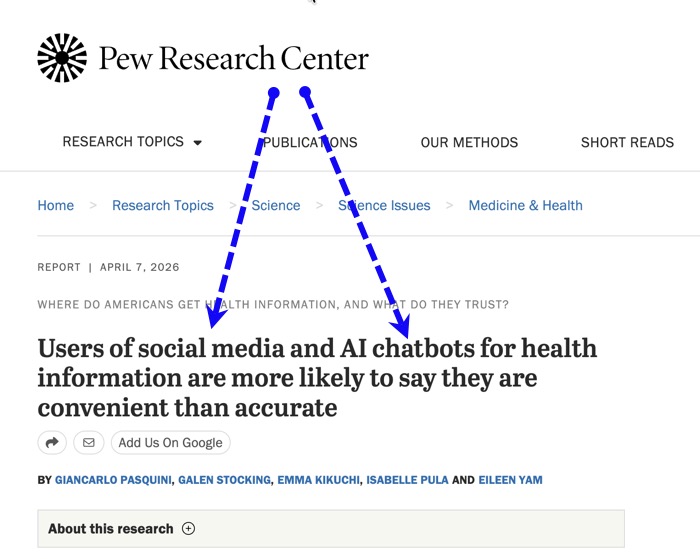
Social Media trust is much less than Google for patients
Patients trust Google Search and verified websites far more than social media platforms when evaluating doctors and medical information. While social media is a powerful tool for discovering content and raising awareness, consumers remain highly skeptical of its accuracy due to the rampant spread of health misinformation. Research consistently demonstrates a massive “trust gap” between Google (Search/Reviews) and social networks.
The distinct differences in consumer trust include:
1. Overall Trust Metrics
- Search Engine Dominance: According to data from eMarketer, 84% of consumers look to search engines like Google when researching health information. Only 31% turn to social media.
- The Accuracy Gap: A Pew Research Center study revealed that 47% of users explicitly rate social media health advice as inaccurate. In contrast, established medical websites discovered via search engines enjoy trust levels up to three times higher than social media apps.
2. High Intent vs. Passive Browsing
- Google is a “Pull” platform: When a user types “cardiologist near me” or “herniated disc treatments”into Google, they are a high-intent patient actively looking for a medical solution.
- Social Media is a “Push” platform: Users on Instagram or TikTok are scrolling passively for entertainment. In fact, healthcare marketing surveys find that 75% of users find it off-putting or invasive when targeted by medical ads regarding their specific conditions while browsing social timelines.
3. Misinformation and Verification
- Anyone Can Post: A primary driver of low social media trust is anonymity; 35% of consumers express anxiety that anyone on social media can claim to be a doctor, even without real credentials.
- The 4-Star Barrier: Google Reviews are viewed by the public as authentic consumer peer reports. Because 76% of people check these reviews before booking, a doctor’s Google Business Profile acts as an immediate verification mechanism.
Summary of Roles: Google vs. Social Media
Because of this trust gap, successful medical practices treat the two channels differently:
- Google Search & SEO: Used to capture high-trust, high-intent patients who are ready to book an appointment right now.
- Social Media: Used strictly for brand building, community education, and humanizing the staff rather than driving direct, medical-grade trust.
PatientGain achieves vendor consolidation by replacing 5 to 8 standalone service providers (such as SEO agencies, separate CRMs, standalone chatbots, and texting apps) into one centralized, HIPAA-compliant software ecosystem. Clinics can reduce administrative costs and improve operational efficiency through this streamlined approach
 Send Text
 How may I help you?