

What is AI + Human Hybrid Healthcare Marketing?
AI + Human Hybrid Healthcare Marketing is a modern approach that combines automation powered by AI with human expertise to grow healthcare practices more efficiently — without losing the personal touch patients expect. Instead of relying only on automation or only on staff, this model uses AI for speed and scale and humans for judgment, trust, and relationship-building.
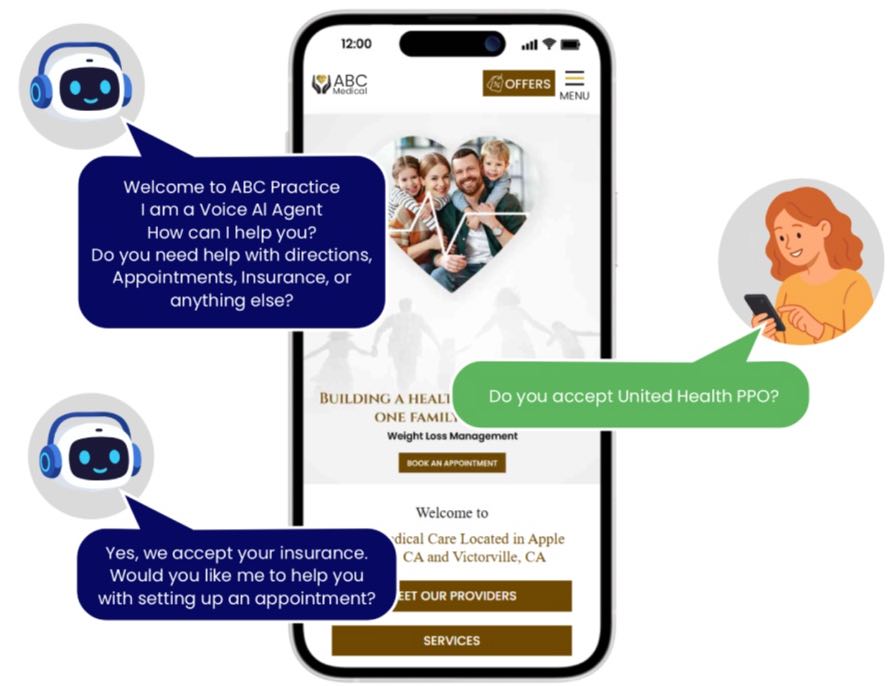
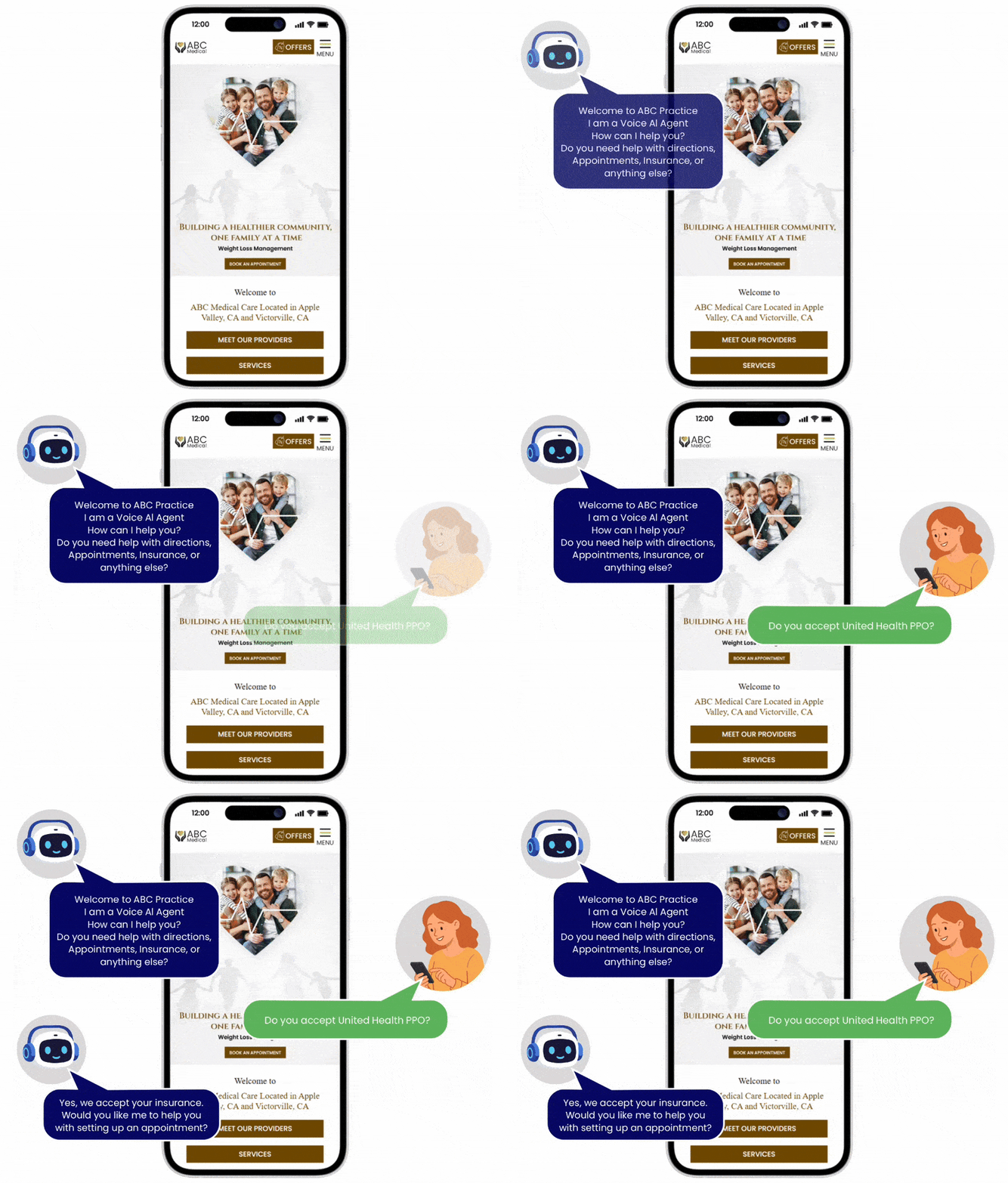
AI + Human Hybrid Marketing = AI handles repetitive tasks + Humans handle high-value interactions
This approach helps healthcare practices:
- Grow faster
- Reduce staff workload
- Improve patient experience
- Increase conversions
- Maintain personal care
PatientGain’s data shows that patients get frustrated with too many questions from AI agents – So if the AI agent allows them to skip automation and go to a real human, it improves conversions. Why is this ?
In the digital marketing and UX (User Experience) world, providing an easy way to bypass a chatbot is known as offering an “escape hatch.”
When an AI agent allows a patient to skip the automated questions and connect directly with a real human, conversions (booked appointments or captured leads) improve for a few deeply psychological and practical reasons—especially in healthcare.
Here is why this blended approach is the gold standard for conversion rates.
1. Healthcare is High-Stakes and Emotional
Unlike buying a pair of shoes online, booking a medical or dental appointment is often driven by pain, anxiety, or urgency.
- The AI Limitation: AI agents are highly efficient, but they lack genuine empathy.
- The Conversion Impact: When a patient is stressed about a sick child or a cracked tooth, being interrogated by a bot feels dismissive. Giving them an immediate “speak to a human” option validates their urgency, providing the reassurance needed to actually follow through and book the appointment.
2. Eliminating the “Friction Bounce”
In marketing, “friction” is any obstacle that slows a user down. “Bouncing” is when a user gets frustrated and leaves your website to go to a competitor.
- The AI Limitation: Even the smartest AI agents can get confused or trap users in endless loops of clarification if the patient types something unexpected.
- The Conversion Impact: If a patient feels trapped in an automated loop with no way out, they will simply close the window and call the clinic down the street. The “skip automation” button eliminates this friction. It keeps the user engaged with your practice rather than abandoning the interaction altogether.
3. The Psychology of Autonomy and Control
People generally do not mind using AI for quick tasks (like checking office hours or verifying the address), but they hate being forced to use it for everything.
- The Conversion Impact: Simply knowing that a human is just one click away drastically reduces user anxiety. Ironically, when patients feel they have the control to bypass the bot at any time, they are actually more likely to tolerate the AI for basic questions. It builds trust, and trust drives conversions.
4. Nuance in Medical Triage
Medical questions rarely fit perfectly into neat, pre-programmed boxes.
- The AI Limitation: A patient might have a highly specific, multi-part question: “I’m a new patient, my jaw hurts on the left side, I’m on blood thinners, and I need to know if you take Aetna PPO.” An AI might struggle to process all those variables at once.
- The Conversion Impact: A human front desk worker can instantly process that complex scenario, say, “Yes, we can handle that, let’s get you in at 2 PM,” and secure the lead. Forcing the AI to handle it might result in an error message, costing you a high-value patient.
The Takeaway
An AI agent shouldn’t be built to act as a wall between your patients and your staff; it should act as a sieve. It efficiently catches the 60% of routine questions (freeing up your staff), while seamlessly passing the complex, high-value, or frustrated 40% directly to a human to close the deal.
AI + Human Hybrid Healthcare Marketing is the exact principle: AI “escape hatch,” scaled up to cover your entire marketing strategy. It is the deliberate combination of the speed, data-processing, and 24/7 availability of artificial intelligence with the empathy, clinical judgment, and relationship-building skills of human staff.
In healthcare, neither extreme works perfectly on its own. A 100% human-driven strategy is too expensive and slow (your front desk can’t answer web chats at 2 AM). A 100% AI-driven strategy feels robotic, alienates anxious patients, and risks clinical or HIPAA compliance errors.
The hybrid model operates on a simple philosophy: AI handles the volume, so humans can handle the value.
1. Patient Acquisition and Advertising
- The AI Role: Machine learning algorithms run in the background of your Google and Facebook ads. The AI analyzes thousands of data points in milliseconds to adjust your bidding strategy, ensuring you get the lowest Cost-Per-Click and targeting users most likely to convert.
- The Human Role: Human marketers and practice managers design the actual ad creatives, write the empathetic copy, and dictate the overarching strategy (e.g., deciding to push Invisalign this month instead of teeth whitening). The human ensures the message resonates emotionally.
2. First Contact and Patient Triage
- The AI Role: An AI chatbot or text auto-responder acts as the first line of defense. It instantly answers routine questions (“Do you accept Medicare?” or “What are your hours?”), captures the lead’s contact info, and attempts to book them into the calendar, even on weekends.
- The Human Role: As soon as the AI detects frustration, a complex medical inquiry, or the patient clicks “Speak to Staff,” the AI instantly hands the chat transcript over to a live human. The human takes over seamlessly to provide reassurance, nuance, and customized scheduling.
3. Content Creation and SEO
- The AI Role: Generative AI tools are used to quickly outline blog posts, brainstorm FAQ sections, or draft initial website copy about specific treatments.
- The Human Role: A doctor, dentist, or trained medical writer reviews, edits, and verifies the AI’s draft. The human ensures clinical accuracy, adds the specific “voice” or bedside manner of the practice, and guarantees the content complies with medical advertising regulations.
4. Patient Retention and CRM
- The AI Role: Your CRM uses predictive AI to scan your patient database and identify patterns. It automatically flags patients who are due for a 6-month checkup, or those who consulted for a high-value procedure but never booked, and sends an automated SMS reminder.
- The Human Role: If the patient responds to that automated text with a concern about pricing or pain, your front desk steps in to have a personalized, empathetic conversation to overcome their hesitations.
Why the Hybrid Model is Winning
Healthcare marketing is fundamentally about building trust before the patient ever walks through the door. An algorithm cannot feel empathy or build trust, but it can clear the administrative runway. By letting AI handle the repetitive heavy lifting, your human staff has the time and energy to provide the warm, personalized interactions that actually secure lifelong patients.
 Send Text
 How may I help you?